Editorial introduction
This week's main article comes from a recent student at ALEPH Educational Institution, Ivan Sverdlick, a strategist and communications professional and Managing Director of Sustantiva | Data y Estrategia, a consultancy and agency specialising in analysis, communications and digital public affairs.
I had the pleasure of teaching him this past May on the Diploma in Digital Electoral Campaign Management, a programme certified by George Washington University, ESIC Business & Marketing School and ALEPH Educational Institution, and directed by consultant Xavier Peytibi. I was soon struck by how thoroughly he had already integrated artificial intelligence into his everyday work and by the maturity of his experiments with these tools. That is why we invited him to share some of those experiences with estrategIA's readers.
The article was originally planned for early summer, but professional commitments kept pushing it back until now. We believe it has been worth the wait. In this piece, Ivan takes us inside his consultancy's workflow and explains how they have moved from individual use of tools such as ChatGPT, Gemini and Claude towards something much more interesting: progressively redesigning processes, knowledge and ways of working to integrate AI into the organisation's very architecture.
Perhaps the most important question we should be asking is no longer which tasks we can complete faster with artificial intelligence, but what kind of environment we need to build to work really well with it, and where human judgement must continue to play a part. That is the question explored in the article below.
A blank page in front of you. The PC is on. Claude, GPT and Gemini are open. Who or what starts writing, and where?
The question arises as new technologies develop rapidly, bringing the tangible promise of producing more, faster. Faster processes, new resources and tools and, above all, changes to workflows, methodologies and products.
As these new technologies emerged, natural language models offered quick solutions to labour-intensive tasks. Research that once took dozens of days can now be completed in dozens of minutes. Bringing together findings from surveys, focus groups and analysis of online public discussion to obtain valuable insights — work that required several professionals to collaborate — can now be done in little time. Is finding solutions to individual tasks the best way to put this vast range of resources to work?
Two paths
This situation opens up different paths for an organisation's architecture. “The difference lies in where AI is introduced. If it remains an extra layer on top of existing processes, each person automates little pieces of their work and the organisation's overall workflow stays the same. This model improves productivity at the margins. The other can change the scale of what an organisation is capable of doing,” says Nicolás Rubinstein, co-founder of Sustantiva and an AI consultant.
Translation note: Rubinstein's quotation is translated from the Spanish source.
The proposal, then, is to redesign the environment on the assumption that new “actors” are joining the game. To rethink information flows and where we store that information. Who decides how it is checked and curated, and at what point. A way of working.
This roadmap means repositioning human ingenuity within these processes. We do not become useless. We need to adapt to a new situation. Or, more precisely, we need the ability to change by integrating new knowledge and circumstances in a mature way.
A collective exploration
At Sustantiva, the process unfolded on two fronts. The first was individual: it began with the arrival of ChatGPT, when we started speeding up tasks by treating AI as a set of tools made widely accessible. This is the extra layer Nicolás describes. The second was organisational. With Gemini, we began coordinating projects, creating customised agents and systematising general working methods. Adopting Claude helped us consolidate a common knowledge base and embark on more advanced uses of these technologies: building our own environments for AI, developing shared skills and breaking workflows down into fully developed processes with strategic points for human intervention.
We moved from scattered, impulsive initiatives to collective deliberation, identifying processes and opportunities.
Where human ingenuity belongs
The repositioning of human ingenuity is clearest in practice. We organise our research around five linked questions, from “Where are we?” to “How do we know we have arrived?” The first two involve gathering information — social listening, desk research and interviews — with strategists, analysts and data scientists taking part. What has changed is that the consultant or strategist's contribution has become, for the most part, a matter of selection. An LLM fills the four quadrants of a SWOT analysis — strengths, weaknesses, opportunities and threats — with twenty items each, and they are all true. But a SWOT analysis with eighty true items is no use at all.
Cross-matching the SWOT quadrants already begins to turn diagnosis into direction, and the next question — “Where could we be?” — is the pivot. You do not answer it by gathering more information, but by restructuring what you already have. It is a moment for deciding, not searching.
This leads into the creative work, one of the areas where human ingenuity is indispensable. AI supplies variations, volume and the expected. What it does not supply is the synapse: the leap between two things that did not have to belong together. Filtering, framing and making that leap remain our contribution.
What gives all this its structure is the human in the loop. It means deciding in advance at which points along the way a person intervenes: where there is risk, where judgement is needed and where responsibility lies. There is a technical reason as well as a moral one. The American computer scientist Melanie Mitchell discusses jagged intelligence: the landscape of these systems' capabilities is uneven. They are excellent at some problems and poor at others. In people, one skill predicts similar skills; here, it does not. That is why human review cannot be arranged as we go along: it must be defined in advance.
This is why asking whether AI will replace us frames the question badly. Mitchell explains that jobs are not collections of independent tasks: they require an understanding of how those tasks relate to one another and the ability to adapt as we go. Tasks are automated. A job is the relationship between them.
The mind palace
All of this needs somewhere to happen. A mind palace is a personal construction. Each of us organises our own differently. The difference here is that we are not building it around our needs, but with processes unlike those of the human brain in mind.
Let us dwell on that concept: environment. We should be wary of the metaphor itself, though, because taking it too literally leads us to design a room for a human guest. And this guest is not human. That is why the opening question includes a “what”.
What does this environment need? Three things. First, the information must be brought together: if it is scattered across spreadsheets, chats and the memory of whoever attended the meeting, the agent works with an incomplete picture of reality. Second, it needs a hierarchy: without knowing which document carries more weight than another, accumulating files is not the same as organising them. Third, it must leave a trail: an environment for agents cannot be a black box.
The temptation
When that environment is missing, all that remains is a tool in isolation, and this becomes immediately apparent in digital content production. Content responds to the message, the agenda and analysis of public discussion, but above all it competes for attention. And it competes with influencers and content creators, not other politicians. In a context of political disaffection such as Argentina's, the challenge is enormous.
In the 2023 election, before the run-off, a key move towards Javier Milei's victory was the backing of Mauricio Macri and Patricia Bullrich. This was communicated through an AI-generated image of a lion and a duck embracing. It was novel, disruptive and even a little naïve. Today, the same kind of piece has the opposite effect: an immediate scroll past.

Let us take a step back: what is slop? Low-quality content generated cheaply and at scale using artificial intelligence. In 2025, it was the word of the year for Merriam-Webster and the American Dialect Society. Its political version is slopaganda: the systematic use of slop to saturate the media and induce cognitive exhaustion. And the discomfort has been measured: 46% feel uncomfortable with political news produced mostly by AI, compared with 27% for sports news, according to the Reuters Institute.
The problem arises when producing something stops being a decision and becomes the default. Someone on a project may request a generated image simply because it is possible, or we may produce endless internal documentation because the cost is low. The result is that the documentation goes unused and the content is lost among pieces that all look the same. Giving in to a resource just because it is available is a mistake. The French philosopher Éric Sadin puts it differently: AI sets itself up as something that pronounces the truth, and the risk is that we become accustomed to receiving an answer that has already been decided, ceasing to be the ones who decide what is said. Without strategic judgement to determine what gets produced and what does not, the tool does not improve implementation.
Let us return to the beginning. The blank page. We should not be asking who writes. The question is: who builds the room?
Ivan Sverdlick, strategist and communications professional.
Managing Director of Sustantiva | Data y Estrategia.
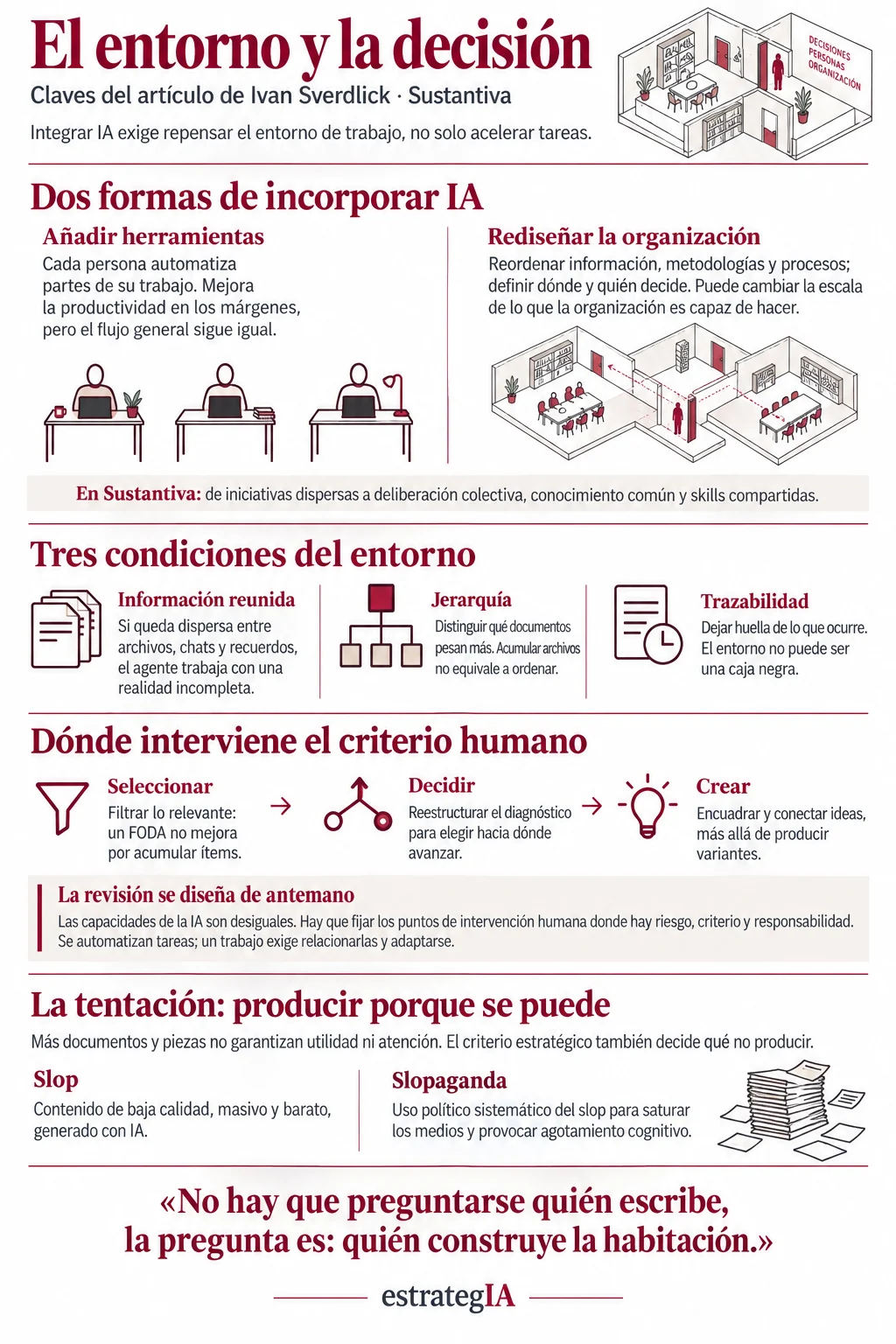
English transcription of the original infographic
The environment and the decision
Key ideas from Ivan Sverdlick's article · Sustantiva
Integrating AI means rethinking the working environment, not just speeding up tasks. The room illustration is labelled “Decisions · People · Organisation”.
Two ways to adopt AI
- Add tools. Each person automates parts of their work. Productivity improves at the margins, but the overall workflow stays the same.
- Redesign the organisation. Reorganise information, methodologies and processes; define where decisions are made and who makes them. This can change the scale of what the organisation is capable of doing.
At Sustantiva: from scattered initiatives to collective deliberation, common knowledge and shared skills.
Three requirements for the environment
- Information brought together. If it remains scattered across files, chats and memories, the agent works with an incomplete picture of reality.
- Hierarchy. Distinguish which documents carry more weight. Accumulating files is not the same as organising them.
- Traceability. Leave a record of what happens. The environment cannot be a black box.
Where human judgement intervenes
- Select: filter for what matters. A SWOT analysis does not improve by accumulating items.
- Decide: restructure the diagnosis to choose a direction.
- Create: frame and connect ideas, going beyond the production of variations.
Review is designed in advance. AI capabilities are uneven. Points for human intervention must be defined wherever there is risk, a need for judgement or responsibility. Tasks are automated; a job requires connecting them and adapting.
The temptation: producing because we can. More documents and content do not guarantee usefulness or attention. Strategic judgement also determines what not to produce.
- Slop: low-quality content generated cheaply and at scale with AI.
- Slopaganda: the systematic political use of slop to saturate the media and cause cognitive exhaustion.
“We should not be asking who writes. The question is: who builds the room?”
estrategIA
Cite this essay
Ivan Sverdlick. “The environment and the decision.” estrategIA, issue 157, 30 September 2026. English edition, 1 October 2026. https://elcontemplador.github.io/estrategia-english/essays/157/