At estrategIA, we have long been calling on politics to take artificial intelligence seriously. With the general election approaching on 29 November, it seemed to me that it was time to turn that demand into something concrete: open the manifestos and examine what each party commits to doing.
Behind the promise to make use of AI are decisions that affect us: who will pay for training for a worker whose job changes, what someone can challenge when faced with an automated decision, or how the benefits of producing more with less work will be shared. Those are the questions I wanted to examine this week.
For this reading, carried out with the help of Fable 5.2 and GPT-6 Astra, I have focused on the PP, PSOE, Vox and Frente Amplio, with a final look at other candidacies. The aim is to offer an initial overview, make comparison easier and keep the sources at hand for anyone who wants to explore further.
Before examining the proposals, it is worth putting the comparison in context. The manifestos differ in length and use both the Spanish expression for artificial intelligence and its abbreviation, “IA”. Among the four main parties, PSOE and Frente Amplio have the most mentions, as the following graphic shows:
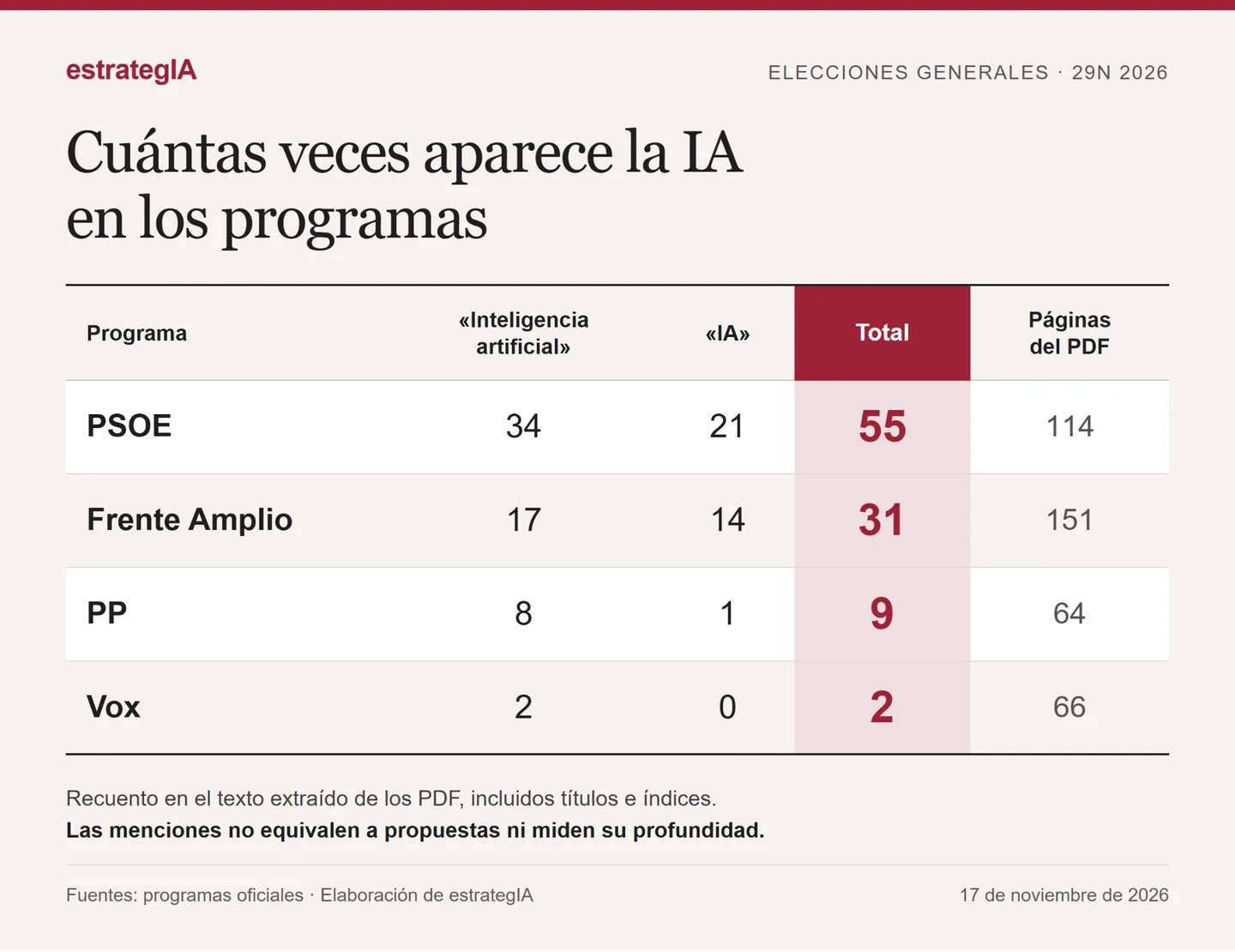
English transcription of the graphic: how often AI appears in the manifestos. Counts refer to the Spanish terms “inteligencia artificial” and “IA”, respectively, followed by their total and the number of PDF pages.
Scroll across the table to read all columns.
| Manifesto | “Inteligencia artificial” | “IA” | Total | PDF pages |
|---|---|---|---|---|
| PSOE | 34 | 21 | 55 | 114 |
| Frente Amplio | 17 | 14 | 31 | 151 |
| PP | 8 | 1 | 9 | 64 |
| Vox | 2 | 0 | 2 | 66 |
The counts are from text extracted from the PDFs, including headings and contents pages. Mentions are not the same as proposals and do not measure their depth. Sources: official manifestos; analysis by estrategIA, 17 November 2026.
In this dossier of AI proposals, we also bring together all the AI measures we have located in election manifestos and official campaign websites.
PP: facilitating adoption and supporting the employment transition
The Partido Popular proposes bringing AI to SMEs through ready-to-use applications, advice, training and cybersecurity. Its measure 190 proposes safe testing environments, without adding national burdens to the European framework, and a Spanish Agency for the Supervision of Artificial Intelligence — AESIA — oriented towards helping companies comply. It also promises a response to administrative procedures within thirty days; a response is not the same as automatically granting an authorisation.

English translation of the Spanish excerpt: “Spain will be a centre for artificial intelligence applications for the real economy. We will support companies bringing AI from the laboratory to the factory. SMEs will have ready-to-use applications, with advice, training and help to protect themselves against cyberattacks. There will be safe testing environments, without national burdens added to the European framework, and responses to administrative procedures within thirty days. The Spanish Agency for the Supervision of Artificial Intelligence (AESIA) will help companies comply with the new rules and will not confine itself to monitoring them.”
For workers, the party proposes an individual AI training voucher that stays with them when they change employer, with more resources for older workers and the most exposed sectors. It would be financed from existing training contributions, within a transition agreed with employers and trade unions.
The package includes tax incentives: allowing investments in AI and other technologies to be fully depreciated in the same financial year, and creating innovation zones with accelerated procedures and favourable tax treatment for seven years, conditional on investing, hiring and innovating in Spain.
PSOE: expanding access and regulating automated decisions
PSOE proposes expanding Bono IA and the NEURONA network, creating a public service offering access to advanced tools with training and support, and developing an AI-for-science strategy covering computing, data and talent.
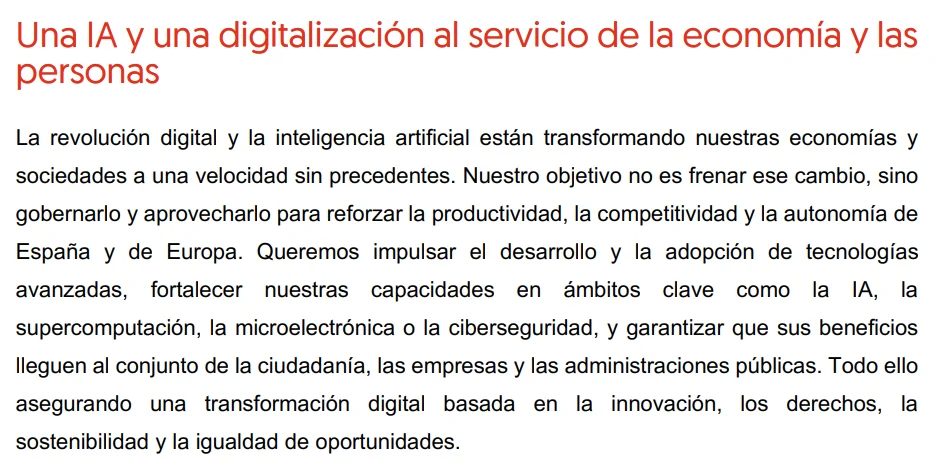
English translation of the Spanish excerpt: “AI and digitalisation in the service of the economy and people. The digital revolution and artificial intelligence are transforming our economies and societies at an unprecedented speed. Our objective is not to stop this change, but to govern it and use it to strengthen the productivity, competitiveness and autonomy of Spain and Europe. We want to promote the development and adoption of advanced technologies, strengthen our capabilities in key areas such as AI, supercomputing, microelectronics and cybersecurity, and ensure that their benefits reach all citizens, businesses and public administrations. All of this while ensuring a digital transformation based on innovation, rights, sustainability and equal opportunities.”
On safeguards, it proposes an AI governance law, promised for the first year of the parliamentary term, and another on algorithmic transparency. These include human oversight, labelling generated or manipulated content, a ban on non-consensual audiovisual fabrications and fines of up to €35 million. It adds independent audits of systems affecting rights, public verification tools from AESIA and an observatory for algorithmic discrimination. It also proposes giving the Charter of Digital Rights the force of law, including the right to be assisted by a person in any public service and to human review of automated decisions affecting citizens.
On employment, it proposes an agreement with employers and trade unions, audits of algorithms used for recruitment, assessment, promotion or dismissal, and limits on digital surveillance. On pensions, it proposes agreeing new sources of funding so that productivity gains from automation also strengthen Social Security. It leaves the details to the Toledo Pact and social dialogue.
There is a specific proposal for conversational assistants: restricting their unrestricted use by under-sixteens without parental consent and requiring companies to detect risks of self-harm, emotional dependency or sexual content and trigger alerts.
The manifesto also brings AI into teacher training and a public educational resources platform; public administration, to free up time spent on repetitive tasks under human oversight; and culture, through creators' authorisation and remuneration for the use of their works.
On taxation, it proposes measures additional to the Google tax for large technology companies and the AI sector, without setting rates. It also commits to promoting an international debate on a levy on tokens, the units models use to process information. The specific commitment is to advance that debate; the manifesto does not establish a Spanish tax on tokens.
Vox: research, businesses and reducing bureaucracy
Vox concentrates its explicit AI proposal in measure 37, within its deregulation section. It proposes promoting research, development and application; facilitating adoption by businesses, particularly SMEs and self-employed workers; training workers and young people; and using AI in public administrations to reduce bureaucracy and improve services, while guaranteeing in-person assistance.
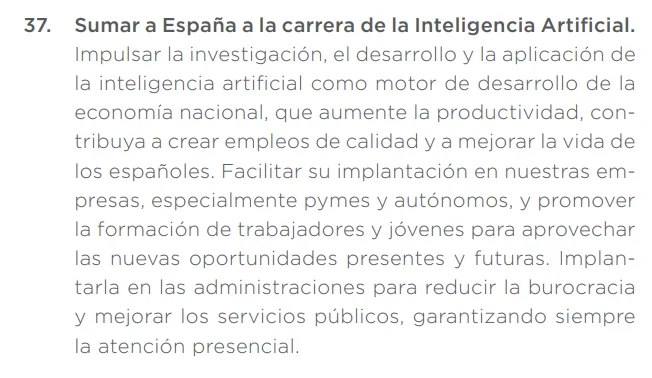
English translation of the Spanish excerpt: “Bring Spain into the artificial intelligence race. Promote research, development and application of artificial intelligence as an engine for the development of the national economy, increasing productivity, helping to create quality jobs and improving the lives of Spaniards. Facilitate its adoption by our businesses, especially SMEs and the self-employed, and promote training for workers and young people to take advantage of new opportunities, present and future. Introduce it into public administrations to reduce bureaucracy and improve public services, always guaranteeing in-person assistance.”
Frente Amplio: public oversight, collective bargaining and employment conditions
Frente Amplio devotes an AI section to its chapter on digital power. It proposes a law on its use in the public sector, with a mandatory inventory of systems, their purpose, data, error rates and biases. AI-assisted decisions would have to indicate this expressly and allow people to request review by a public employee. It adds independent audits before deployment in public contracts and for automated decisions in employment, credit, insurance and essential services.
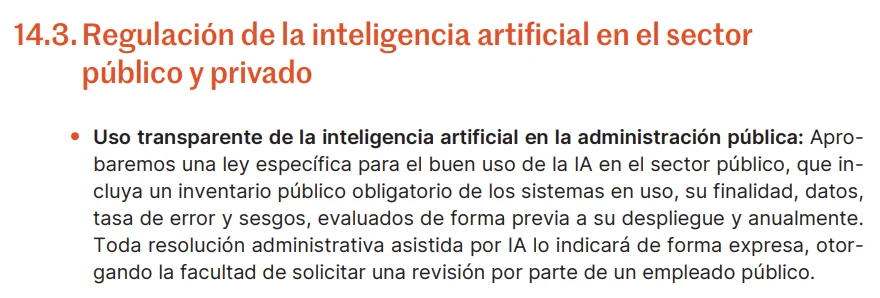
English translation of the Spanish excerpt: “Transparent use of artificial intelligence in public administration: We will approve a specific law for the proper use of AI in the public sector, including a mandatory public inventory of systems in use, their purpose, data, error rates and biases, evaluated before deployment and annually. Every administrative decision assisted by AI will expressly indicate this, giving people the ability to request review by a public employee.”
At work, it develops several mechanisms: human review of algorithmic dismissals and sanctions, access for workers' representatives to their parameters, and mandatory bargaining over AI introduction. It also proposes that works councils be able to configure, approve or veto AI systems used to organise, monitor or assess work. It adds an additional Social Security contribution for companies that dismiss workers as a result of introducing AI or automation.
For SMEs, the self-employed and the social economy, it proposes an AI and digital technology adoption plan, with technical support, public computing and priority for open source, conditional on not dismissing staff. Its 2030 target is for 90% of SMEs to reach at least a basic level of digital intensity. That percentage refers to digitalisation; it does not require all those businesses to use AI.
The manifesto also envisages mandatory appearances by AI company executives, among other circumstances when their systems endanger public safety or access personal data administered by the state. It would treat non-consensual distribution of hyperrealistic fake images or voices as an unlawful intrusion, with exceptions for satire and public criticism. It also proposes a risk observatory and restrictions on companion assistants, which could not simulate romantic bonds or use manipulative dynamics to retain users.
At European level it proposes a sovereign AI fund funded by what the text calls a “50% tax in shares” on EU-based companies with more than €200 million in annual AI revenue. The passage does not explain how that tax would work.
Podemos: copyright, literacy and data centres
In the 141 pages of its manifesto, presented on 17 November when we were already closing this edition, the Spanish phrase “inteligencia artificial” appears seven times and the abbreviation “IA” twice. It proposes a voluntary public register so creators can decide whether their works may be used in AI projects. It also proposes giving victims of sexist and LGBTIphobic digital abuse, including abuse using deepfakes, the same rights as other victims of gender-based violence. In education it proposes teaching people to understand algorithms and AI. For large data centres, it proposes a law with requirements for energy efficiency, water consumption and environmental transparency.
Other proposals worth reading
The overview would be incomplete without regional candidacies. Among their proposals are some worth bringing into this conversation:
BNG: binding human review. Alongside the presence of Galician and support for small, specialised language models, it proposes that no critical administrative or economic decision be executed without binding final review by competent staff. It adds bans on using AI to select targets in armed conflicts and on predictive policing.
Adelante Andalucía: train and redeploy before dismissal. Companies that replace tasks using AI would have to train and redeploy their staff; dismissals bypassing that process would be void. It also proposes that productivity from AI and robots contribute to Social Security.
EH Bildu: turning productivity into time. It links the benefits of AI to reducing working hours without lowering wages and to retraining. It adds the inclusion of Basque on equal terms in AI development and the promotion of “green algorithms” to reduce environmental impact.
ERC: the right to challenge an automated decision. It proposes guaranteeing the right to know about, understand and challenge such decisions, with human oversight, independent auditing and liability for harm.
Junts and Catalan in AI. It proposes incorporating Catalan natively into AI and digital platforms. The measure appears on its official 29 November campaign website. At the close of this edition, Junts had not yet published its full manifesto.
Compromís proposes banning digital assistants that generate emotional dependency. It also proposes strengthening protection against AI-generated fabrications (deepfakes) and adopting rules to make algorithms more transparent and combat their biases.
EAJ-PNV: AI within industrial modernisation. The explicit mention located proposes supporting SMEs in adopting digital solutions and AI.
In Coalición Canaria's policy foundations and the simplified contract of Se Acabó La Fiesta, both included in our comparison, we did not locate explicit mentions of AI.
This week we wanted to gather what the parties propose and make it easier for you to read it with the sources in front of you. In the next issue it will be our turn to formulate our own proposal, bringing together some of the ideas we have defended in estrategIA about what any government should consider during the next parliamentary term.
We will discuss governing in the fog, making access to AI a policy of equality and turning some of the productivity we may gain into time and freedom. We will also consider how government itself should change to live up to what it asks of others. Five principles centred on one question: what must we build so that increasingly capable artificial intelligence translates into a better life for the majority? But that will be next week. We look forward to seeing you.
Director of Digital Innovation at Institución Educativa ALEPH and director of the estrategIA newsletter.
Cite this essay
Fernando Nieto Lobato. “The AI promises on the campaign trail.” estrategIA, issue 164, 18 November 2026. English edition, 19 November 2026. https://elcontemplador.github.io/estrategia-english/essays/164/