Archive note: this visual exploration was published on 9 April 2025. It preserves the original experiments, prompts, synthetic examples and historical claims about GPT-4o; the retained images have not been regenerated. Translations of their text appear alongside them.
Original newsletter note: because this week's newsletter contains dozens of images, it will be very long and probably will not arrive complete in your email. If you find that the content has been cut off, please open the Substack app to read it. This time, we are also not providing an audio version of the main article: because it is so predominantly visual, simply listening to it would make little sense.
After last week's dense and important article about the debate on universal basic income amid AI's rapid advance, this week we have decided to bring you almost the opposite: an imaginative exploration of the impressive possibilities offered by GPT-4o's new image-generation model, even to those of us without advanced design knowledge or skills in drawing or complex computer image editing. That said, as in any other field where AI is developing rapidly, experts and people with greater knowledge of the subject are very likely to get the most out of it. These developments are also likely to have much less impact on high-budget presidential or national campaigns, or communications by large governments, which can afford extensive teams of specialist professionals—many of whom will also use and make the most of these new technologies. But for many rank-and-file politicians and small governments, these new tools could directly and substantially multiply the impact of their visual communication strategies.
Best of all, every one of you can already use this model in ChatGPT, even free of charge, albeit with a daily usage limit. This article's main purpose is to encourage you to try it and experiment.
Before showing you the results of our exploration and the examples we have created over the past few days, we would like to highlight briefly what makes this image generator stand out “above the competition”: its strong fidelity to what it is asked to do, technically known as “prompt adherence”, and the remarkable visual quality of the results, even when it is asked to include text within the image. Coupled with enormous ease of use—you simply use it within ChatGPT with very straightforward instructions, as we will see—this makes it an excellent model. As always, remember that this is the worst AI we will use for the rest of our lives, and that these systems improve very quickly. It can do a great many interesting things beyond filling social media with beautiful “Ghibli-style” images.
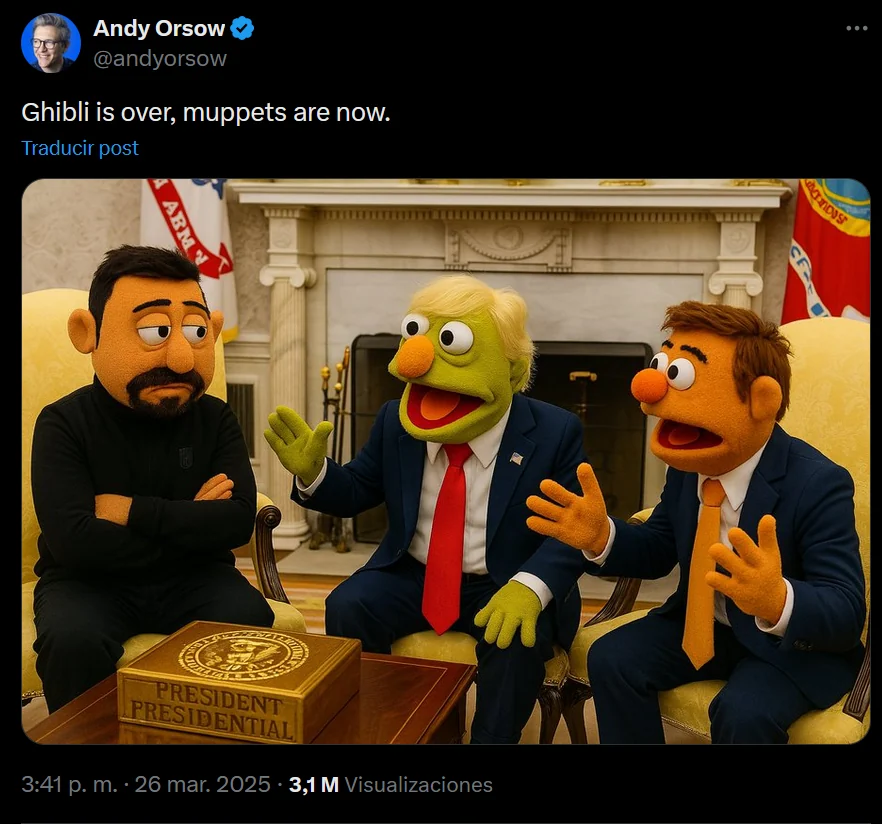
Retained example post by Andy Orsow, @andyorsow. Its original English caption reads: “Ghibli is over, muppets are now.” The screenshot is dated 26 March 2025 at 15:41 and shows 3.1 million views. The synthetic image depicts three puppet-like figures in a presidential setting; a box bears the generated wording “PRESIDENT PRESIDENTIAL”.
One brief point before we begin looking at the interesting or curious examples we have created over the past few days: although the model works with very simple, short prompts—instructions—you can achieve much better results if you know exactly what to ask for and compose more detailed instructions. This is one area in which image and design professionals bring clear added value. Even so, you can always iterate from a simple starting point. In general, all the prompts we used in this exploration are direct, one-line instructions, unless we explicitly state otherwise.
One concrete example of how different instructions can sometimes lead to more advanced results is another style that has been highly successful on social media: generating marble sculptures from any photograph, even in a particular colour, which could be that of a political party.
To begin with, I would simply give the model Obama's image from Wikipedia and ask something like:
“Transform that image into a marble sculpture.”
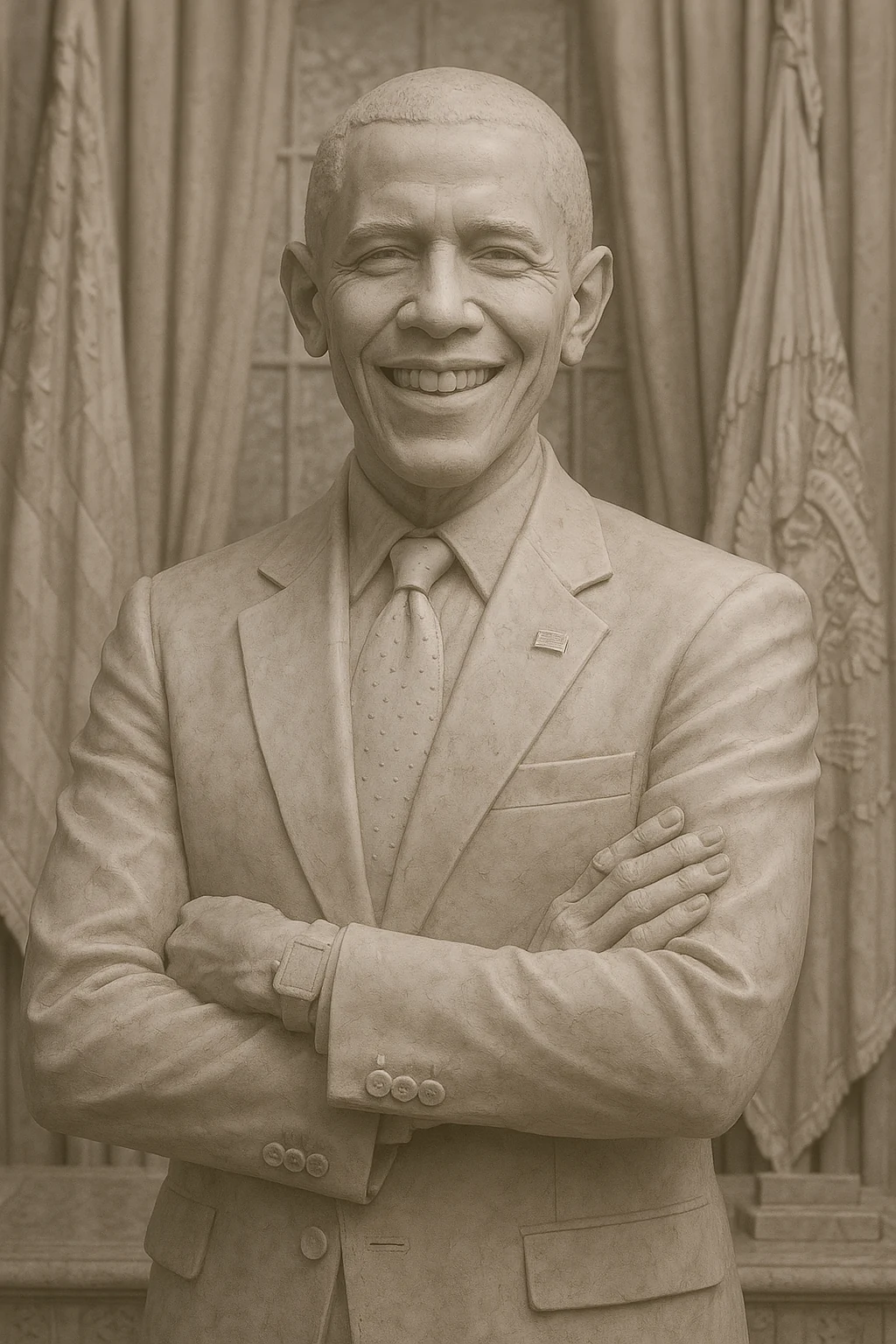
The result of the simple prompt: a synthetic marble treatment of the portrait described above.
The result is not bad. But a creator with expertise in these matters, Umesh, would write instructions such as the following and obtain more advanced effects. Instructions in this format were also necessary to obtain good results with other image models such as Midjourney or Stable Diffusion. The 4o model is infinitely more intelligent in its comprehension because of the kind of AI model it is, although we will not get into technical discussions here.
A photorealistic image of an ultra-detailed [COLOR] calacatta elegant sculpture bust of the subject in image made of shining marble. The sculpture should display smooth and reflective marble surface, emphasizing its luster and artistic craftsmanship. The design is elegant, highlighting the beauty and depth of marble. The lighting in the image should enhance the sculpture's contours and textures, creating a visually stunning and mesmerizing effect
The prompt above was already in English in the original article and is reproduced unchanged.
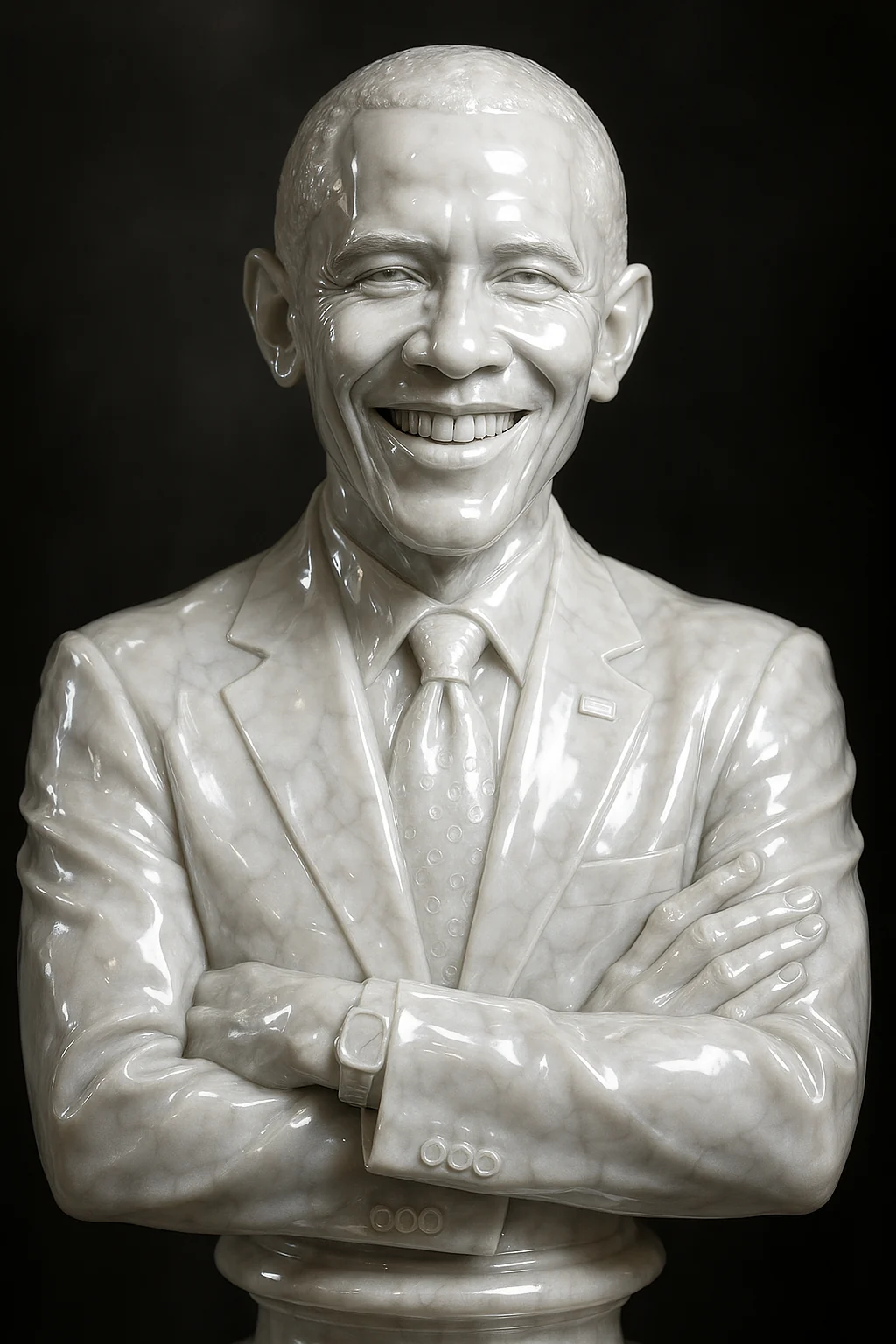
The more detailed prompt's white-marble bust, with a polished, reflective surface.
And in the party's colour, replacing white with blue in the [COLOR] parameter:
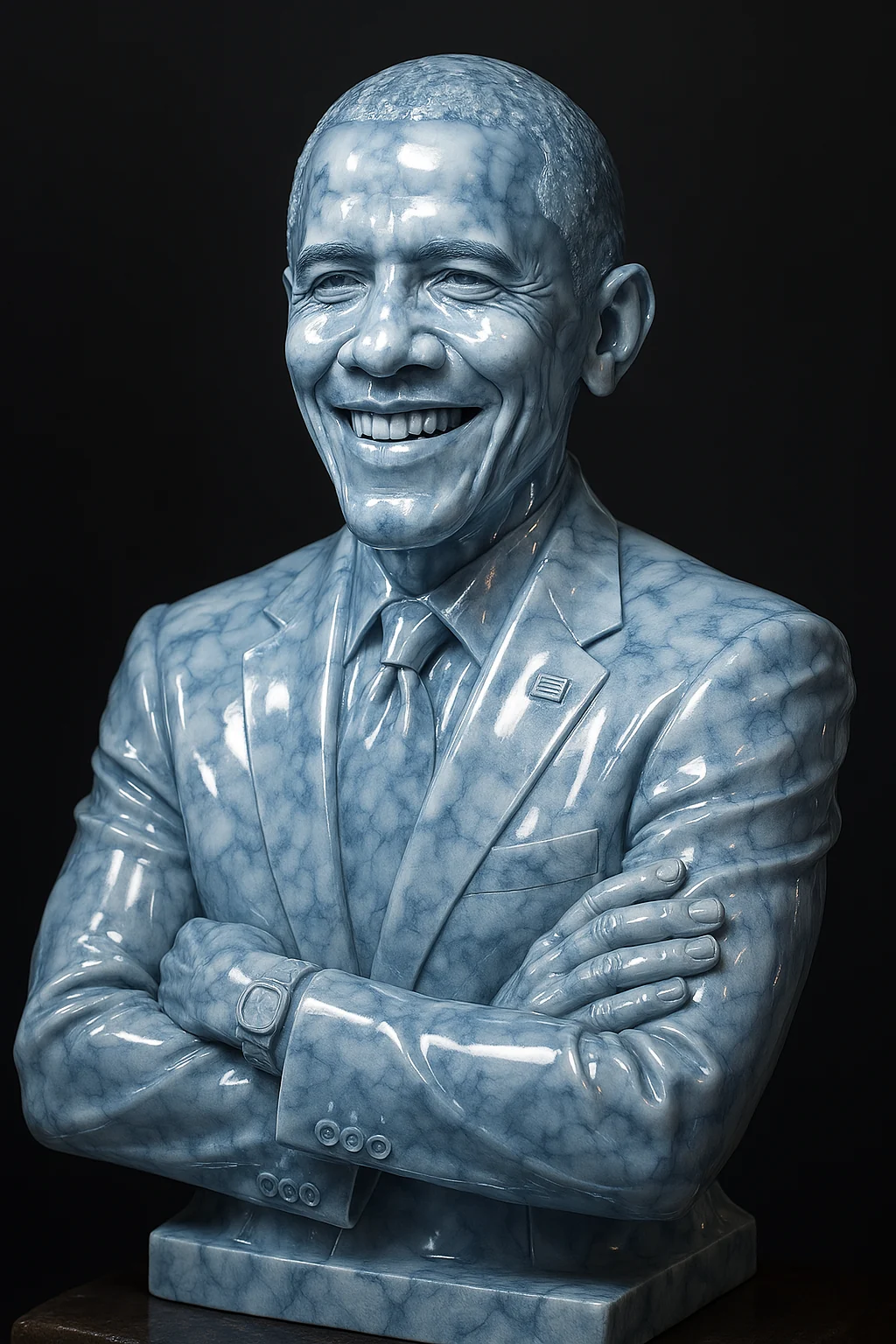
The blue-marble variation of the same synthetic portrait treatment.
Best of all, you are not limited to textual instructions. Those who can draw—I probably could not even manage a diagram like the one below—can make a sketch on paper, give ChatGPT a photograph of it, and obtain a result like this:
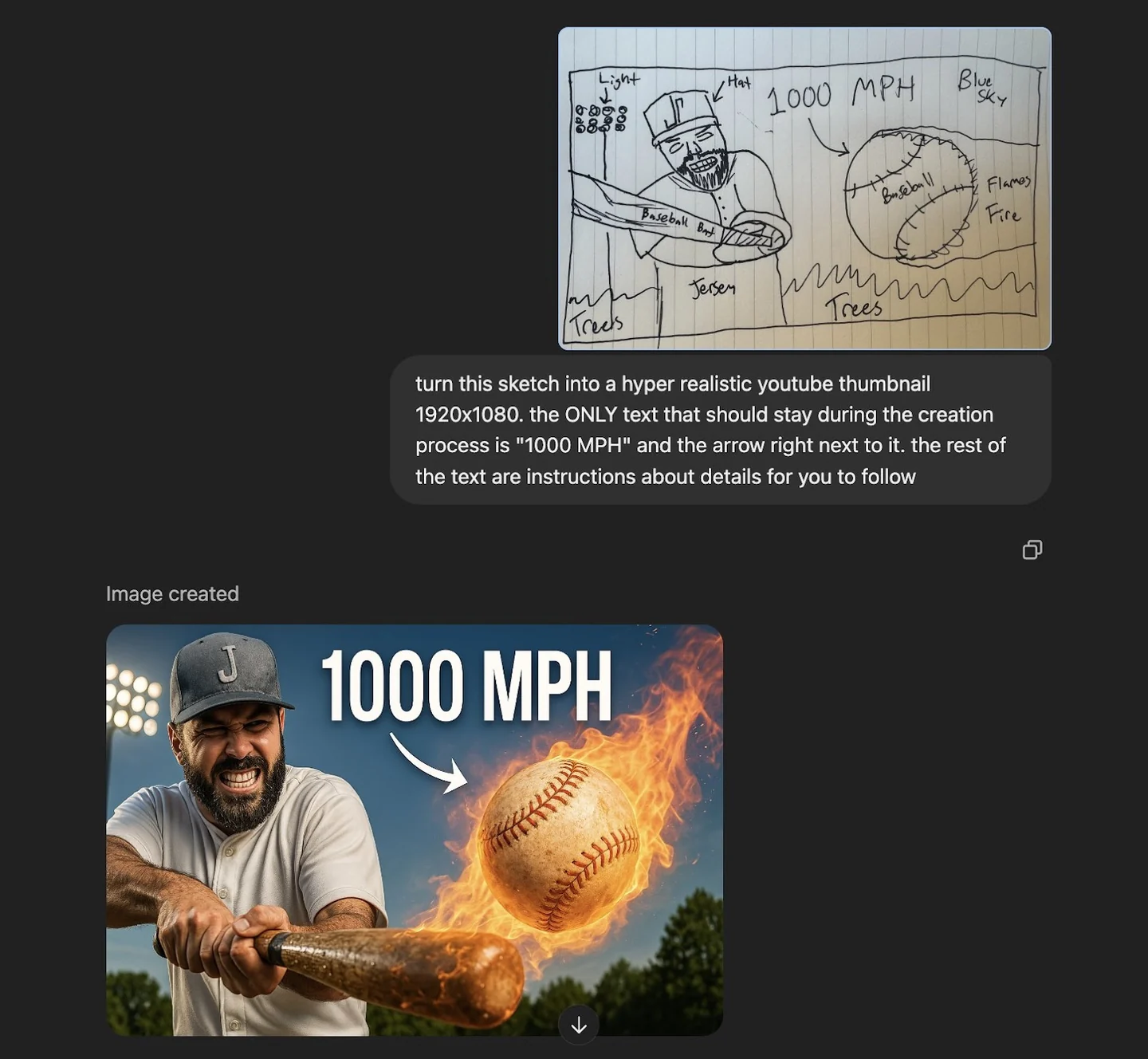
The original English prompt in the screenshot reads:
turn this sketch into a hyper realistic youtube thumbnail 1920x1080. the ONLY text that should stay during the creation process is "1000 MPH" and the arrow right next to it. the rest of the text are instructions about details for you to follow
The sketch labels a light, hat, blue sky, baseball bat, baseball, flames/fire, jersey and trees, alongside “1000 MPH” and its arrow. The result, labelled “Image created”, shows a batter hitting a flaming baseball, with “1000 MPH” and the arrow retained. The labels function as drawing instructions rather than a factual sports claim.
Ten interesting or unusual possible uses of 4o's image-generation model in ChatGPT for politics and government
1. Make campaign posters in different visual styles simply by asking in the prompt
I simply ask ChatGPT for a campaign poster, it suggests different styles, and I try them out… The images below are utopian retrofuturist propaganda—the first one it generates, with text it also writes—then a Simpsons-style version, and finally futuristic pre-Columbian art, a style suggested by ChatGPT. Imagination is the limit, and AI itself can suggest styles.
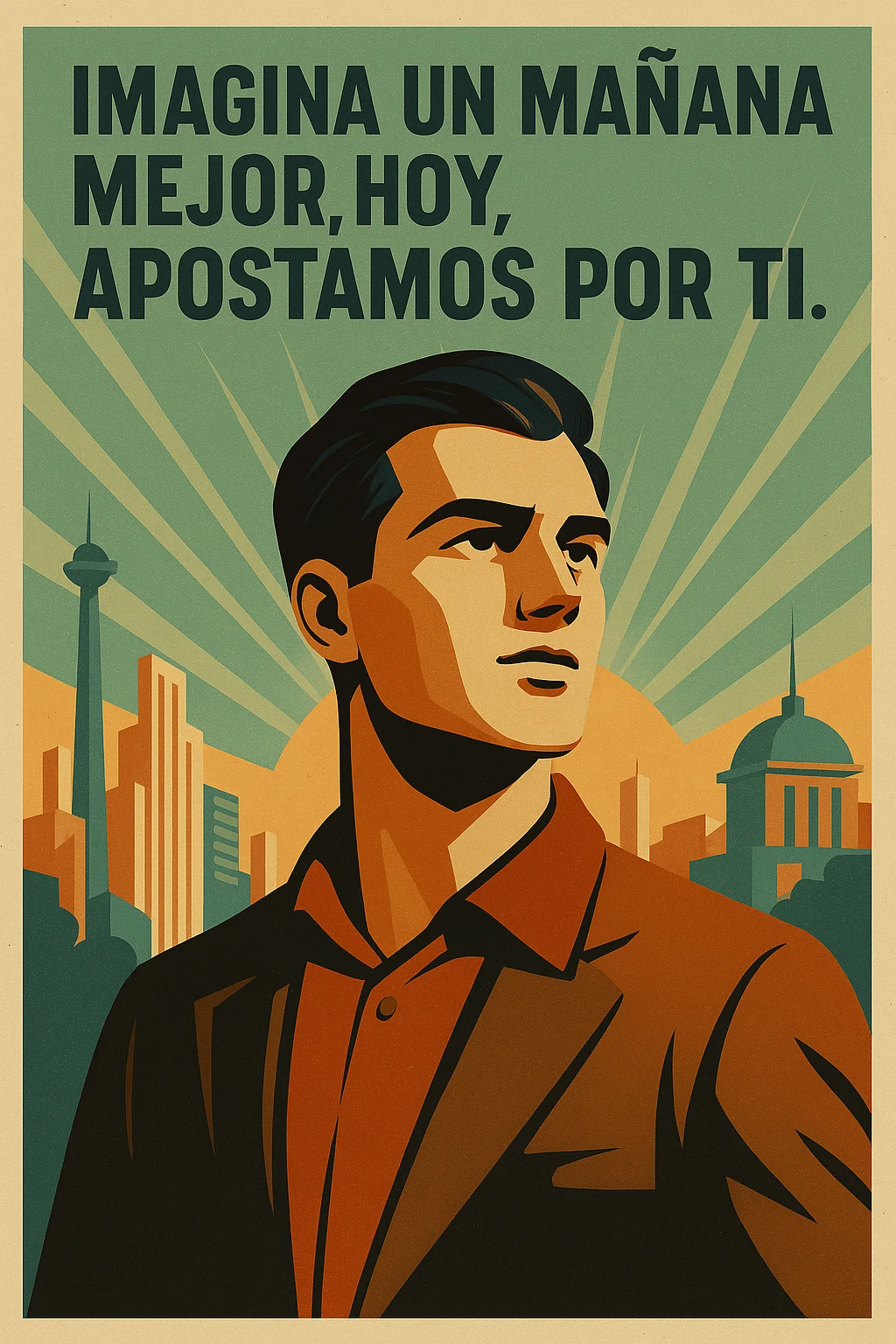
Retrofuturist example. Poster text: “Imagine a better tomorrow. Today, we're backing you.”
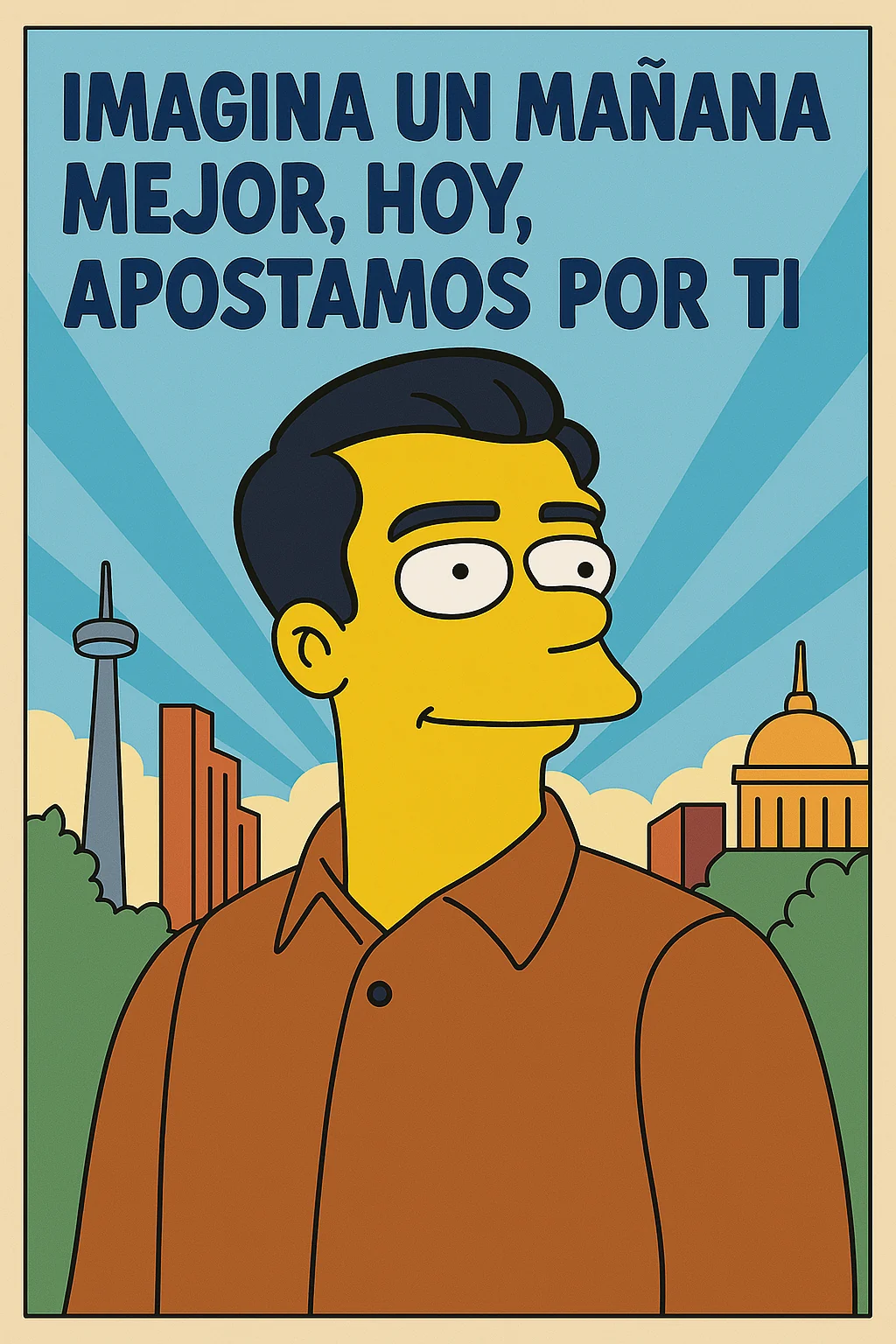
Simpsons-style example, with the same text: “Imagine a better tomorrow. Today, we're backing you.”
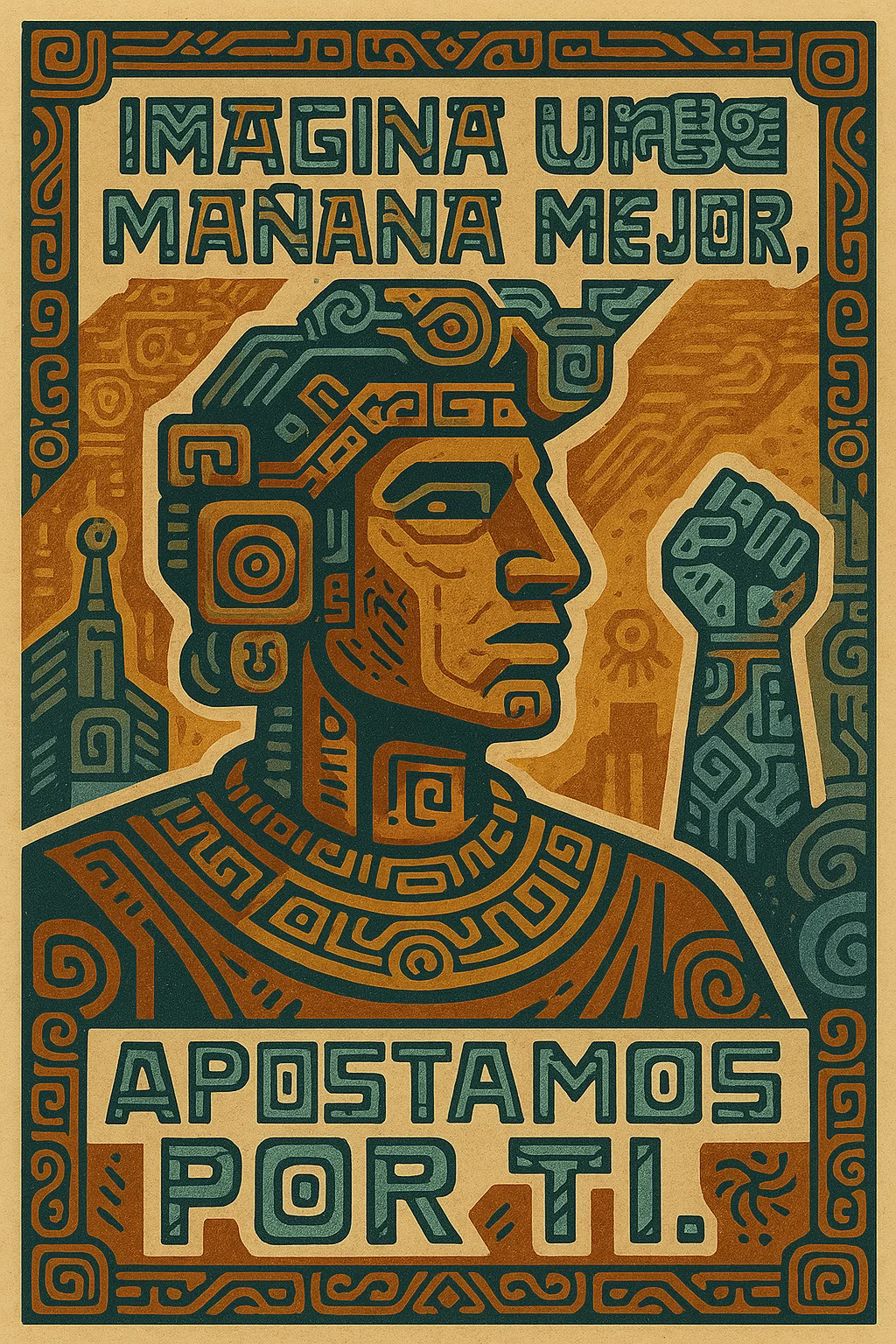
Futuristic pre-Columbian example. The readable wording says: “Imagine … a better tomorrow. We're backing you.” Some generated lettering after “IMAGINA” is malformed; it has not been reconstructed as a clean original slogan.
2. Turn any image into a poster, advertisement or social media asset, using one of the model's main strengths: handling text, even in Spanish
For this example, we use an image of Elena Vidal, the virtual candidate we created with AI last year for the fictional party Europa Estoica Unida, ahead of the European elections.
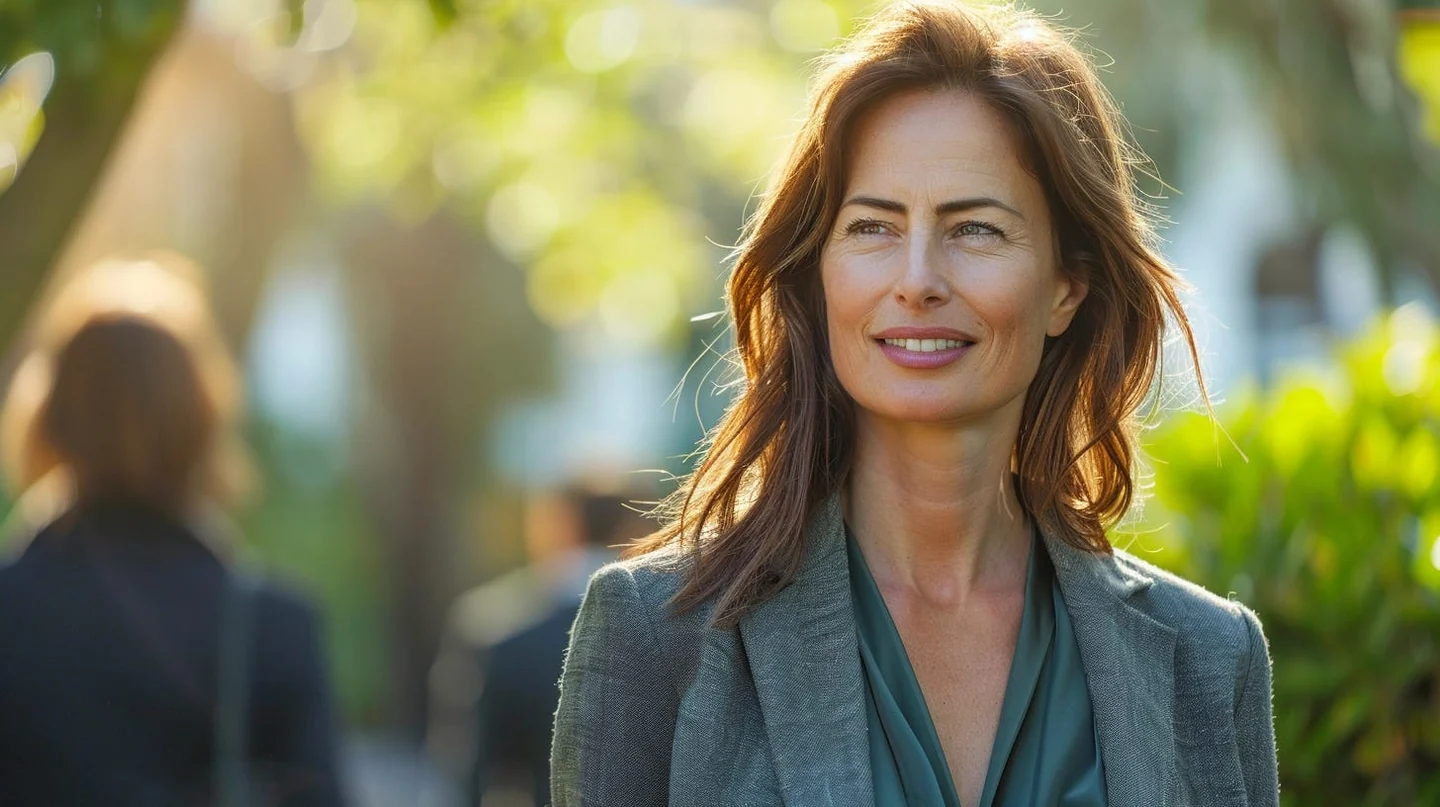
The original synthetic portrait of Elena Vidal used as input.
We give the model a very simple instruction along with the image:
Transform that image into an advertisement for the fictional party “Europa Estoica Unida”.
And here is the result. Nothing spectacular, but it took 30 seconds and required no design software.
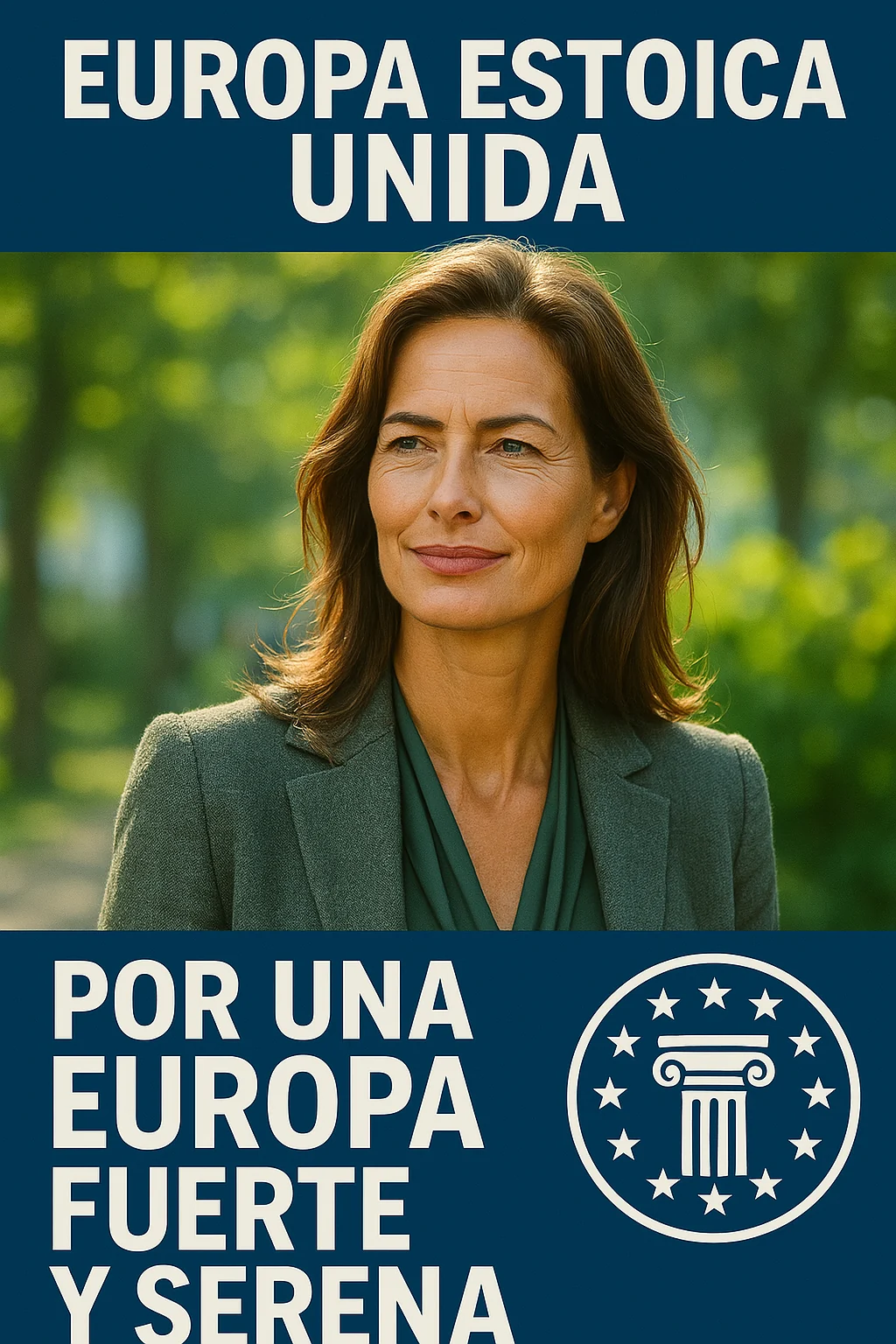
The generated poster reads “Europa Estoica Unida”—“United Stoic Europe”—and “For a strong and serene Europe”. This is the fictional party described above.
3. Create an action figure, for example of a party leader
This is another style that has been highly successful on social media, and it is fairly simple. We can generate the figure with or without packaging. The main point to specify in the prompt is the list of items we want alongside it.
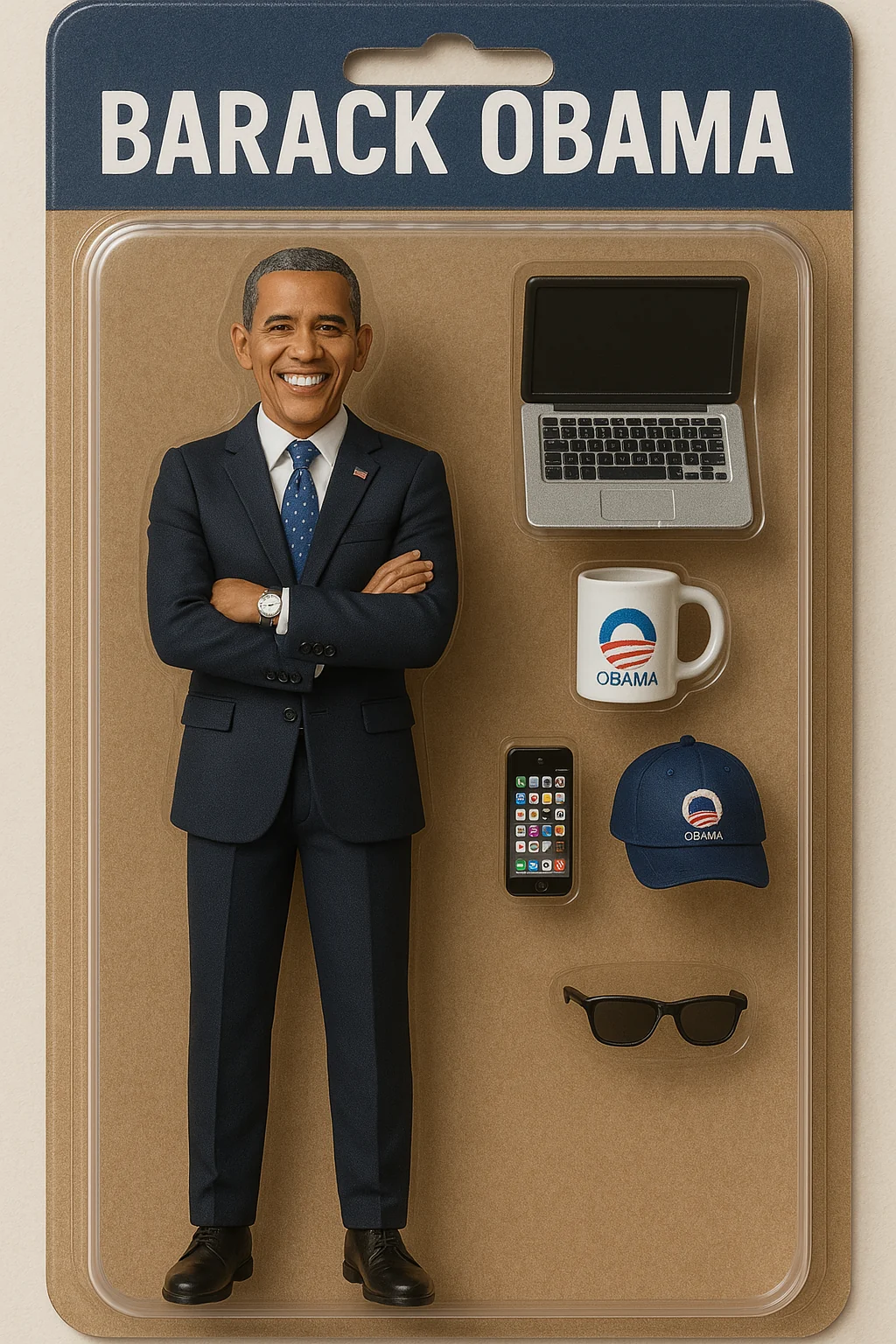
Boxed synthetic action figure labelled “BARACK OBAMA”, with a laptop, mug, phone, cap and sunglasses. The mug and cap also carry the name “OBAMA”.
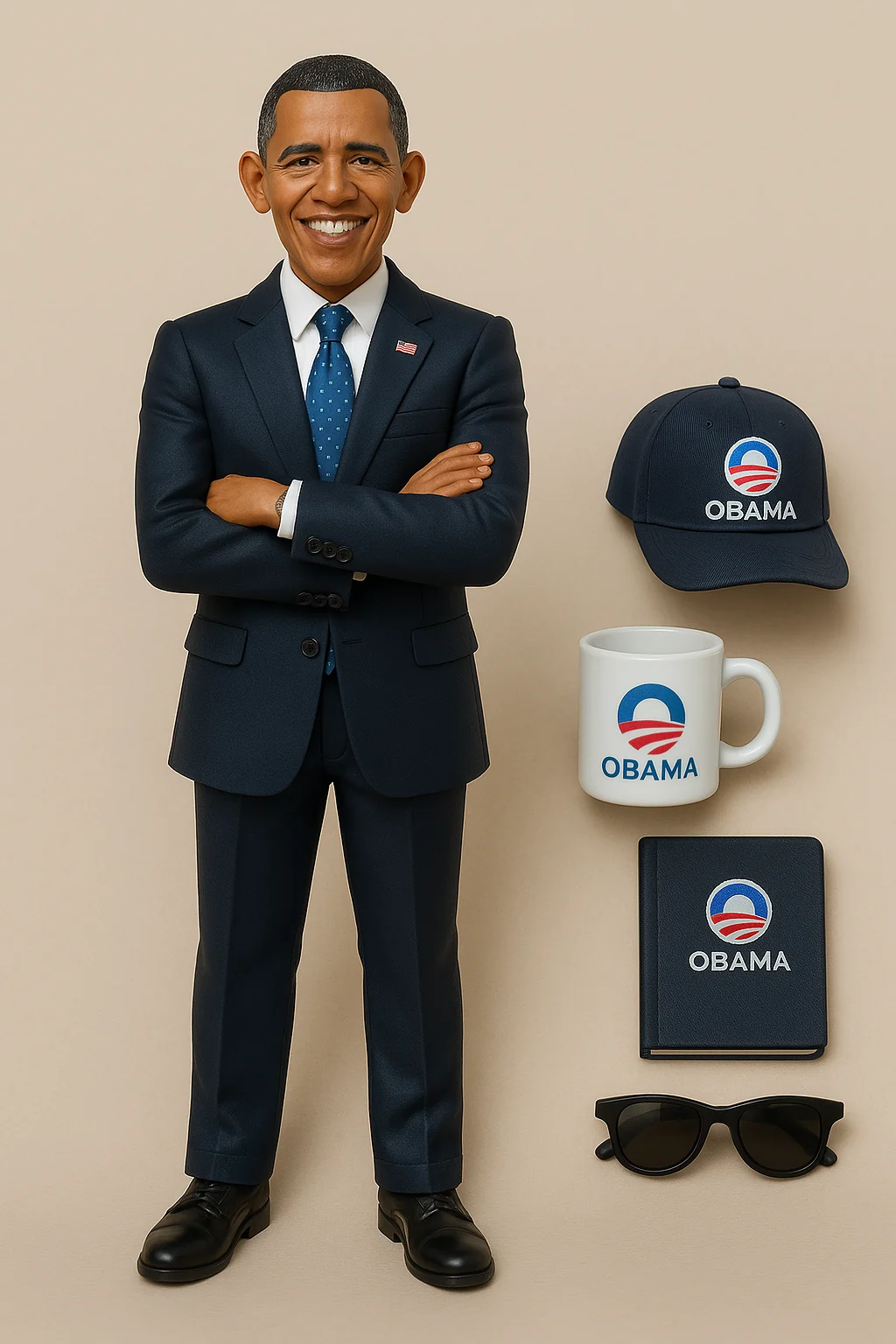
Unboxed variation, with a cap, mug, notebook and sunglasses; the name “OBAMA” appears on the first three accessories.
It can also create group action figures from images such as this one of a US–EU summit in 2023:
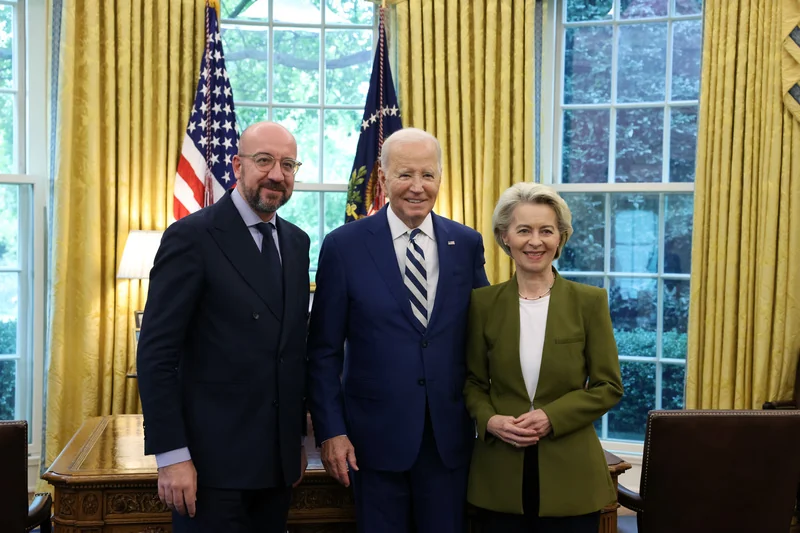
The source photograph used for the group example, showing three leaders at the summit described in the article.
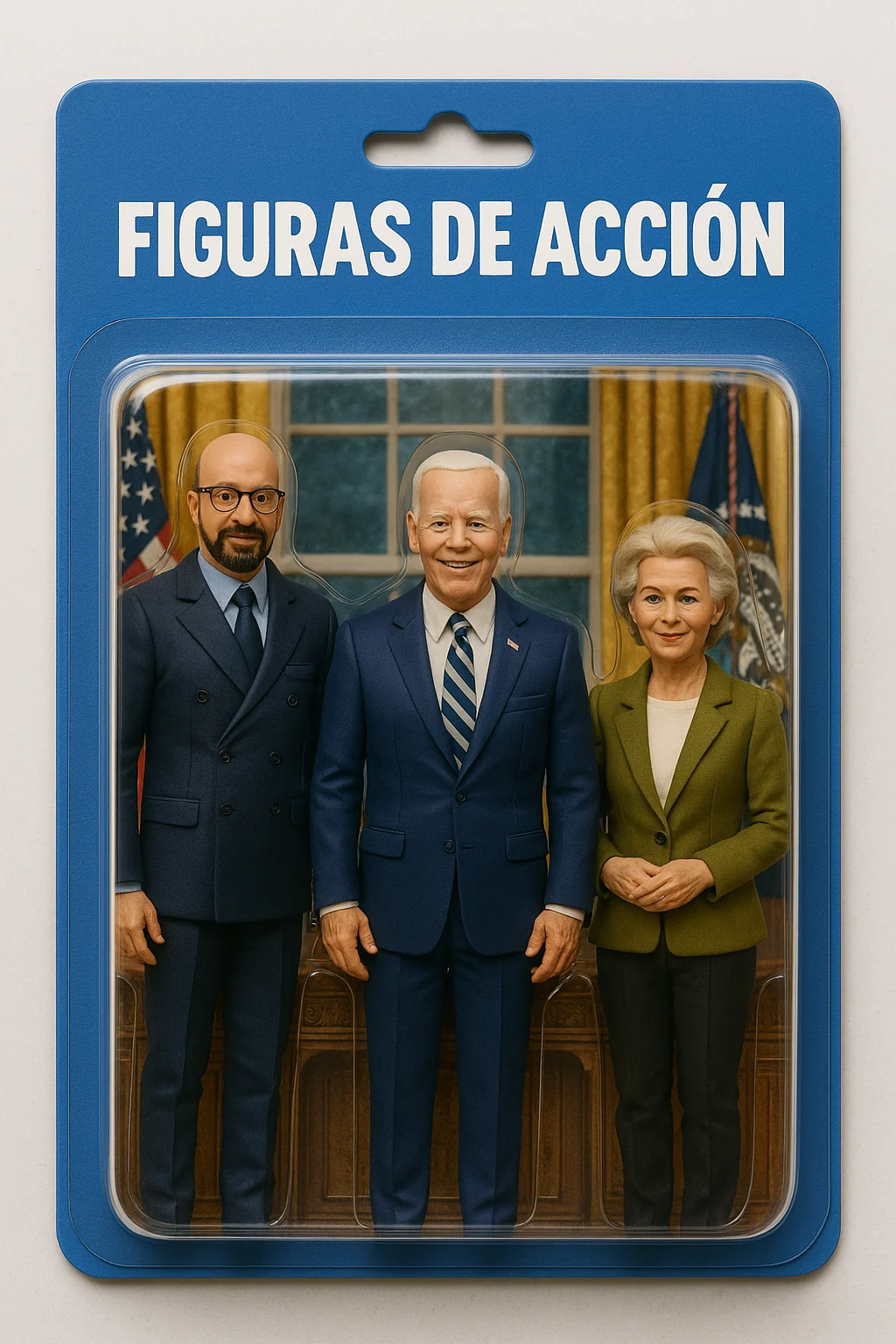
The generated boxed group version. The packaging reads “Action figures”.
4. Add objects to images
The new image model is also fairly good at adding any object to an image. This could be used, for example, to present documents—a budget, a new law… In our example, we have simply set Obama reading Don Quixote.
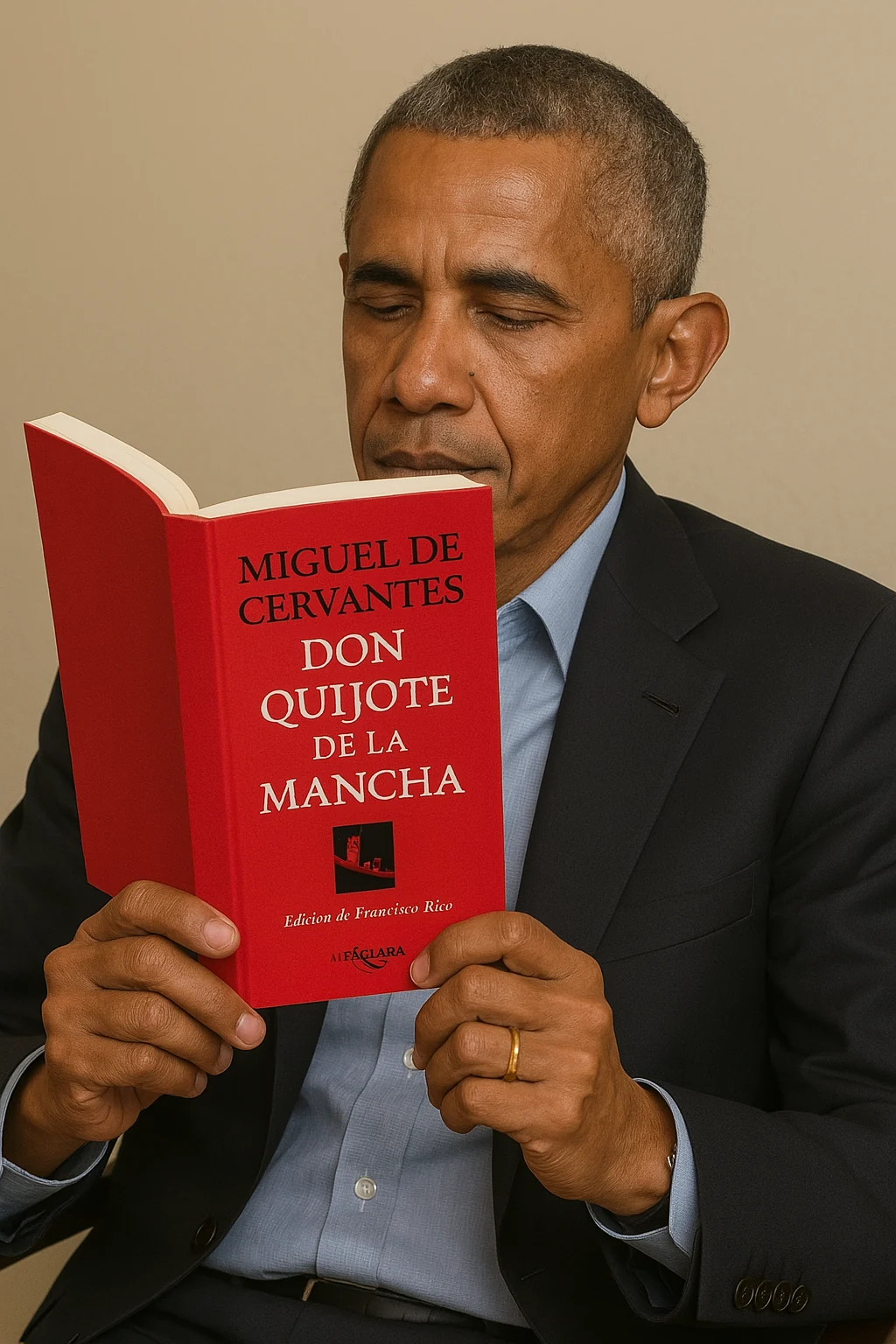
Synthetic reading scene. The book cover reads “Miguel de Cervantes”, “Don Quijote de la Mancha” and “Edition by Francisco Rico”; the small generated publisher lettering is distorted. This is an image-editing demonstration, not a documentary photograph.
5. Create comics that explain concepts
There are still occasional errors in the text, which will surely improve in later versions. But you can ask the new model to generate comics without even providing a script, because it draws on GPT-4o's capabilities and knowledge. Undoubtedly one of our favourite functions.
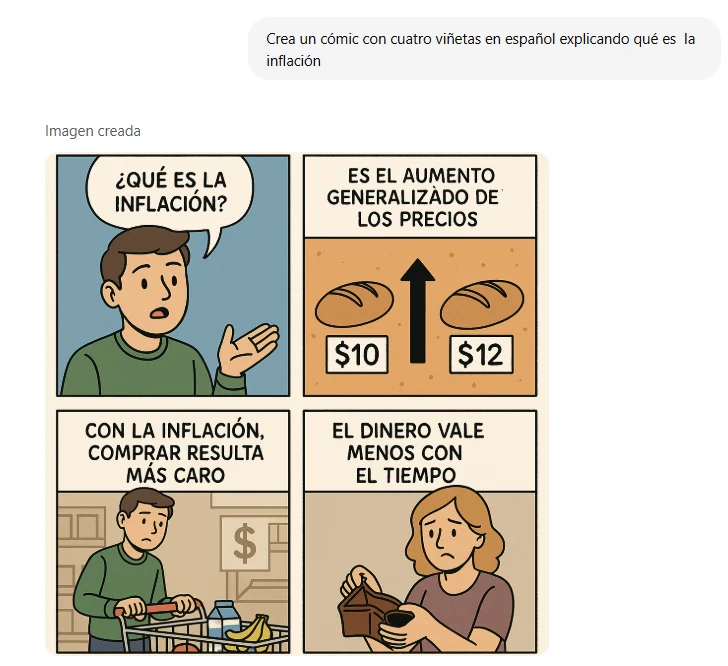
Translation of the prompt in the screenshot: “Create a four-panel comic in Spanish explaining what inflation is.” The interface says “Image created”. The four panels read:
- “What is inflation?”
- “It is the general rise in prices”, illustrated by bread increasing from $10 to $12.
- “With inflation, shopping becomes more expensive.”
- “Money is worth less over time.”
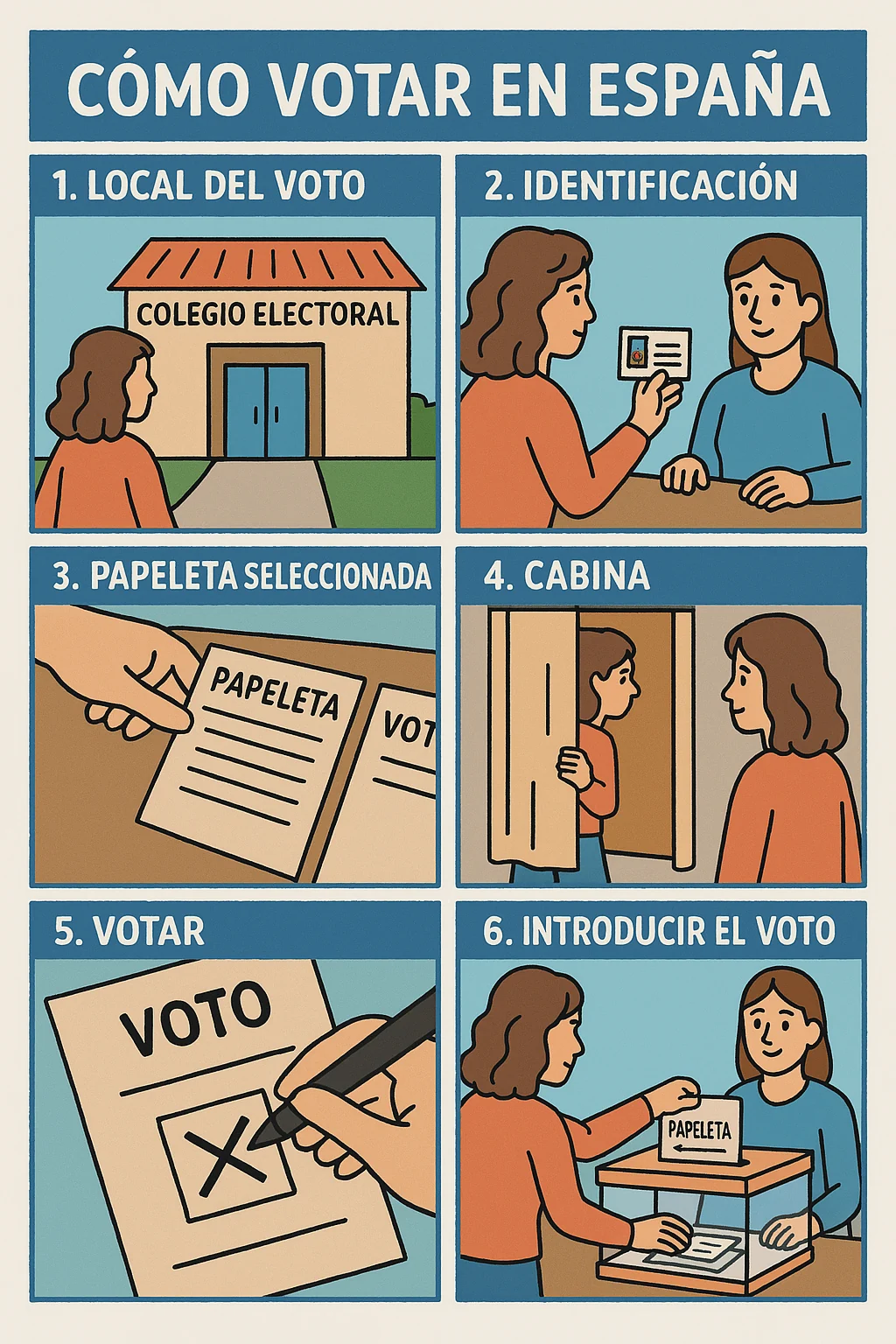
Complete translation of the generated comic “How to vote in Spain”:
- Voting location: the building is labelled “Polling station”.
- Identification: a voter shows an identity document.
- Selected ballot paper: the visible paper is labelled “Ballot paper”; another label is cut off.
- Booth.
- Vote: a paper labelled “Vote” is shown being marked with an X.
- Insert the vote: a paper labelled “Ballot paper” is placed in a ballot box.
Archive note: this is an AI-generated illustration reproduced as a model-capability example, not verified voting instructions.
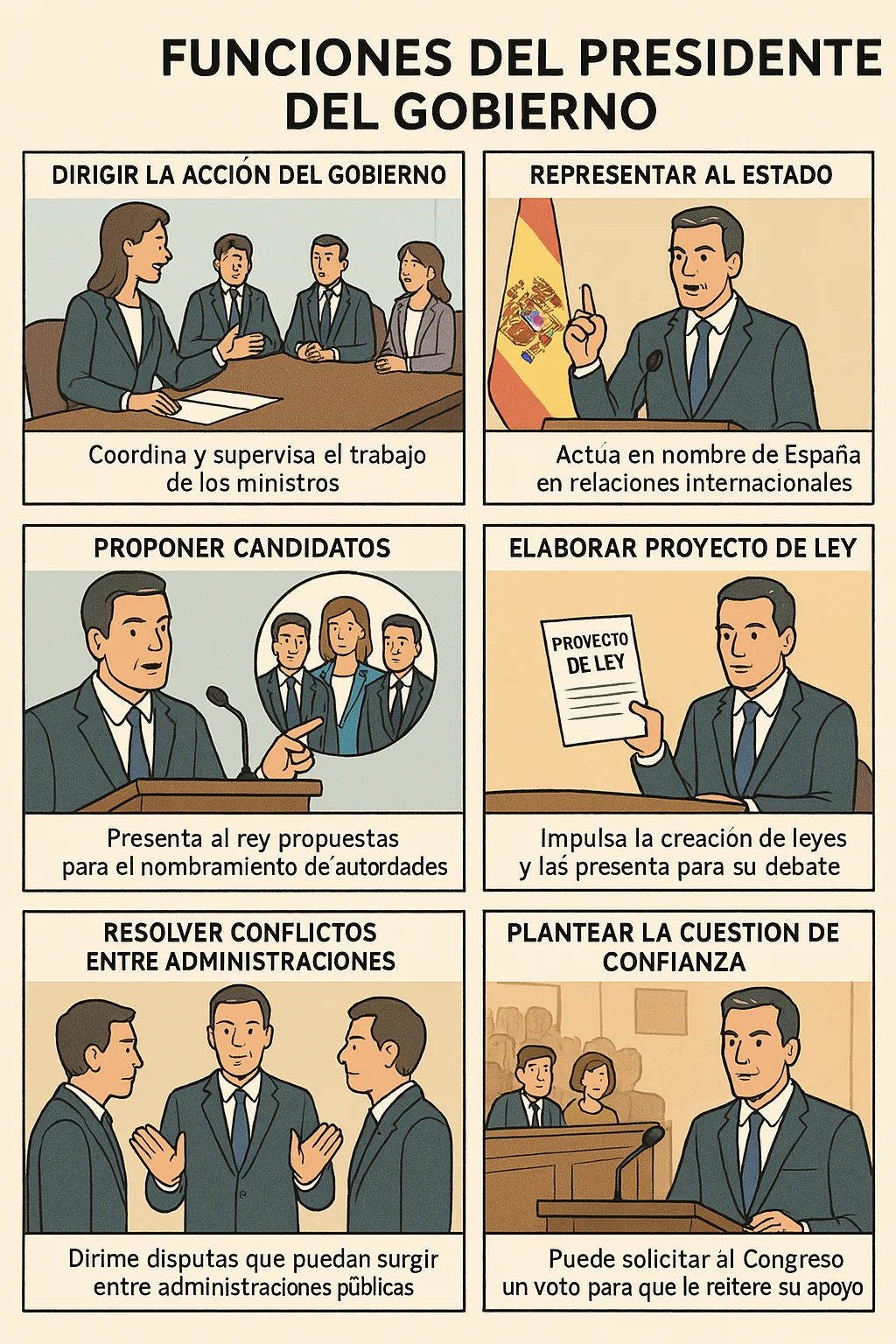
Complete translation of the generated comic “Functions of the Prime Minister”:
Scroll across the table to read all columns.
| Panel heading | Panel text |
|---|---|
| Direct the government's work | Coordinates and supervises the work of ministers. |
| Represent the state | Acts on Spain's behalf in international relations. |
| Propose candidates | Submits proposals to the King for the appointment of office-holders. |
| Draw up a bill | Promotes the creation of laws and presents them for debate. The document shown is labelled “Bill”. |
| Resolve conflicts between administrations | Settles disputes that may arise between public administrations. |
| Request a vote of confidence | May ask Congress for a vote reaffirming its support. |
These are the original generated panels' claims, translated for accessibility; they are not a verified account of constitutional powers.
6. Create cartoons, political panels and caricatures
We asked for a political cartoon and it generated these two. The script is entirely ChatGPT's, and this is part of its explanation of what it created:
“The cartoon criticises depersonalisation and narcissism in modern politics.
It portrays politicians as prefabricated products, without critical thought, obsessed with their own image, incapable of representing anything beyond themselves… when they do not even have an identity of their own.”
The explanation above is translated from ChatGPT's Spanish wording quoted in the original article.
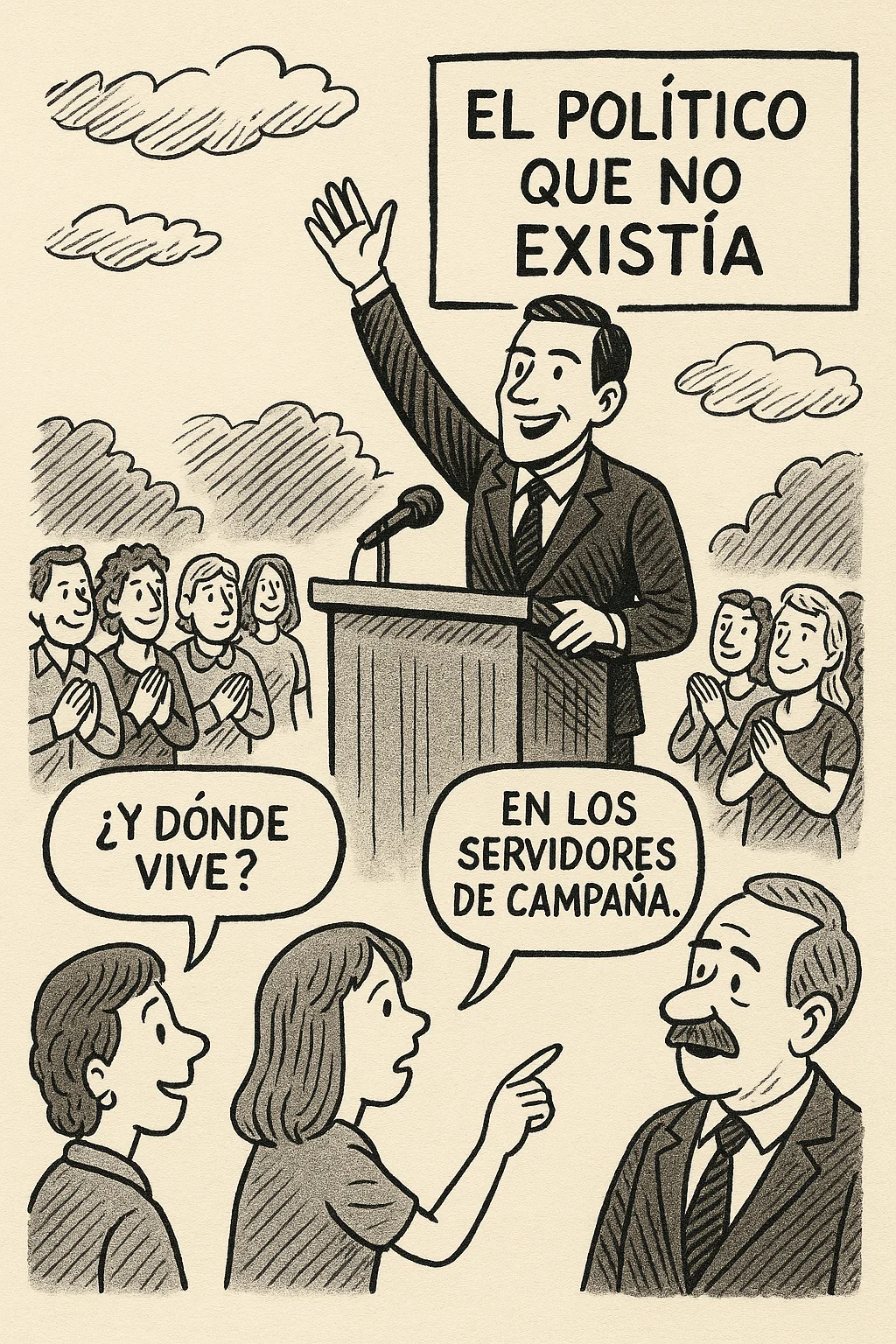
Complete cartoon text: “The politician who did not exist.” A spectator asks, “And where does he live?” The answer is, “On the campaign servers.”
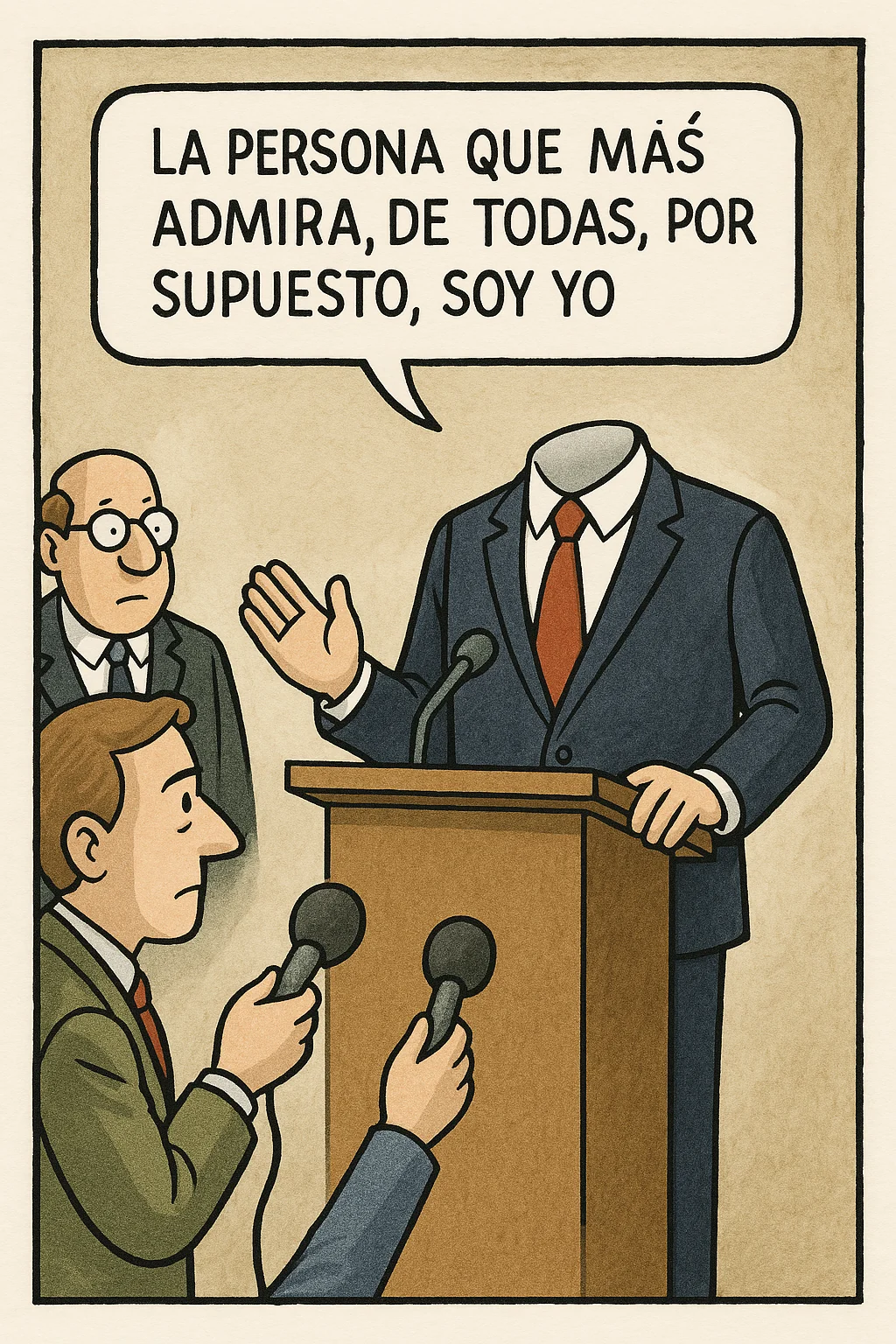
The headless politician's speech bubble reads, literally: “The person you admire most of all is, of course, me.” The Spanish uses “admira”, with its subject left unstated; this wording is retained rather than silently changed to “I admire”.
The model is also very capable at generating caricatures, such as this one of Barack Obama based on his Wikipedia image:
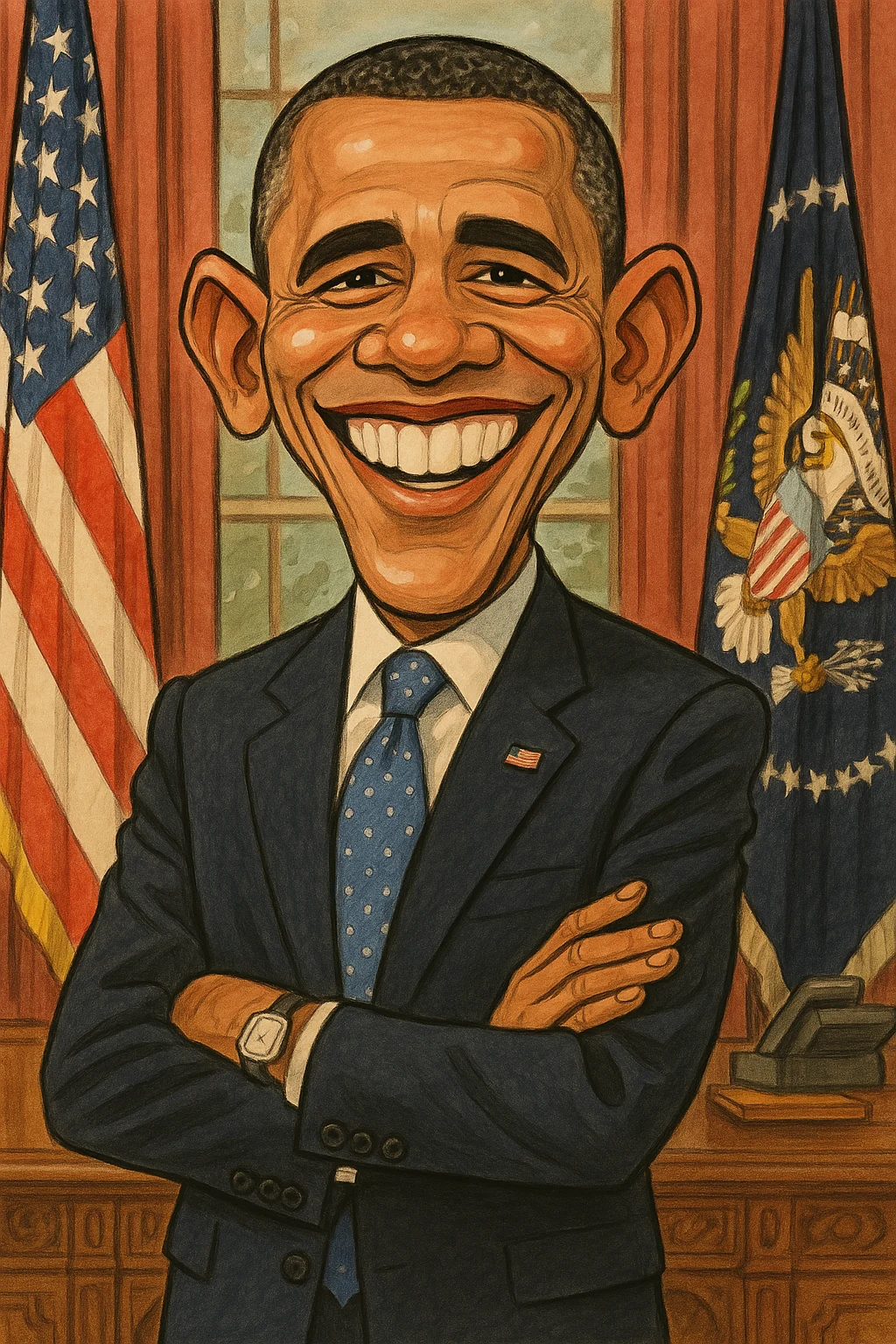
The generated caricature retains the portrait's crossed-arm pose, exaggerating the smile and facial features.
7. Generate memes, for example through contrasts or popular-culture references
The new model can also be excellent for making simple contrast memes, even exaggerated ones, of the kind familiar in party politics. This one, related to last week's article, came to mind readily:
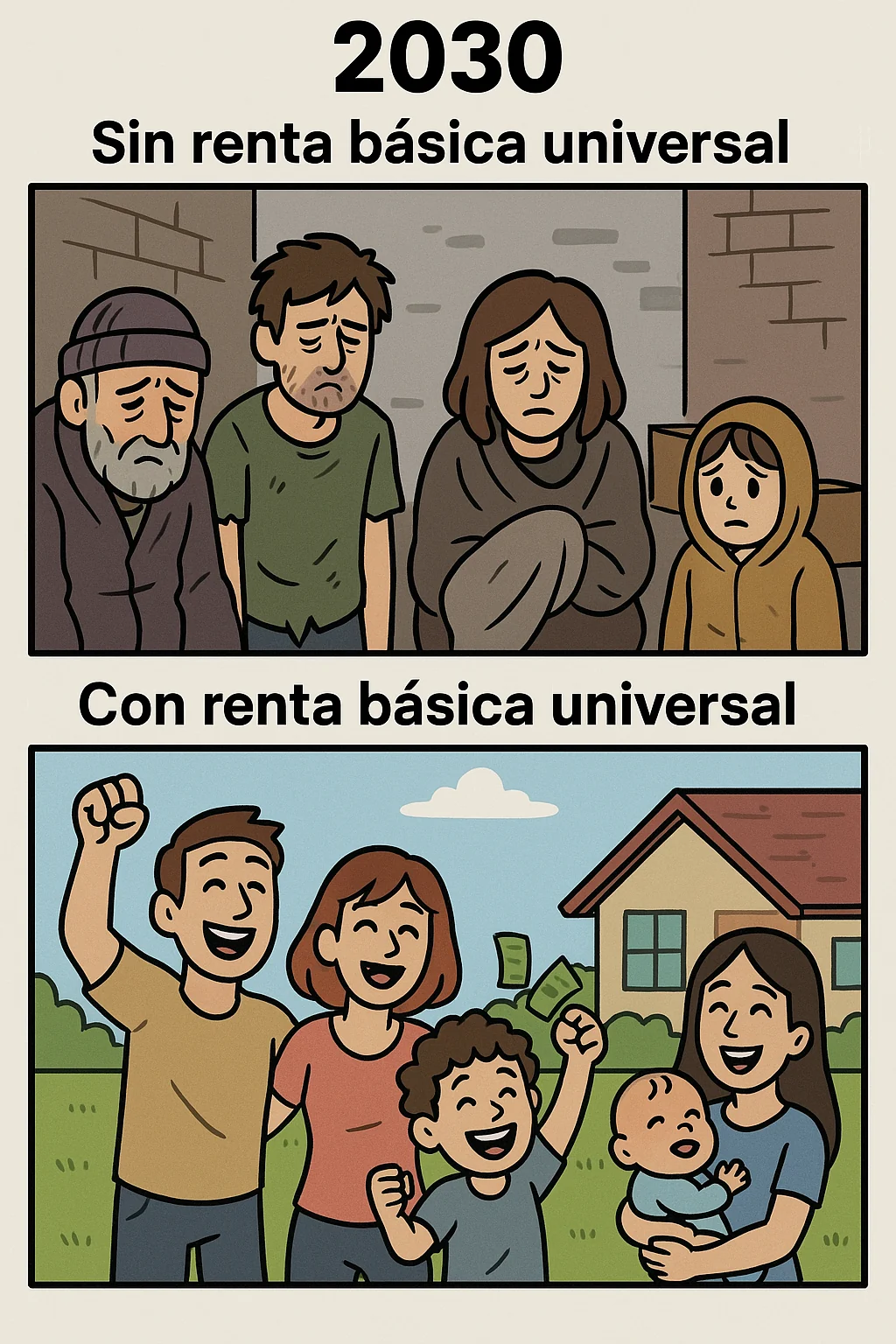
Complete meme text: “2030. Without universal basic income. With universal basic income.” The upper panel depicts distress and deprivation; the lower depicts smiling people beside a home. This is the article's illustrative contrast, not an observed result.
And, of course, it can generate it in a Ghibli style too:
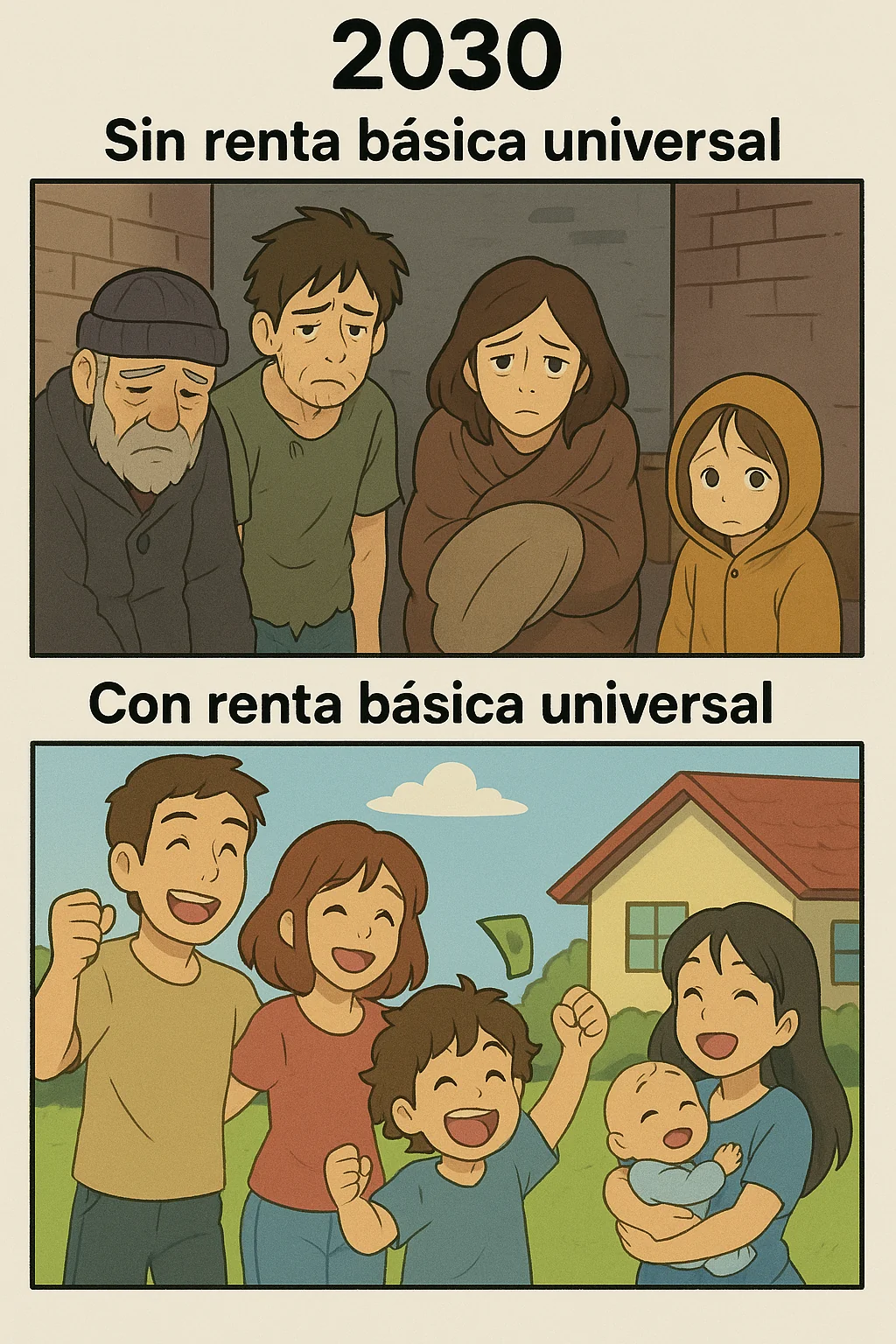
The same meme, restyled: “2030. Without universal basic income. With universal basic income.”
It is also a rich resource for creating memes around trending concepts or ones deeply rooted in popular culture. The following example was generated automatically simply by uploading the image of TVE's four-way debate in 2019 and asking it to turn the participants into members of the Hogwarts houses:
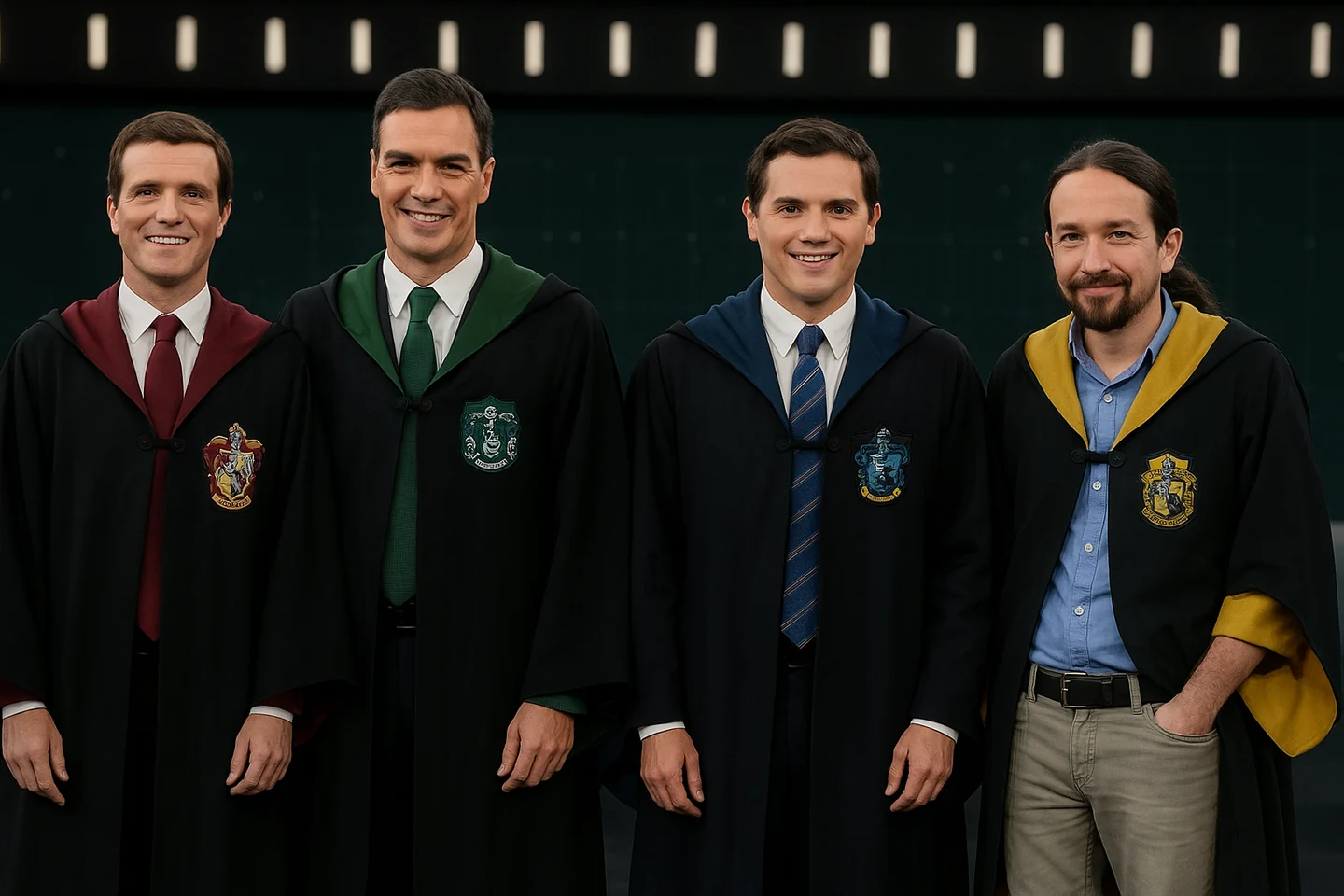
The synthetic edit gives the four debate participants robes in the colours of the Hogwarts houses; it is not a photograph of an actual costumed debate.
Or putting anyone into a film, following this prompt by Javi López:
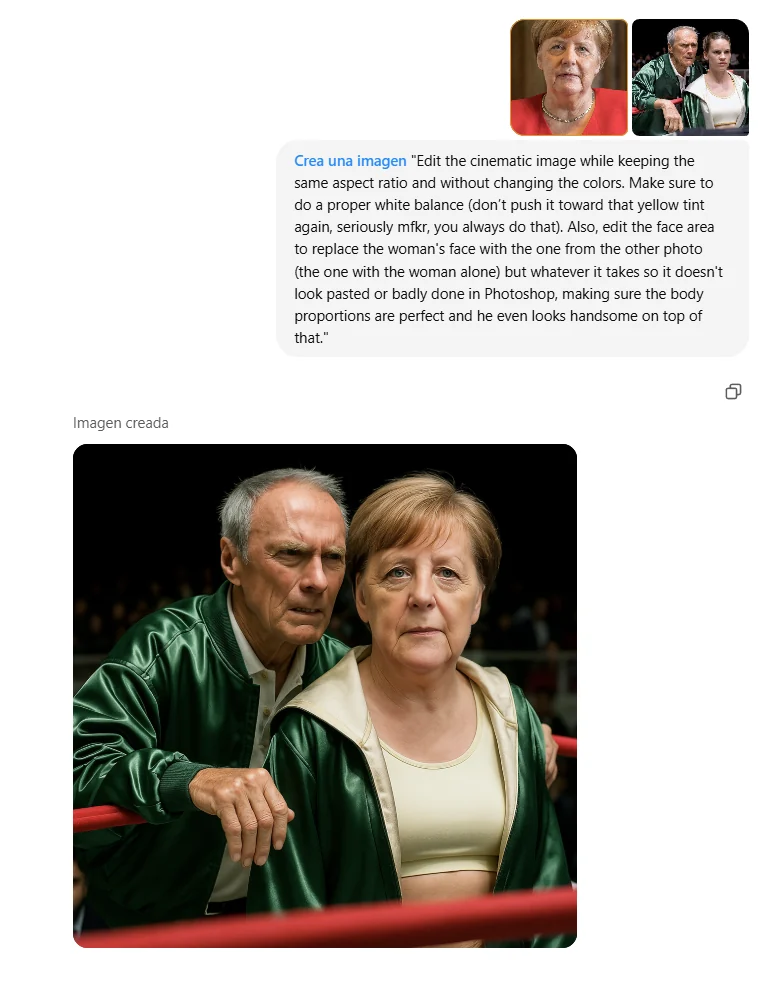
The screenshot shows two input photographs and a synthetic boxing-film result. Its interface labels mean “Create an image” and “Image created”. The prompt itself is already in English and reads:
"Edit the cinematic image while keeping the same aspect ratio and without changing the colors. Make sure to do a proper white balance (don’t push it toward that yellow tint again, seriously mfkr, you always do that). Also, edit the face area to replace the woman's face with the one from the other photo (the one with the woman alone) but whatever it takes so it doesn't look pasted or badly done in Photoshop, making sure the body proportions are perfect and he even looks handsome on top of that."
8. Transform any space to see how it would look
This is a prompt I have seen online in the context of home renovation and furnishing rooms, and it works very well. But it can be applied to any space—in this example, the press room of Spain's Congress of Deputies. It could have very interesting applications in designing stages for rallies, backdrops for special campaigns…
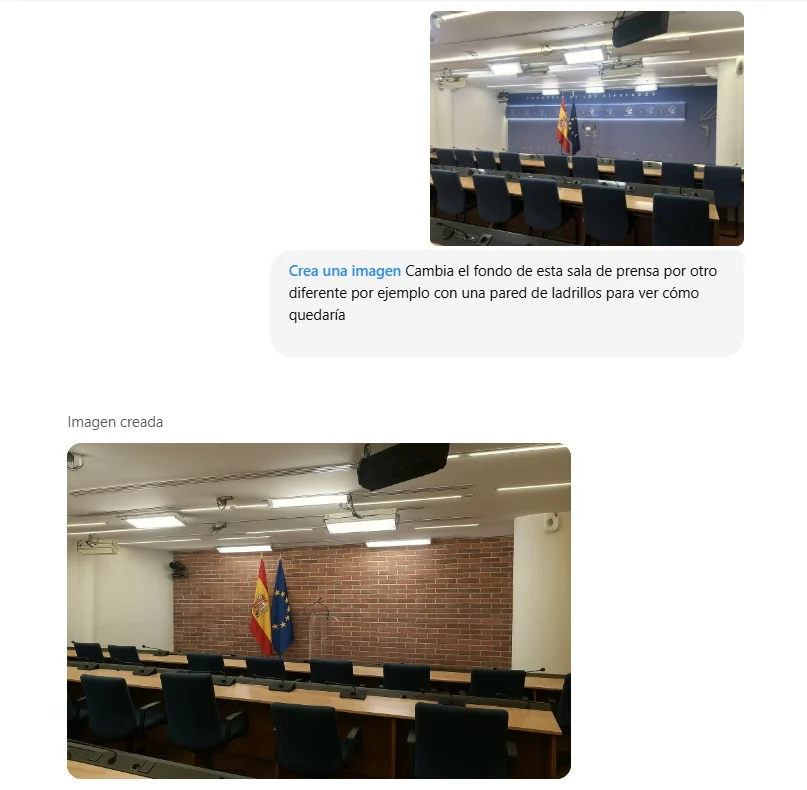
Complete translation of the prompt shown beside “Create an image”: “Change the background of this press room to a different one, for example a brick wall, to see how it would look.” The response is labelled “Image created”. The screenshot contains the source photograph above and the synthetic edit below.
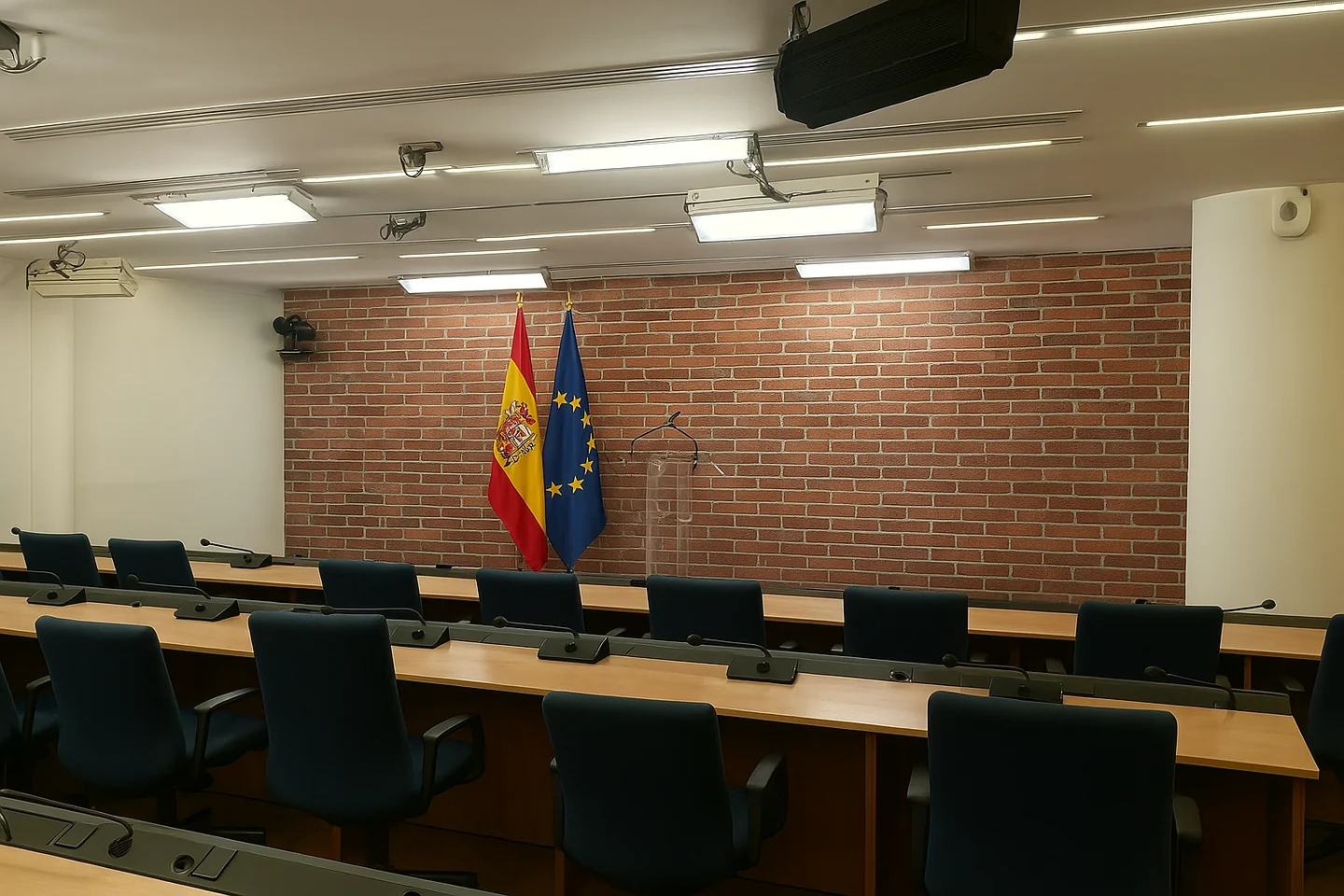
The generated result at larger size, showing a brick wall behind the lectern and flags. This visualisation is not evidence of an actual renovation.
9. Create awareness campaigns
GPT-4o can suggest and generate very powerful images to express ideas visually, such as this example:
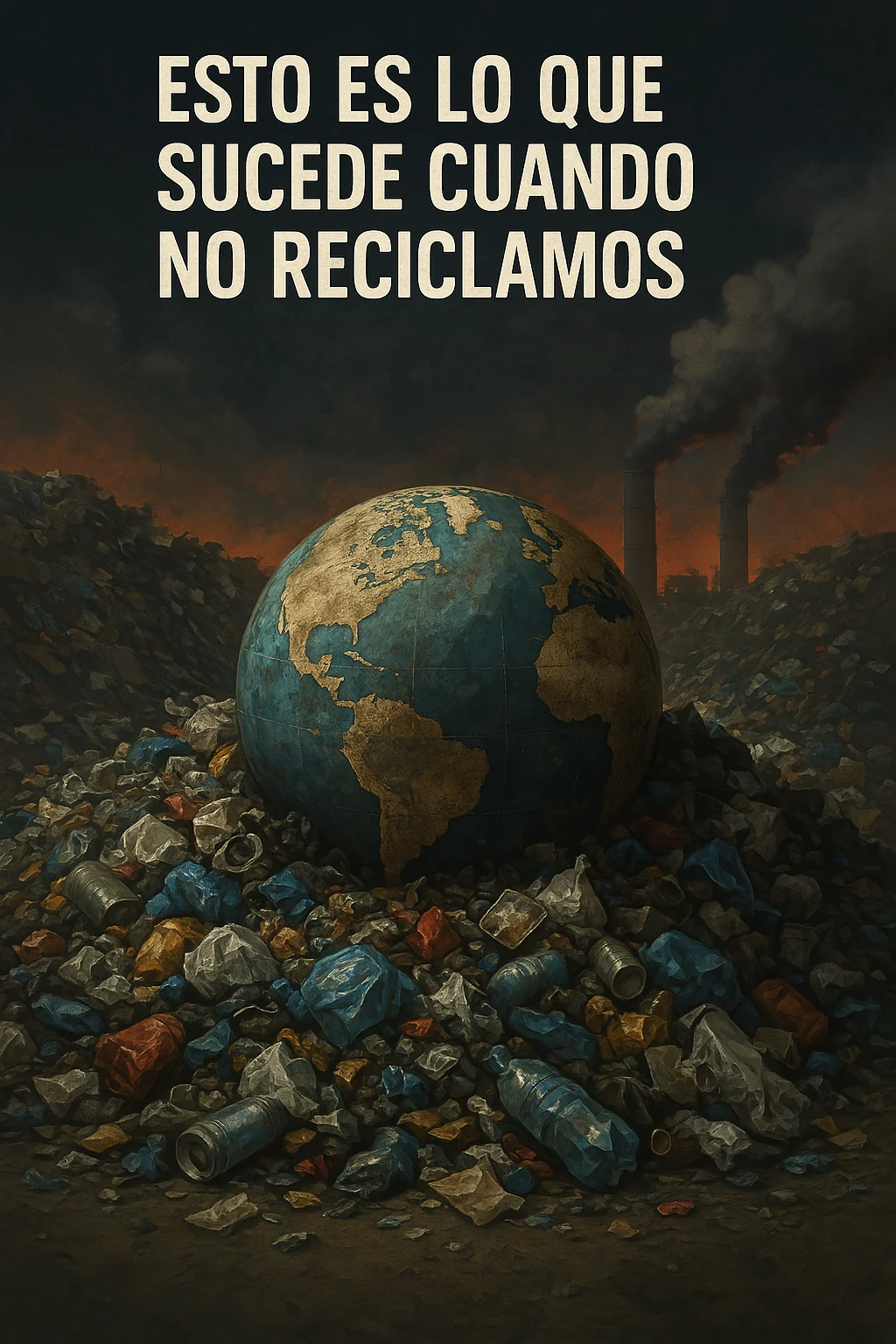
The original generated awareness poster reads: “This is what happens when we do not recycle.” It depicts a globe surrounded by rubbish beneath a smoky sky.
10. Visualise the future, especially infrastructure
For example, by generating a new sports complex on a map:
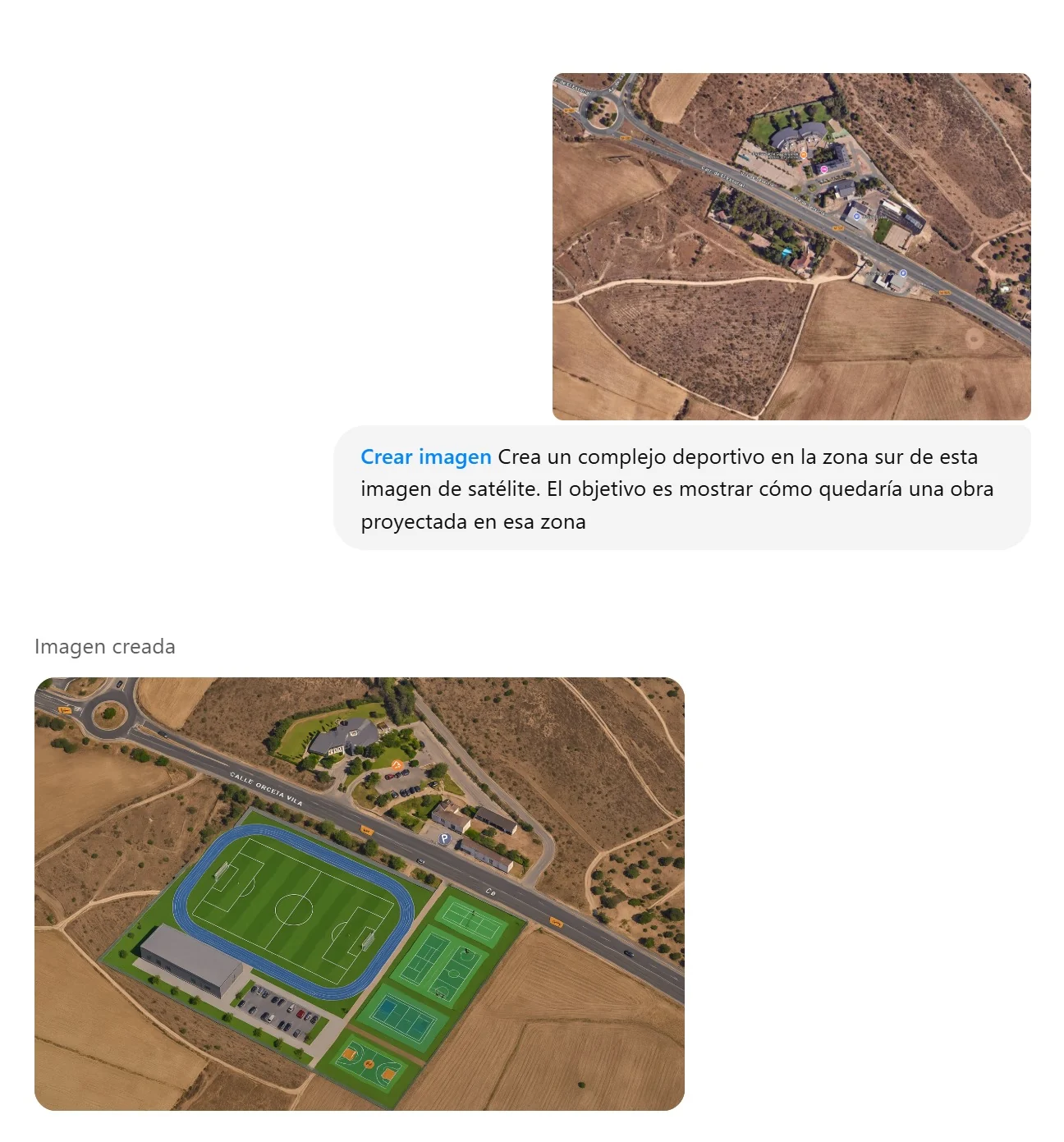
Complete translation of the prompt in the screenshot: “Create a sports complex in the southern part of this satellite image. The aim is to show what a development planned for that area would look like.” The interface labels read “Create image” and “Image created”. The generated result adds a running track, football pitch, courts, a building and parking. Small place labels in the generated map are distorted; this is a concept demonstration rather than a verified site plan.
It can create a concept to help people visualise it:

Generated concept image. The heading reads “New health centre” and the building is labelled “Health centre”.
And it can produce visually powerful “before and after” images for the public, for example showing how a run-down neighbourhood would change following a public intervention.
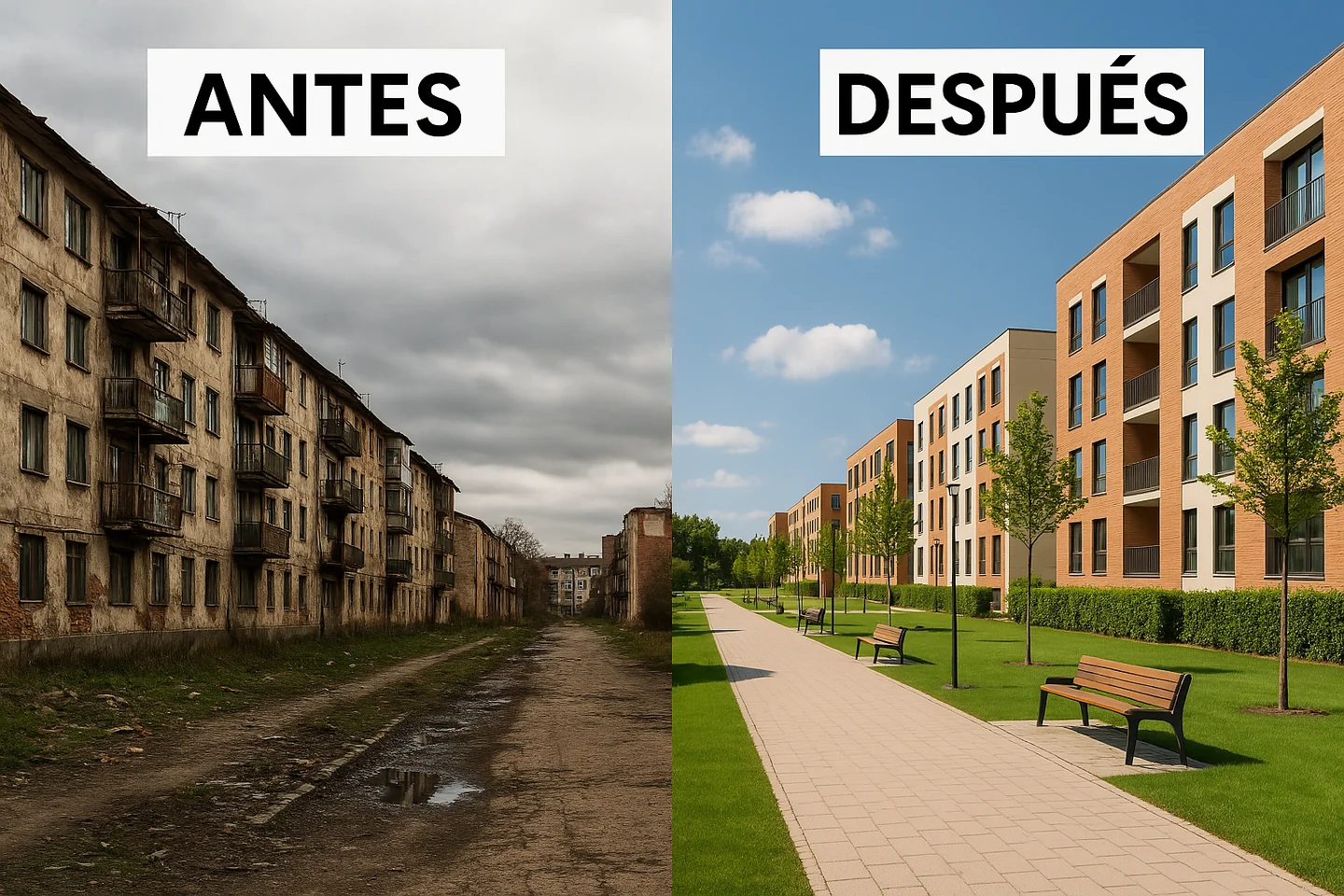
The synthetic comparison is labelled “Before” and “After”, contrasting deteriorated housing with a renewed neighbourhood. It illustrates a possible transformation rather than documenting completed works.
These are just a few examples. Imagination, common sense and ethics—crucial here, because not everything that can easily be done should be done—are the only limits to a technology that is already excellent in its ease of use and results. Moreover, because it can be used directly within ChatGPT with 4o, the model itself offers new suggestions and options. We encourage you to try, experiment and create.
Director of Digital Innovation at the ALEPH Educational Institution
Cite this essay
Fernando Nieto Lobato. “Ten uses for ChatGPT's new image-generation system: how easy AI image creation could redraw political communication.” estrategIA, issue 080, 9 April 2025. English edition, 29 September 2026. https://elcontemplador.github.io/estrategia-english/essays/080/