“Entrepreneurship and mass innovation.” These words, spoken by Chinese Premier Li Keqiang at the Davos Forum in 2014, sum up the strategy China has pursued over the past decade. The result: the Asian giant leads in the number of artificial intelligence patents, leads the world in 5G connectivity and, it seems, may also have achieved quantum supremacy.
Translation note: the quotation above is translated from the Spanish article. Its original wording has not been independently verified.
Despite this technological momentum, Chinese artificial intelligence companies had yet to launch practical commercial applications on a par with their American counterparts. Last week, however, Baidu, “China's Google”, unveiled ERNIE 4.0, a chatbot capable of rivalling ChatGPT 4. At the launch event, the company's CEO, Robin Li, demonstrated how ERNIE 4.0 could generate the plot for a novel and even a video advertisement for a car in a matter of minutes.
Aware of China's technological strength, the United States is trying to curb its momentum through trade restrictions, such as those imposed on Huawei a few years ago or, more recently, the ban on exporting to China chips needed for artificial intelligence development, including the H800 and A800 from Nvidia, the sector's leading producer.
The contest to lead the next wave is probably the most consequential in history. Artificial intelligence amplifies the winner-takes-all economy and will therefore bring an unprecedented concentration of wealth into the hands of very few companies and countries.
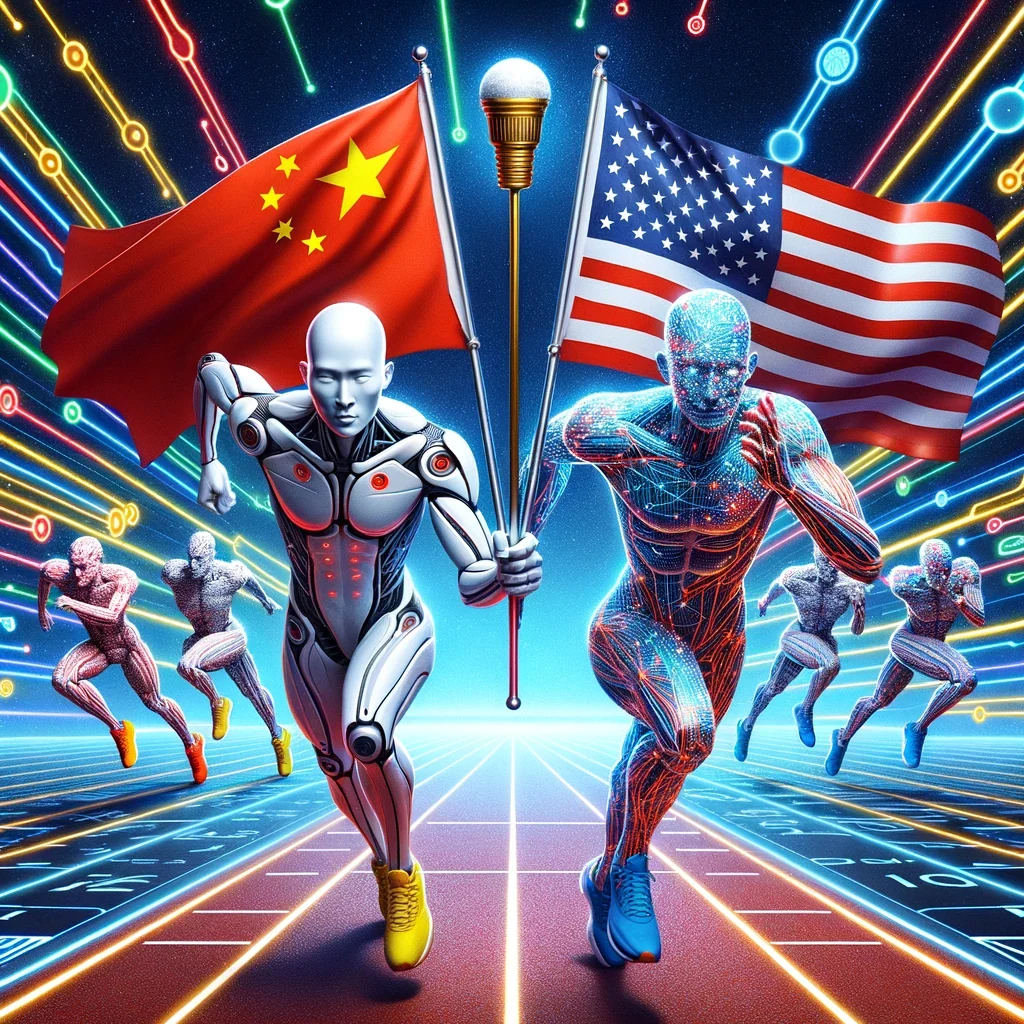
Created with DALL·E 3 through ChatGPT. Original caption, translated from Spanish: An artistic image of a relay race, with runners representing China and the United States. They carry a baton symbolising artificial intelligence as they run along a digital track.
From a Western perspective, the strength of the United States and Silicon Valley's giants is clear. Since the launch of ChatGPT, news of advances linked to artificial intelligence has appeared daily, while its possible applications across all kinds of sectors have multiplied. But what do we know about what is happening in China? Is China really capable of leading the AI wave?
In this issue, we want to explore a Chinese perspective through Kai-Fu Lee, one of the world's foremost experts on artificial intelligence. Lee has worked for Apple and Microsoft, and was even president of Google China. He now runs his own venture capital fund to finance Chinese high-technology companies.
In his book AI Superpowers, published in Spanish as Superpotencias de la Inteligencia Artificial, Lee argues that China is better equipped than other countries to lead the AI wave for the following reasons:
-
Vast quantities of data: China has a huge population and a growing middle class that actively uses technology, particularly through WeChat, an all-in-one app combining chat, multimedia, payments, healthcare and more. This enormous volume of data is essential for training artificial intelligence models and improving their accuracy.
-
Government investment: the Chinese government has demonstrated a strong commitment to AI by investing significantly in research, development and practical applications. Programmes such as the New Generation Artificial Intelligence Development Plan underpin this investment.
-
Leading technology companies: China is home to some of the world's largest and most advanced technology companies, including Alibaba, Tencent and Baidu, which are at the forefront of AI research and development. These companies compete fiercely to lead in areas such as facial recognition, natural language processing and robotics.
-
A culture of rapid development: China's combative entrepreneurial mindset favours rapid experimentation and constant iteration. Companies can test new ideas and adapt quickly in response to the results, driving innovation in AI. Lee also argues that the talent of exceptional geniuses will matter less than the work of large numbers of well-trained engineers assisted by artificial intelligence itself.
Despite the excessively competitive, almost warlike tone of the opening chapters, the end of the book, influenced by the author's experience of lymphoma, offers a universal, humanistic message, with concrete proposals for a new social contract as artificial intelligence's influence grows exponentially:
-
Ethics in AI: the author stresses the importance of developing ethical and responsible AI, with guidelines and regulations to ensure that the technology is used fairly and safely. This means transparency in data use, privacy protection and consideration of the ethical implications of AI in decision-making.
-
International collaboration: Lee advocates international cooperation in AI regulation and development. AI is a global technology, and nations must work together to address its challenges and share its benefits fairly.
-
Career reorientation and lifelong learning: Lee argues that people must be willing to adapt and acquire new skills as AI transforms the economy and labour market. This requires greater investment in education and in developing skills that are difficult to automate and have a strong creative and strategic component.
-
Cultural change: in any event, AI will eventually perform a large share of jobs. The writer therefore calls for a cultural shift in how societies perceive work and success, encouraging a focus on personal fulfilment and wellbeing instead of measuring a person's worth solely through their productivity at work. Professions exist today that would have been entirely undervalued a hundred years ago. Perhaps keeping older people company will become one of society's most highly valued occupations.
-
Universal basic income or a social investment stipend: voices in Silicon Valley have advocated introducing a universal basic income as AI generates substantial economic gains while also affecting the labour market. Lee, however, believes it is important to give people a purpose so that they feel fulfilled. He therefore promotes a “social investment stipend”: “a living wage provided by the government for those who invest their time and energy in activities that promote a kind, compassionate and creative society. It would encompass three broad categories: care work, community service and education.”
Translation note: the quotation defining the social investment stipend is translated from the Spanish article; its precise wording in the original English book has not been independently verified.
Ultimately, the coming years will be marked by intense competition between the United States and China. But the impact of advances in artificial intelligence will affect all of humanity, and politics must be ready to offer citizens solutions that avert dystopian outcomes.
P.S. Did you miss the words “Europe” or “European Union”? It seems that the Old Continent has been relegated to the role of legislator in this struggle to ride the AI wave. But that is a story for another issue…
Pablo Martín Diez
Academic Director, Institución Educativa ALEPH
Cite this essay
Pablo Martín Diez. “The silent battle: China, the United States and the race for AI supremacy.” estrategIA, issue 004, 25 October 2023. English edition, 29 September 2026. https://elcontemplador.github.io/estrategia-english/essays/004/