If 2023 was the year when generative artificial intelligence put itself on the map, following the arrival of hugely popular applications such as ChatGPT in late 2022, 2024 will very probably be the year when adoption among ordinary users takes off.
In the closing weeks of 2023, numerous news articles, blog posts, Reddit threads and posts by industry leaders themselves on X and LinkedIn considered what we can expect in 2024. Drawing on all that information, below we summarise the five main AI trends expected for 2024, and one more that will undoubtedly be crucial at the intersection of AI and politics.
1. AI will be integrated into our everyday tools, and we will increasingly use it almost without noticing
It seems that 2024 will not yet be the year when we can expect artificial general intelligence, or AGI, to arrive. Meanwhile, however, the world's largest companies are investing enormous resources in bringing today's AI systems directly into our lives. We will have fairly powerful AI fully integrated into WhatsApp and our social networks, our computer and mobile operating systems, our office software, our phone cameras, improving our apps, and in our voice assistants… The vast majority of experts agree that 2024 will be the year when advances in generative AI gradually become part of our daily routines.
2. Open-source models will narrow the gap with the large proprietary commercial models still further, although the latter will remain more powerful. An open model might even match the capabilities of today's GPT-4
The open-source world is currently in a position to make giant strides, despite having far fewer financial resources than major corporations such as Microsoft or Google. Although this carries certain risks — it is much harder to control a proliferation of models spread across hundreds of academic institutions, companies and advanced users who retrain earlier models — it could be very good news for AI innovation, as well as an important milestone in democratising access and use. Meta's Chief AI Scientist Yann LeCun put it very clearly in a recent interview:
“You do not want your citizens' digital diet to be controlled by a small number of people.”
Translation note: this quotation is translated from the Spanish article; its original English wording has not been independently verified.
Open-source models appear to be the necessary counterweight to the large AI models controlled by major companies, which also enjoy the enormous commercial advantage of being able to integrate them — as discussed in the previous trend — into products we all already use every day. It remains to be seen how two issues that will also, in their own way, be trends this year — the battle over copyright in AI and legislative regulation — will affect the development of open models.
3. New mobile phones will have AI, in some cases even running locally
Google and Samsung have already presented highly promising integrations of their latest AI models into smartphones in recent weeks. Apple is joining the race with a different approach, exploring the option of running AI on the user's own device, interacting with its operating system and making the fullest use of private user data without compromising it, by keeping it local. One way or another, it seems that AI will define each company's flagship phone launches in 2024, potentially revitalising sales while also raising prices.
4. 2024 will be the year of the great revolution in AI-generated video and audio
By the end of 2023, particularly with the launch of Midjourney version 6, excellence had already been achieved in images and photorealism. A similarly rapid pace of development is expected in 2024 for video and audio created with generative AI tools. Elon Musk himself put it very succinctly in a late-December tweet, responding to a short video made by a user with Midjourney and Pika Labs:
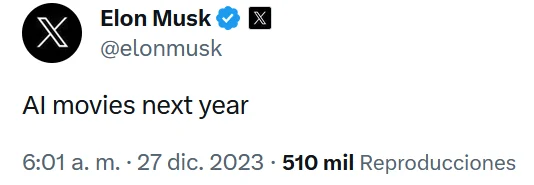
Original English text visible in the screenshot: Elon Musk, 27 December 2023 — “AI movies next year”.
5. Robots
Advances in recent years in large language models, or LLMs, such as GPT, Claude and Gemini, and in image generators such as DALL·E, Stable Diffusion and Midjourney, have focused our attention squarely on generative AI. Yet AI has an enormous field of application in other areas, such as research and scientific progress, and in robotics, where major advances are expected in the year now beginning.
“I have been asked what the biggest development in 2024 will be apart from large language models (LLMs). It is robotics. Full stop. We are around three years away from the ChatGPT moment for physical AI agents. We have been cursed by Moravec's paradox for too long: the counterintuitive phenomenon whereby ‘tasks that humans find easy are extremely difficult for AI, and vice versa’.
“2024 will be remembered as the first year when the AI community fights back against the curse in a big way. We will not win immediately, but we will be on the road to victory.”
These are the words of Jim Fan, NVIDIA Senior Research Scientist and Lead of AI Agents, in a LinkedIn post. The advances demonstrated by Tesla, Boston Dynamics and other robotics companies in the closing months of 2023 also seem to support this direction of travel.
Translation note: Jim Fan's quotation is translated from the Spanish article; the original English post has not been independently checked.
If those are five of the biggest and clearest trends expected for 2024, there is one more that numerous experts also mention, and which will have an enormous impact on how society perceives artificial intelligence over the coming years.
Artificial intelligence in the US elections
Within the dynamic interplay of artificial intelligence, politics and government, several other trends are attracting our attention, and we have already devoted articles in estrategIA to them: deepfakes and AI regulation, notably the final phase of the European Union's AI Act. In this context, Bill Gates's annual letter highlights significant AI-driven advances in education and health, subjects we will also explore throughout the year. Yet one aspect stands out in experts' predictions for 2024: AI's impact on the US elections and how this will shape public perceptions.
This phenomenon, crucial to political marketing worldwide — traditionally influenced by the United States — deserves particular attention. We will therefore devote our next issue's article to a detailed analysis of predictions and trends in this area. Meanwhile, as a taster, the following section contains relevant news on a subject that will undoubtedly be one of estrategIA's major themes in 2024.
English edition note: the “following section” refers to the news round-up in the original newsletter, which is outside this article's boundaries.
Fernando Nieto Lobato
Director of Digital Innovation, Institución Educativa ALEPH
Cite this essay
Fernando Nieto Lobato. “The rise of AI: key predictions for 2024.” estrategIA, issue 014, 3 January 2024. English edition, 29 September 2026. https://elcontemplador.github.io/estrategia-english/essays/014/