Before anything else, let me say that this week we reach issue 150 of estrategIA, a milestone we want to use to thank you for continuing to be part of this project. We now have more than 2,000 subscribers on Substack, alongside over 700 on LinkedIn. This growing community confirms the need to keep reflecting, rigorously and from a political perspective, on a technological transformation that accelerates week after week.
In this new summer historIA, we imagine a very near future in which artificial intelligence allows governments and parties to detect thousands of possible irregularities, contradictions and questionable expenses in seconds. Yet when finding an accusation becomes almost free, real power no longer lies in discovering information, but in deciding what deserves attention. Will our representatives choose the most serious problems, or those that make the best social media video?
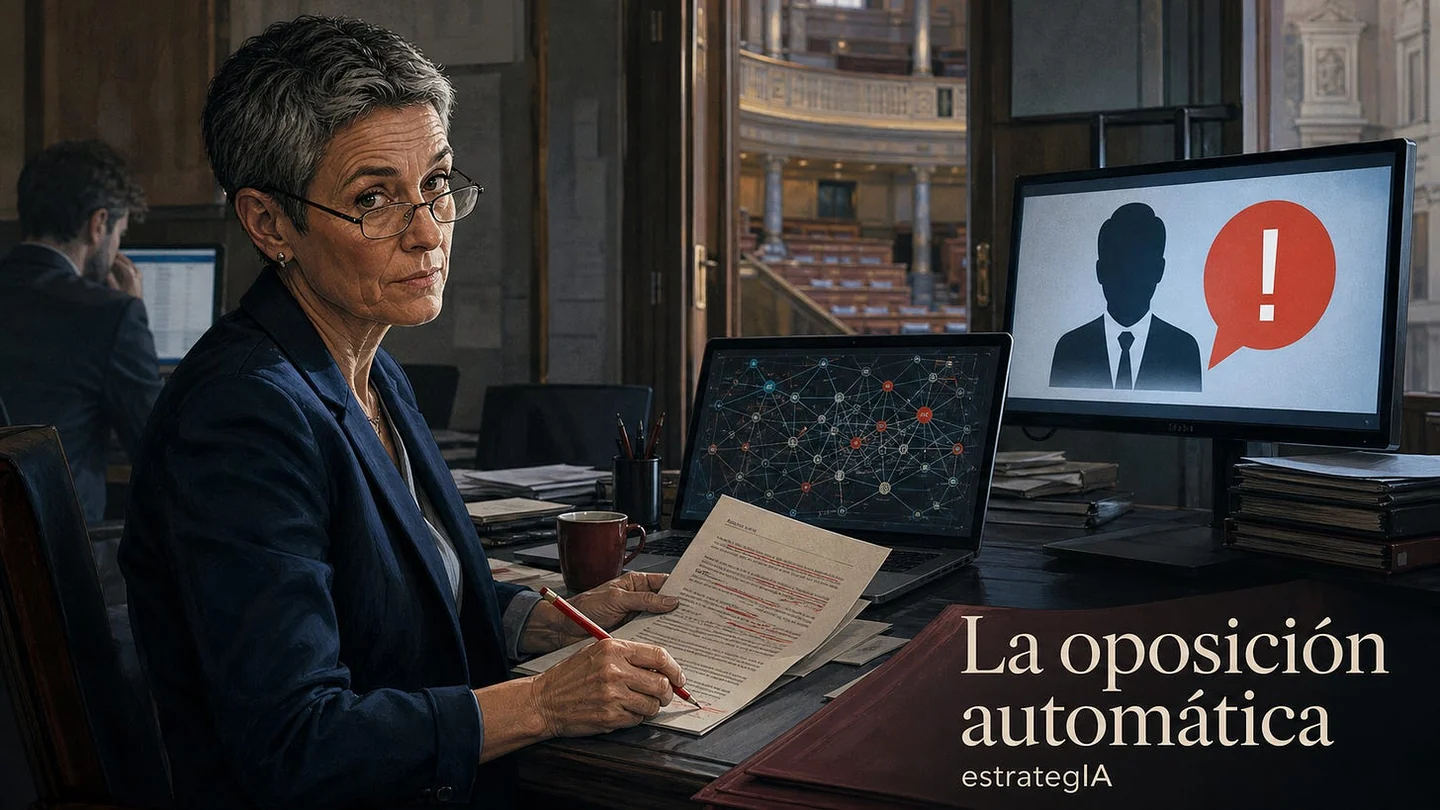
Original illustration. The Spanish title reads ‘The automated opposition’. Fine print on the papers and network diagram is decorative or unreadable.
At four minutes past seven, Argos found 1,286 matters that warranted an explanation from the government.
Eva Robles set her coffee beside the keyboard and picked up her red pencil. She had been an auditor before becoming an MP, and still printed out a page when she needed to know whether she understood something.
In her old office, finding three anomalies in a week had counted as a good result. Then came the calls, the original invoices and the explanations that turned two into mistakes and left one useful question. Argos could find three before her coffee went cold.
‘Sort by seriousness,’ she said.
‘Legal, economic, institutional or communications seriousness?’
‘By what ought to matter.’
Argos displayed four rankings.
The agent had been a good investment. In six months it had detected duplicate invoices, incompatible grants and medical supplies billed twice. Several public authorities had corrected errors before the parliamentary group exposed them. Eva insisted on making those corrections public too. Her chief of staff called it handing victories to their political opponent.
That morning, two cases stood out.
The first concerned the avatar that stood in for the Minister for Infrastructure in routine videos. The ministry had paid €14,600 to teach it to pronounce the minister’s own surname correctly.
Probably lawful. Low economic impact. Communications potential: very high.
The second was more difficult. Forty-three contracts awarded by different public bodies ended up with companies that shared directors, former addresses and technical staff. They involved school meals, hospital laundry and care-home maintenance. Each procurement file appeared lawful. Together they formed a concentration of ownership that nobody had declared. One company also assessed work carried out by another in the same group.
Systemic risk. Recommended human verification: three weeks.
Eva circled the second.
‘This one.’
‘Question time starts in ninety minutes,’ said Sergio, her chief of staff. ‘We need something that fits into a question.’
‘It does: why have forty-three contracts…?’
‘We’ve already lost half the country. If we don’t survive the news bulletin, there won’t be a committee to investigate those contracts.’
Sergio played the avatar’s video. It pronounced the surname with perfect solemnity.
Eva had spent two months preparing investigations that never reached the chamber. The group’s leadership wanted ‘more responsiveness’. At the last meeting, someone had suggested that Sergio take over as spokesperson.
In the lift on the way to the chamber, Eva folded the sheet about the second case and put it in her pocket. Then she changed her question.
‘Minister, how many taxpayers does it take for your digital double to learn your name?’
The video had been clipped before she sat down again. From her seat, Eva watched Sergio add a caption and choose the thumbnail in which the minister looked most offended.
The minister explained that the adjustment also covered place names and foreign names. That was true. Eva replied that she hoped the avatar would at least remember his surname when he left office. Sergio smiled from the benches.
By midday, her intervention topped the political trending topics. Argos recorded hundreds of thousands of views and an improvement in Eva’s ratings.
Inés Vidal, who had been her boss at the regional audit office before they both went into politics, was waiting in the corridor.
‘Was that the most important thing you found today?’
Eva looked at the red pencil she was still holding.
‘It was what I could prove today.’
‘That isn’t the same thing.’
‘No.’
The government responded at thirteen minutes past twelve. Its integrity agent had detected that a council run by Eva’s party was paying an annual subscription to generate the mayor’s speeches, even though it was still paying a communications consultancy.
That was true too.
Sergio came into the office with the video ready.
‘They’re calling us hypocrites. We need a response before the news.’
Eva opened the investigation into the forty-three contracts. Two analysts had begun reconstructing the corporate relationships.
‘Let them carry on.’
‘I need them to check our councils.’
‘Take one. The other stays on the contracts.’
Sergio shook his head.
‘If we don’t clear up our own affairs, nobody will believe the story about the forty-three tomorrow.’
Eva called the group’s leadership and defended the investigation for six minutes. When she hung up, the reassignment of both analysts was already marked as approved in their calendars.
Argos recalculated. Without human support, verification of the contracting pattern went from three weeks to ‘no estimated completion date’.
‘Find government inconsistencies comparable to the subscription,’ Sergio ordered.
The system found 312 in seventeen seconds.
Eva sorted by seriousness again. Then she looked at the television news, where her question from that morning was being replayed without sound.
‘Sort by reach,’ she said.
Argos put one alert at the top.
A state body had rented two hundred chairs while keeping three hundred in a warehouse. There was an explanation involving ergonomics and insurance, but it would not fit into the video.
‘Prepare the question.’
Argos began drafting.
On the other screen, the network of forty-three contracts dropped to position 1,287.
After the fiction
Artificial intelligence already makes it possible to review large volumes of contracts, grants and public data to detect patterns that warrant investigation. These tools can reduce a very common form of opacity: information that is formally public, but too scattered or complex for effective scrutiny.
The story imagines what happens when that capability becomes fully embedded in political competition. Detecting alerts becomes cheap; verifying, contextualising and explaining them still takes human time. The scarce resource is no longer data, but the attention of analysts, journalists, institutions and citizens.
Selection is never neutral. Sorting by legal seriousness, material harm, speed of verification or communications impact produces different agendas. The risk is not only the circulation of false accusations, but that an avalanche of genuine yet minor findings displaces more important investigations. Restricting these tools would hand the advantage back to those who benefit from opacity; using them without judgement can turn scrutiny into noise.
Director of Digital Innovation at Institución Educativa ALEPH and editor of the estrategIA newsletter
Cite this essay
Fernando Nieto Lobato. “The automated opposition.” estrategIA, issue 150, 12 August 2026. English edition, 29 September 2026. https://elcontemplador.github.io/estrategia-english/essays/150/