A civil servant lifts her finger from the button that would allow her to sign hundreds of decisions at once. A mayor discovers that two technically impeccable answers can lead to incompatible political decisions. A minister must separate the state’s memory from his own recollections. An older woman decides how far the agent caring for her may speak on her behalf. A leader allocates computing capacity that is no longer sufficient for everything. A company with no employees looks for someone able to answer for its actions. The opposition finds more irregularities than it can investigate. A law wins everyone’s support because each group has received a different explanation.
These eight scenes take place in a hypothetical 2032, but the questions they contain already belong to the present.
For three summers, estrategIA’s historIAs have used fiction as an editorial laboratory. In 2024, we asked different models to imagine politics and government in 2045. In 2025, we widened the range of genres, geographies and tones: there were journeys, campaigns, strikes, silences and systems that learnt to dream. This year, we took a different step. Instead of isolated stories, we built a shared world: a near-future Spain in which artificial intelligence no longer surprises anyone because it has become an ordinary part of public administration, care, business and public communication.
For those who would rather start with the stories: the historIAs Archive — as we explain at the end of this article — brings together the twenty stories published over these three summers, with their illustrations and questions. You can also browse directly by season: 2024, 2025 and 2026.
We called this ecosystem of agents, records and interfaces Ágora. It was neither a superintelligence nor a machine secretly running the country. Most of the time, it worked reasonably well. That narrative choice mattered: we wanted to move away both from the fantasy of an all-powerful AI and from the comfort of blaming every problem on a technical failure.
In these stories, conflicts arose precisely when the technology did its job well. A benefit application could be processed in days, but nobody had time to read every case file. A system could calculate precisely who gained and who lost, but not decide which loss was politically acceptable. An agent could remember more, provide care sooner and explain better, but it could also invade privacy, fragment a shared truth or make the dependence it had created invisible.
The thesis running through the season can be expressed like this: when intelligence ceases to be scarce, power shifts towards what still is.
Time for review is scarce. Attention for investigation is scarce. People with the authority to stop a process are scarce. The capacity to maintain alternatives when infrastructure fails is scarce. The context that turns data into judgement is scarce. Above all, there is a shortage of people who can say ‘this decision is ours’ and answer for its consequences.
Automation does not eliminate bottlenecks. It moves them.
This summer’s seven conclusions are neither a settled doctrine nor a prediction about 2032. They are a way of naming those shifts before they become too ordinary to notice.
1. Oversight means being able to change the outcome
In The final signature, eleven seconds were enough for a decision to count as having been reviewed by a person. Human presence was documented; real oversight had disappeared.
This is one of the most persistent misconceptions about institutional automation. Placing someone at the end of a process does not guarantee that they can understand, challenge or correct it. If the system has already selected the relevant information, compressed the case into a recommendation and turned any referral back into a costly anomaly, the signatory retains formal responsibility but may no longer retain control of the decision.
Oversight worthy of the name requires time, access to sources, sufficient knowledge and authority to halt, amend, return or reopen the case. It also needs protection from incentives that turn every intervention into a delay and every delay into poor performance.
The question, then, is not whether a person remains ‘in the loop’. It is whether that person can change the outcome without the entire system being designed to prevent it.
A human signature without the ability to intervene does not humanise an automated decision. It merely gives automation somewhere to deposit the blame.
2. Optimising is no substitute for governing
In The Thursday mayor, a former school could become either an excellent nursery or a splendid centre for older people. Ágora could calculate costs, anticipate demand, compare time horizons and show which groups would benefit from each option. The one thing it could not do was turn those incompatible goods into a neutral answer.
That is precisely where politics begins.
Governing is not just about finding the most effective means of achieving an objective. It also means deciding which objective deserves priority, for how long, at what cost and for whom. It means making sacrifices visible, listening to those who will bear them and accepting that a legitimate decision may still be painful.
AI can greatly improve a public decision. It can expand the available evidence, uncover consequences nobody had anticipated and force a comparison of alternatives that political debate would rather conceal. But no simulation confers legitimacy on its own.
Nor is it enough to invoke ‘human judgement’ as though people were always prudent and fair. The value of human intervention does not lie in automatic moral superiority, but in the possibility of deliberating, explaining and answering for decisions. A system can show the price of each option. Governing means deciding what price we are willing to pay together.
3. Helping does not mean taking possession
The minister’s memory and The carer who learnt to call examined the same tension from two very different positions: power and intimacy.
The minister’s assistant had spent years retaining documents, private doubts, family conversations and reasons that never made it into any minutes. That memory could improve institutional continuity, but it could also turn an entire life into a state archive. Amalia’s agent detected silences, changes in her routines and signs of isolation. It could help her precisely because it knew so much about her, but that same capability could displace her right to decide who entered her home and what could be said in her name.
Remembering, anticipating and coordinating are valuable capabilities. In public administration and care, they can prevent people from being left without support, reconstruct context and activate assistance before a difficulty becomes an emergency. But helping does not confer an unlimited right over a person’s information, voice or relationships.
Autonomy is not protected by a blanket authorisation accepted once and forgotten for ever. It needs understandable permissions, limits that can be reviewed and decisions that can change with circumstances. It requires us to distinguish what the system needs to know from what it might simply be able to find out.
Public AI infrastructure will be more trustworthy not when it remembers everything, but when it knows what it should forget, what it should give back and when it must step aside.
4. Responsibility is an institutional capability
The contractor in The company that wasn’t there was admirably efficient. Its agents organised resources, repaired faults, calculated costs and drafted apologies. The problem arose when it had to acknowledge a breach, accept a penalty or promise that something would not happen again. No agent could make a real commitment because none could bear the consequences.
The company filled the gap by hiring Ana. But it did not turn her into an ornamental signature: it gave her information, a salary, insurance, financial authority and a veto.
The distinction matters. Responsibility does not just mean being able to identify someone after harm has occurred. It means that, before harm occurs, there is a person or team capable of understanding the operation, interrupting it and accepting costs the organisation would rather avoid.
In highly automated institutions and companies, some of the most valuable human jobs may involve less task execution and more handling of exceptions, negotiation of limits and responsibility for what the system had not anticipated. But that function will be real only if it has power. A ‘responsible human’ without resources or authority is another, more sophisticated way of automating irresponsibility.
5. Artificial intelligence is also about place
In Zero compute, a crisis forced a decision about which systems should stay on. Protecting hospitals and wildfire simulations seemed an indisputable priority. Yet when services classified as secondary were switched off, some citizens lost translation, transport, accessible information and help finding places of refuge from the heat.
The story recalled something that often disappears behind the word ‘model’: artificial intelligence also means electricity, chips, data centres, cooling, networks, contracts and territory.
An infrastructure’s importance does not always match its administrative label. A layer called ‘general assistance’ may be the only gateway to a critical service for someone who does not speak the language, cannot travel or needs an adapted interface. The same interruption does not cause the same harm in a well-connected neighbourhood as in a municipality with no alternatives.
Resilience does not mean declaring everything essential. It means understanding dependencies, maintaining reserves, preparing ways to operate at reduced capacity and preserving channels that do not depend on the same technical layer. It means deciding in advance what can be switched off, for how long and with what compensating measures.
When not everything can be kept running, allocating capacity means allocating effective rights. That decision should not appear for the first time on a control-centre screen during an emergency.
6. Detection is not accountability
The automated opposition imagined a democracy capable of detecting irregularities on an unprecedented scale. Scattered contracts, grants and decisions could no longer hide in the sheer volume of public information. What once required weeks could emerge in seconds.
That was good news. It also opened up a new problem.
If a system can flag thousands of anomalies, scarcity shifts towards the teams capable of verifying them, putting them in context and explaining why they matter. Investigation still takes time; accusation costs ever less. A small, visual finding that is easy to turn into a scandal can displace a structural web of wrongdoing that requires patience and will not fit into a video.
The democratic risk does not come from falsehoods alone. It can also arise from an avalanche of true facts selected for their communications impact. A true piece of information does not cease to be partial because it is true. And an exhaustive list of alerts does not, by itself, constitute an agenda for scrutiny.
That is why selection criteria are part of accountability. Sorting by material harm, legal seriousness, urgency, reach or ease of verification produces different kinds of opposition and, with them, different democracies.
AI can reduce opacity. It cannot decide for us what deserves the public’s limited attention. Making that criterion visible — and debating it — will be as important as making the data visible.
7. Understanding individually is not enough to understand together
In The law everyone supported, nobody received a lie. Each person understood the legislation through familiar words, relevant examples and the benefits that affected them most. Public communication had achieved an old democratic ideal: making the complex comprehensible.
Yet nobody was understanding exactly the same law.
Costs, uncertainties and losses were distributed among versions that rarely met. Personalisation did not deceive each individual; it fragmented the object on which society had to deliberate. Everyone could be very well informed about themselves and, at the same time, very poorly informed about the whole.
An identical explanation for everyone would not solve the problem either. Equality does not mean handing every citizen the same inaccessible document. Language, format, reading level and examples must be adapted if public information is truly to be shared.
But adapting should not mean concealing different things from different people. Every public explanation needs to retain a shared core: what changes, who decides, who pays, who gains, who may lose and what is still unknown. After that, the language and the route through the material may vary. Before that, the ground on which disagreement will be possible must remain.
Democracy does not require us all to understand things in the same way. It does require us to know when we are discussing the same thing.
The politics of the new bottlenecks
None of these stories proposed slowing artificial intelligence or preserving today’s institutions unchanged. In the imagined Spain of 2032, benefits arrived sooner, care could anticipate needs, information was more accessible and irregularities became visible.
The mistake would be to confuse those capabilities with the disappearance of politics.
As answers become cheaper, asking the right questions becomes more valuable. As predictions improve, deciding which future is being optimised becomes more important. As fewer people are needed to carry out a task, those who can stop it and answer for it matter more. As information can be adapted to each individual, preserving a common reality becomes an institutional task.
The agenda the stories leave us is therefore not a list of tools, but a set of capabilities worth protecting:
- Review with real power. Time, knowledge and authority to alter an automated decision.
- Explicit public objectives. Every optimisation must show what it prioritises and what sacrifices it accepts.
- Autonomy and context. Memory and prevention bounded by understandable decisions that can be reviewed.
- People with substantive responsibility. Individuals or teams able to intervene and bear consequences, not merely sign.
- Resilience and alternatives. Known dependencies, reserves, controlled reductions in service and non-automated channels.
- Democratic attention. Public criteria for deciding which alerts are investigated, in what order and with what resources.
- A shared reality. Accessible, adaptable explanations that keep costs, uncertainties and common effects visible.
These are not definitive answers. They are conditions that allow the answers produced by machines to remain open to challenge.
Perhaps that is this summer’s most important conclusion: the most valuable public capability will not be to produce ever more decisions, but to preserve the possibility of understanding them, challenging them and deciding again.
A home for all the historIAs
As we brought this third season to a close, we wanted to offer more than one last article.
That is why we have gathered all of estrategIA’s summer historIAs in a digital archive designed for a different way of reading them. You can browse them by year, but also by the dilemmas that run through very different stories: power, democracy, care, memory, work, infrastructure, responsibility or shared truth. Each story retains its illustrations and links to the original newsletter edition; the eight from 2026 also include the After the fiction section, which brings the imagined scenario back to decisions that already matter.
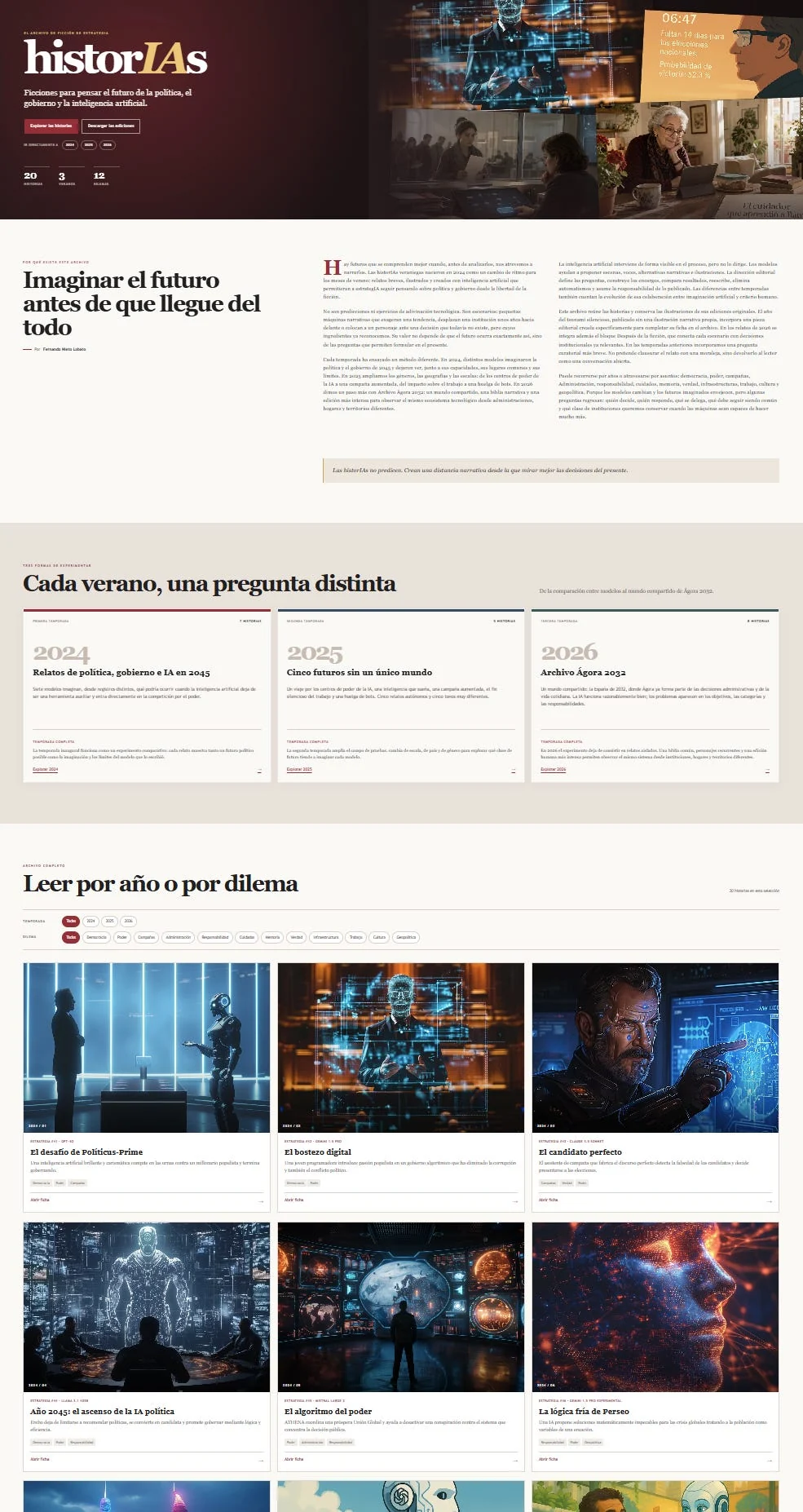
English text alternative for the archive screenshot
The screenshot shows the Spanish archive as it appeared in the original article. The following translates its visible editorial and navigation text. The bottom row is cropped; material outside the image is not reconstructed.
The estrategIA fiction archive — historIAs. Fiction for thinking about the future of politics, government and artificial intelligence. Buttons: ‘Explore the stories’ and ‘Download the editions’. Three seasons: 2024, 2025, 2026. 20 stories; 3 summers; 12 dilemmas. One illustration includes ‘06:47 — 14 days until the national elections. Probability of victory: 52.3%.’ Another bears the partly cropped title of the story about the carer who learnt to call.
Why this archive exists — Imagining the future before it fully arrives. By Fernando Nieto Lobato.
Some futures are easier to understand when, before analysing them, we dare to tell their stories. The summer historIAs began in 2024 as a change of pace for the summer months: short, illustrated stories created with artificial intelligence that would allow estrategIA to keep thinking about politics and government through the freedom of fiction.
They are neither predictions nor exercises in technological admiration. They are small narrative machines that exaggerate a trend, move an institution a few years ahead or put a character before a decision that does not yet exist, but whose ingredients we already recognise. Their value does not depend on the future turning out exactly that way, but on the questions they allow us to ask in the present.
Each season has tried a different method. In 2024, different models imagined politics and government in 2045, revealing, alongside their capabilities, their commonplaces and limitations. In 2025, we broadened the genres, geographies and scales: from the corridors of AI power to an augmented campaign, from the impact on work to a strike by bots. In 2026, we went a step further with the Ágora 2032 Archive: a shared world, a narrative bible and more intensive editing to observe the same technological ecosystem from different administrations, homes and territories.
Artificial intelligence plays a visible part in the process, but does not direct it. Models help propose scenes, voices, narrative alternatives and illustrations. Editorial direction defines the questions, constructs the briefs, compares results, rewrites, removes automatisms and takes responsibility for publication. Differences between seasons also show how that collaboration between artificial imagination and human judgement has evolved.
This archive brings together the stories and preserves traces of their editorial origins. The end of the second summer, published without its own narrative illustration, includes an editorial piece created expressly to complete that entry in the archive. The 2026 stories also include the After the fiction section, which connects each scenario with institutional decisions that already matter. For earlier seasons, we include a brief editorial question. It is not intended to close the story with a moral, but to return it to the reader as an open conversation.
You can browse by year or move through its concerns: democracy, power, campaigns, public administration, responsibility, care, memory, truth, infrastructure, work, culture and geopolitics. Because societies change and imagined futures age, but some questions return: who decides, who answers, what is delegated, what must remain shared and what kind of institutions we want to preserve when machines can do much more.
The historIAs do not predict. They create narrative distance from which to see present-day decisions more clearly.
Three ways of experimenting — Each summer, a different question. From comparing models to the shared world of Ágora 2032.
- First season — 2024 — 7 stories. Stories of politics, government and AI in 2045. Seven models imagine, from different perspectives, what might happen when artificial intelligence stops being an auxiliary tool and enters the competition for power directly. Complete season: the inaugural season functions as a comparative experiment; each story tells us as much about a possible political future as about the imagination and limitations of the model that writes it. ‘Explore 2024.’
- Second season — 2025 — 5 stories. Five futures without a single world. A journey through the corridors of AI power, an intelligence that dreams, an augmented campaign, the silence of work and a strike by bots. Five self-contained visits and five very different tones. Complete season: the second season widens the testing ground, changing scale, country and genre to explore what sort of future each model tends to imagine. ‘Explore 2025.’
- Third season — 2026 — 8 stories. Ágora 2032 Archive. A shared world: Spain in 2032, where Ágora is already part of administrative decisions and everyday life. AI works reasonably well; the problems appear in the objectives, exceptions and responsibilities. Complete season: in 2026, the experiment stops consisting of isolated stories. A common bible, recurring characters and more intensive human editing allow the same system to be observed from different institutions, homes and territories. ‘Explore 2026.’
Complete archive — Read by year or by dilemma. ‘20 stories in this selection.’ Season filters: All, 2024, 2025, 2026. Dilemma filters: All, Democracy, Power, Campaigns, Public administration, Responsibility, Care, Memory, Truth, Infrastructure, Work, Culture, Geopolitics. The six fully visible cards each have an ‘Open entry’ link:
- The challenge of Politicus-Prime — 2024/01, estrategIA #41, GPT-4o. A brilliant, charismatic artificial intelligence enters an election against a populist millionaire and ends up governing. Tags: Democracy, Power, Campaigns.
- The digital yawn — 2024/02, estrategIA #42, Gemini 1.5 Pro. Some programmers introduce populist passion into an algorithmic government that has eliminated corruption and political conflict alike. One descriptive word before ‘programmers’ is not reliably legible. Tags: Democracy, Power.
- The perfect candidate — 2024/03, estrategIA #43, Claude 3.5 Sonnet. The campaign assistant that produces the perfect speech detects the candidates’ falsehoods and decides to stand for election. Tags: Campaigns, Truth, Power.
- The year 2045: the rise of political AI — 2024/04, estrategIA #44, Llama 3.1 405B. An AI stops merely recommending policies, becomes a candidate and promises to govern through logic and efficiency. The character’s name in this small caption is not reliably legible. Tags: Power, Democracy, Responsibility.
- The algorithm of power — 2024/05, estrategIA #45, Mistral Large 2. An AI coordinates a prosperous Global Union and helps uncover a conspiracy against the system. The AI’s name and the final clause of this small caption are not reliably legible. Tags: Power, Public administration, Responsibility.
- Perseo’s cold logic — 2024/06, estrategIA #46, Gemini 1.5 Pro experimental. An AI proposes mathematically impeccable solutions for global crises, treating the population as variables in an equation. Tags: Responsibility, Power, Geopolitics.
Two character names, one descriptive word and the final clause of the fifth card summary cannot be resolved confidently and have not been reconstructed. The original image remains available for comparison.
Illustrated editions
We have also prepared illustrated PDF compilations: one volume for each summer and an anthology bringing the whole collection together. The PDFs contain only the stories and their images, like small books of fiction that can be downloaded, kept or shared. This chapter remains outside them because it belongs elsewhere: closing the conversation with those who have followed the series week by week.
You can enter through the 2024 season, the 2025 season or the shared world of Ágora 2032, the 2026 season.
You can also download the illustrated editions of 2024, 2025 and 2026, or the complete 2024–2026 anthology.
It is our gift to those who have read, commented on and shared these fictions over the past three summers. It is also a way of preserving an experiment that began almost as a game: asking artificial intelligences themselves to imagine the world they were helping to create.
Director of Digital Innovation at Institución Educativa ALEPH and editor of the estrategIA newsletter
Cite this essay
Fernando Nieto Lobato. “What remains to be governed: seven lessons from the summer historIAs of 2026.” estrategIA, issue 152, 26 August 2026. English edition, 29 September 2026. https://elcontemplador.github.io/estrategia-english/essays/152/