With July's arrival, estrategIA returns to a tradition that began almost as a game two summers ago and has become one of our freest ways of thinking about artificial intelligence, politics and government: the summer historIAs. In 2024 and 2025, we used science fiction as an editorial laboratory to test what AI models could imagine about the future: short, speculative stories, sometimes unsettling, sometimes ironic, always intended to offer another angle on the questions we examine during the rest of the year through articles, reports, technical recommendations and real cases.
The 2026 edition takes this a step further. Instead of simply asking different models to write stand-alone stories over the summer, we are building a small shared world: Spain in 2032, where Ágora—a public ecosystem of agents, registers and intelligent interfaces—has become part of many administrative decisions. This is neither a dystopia nor a naive technological promise. It is a fictional setting, created mainly with Codex but with five frontier AI models working together, to explore something very specific: what happens when AI does not fail spectacularly, but works reasonably well… and still shifts responsibility, changes incentives, rearranges public attention or redefines what we mean by overseeing, caring, deciding or being accountable. Over the coming weeks, the summer historIAs will provide that lighter, narrative, experimental space from which estrategIA will keep doing what it has always done: thinking about the future before it fully arrives. And we will do so while continuing to follow current affairs and provide practical material. Even in summer, we will remain at our posts, bringing you the most relevant news—such as the delayed release of the latest AI models at the US government's direction—alongside useful tools, prompts and recommendations.
The story
“You have four hundred and eighty-six decisions and forty-three minutes left,” the screen announced.
Elena Martín moved her finger towards the blue button: Sign batch. She had pressed it hundreds of times since Ágora arrived at Valdearenas Council. Since the last audit, each batch was sealed before signing: splitting it meant restarting the entire audit trail. An emergency grant used to take three months. Now almost all were processed in four days, and the social workers had gone back to visiting homes instead of sorting papers.
Elena withdrew her finger when someone knocked on the glass.
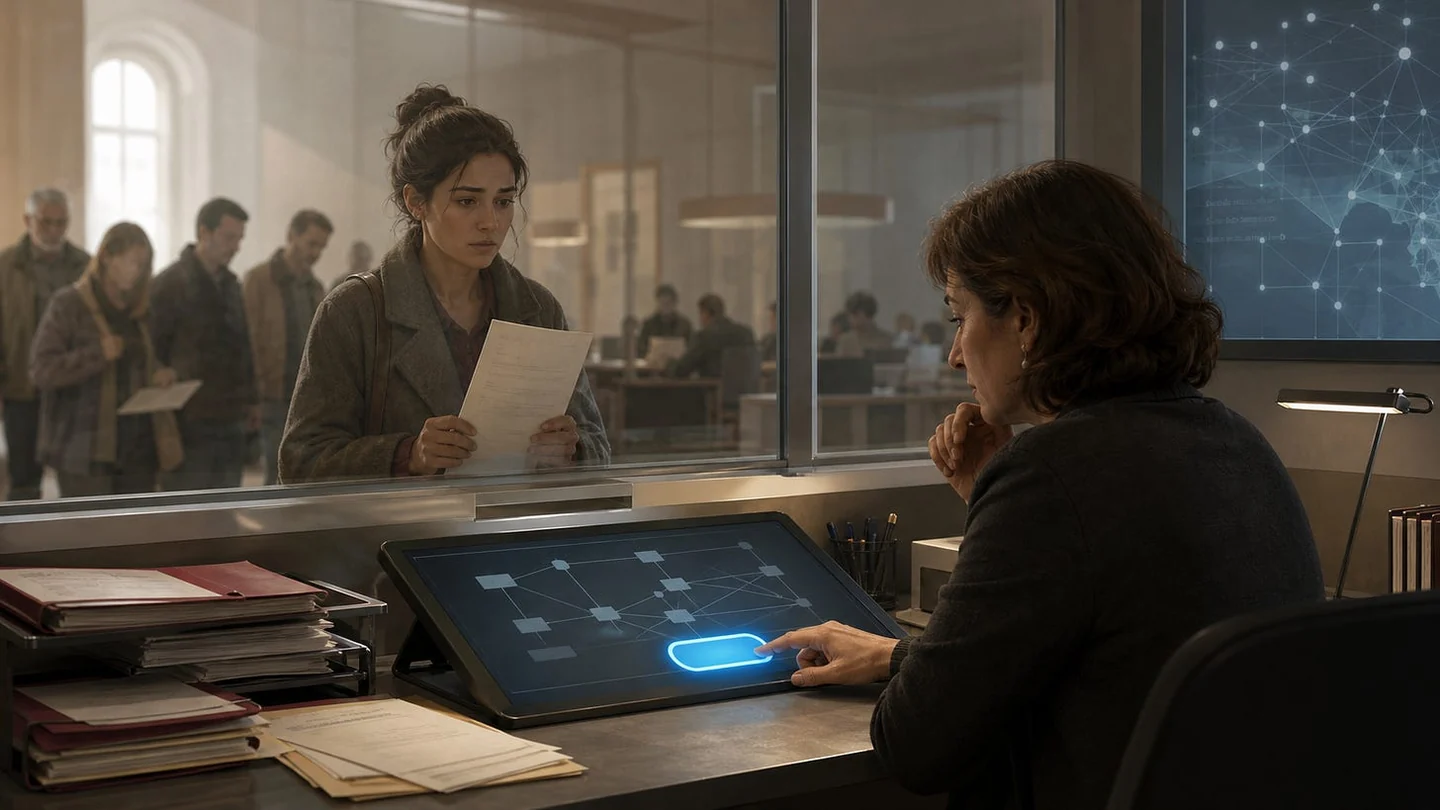
Original illustration accompanying the fiction. A woman waits with a printed decision while an officer considers a glowing blue button; other applicants queue behind her. The tiny decorative document and interface text is not reliably legible and is not reconstructed.
A woman was holding a printed decision. She looked a little over thirty and had kept her coat buttoned despite the heat in the office.
“They told me you had reviewed it.”
Elena looked at the heading. Samira Haddad. Municipal emergency rent assistance. Refused.
“If you have an appointment, they will see you downstairs.”
“The first one available is in nine days. The rent for the room where my children and I are staying is due on Friday.”
In the margin, Samira had written down three cleaning shifts, the landlord's telephone number and a calculation: 180 euros minus 22 for the bus.
Elena opened the case file. Ágora displayed an impeccable explanation: the applicant owned a small share of a house in Villaseca; the municipal by-law excluded anyone with another habitable property; the report declaring that house uninhabitable had passed its expiry date.
“The house belonged to my grandfather,” Samira said. “It has no roof.”
Elena opened the document. Photographs of damp walls, broken beams and sky where there should have been tiles. The technical certificate was dated seven months earlier. The protocol allowed six.
Ágora had made no mistake.
“You need a new report.”
“It costs money I haven't got. And it takes two weeks.”
The explanation supplied every link: the cadastral register, the by-law, the certificate, the calculation. Elena had spent half her life looking for documents that now appeared in seconds. This was precisely what they had asked for over so many years.
She remembered the folders piled up before Ágora, and the winter when a grant arrived after the eviction it was meant to prevent. The system had not erased people: Elena could once again listen to whole stories without staring at a mountain of forms.
Then she saw a line at the bottom:
Human review completed: Elena Martín. Review time: 11 seconds.
She remembered the previous afternoon. She had opened an alert, read “alternative property verified” and moved on through the batch. Eleven seconds were enough for the system to consider the safeguard fulfilled.
The interface was not lying. She had accessed the file, and her identification had been recorded. What it did not record was the mountain of decisions still waiting for her.
“I didn't review this,” she said.
“It says here that you did.”
The head of service appeared behind the partition. She looked at Samira, then at Elena's clock.
“We can initiate the standard appeal,” she said. “In the meantime, sign the batch. There are more than four hundred families waiting.”
“A hundred and twelve are refusals.”
“And three hundred and seventy-four are grants. If you block the batch, they won't be paid either.”
The head of service did not raise her voice. Since Ágora had been introduced, complaints about delays had fallen and the team was handling twice as many cases with three posts vacant. Elena knew those figures. She also knew how long a manual review would take.
On the screen, the blue button was still waiting.
“Let's separate out the refusals based on property ownership,” Elena said.
“The batch is already sealed for audit,” said her manager. “If we split it, we have to cancel the audit trail and generate it again.”
“Then I'll send the whole batch back.”
“Elena.”
“My name is on a hundred and twelve decisions I haven't read.”
Samira folded the paper carefully, as though she feared breaking something more than the sheet.
“I don't want anyone to miss their payment because of me,” she said. “I just don't want you to put your name on it if you haven't looked.”
Elena opened the incident menu. Ágora asked for a reason, a scope and a responsible person. She selected insufficient oversight, marked the cases involving alternative property and activated an urgent review for Samira. The interface warned of delays, possible duplication and deteriorating service indicators.
“Confirm return?” the neutral voice asked.
The head of service looked at the queue forming on the other side of the glass.
“Tomorrow everyone who hasn't been paid will be here.”
“Tomorrow we will be able to tell them who made the decision.”
Elena confirmed.
The blue button disappeared. Two red lines replaced it: Batch halted. Human review requested. The screen calculated that reviewing every case with the available staff would take several days. On one grant already approved, the payment date changed from tomorrow to pending renewed validation.
Samira opened her mouth to ask whether this meant she would receive the assistance.
“It means someone will have to look at your house,” Elena said.
The decisions were still pending on the counter. Beneath the review request appeared a space for two signatures. The head of service stood motionless for a few seconds, then brought her card up to the screen.
Elena read the whole document before adding her own signature. When she finished, Samira was still waiting, the queue had reached the corridor, and Ágora had begun another countdown.
After the fiction
This story imagines public administration in 2032 made much faster by agents able to cross-reference registers, check eligibility and prepare decisions. That level of integration still belongs to speculative fiction, but the dilemma is already unfolding: public administrations are beginning to automate tasks that directly affect rights, benefits and opportunities.
The decisive question is not simply whether the system gets it right. Ágora applies a rule correctly and can nevertheless produce an unjust decision because the real case is trapped within an administrative category. Nor is it enough to place a person at the end of the process if their intervention consists of opening an alert, looking at a label and confirming a batch.
Yet reviewing every case manually would also have costs. Delays would return, urgent assistance would be held up, and many people would receive too late what they need now. An institutional safeguard does not require us to set automation against humanity. It requires thresholds, review rights and sufficient time for oversight, so that a signature can change the outcome. A human signature protects people only when it is not used to conceal the fact that nobody has looked.
Director of Digital Innovation at ALEPH Educational Institution and editor of the estrategIA newsletter.
Cite this essay
Fernando Nieto Lobato. “The final signature.” estrategIA, issue 144, 1 July 2026. English edition, 29 September 2026. https://elcontemplador.github.io/estrategia-english/essays/144/