“I am making an urgent request for you to act tonight” (translated from the Spanish source). Last Wednesday, 21 October, Japan's Prime Minister, Sanae Takaichi, used X to warn of two serious security flaws in PHP, a technology that powers many of the websites we visit. She called for preparations to update it immediately and said that, where this could not be done promptly, temporarily taking websites offline was one way to reduce the risk.
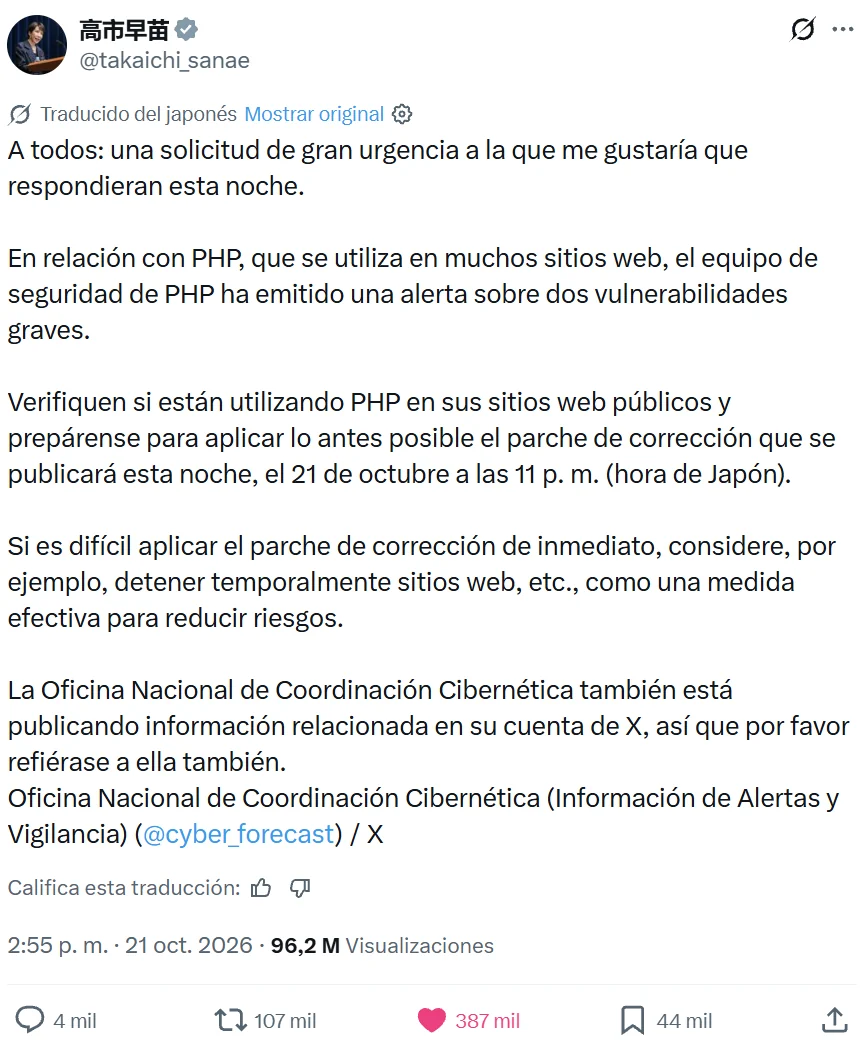
English translation of the Spanish text in the screenshot — Sanae Takaichi, 21 October 2026:
To everyone: a very urgent request that I would like you to respond to tonight.
Regarding PHP, which is used on many websites, the PHP security team has issued an alert about two serious vulnerabilities.
Check whether you are using PHP on your public websites and prepare to apply, as soon as possible, the patch that will be released tonight, 21 October, at 11 p.m. Japan time.
If it is difficult to apply the patch immediately, consider, for example, temporarily shutting down websites as an effective measure to reduce risk.
The National Cybersecurity Coordination Office is also publishing related information on its X account, so please refer to that as well.
National Cybersecurity Coordination Office (Alert and Monitoring Information), @cyber_forecast / X.
A head of government explaining to those responsible for websites what they needed to do that night. There is a political lesson in that scene: the security of everyday services can depend on decisions that must be taken within hours, with incomplete information and consequences reaching far beyond IT departments.
In August, some two months before the alert, AI helped discover those serious flaws in PHP and demonstrate their impact. These problems had been there for years, without their danger being fully understood. Researchers and those responsible for PHP had been working since then on an update to fix them. That is the opportunity: finding threats in time to prevent their consequences.
When the problem became public, the fix was already ready, but it had to be installed on every system. As organisations rushed to protect themselves, Cloudflare recorded tens of thousands of attempted attacks in the 45 minutes following the announcement. That does not show that the attackers succeeded in gaining access, but it does show how quickly action was needed. Having a solution available was not enough: it had to be applied in time.
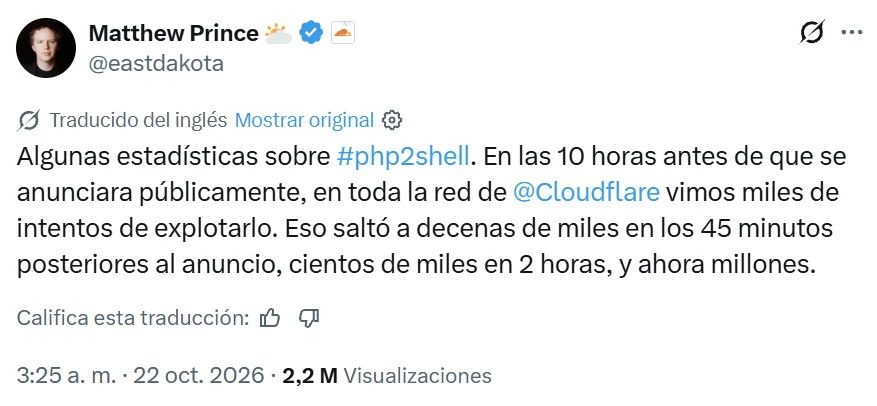
English translation of the Spanish text in the screenshot — Matthew Prince, 22 October 2026:
Some statistics on #php2shell. In the 10 hours before it was publicly announced, we saw thousands of attempts to exploit it across the @Cloudflare network. That jumped to tens of thousands in the 45 minutes after the announcement, hundreds of thousands in 2 hours, and now millions.
The same AI that helps us find and fix a flaw can make it easier for someone to exploit it in an attack. We do not know whether AI was used in those attempts. We can see, however, that the advantage of detecting a problem earlier can be lost if we respond too late.
In estrategIA, we have discussed governing in the fog. Here, that idea acquires a concrete measure: the minutes between an alert and a decision. Artificial intelligence is dramatically compressing the timescales of a great many processes: tasks that once required months can now be completed in days or minutes… Governments need to know which services may be affected and who is responsible for them. From there, they need teams able to assess what is happening, decision-makers with authority and rehearsed procedures for intervening within hours. Acting quickly requires the ability to review and explain decisions afterwards. That capacity is prepared before the emergency.
Such preparation also requires supporting those who maintain the technologies we depend on. On 23 October, the director of the PHP Foundation told Reuters that the organisation had just one full-time employee and fourteen external professionals, most of them working part-time, and warned that it was underfunded. AI can help discover flaws, but fixing them still requires people, expertise and resources.
Improving prevention also requires a budget to procure access to frontier AI — the most capable models available — and professionals who know how to use it and check its results. Its value is measured in flaws detected and fixed, effective protection and response times. Sharing teams and tools would allow them to reach smaller public administrations that could hardly sustain them on their own. It is also advisable to retain enough public sector capacity to assess suppliers and switch tools: protecting ourselves should not force us to depend on a single company. Waiting for the next alert before starting to procure cybersecurity or advanced maintenance gives the adversary a clear advantage.
Preparation also means looking beyond this crisis. On 22 October, Jason Clinton, Anthropic's deputy head of cybersecurity, warned that the situation would get worse before it improved and called on boards to support their technical departments in strengthening basic security. His forecast that the next eighteen months will be difficult is not a guaranteed timeframe. For governments, anticipating such scenarios makes it possible to rehearse responses, prepare teams and secure resources before urgency forces them to improvise, or even to go out in the middle of the night to call for an urgent response or for websites to be taken offline.
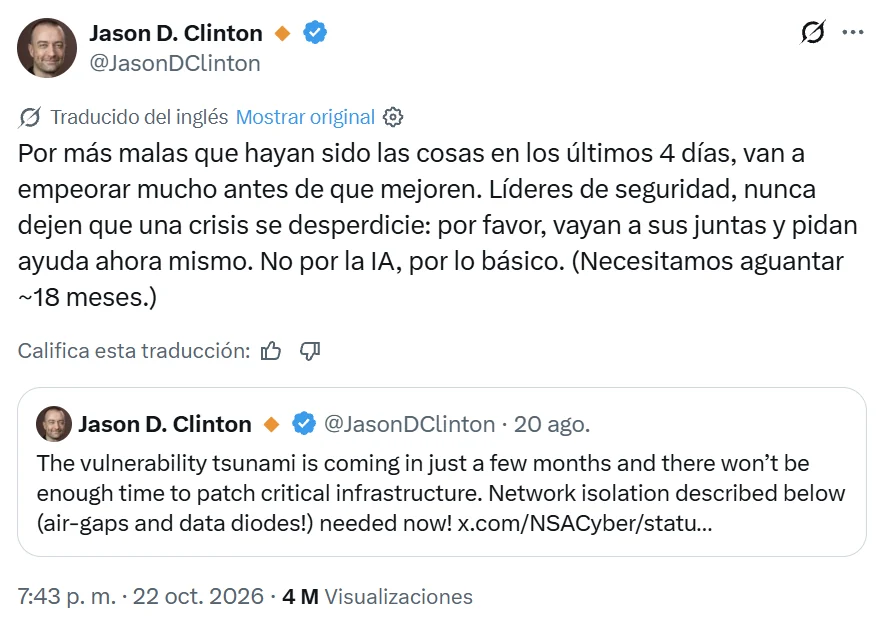
English translation of the Spanish text in the screenshot — Jason D. Clinton, 22 October 2026:
However bad things have been over the last 4 days, they are going to get much worse before they get better. Security leaders, never let a crisis go to waste: please go to your boards and ask for help right now. Not for AI, but for the basics. (We need to hold out for ~18 months.)
Earlier post of 20 August, transcribed from the English text visible in the same screenshot:
The vulnerability tsunami is coming in just a few months and there won’t be enough time to patch critical infrastructure. Network isolation described below (air-gaps and data diodes!) needed now! x.com/NSACyber/statu...
Accountability, including that of a government or public administration, must cover those times: how long it takes to identify services at risk, protect them and check that the fix works. A cybersecurity strategy needs to demonstrate that it can be translated into decisions and action when the alert arrives.
Prime Minister Takaichi's request had a deadline: that night. To be able to respond then, someone must already have decided who will act, with what resources and with what authority. It is essential to prepare now for what may come in the months ahead. The consequences of being late can be very concrete: doctors unable to access the prescription system, citizens unable to access their bank, or attacks that interrupt the electricity supply. These are scenarios that governments must consider and for which they need to prepare responses before they become an emergency. That, too, is the work of governing.
Director of Digital Innovation at Institución Educativa ALEPH and director of the estrategIA newsletter.
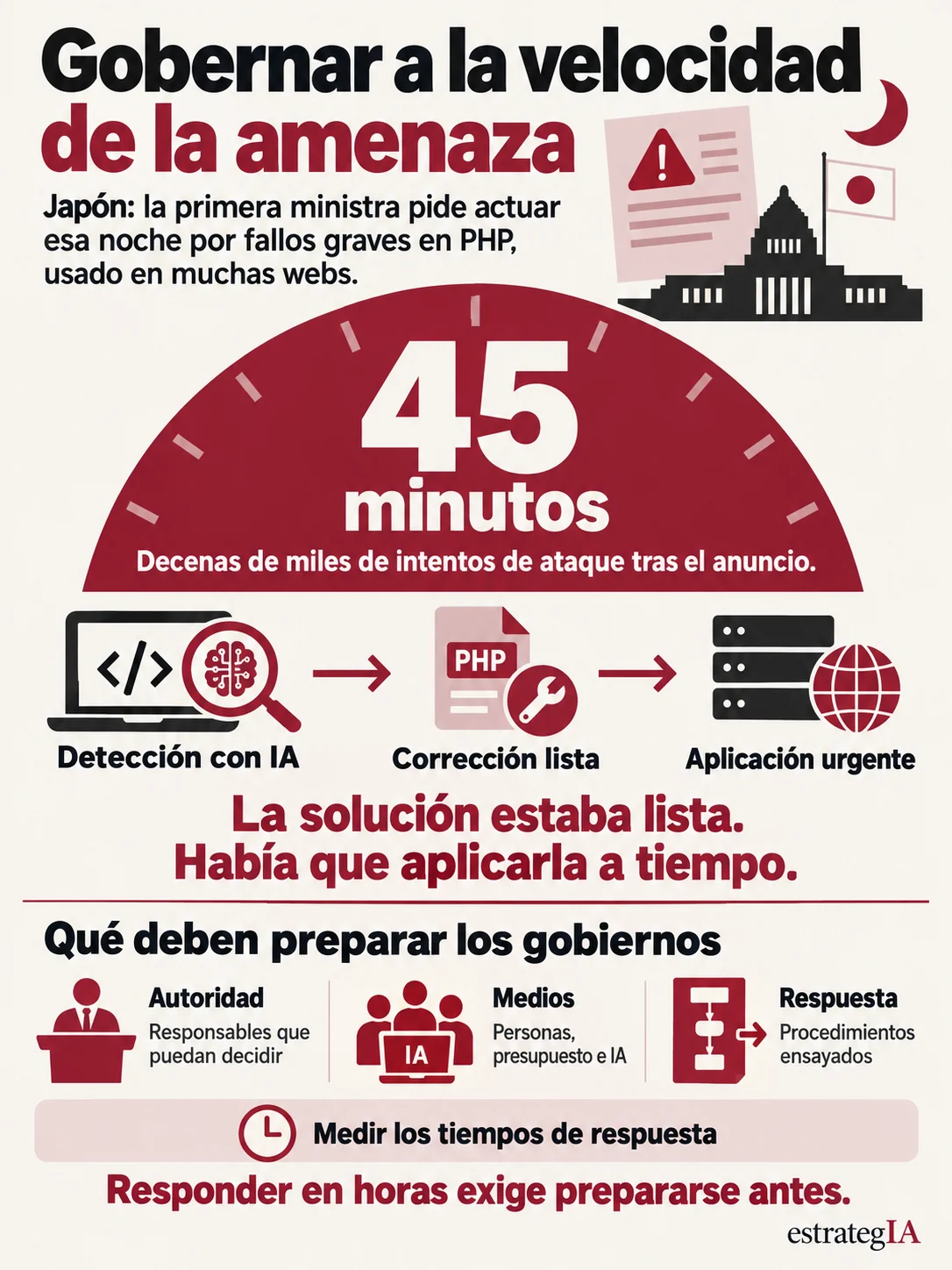
English transcription of the infographic:
Governing at the speed of the threat. Japan: the Prime Minister calls for action that night over serious flaws in PHP, used on many websites.
45 minutes. Tens of thousands of attempted attacks after the announcement.
Detection with AI → Fix ready → Urgent deployment.
The solution was ready. It had to be applied in time.
What governments need to prepare:
- Authority: people responsible who can make decisions.
- Resources: people, budget and AI.
- Response: rehearsed procedures.
Measure response times. Responding within hours requires preparing beforehand.
estrategIA.
Cite this essay
Fernando Nieto Lobato. “Governing at the speed of the threat.” estrategIA, issue 161, 28 October 2026. English edition, 29 October 2026. https://elcontemplador.github.io/estrategia-english/essays/161/