Archive note: these scenarios and judgements retain the perspective of 15 April 2026. Time horizons such as “the next two or three years” refer to that publication date.
What will the world of artificial intelligence look like in four years' time? Nobody knows for certain, but the question matters too much for us simply to shrug. What we now call artificial intelligence is no longer the friendly chatbot that surprised us at the end of 2022. It has become a force that reorganises industries, transforms professions and redefines the balance of power between countries. Anticipating where it is heading is no academic exercise: it is a practical necessity for anyone who wants to make informed decisions about their career, their business or their country.
Over recent weeks, for several important projects, I have carried out intensive foresight work, cross-referencing technical, economic and geopolitical sources to try to map the most likely scenarios between now and 2030. We want to share the essentials of that exercise in a very condensed form. Rather than betting on a single forecast — the familiar categorical prediction that rarely comes true — we have followed the OECD's recommendation to work with several plausible scenarios at once. The result is three possible futures. Three worlds with logics of their own, representing branching paths rather than an inevitable staircase.
Plateau — AI as electricity: everywhere, but no better at thinking
The first scenario — probably the least plausible in the light of recent advances — envisages no major qualitative leap in artificial intelligence between now and 2030, but its becoming ubiquitous. Models will not be radically more intelligent than today's, but they will be vastly cheaper and embedded in almost everything: from the software we use at work to public administration procedures and the management of a small or medium-sized business.
Think of how electricity changed factories in the early twentieth century. Production was revolutionised not by a new invention, but by energy becoming so cheap and ubiquitous that it reorganised everything else. The same could happen with AI: it does not need to become smarter to change the world profoundly; becoming cheaper and easier to use would be enough.
The subtler risk in this scenario would be complacency: believing that, because no superintelligence has arrived, there is no urgency. Meanwhile, whoever controls the infrastructure — data centres, chips and platforms — will capture most of the value others generate. As we have been reporting in estrategIA, this is already happening.
Ascent — the machine that sustains work: more intelligent, more autonomous, more disruptive
The second scenario — the one we consider most likely — is considerably more unsettling. Here, AI improves substantially and cumulatively in reasoning, the ability to act independently and mastery of multiple formats. The arrival of the much-discussed AGI — artificial intelligence capable of matching human beings in everything — is not declared before 2030, but the automation of intellectual work becomes broad and deep.
The crucial change is that systems move from assisting with tasks lasting minutes to sustaining complete workflows for days or weeks with little human supervision. The question stops being “Can AI write a good report?” and becomes “Can it carry out an entire audit, a legal process or the complete development of a computer program?”
Regular readers know this is one of the issues that concerns us most: the growing pressure on entry-level positions in professions such as law, finance, consultancy and programming. The routine tasks that historically helped train younger people are precisely the first to be automated. In this scenario, the risk is not mass unemployment overnight, but something more insidious: an economy that produces more with fewer people, in which wealth is concentrated among those who own the models and infrastructure, while the traditional mechanisms that distribute prosperity today — employment, wages and social security contributions — erode without anyone having replaced them. As we said in our requests at the beginning of the year, politicians cannot keep governing for the next election when we face a technology that will transform the world for the next generations.
Take-off — the unexpected leap: AGI and superintelligence before 2030
The third scenario is perhaps less likely than the second, but it also has the most profound consequences. We are not talking here about AI improving AI research: as several major laboratories have already reported, that is beginning to happen. We are talking about something qualitatively different: artificial intelligence at or above human level in practically every relevant field — known as AGI — emerging before 2030, and that capability rapidly developing into artificial superintelligence, or ASI, far surpassing human beings. A large part of the scientific community believes this will happen in the coming decades, but not so soon: not within the next three or four years.
This scenario branches into two very different paths. If the technology is developed with effective controls and international governance, we could witness an era of unprecedented scientific abundance: accelerated advances in medicine, energy and new materials. But if, as many of us fear, competition between companies and powers drives the deployment of increasingly powerful systems without the necessary safeguards, with policymakers taking the wrong measures towards a technology they do not understand, the consequences could be serious and unpredictable. Shortages of advanced chips and limits on electricity generation currently act as natural brakes. Yet we should not place too much faith in their continuing to be enough to slow a technology whose principal distinguishing feature is its ability to improve itself.
Preparing for uncertainty
Our analysis leads to a clear conclusion: the likeliest outcome is neither that the world comes to a halt nor that it becomes unrecognisable, but that, in the short term, we enter an era of uneven acceleration. Some countries, companies and individuals will advance far faster than others. That gap will depend not only on the technology, but on who has the infrastructure, energy, education and strategic vision to make use of it.
The window for taking the decisions that will define our position is narrow: the next two or three years will be critical. The task is not to guess which of these three worlds we will inhabit, but to develop the capacity to act effectively in any of them. The real risk is not choosing the wrong scenario, but preparing for only one — or not preparing at all.
Director of Digital Innovation at Institución Educativa ALEPH and editor of the estrategIA newsletter
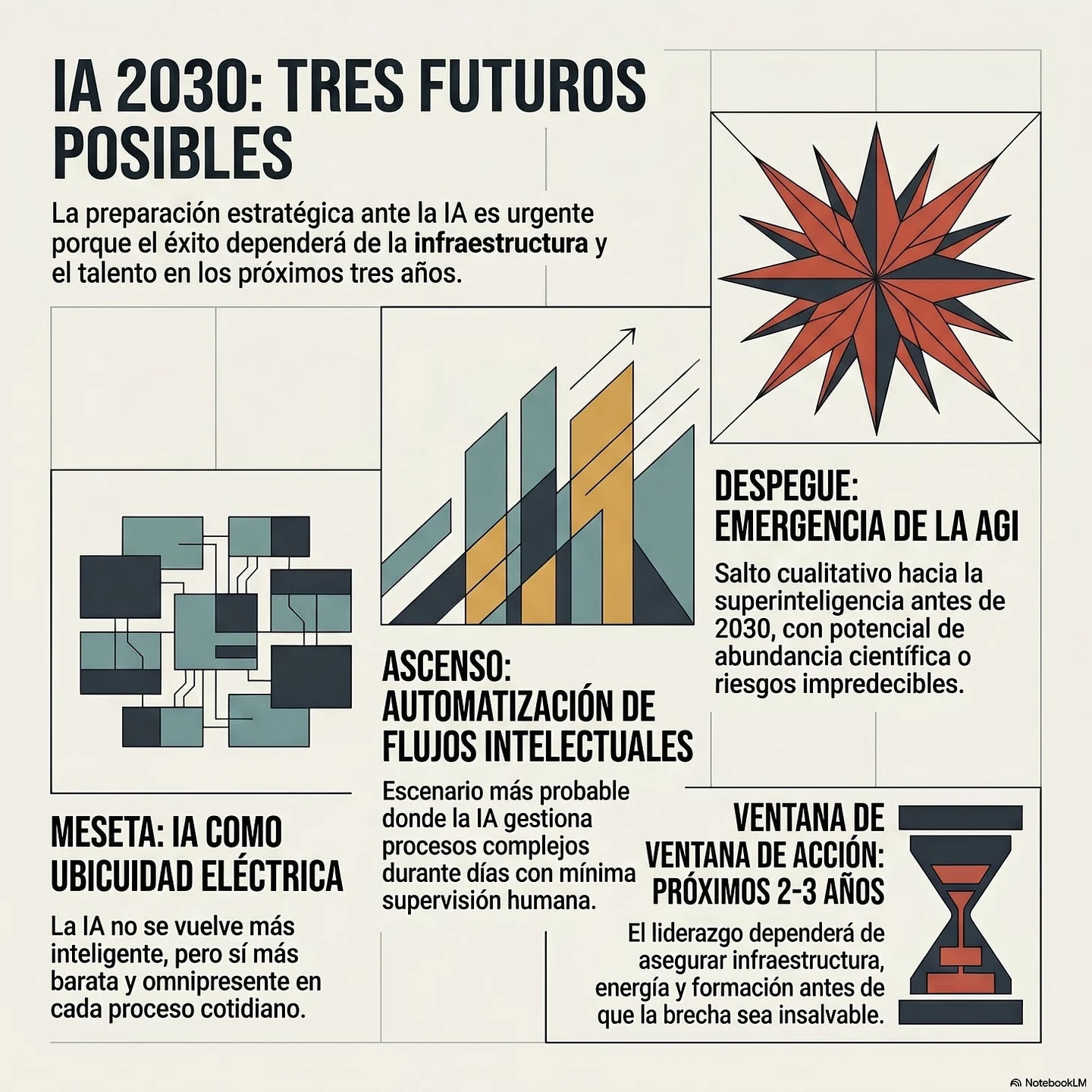
English translation of the infographic's text:
AI 2030: three possible futures. Strategic preparation for AI is urgent because success will depend on infrastructure and talent over the next three years.
- Plateau: AI as ubiquitous as electricity. AI does not become more intelligent, but does become cheaper and omnipresent in every everyday process.
- Ascent: automation of intellectual workflows. The most likely scenario, in which AI manages complex processes for days with minimal human supervision.
- Take-off: the emergence of AGI. A qualitative leap towards superintelligence before 2030, with the potential for scientific abundance or unpredictable risks.
- Window for action: the next two to three years. Leadership will depend on securing infrastructure, energy and education before the gap becomes insurmountable.
The original graphic repeats the start of its final heading (“Window for / Window for action”). Credit: NotebookLM.
Cite this essay
Fernando Nieto Lobato. “Three possible futures for artificial intelligence in 2030.” estrategIA, issue 133, 15 April 2026. English edition, 29 September 2026. https://elcontemplador.github.io/estrategia-english/essays/133/