Last Thursday, 8 October, the State of AI Report 2026, produced by Nathan Benaich and Air Street Capital, was published. It has become an annual fixture in estrategIA, where we analysed the 2024 and 2025 editions. Its 244 pages cover research, industry, politics and safety, bringing together developments that usually reach us separately. As every year, we recommend reading it, or at least taking a look through it (it is a highly visual report); here we will focus on five key lessons and what deserves close attention.
The comparison between editions is revealing. In 2024 we highlighted expanding capabilities; in 2025, the leap from reasoning to action. This year, something that could accelerate everything else is gaining momentum: AI's involvement in scientific research and in the development of better artificial intelligence.
1. Models are outgrowing the tests used to assess them
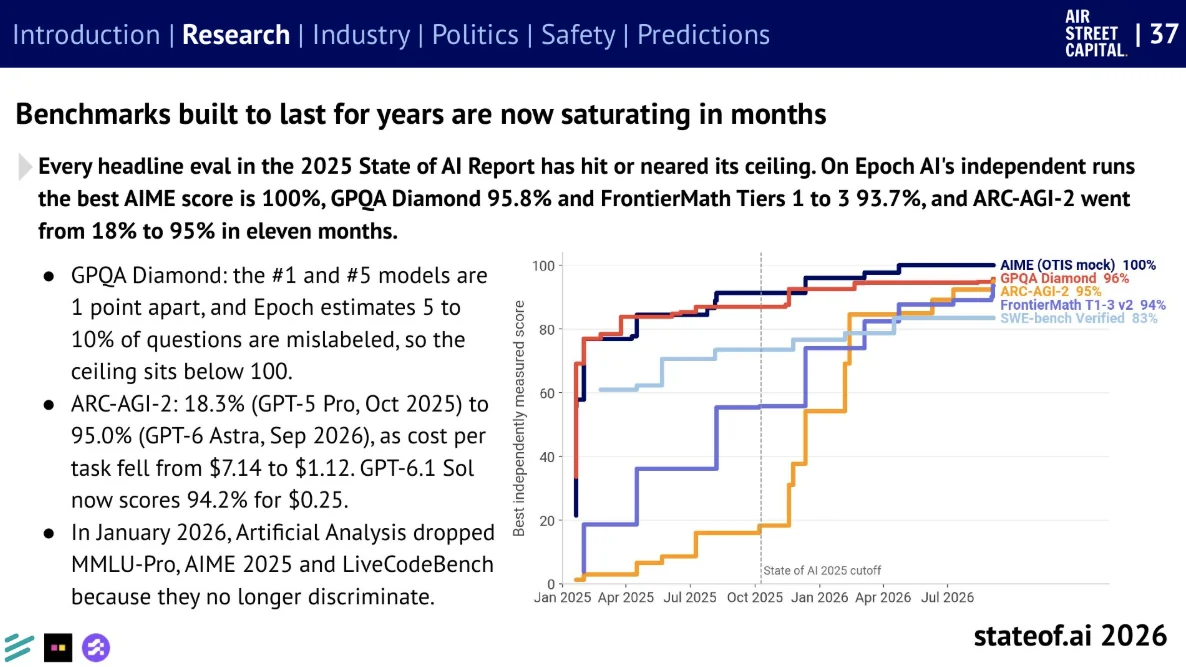
Across the 120 tasks in ARC-AGI-2's semi-private evaluation set, which require systems to infer rules and solve new visual problems, performance rose from GPT-5 Pro's 18.3% to GPT-6 Astra's 95%, verified by ARC Prize, in eleven months. The report puts the cost of the latter run at $1.12 per task. The test is approaching its ceiling: we need more demanding evaluations and to check what can be achieved beyond the test itself, because many benchmarks are already saturated or close to their ceiling and are becoming less able to distinguish improvements in capability.
Research already offers examples. The mathematical results shared by OpenAI on 6 October include contributions to open problems, with some proofs formally verified. In biology, the report describes models that design proteins and select candidates for laboratory testing; in robotics, systems that learn new tasks from demonstrations.
2. AI is beginning to accelerate its own development
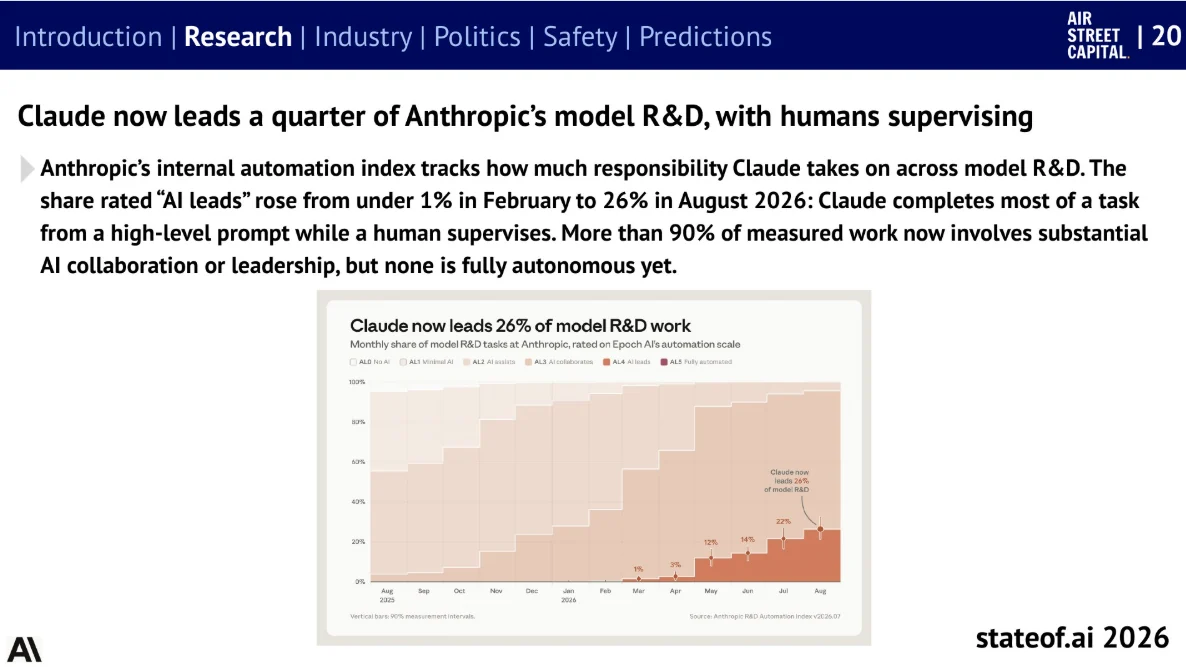
AI is also already involved, as we discussed in last week's issue, in creating its successors. According to Anthropic's index, in August Claude could complete most of a task, from general instructions and with human supervision, in 26% of the research and development work assessed. In February, that category accounted for less than 1%. This is the company's own measurement, which should be independently checked. It gives concrete form to the mechanism we have been following: better research tools can accelerate the creation of even better tools. Our reading is that we are seeing the first steps towards recursive self-improvement, or RSI, still with human involvement.
3. Achieving the same capability keeps getting cheaper
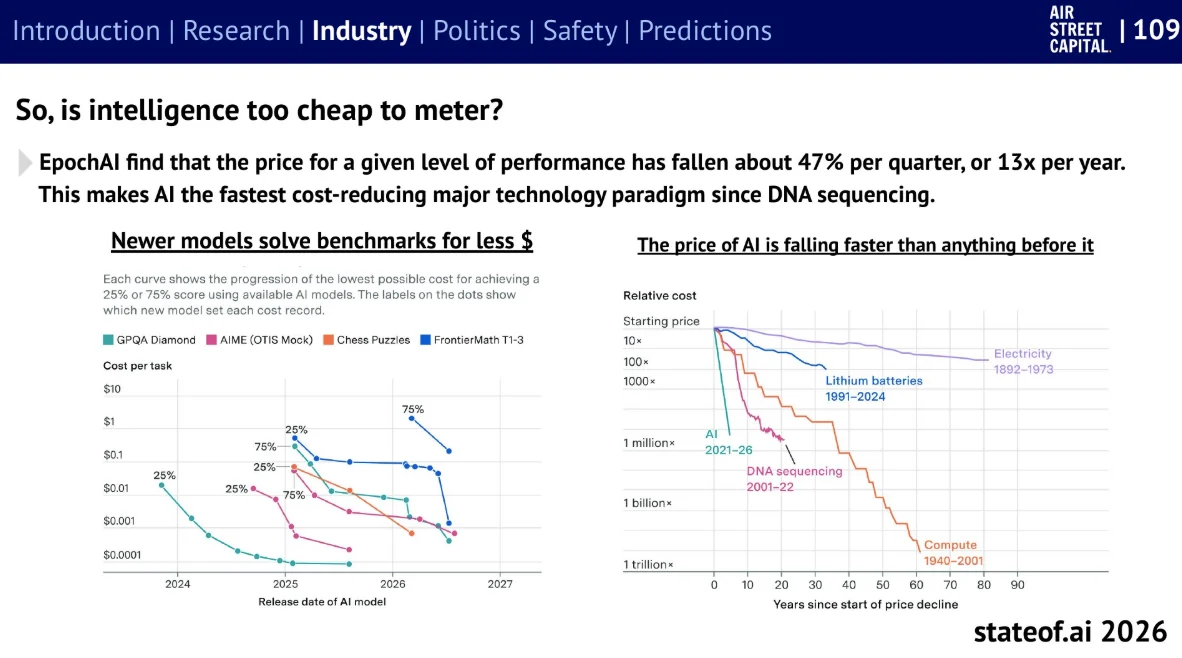
Epoch AI estimates that achieving the same performance across the five benchmarks studied became around 47% cheaper per quarter from 2023 onwards: a fall equivalent to a thirteenfold reduction in cost over a year. This is the cost of using the models, not the cost of an entire implementation. Even with that distinction, the finding considerably expands the possibilities for using them.
Paradoxically, this fall in costs could increase overall spending on AI, in line with the familiar Jevons paradox: when a technology becomes more efficient and cheaper, its total consumption can grow as its applications multiply. In AI's case, especially with the proliferation of autonomous agents, we could need ever more computing capacity even as each equivalent task becomes much cheaper.
This trend also does not prevent some companies from raising their prices or reducing their services' usage limits. One recent example is OpenAI, which has announced a reduction in the ChatGPT Work and Codex usage limits included in its $200-a-month Pro subscription (the one we use), while keeping the price unchanged. These commercial decisions, possibly linked to the profitability of its subscriptions, do not contradict the underlying trend: achieving the same level of AI capability keeps getting cheaper, although that does not always translate into better terms for users.
4. Governments are seeking their own capacity, with wide disparities
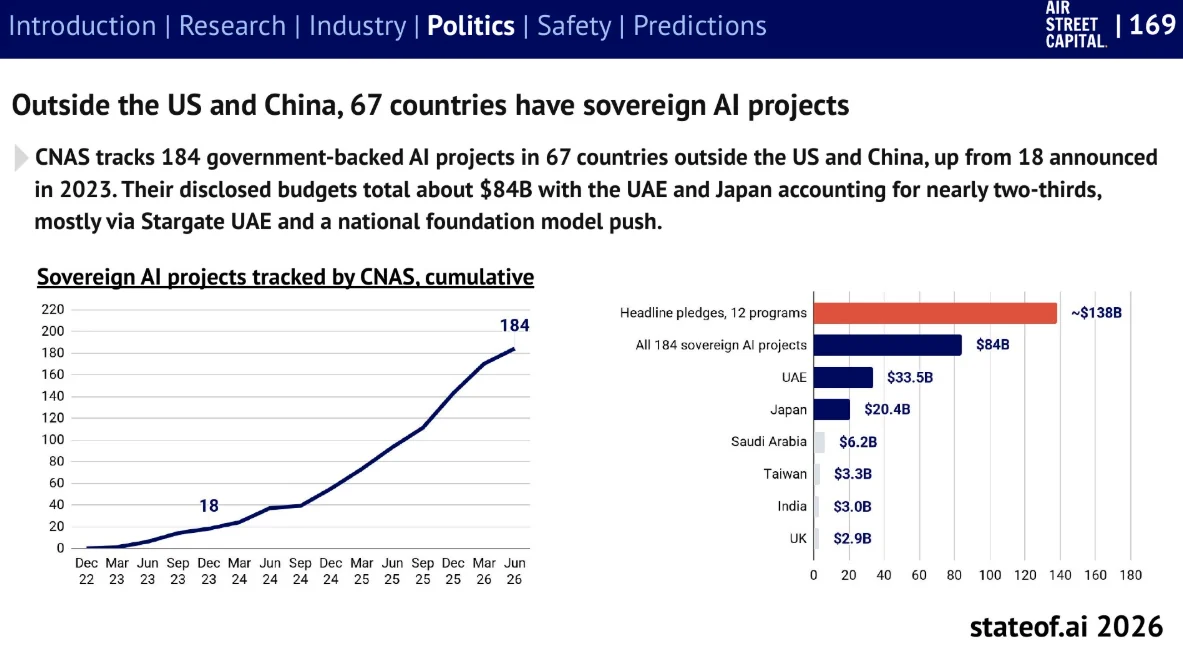
The inventory compiled by the Center for a New American Security, CNAS, and cited in State of AI 2026 rises from 18 government-backed AI projects at the end of 2023 to 184 in June 2026, spread across 67 countries outside the United States and China (which remain far ahead of any competitor). Their stated budgets total around $84 billion, although the United Arab Emirates and Japan account for almost two-thirds. In Europe, the EU plans up to seven gigafactories, with selection in early 2027 and operations expected to begin within the following 18 months. The report places that target around mid-2028. These projects are at different stages; announced budgets do not yet amount to operational capacity.
5. AGI now features among the predictions for 2027
The report ends with nine predictions for the next twelve months. Some spell out how far the transformation could go: an autonomous AI team would outperform a human-led research team in developing models, with the same time and computing resources, while setting its own research agenda. Another anticipates that a US state will require companies to accept cancellations and complaints submitted by AI agents on consumers' behalf.
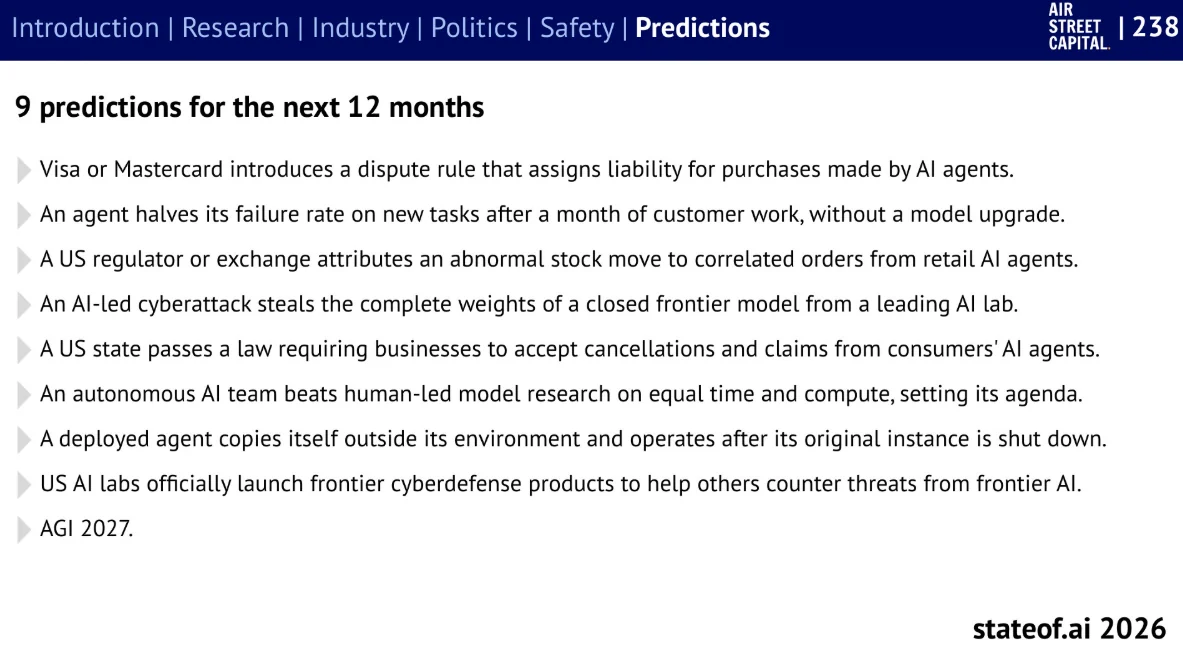
The last prediction says, verbatim, “AGI 2027”: artificial general intelligence next year, something that does not surprise us at estrategIA, where we follow this technology's development closely, week after week. It remains a prediction, and what would count as its fulfilment has yet to be defined. But, read alongside the advances in capability, the beginnings of recursive self-improvement and the falling costs documented in the report, it explains why that horizon deserves to be taken seriously. We have spent three years reporting on how artificial intelligence is accelerating. We have ever more reasons to think that the truly extraordinary is still to come. And ever less time to prepare.
Director of Digital Innovation at Institución Educativa ALEPH and director of the estrategIA newsletter.
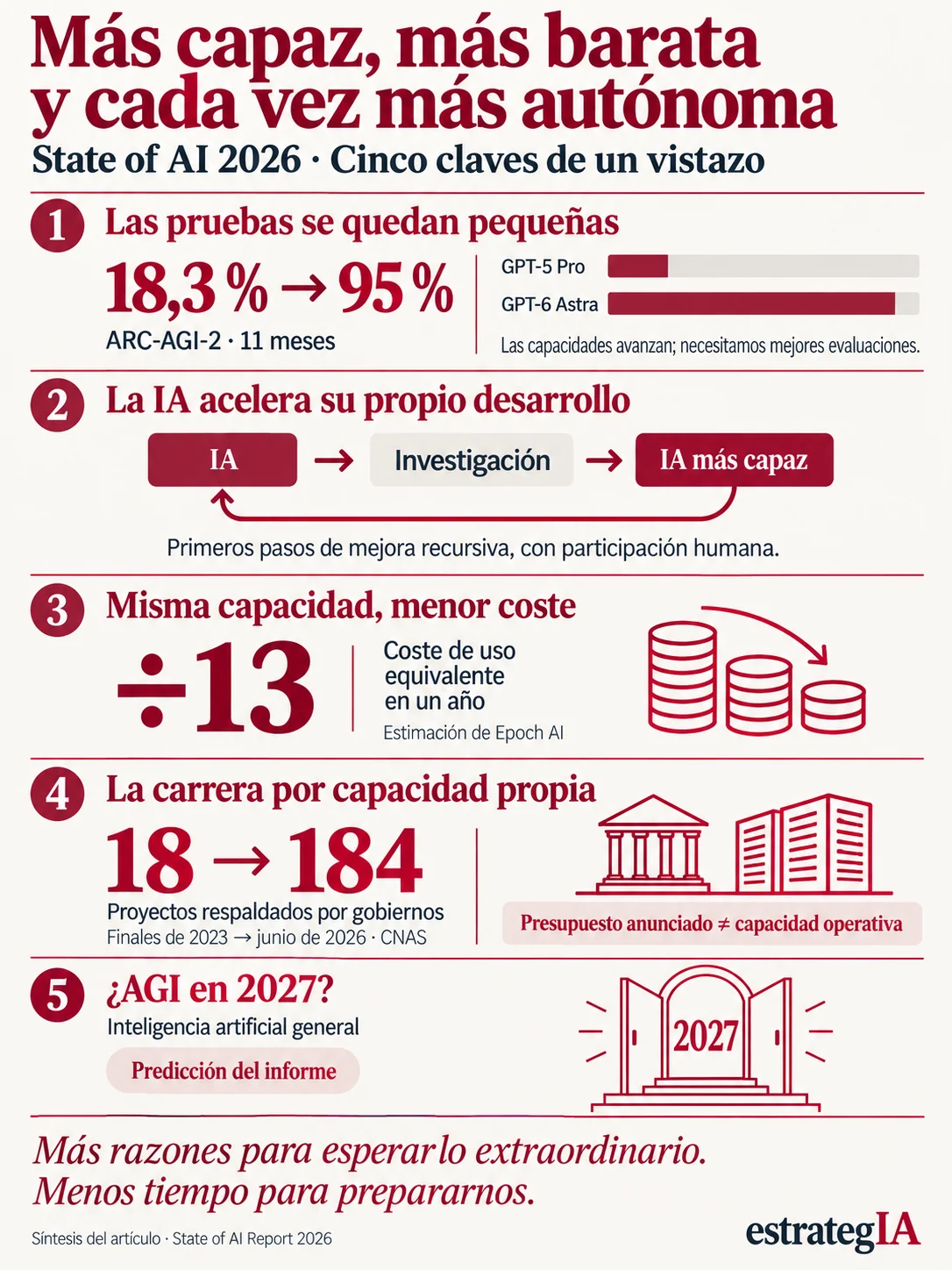
English transcription of the Spanish infographic
More capable, cheaper and increasingly autonomous. State of AI 2026: five key points at a glance.
- The tests are becoming too small. ARC-AGI-2: 18.3% → 95% in eleven months, from GPT-5 Pro to GPT-6 Astra. Capabilities are advancing; we need better evaluations.
- AI accelerates its own development. AI → research → more capable AI, feeding back into the cycle. First steps towards recursive self-improvement, with human involvement.
- The same capability, at lower cost. Equivalent usage cost divided by thirteen in one year. Epoch AI estimate.
- The race for domestic capacity. Government-backed projects: 18 → 184, from the end of 2023 to June 2026. CNAS. Announced budget ≠ operational capacity.
- AGI in 2027? Artificial general intelligence. A prediction made by the report.
More reasons to expect the extraordinary. Less time to prepare.
Article summary · State of AI Report 2026 · estrategIA.
Cite this essay
Fernando Nieto Lobato. “More capable, cheaper and increasingly autonomous: five lessons from a year that is accelerating everything.” estrategIA, issue 159, 14 October 2026. English edition, 15 October 2026. https://elcontemplador.github.io/estrategia-english/essays/159/