This week we continue our summer historIAs: fictional stories exploring some of the political and human dilemmas artificial intelligence may pose in an increasingly near future.
This time we turn to a key question: artificial intelligence as public infrastructure. Hospitals, emergency services, transport, water, energy and citizen services could one day depend on limited, vulnerable computing capacity. But what happens when there are not enough resources to keep every service running? “Zero compute” imagines a climate emergency in which an apparently technical decision forces us to define what we truly consider essential. It reminds us that resilience depends not only on having powerful systems, but also on preserving alternatives, redundancy and local capacity.
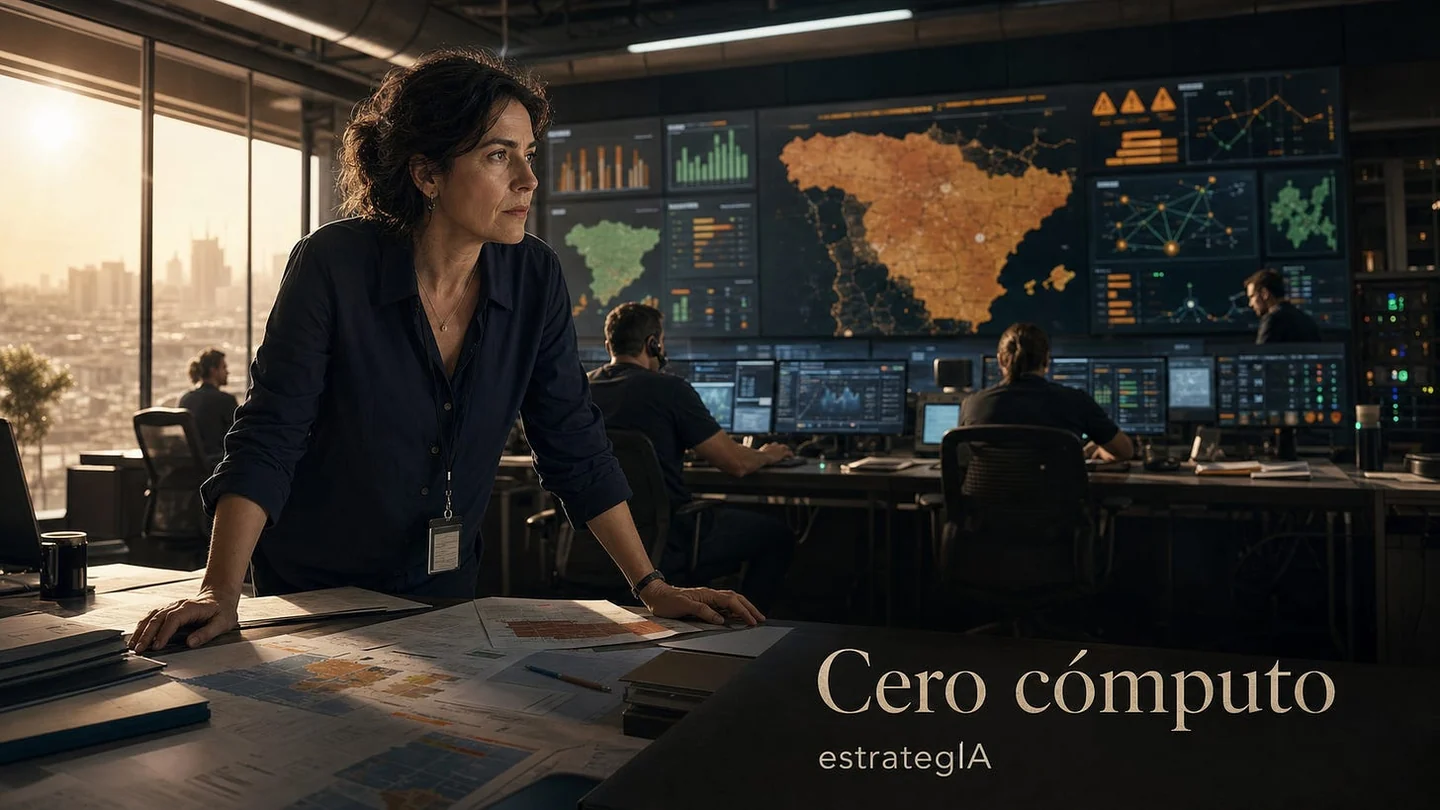
Original illustration titled “Zero compute”. A coordinator stands before a map of Spain and monitoring panels during the fictional emergency. The small dashboard and document markings do not provide reliably readable figures or labels; none are reconstructed.
At 16.12, the map at the National Public Computing Centre lost two regions and turned amber.
The Centre had been created so that hospitals, courts, councils and social services would not depend on a different private provider in every emergency. In reports it appeared as a federated public cloud. In the room, it was heat, cables and decisions that would not fit in a spreadsheet.
“Substation out of service,” someone said. “The northern centre is reducing its load because of cooling.”
Nuria Alarcón watched available capacity fall while requests kept arriving. Hospitals. Fires. Water network. Railways. Laboratories. Courts. Ágora.
Outside, the thermometer had been above forty degrees for three days. Inside, the air conditioning seemed to be running on pride.
“Activate priority one,” she ordered.
The panel asked her to define it.
In both drills, every ministry had declared its systems essential, and the discussion had been postponed: decide according to the emergency. Now there was heat, electricity, fire, health and water. There was no column for that.
Nuria protected the hospital models, fire prediction and the agents balancing water and electricity. She suspended research, non-urgent administrative work and public-content generation. More cuts were still needed.
The Ágora–Citizen Services line consumed a considerable share.
Nuria checked the switchboards' capacity. The indicator said they could absorb the diversion. She checked once more before closing the window.
“Switch it to telephone mode,” she said. “You don't need to wake up the most powerful model to ask where a heat refuge is.”
The bar turned green again.
For seven minutes, it seemed a good decision.
Then the emergency service called.
“Our switchboards are overloaded.”
“Bring in more operators.”
“They're all here already.”
Nuria listened to several calls. An operator was trying to locate Jamal, a man who gave his address only in Arabic and kept repeating the name of a closed pharmacy. On another line, a woman was asking about her accessible bus; nobody could find the booking. In the margin appeared four suspended functions: translation, available places, transport, easy-read information.
Nuria had begun her career on a municipal switchboard. She recognised the operator's pause: the instant when someone on the other end stops asking for help and begins apologising for not knowing how to ask.
Nuria opened the dependency diagram. The layer was classified as general assistance. Beneath it were connections nobody saw on the main screen.
A hospital manager interrupted on another line.
“Don't take capacity away from us. We're reallocating beds and prioritising tests.”
Then the fire service came through:
“The wind is changing. We need to keep the simulations running.”
At the central table, someone asked about the suspended industrial contracts. Nuria raised a hand. Penalties could wait; fire could not. She did not touch the hospital reserve either.
At 16.31, the refuges were still open, but information had fragmented. A bus arrived almost empty at a centre with places available. Several families were waiting outside a library that was full. Jamal appeared in a municipal traffic-camera image, walking south when the nearest refuge was north. A couple pushed a wheelchair to a sports centre and found the ramp closed for building work; the notice existed only in the suspended system.
“How much do we need to reactivate it?” Nuria asked.
The estimate would require cuts to hospitals or fire services. She looked at the panel again, as though a category might change its importance if she insisted.
A call came from Valdearenas. The municipal technician was speaking quickly.
“We have a local model for basic queries. It doesn't plan routes or read every case file, but it translates and works with the latest copy of the refuge list. If you give us a minimal data feed on available places, we can manage.”
“How many municipalities have something like that?”
“The ones that didn't dismantle their local equipment when Ágora arrived.”
There were not many.
The Centre opened a reduced data feed and disconnected secondary functions to keep it running. Municipal teams began loading copies onto computers in libraries, health centres and service points. The small models answered less well, were unaware of recent changes and referred too many queries to people. But they worked without waking the large central systems.
One district recovered translation and basic search. Another discovered that its local copy had not been updated for six months. In one council, they printed the refuge list and sent two local police officers to cross out the full ones by hand.
At 16.48, recovery followed the map of technological investment in earlier years: rapid in some places, almost non-existent in others.
National capacity slowly returned when a European reserve came online. The hospitals had suffered no loss of service. The simulations helped contain the fire before it reached two inhabited settlements. The water network held.
At 17.06, the system generated its first report:
Critical services interrupted: none.
Person responsible for allocation: Nuria Alarcón.
On the adjacent wall, the citizen-services counter showed thousands of calls waiting. Jamal's record finally appeared in translation at 17.09: he had reached a refuge, but not the one with medical places.
Nuria opened the priorities catalogue. She did not alter the report or search for a phrase to justify her choice. She added a new category below hospitals, fires and energy:
Critical social infrastructure. Definition pending.
Before saving, the system asked how much capacity should be reserved for it.
Nuria left the field blank.
After the fiction
Artificial intelligence is also material infrastructure: it depends on data centres, electricity, cooling, chips and networks. The story projects that dependence onto a public service that must allocate scarce capacity during a climate emergency.
The dilemma is not simply deciding which application matters most. It also requires understanding hidden dependencies. A tool classified as general assistance may support translation, accessibility, adapted transport or emergency information. Switching it off does not close a hospital, but it may prevent some people from reaching one.
The municipalities' response offers another lesson: the most powerful systems are not always the most resilient. Local models, up-to-date copies and procedures for operating at reduced capacity can maintain basic functions, although they also reproduce inequalities between areas. Preparing means knowing what can be switched off, what must continue at reduced capacity, and which alternatives survive when the centre fails. The problem is that, if everything is declared critical, no priority is useful. Reserving compute is a political decision before it is a technical one.
Director of Digital Innovation at ALEPH Educational Institution and editor of the estrategIA newsletter.
Cite this essay
Fernando Nieto Lobato. “Zero compute.” estrategIA, issue 148, 29 July 2026. English edition, 29 September 2026. https://elcontemplador.github.io/estrategia-english/essays/148/