A few weeks ago, Toby E. Stuart published an article in Harvard Business Review — highly recommended reading — that I have been turning over in my mind for days. His thesis is elegant and devastating: artificial intelligence has spread a fog so thick across the economy that we can no longer see ten years into the future, or even three. And when visibility falls, everything we bet on, commission and build changes. Those who once built skyscrapers now pitch tents.
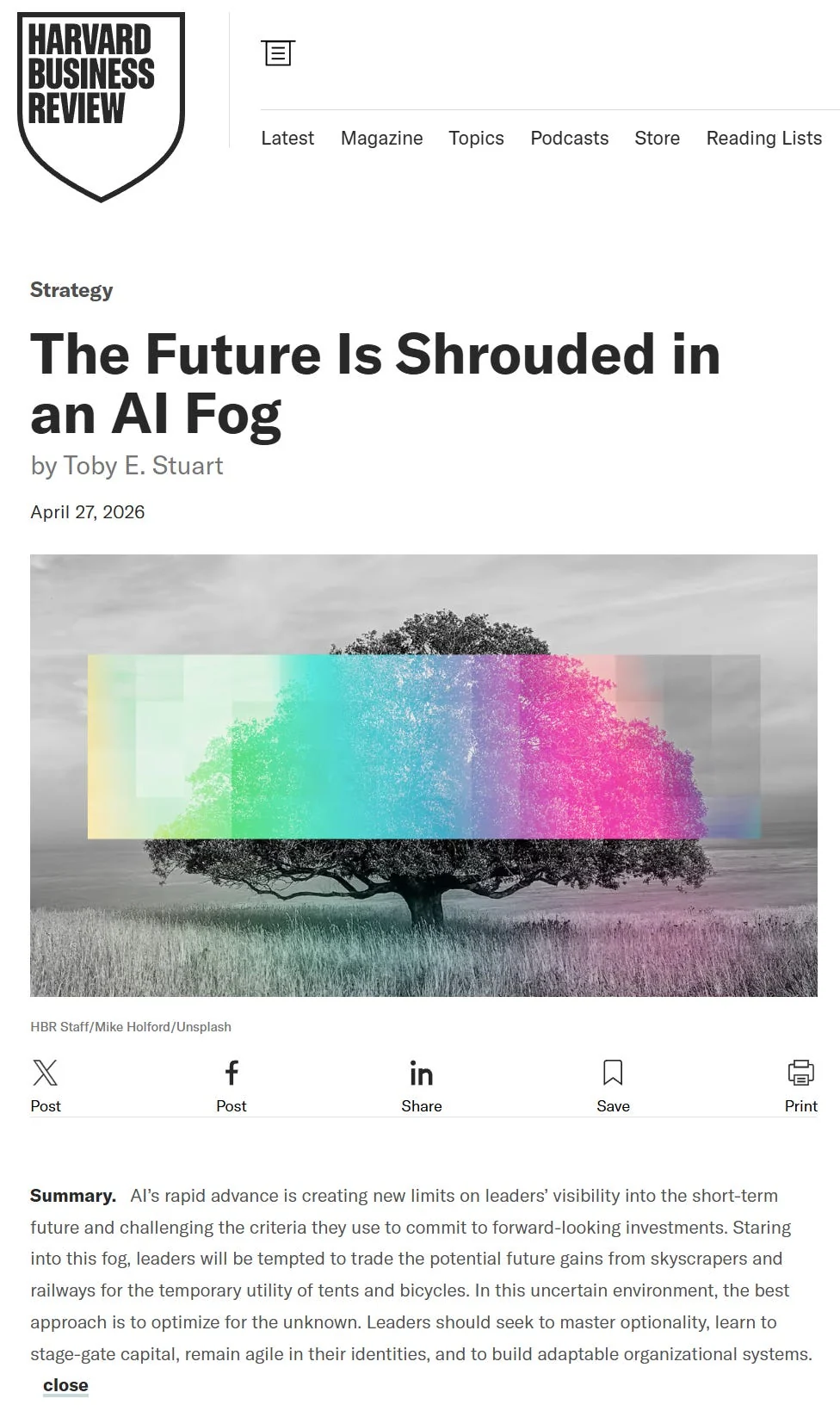
Accessible transcription of the original English screenshot: Harvard Business Review, Strategy. “The Future Is Shrouded in an AI Fog”, by Toby E. Stuart, 27 April 2026. Image credit: HBR Staff/Mike Holford/Unsplash.
Summary. AI’s rapid advance is creating new limits on leaders’ visibility into the short-term future and challenging the criteria they use to commit to forward-looking investments. Staring into this fog, leaders will be tempted to trade the potential future gains from skyscrapers and railways for the temporary utility of tents and bicycles. In this uncertain environment, the best approach is to optimize for the unknown. Leaders should seek to master optionality, learn to stage-gate capital, remain agile in their identities, and to build adaptable organizational systems.
Stuart writes for companies, investors and human resources professionals. But when I finished the article, an uncomfortable question struck me: what happens when the same fog covers the public sphere?
The distinction that matters: risk is not uncertainty
Stuart revives a distinction almost forgotten by economists and consultants: the difference between risk and uncertainty. Risk is quantifiable; we can assign probabilities to it and therefore price, insure and manage it. Uncertainty is different: we do not even know the distribution of possible outcomes. And that is precisely what AI is creating.
This is not just another technology in a long succession of incremental innovations. It is a general-purpose, fast-moving, cross-cutting technology, increasingly capable of changing the conditions that make many other technologies possible. AI does not only change tools; it changes professions, organisations, markets, education systems, power structures and the ways knowledge is produced.
A few weeks ago, in estrategIA, we set out three possible scenarios for artificial intelligence in 2030: a plateau of mass diffusion, a sustained ascent in capabilities, and an accelerated takeoff towards forms of artificial general intelligence or even superintelligence. The conclusion of that exercise was not that we should correctly predict which world will arrive, but precisely the opposite: that the gravest political mistake would be to prepare for only one of them. Governing in the fog means precisely this: designing institutions able to function reasonably well under several possible futures, and to adapt to change far faster than public structures that, all too often, still seem more suited to the nineteenth century than to our own.
For a company, the consequence is strategic: stop investing as if tomorrow were a slightly updated version of today, and start building optionality — staged commitments, flexible identities and active detection systems.
For a democracy, the consequence is political. And much more profound.
The politician’s problem in the fog
People in politics make their living selling certainty. A campaign, an election manifesto or a government programme is — or at least should be — essentially a firm narrative about what will happen and how we will prepare for it. They promise stability, foresight and control.
AI’s fog laughs at all three.
How do you plan the healthcare system for 2035 without knowing what a doctor will be in 2035? How do you design educational reform for a generation whose professions do not yet exist? How do you decide on investment in digital infrastructure, vocational training or active labour-market policies when the labour market could be completely transformed within twenty-four months?
The traditional political response — choose a scenario and commit to it — is optimised for a world that no longer exists. And the public cost of getting it wrong is not measured in market share: it is measured in rights, life opportunities and institutional trust.
From forecasting to steering a course
Taking Stuart’s logic into the public sphere does not mean abandoning planning. It means accepting, as we argued in the previous issue of estrategIA, that public policies must be built on the few reasonable certainties we have about the future, not on a frozen picture of yesterday or today. The verb changes: we stop forecasting and start navigating. That entails three moves that today seem almost heretical in political culture.
First, break commitments into stages. Instead of ten-year plans with rigid objectives, design phased policies with explicit decision points: what minimum investment gives us the right to keep learning? Which metrics will tell us whether this works? Venture capital has been doing it for fifty years; the public sector can learn to do it too.
Second, build optionality into organisational design. Modular administrative structures, interdisciplinary teams with a defined purpose, thin layers of coordination. A public administration that can reorganise itself without having to amend the constitution.
Third, and probably most urgently, build detection systems. Stuart recommends that companies create small teams dedicated full-time to observing the AI frontier and translating it into management implications. The public sector needs exactly the same: teams that turn technical advances into public-policy questions. Before people on the street ask those questions, with less patience.
Consider, for example, a national strategy for employment and social protection in response to AI. Governing with the old map would mean approving a grand five- or ten-year plan based on a fixed prediction of which sectors will grow and which will disappear. Governing in the fog would mean something else: funding reskilling pilots across several sectors, measuring every six months which roles are actually being replaced or augmented by AI, keeping flexible funds to redirect resources, and creating observatories for emerging capabilities.
It would also mean preparing politically crucial decisions in advance: under what conditions would it make sense to begin taxing certain intensive uses of automation; at what level of employment decline would it be appropriate to launch universal basic income mechanisms; and which indicators should trigger an expansion of those policies? This is not about deciding today, with false precision, what the tax or social system of 2035 should be. It is about defining now the sensors, thresholds and procedures that will enable timely decisions.
The political virtue of methodological humility
There is a tension worth naming. Democratic politics rests on comprehensible narratives, on promises citizens can assess. Yet governing in the fog requires publicly acknowledging what is not known.
That tension cannot be resolved by pretending to greater certainty. It calls for a new approach to public explanation: honestly setting out that the future is shrouded in fog, that the fog is real rather than an excuse, and that the best way to serve the public interest is not to promise an exact map, but to commit to a method for learning faster than change.
At heart, it is an invitation to humility. Not the passive humility of giving up, but the active humility of accepting that we must operate with revisable hypotheses, staged commitments and the discipline to look where nobody wants to look.
Stuart closes by asking whether we will redesign our institutions before investment grinds to a halt. Transferred to the public sphere, the question is sharper still: will we redesign our democratic institutions before trust in them evaporates?
The fog is already here. And, as on any passage with poor visibility, speed will not be decisive. The quality of the instruments we carry on board will be. It will be about having better instruments, better lookouts and better protocols for correcting course before it is too late.
Because governing in the fog does not mean governing blind. It means accepting that the map is no longer enough, and that the time has come to take the compass much more seriously.
Director of Digital Innovation at Institución Educativa ALEPH and editor of the estrategIA newsletter
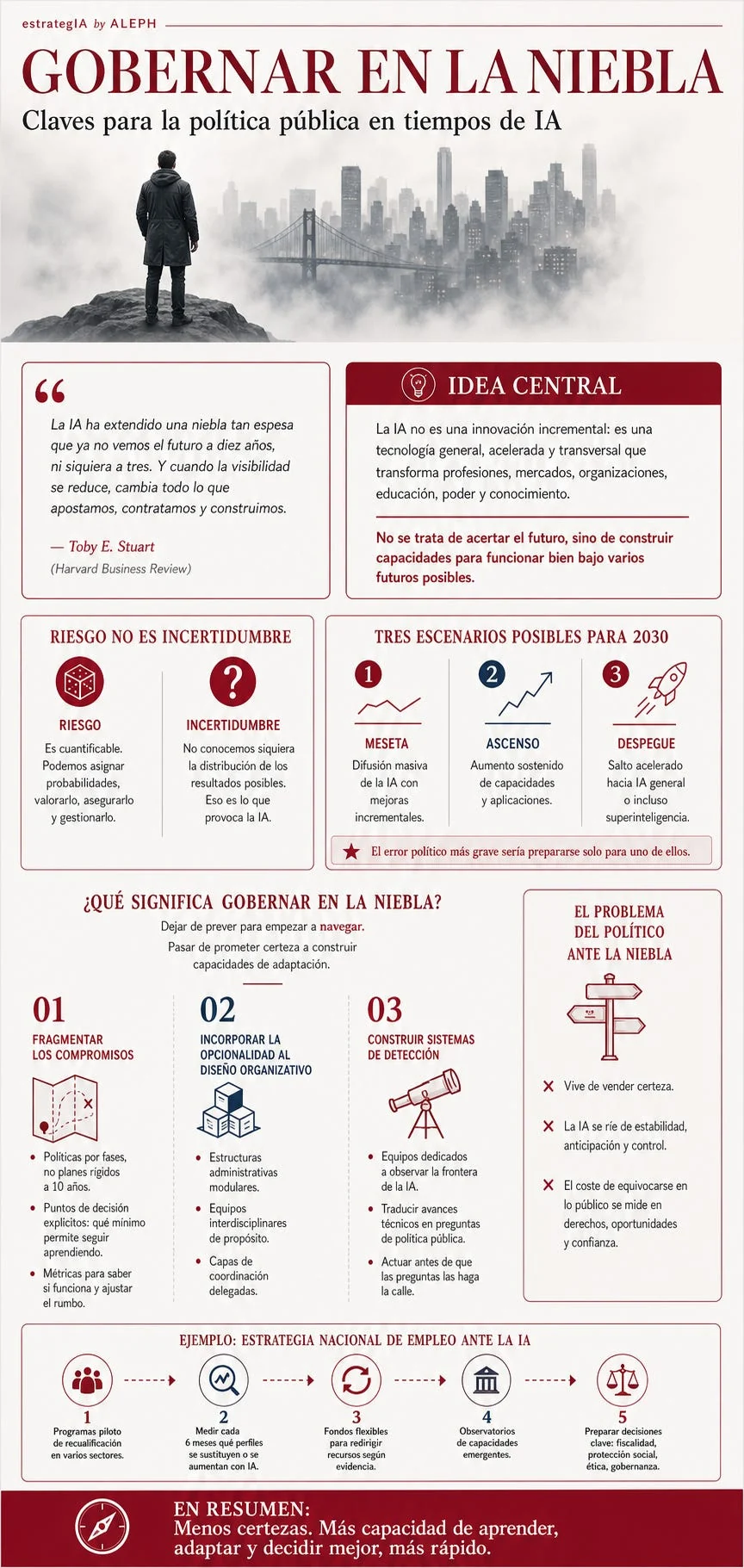
English transcription of the accompanying infographic, branded estrategIA by ALEPH: “Governing in the fog — Principles for public policy in the age of AI”. Its opening passage is attributed to Toby E. Stuart, Harvard Business Review, but the wording below is translated from the Spanish graphic; it is not presented as a verified verbatim English quotation.
AI has spread a fog so thick that we can no longer see ten years into the future, or even three. And when visibility falls, everything we bet on, commission and build changes.
Central idea: AI is not an incremental innovation; it is a general-purpose, accelerated, cross-cutting technology transforming professions, markets, organisations, education, power and knowledge. The aim is not to predict the future correctly but to build capabilities that work well under several possible futures.
Risk is not uncertainty: risk is quantifiable — we can assign probabilities, price it, insure it and manage it. Under uncertainty, we do not even know the distribution of possible outcomes. That is what AI produces.
Three possible scenarios for 2030: 1. Plateau — mass diffusion of AI with incremental improvements. 2. Ascent — sustained growth in capabilities and applications. 3. Takeoff — an accelerated leap towards general AI or even superintelligence. The gravest political mistake would be to prepare for only one.
What does governing in the fog mean? Stop forecasting and start navigating. Move from promising certainty to building adaptive capabilities.
Scroll across the table to read all columns.
| Move | Actions in the graphic |
|---|---|
| 1. Break commitments into stages | Phased policies rather than rigid ten-year plans; explicit decision points about the minimum needed to keep learning; metrics to know whether policies work and to adjust course. |
| 2. Build optionality into organisational design | Modular administrative structures; interdisciplinary teams with a defined purpose; thin coordination layers. |
| 3. Build detection systems | Teams dedicated to observing the AI frontier; translate technical advances into public-policy questions; act before people on the street ask them. |
The politician’s problem in the fog: makes a living selling certainty; AI laughs at stability, foresight and control; the public cost of mistakes is measured in rights, opportunities and trust.
Example — a national employment strategy in response to AI: 1. Reskilling pilots across sectors. 2. Measure every six months which roles are replaced or augmented by AI. 3. Flexible funds to redirect resources according to evidence. 4. Emerging-capability observatories. 5. Prepare crucial decisions on taxation, social protection, ethics and governance.
Closing text: “Less certainty. More capacity to learn, adapt and make better decisions, faster.”
Cite this essay
Fernando Nieto Lobato. “Governing in the fog.” estrategIA, issue 138, 20 May 2026. English edition, 29 September 2026. https://elcontemplador.github.io/estrategia-english/essays/138/