Archive note: this essay preserves the forecasts, assessments and policy proposals published on 13 May 2026. The chart captions distinguish visible measurements and limitations from the author’s interpretation.
In recent months, at Institución Educativa ALEPH, we have been advising public administrations and political leaders on artificial intelligence strategy in very different countries and institutional contexts. In conversations, working documents and strategic plans, we have almost always encountered the same omission: two principles fundamental to a country or territory’s success in its relationship with AI four or five years from now, yet rarely mentioned. There are debates about regulation, technological sovereignty, productivity, foundation models, talent… But these two principles — which come before and matter more than almost everything else — always remain on the margins. That is why we wanted to write this article: to bring them to the centre of public debate before the window for incorporating them closes.
First: plan for the AI we will have to govern, not the AI we already know
Artificial intelligence is probably the first general-purpose technology whose development already depends structurally on earlier versions of itself. Frontier models generate synthetic data to train their successors, evaluate and filter candidates for the next generation, write and debug some of the code for new architectures, and automate growing portions of the research process that produces them. Fully autonomous self-improvement is not yet a reality — although everything suggests it could be within one or two years — but the feedback loop is already operating in development processes. This is neither a metaphor nor a speculative projection: it has been an increasingly common practice in frontier laboratories since 2024. And it explains why the pace of improvement has soared. Available measurements, such as those published by METR on the duration of tasks a system can complete autonomously, suggest that this time horizon has been doubling every few months. By way of example: GPT-4, in 2023, could perform tasks equivalent to around four minutes; Opus 4.6 — a model already surpassed, released in February this year — had already reached twelve hours. This trend also means that any linear projection systematically underestimates what is coming.
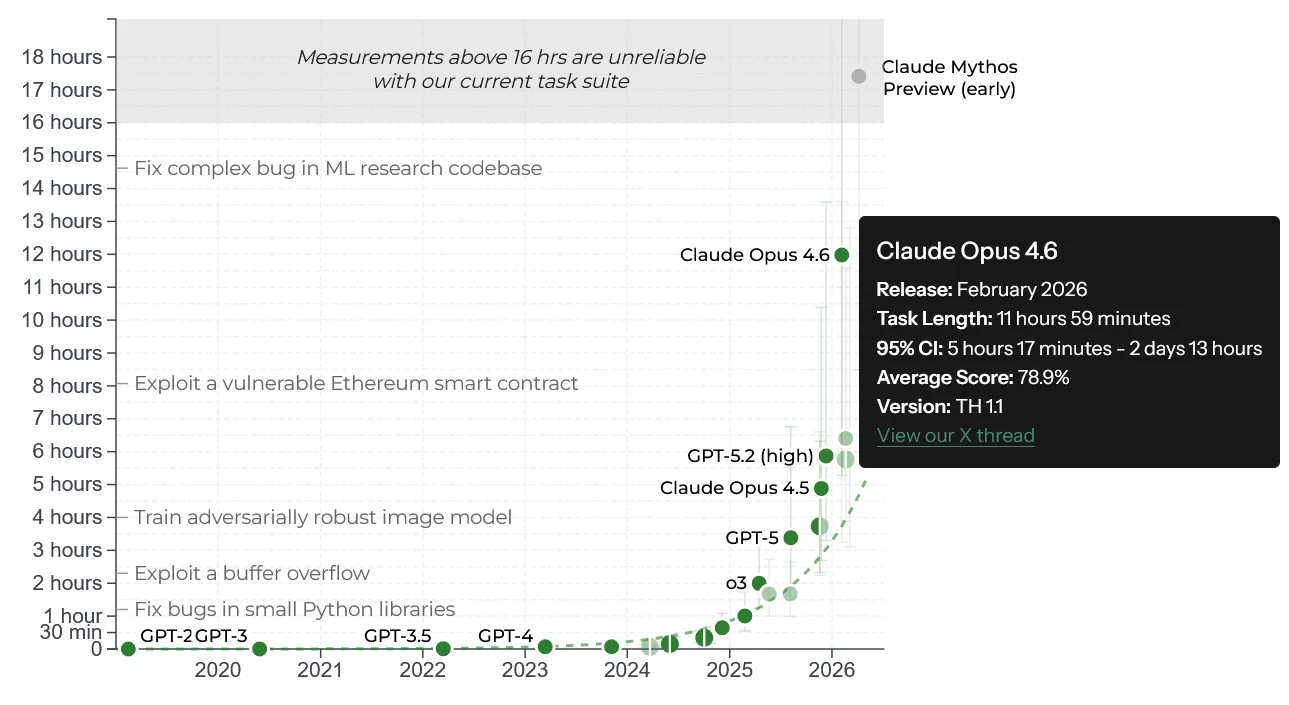
Accessible transcription and description of the original English task-horizon chart. The horizontal axis covers model release dates from before 2020 to 2026; the vertical axis runs from zero to eighteen hours, with a thirty-minute tick. The highlighted tooltip reads: Claude Opus 4.6 — release: February 2026; task length: 11 hours 59 minutes; 95% confidence interval: 5 hours 17 minutes to 2 days 13 hours; average score: 78.9%; version: TH 1.1; “View our X thread”. The shaded area warns: “Measurements above 16 hrs are unreliable with our current task suite.”
Other visible labelled points include GPT-2, GPT-3, GPT-3.5 and GPT-4 close to the baseline; o3 around two hours; GPT-5 around three and a half hours; Claude Opus 4.5 just under five hours; GPT-5.2 (high) just under six hours; and Claude Mythos Preview (early) around seventeen and a half hours, inside the unreliable-measurement area. These positions are approximate readings, not exact point values. Some further points are unlabelled or covered by the tooltip. Illustrative task labels read: “Fix bugs in small Python libraries”, “Exploit a buffer overflow”, “Train adversarially robust image model”, “Exploit a vulnerable Ethereum smart contract” and “Fix complex bug in ML research codebase”.
The consequence for public planning is decisive. Almost all the available literature — UNESCO, the OECD, national reports, sectoral guides and ethical frameworks — is calibrated to generative AI from 2022 to 2024: conversational models without structured reasoning, without significant agentic capabilities, with limited multimodality and without persistent memory. This is the basis on which the papers and recommendations now circulating with authority were written. The problem is that the AI in production when those frameworks take effect — in 2027, 2028 or 2029 — will no longer be that AI. Advanced reasoning, agents able to maintain context and operate across systems, fluid multimodality, persistent memory: four qualitative rather than incremental leaps that change what AI can do, what it should be allowed to do and what it should be prohibited from doing.
The difference between planning for the AI of 2024 or 2025 and planning for the AI of 2030 is of the same order as the difference between regulating postal mail and regulating email. This is not about updating articles: it is about rethinking what we are talking about. Yet the dominant institutional practice is to produce documents that assume, without saying so, that the technology being regulated now will be roughly the technology applied later. It will not. In issue 133 we described three possible futures for AI in 2030 and concluded that the likeliest outcome is not stabilisation but an era of rapid, uneven acceleration — or even a still more advanced scenario of AGI and singularity within a few years. If that reading is correct — and every passing week gives us more reasons to hold it — planning from a snapshot of 2024 or 2025 means legislating for a world that no longer exists.
The antidote is neither to wait for the technology to stabilise — it will not within any foreseeable horizon — nor to abandon infrastructure-building or regulation. It is to change the method. Move from governance of specific technologies to governance of emerging capabilities: define which legal, ethical and operational consequences are triggered when a system reaches a given capability — for example, reasoning autonomously over sensitive data, taking actions without supervision, maintaining prolonged interactions with minors or replacing professional judgement in high-impact decisions — regardless of the specific commercial product embodying it. That is more intellectually demanding, but it is the only way for a regulatory framework to outlast a software version.
Second: treat AI access as basic infrastructure for equality, not as a market matter
Regular readers know this is one of the subjects that matters most to us, and it is worth spelling it out again. Every generation has identified the infrastructure without which equal opportunity is impossible and turned it into a universal right through sustained public effort. Electricity, running water, public healthcare, compulsory education, broadband: in each case, the political decision to guarantee universal access — not merely a theoretical possibility of access, but real, affordable, high-quality availability — marked the boundary between societies that reproduced inherited inequalities and societies that achieved some effective mobility.
The productive AI of 2030 will be on that list. Those who have access to powerful tools, know how to use them judiciously and have an environment that supports their learning will multiply their capabilities in professional work, education, healthcare, legal affairs and administration. Those who do not will see a gap opening that even the most admirable individual efforts cannot close. What distinguishes this from previous stages is the speed and compound nature of the divide: it is not just about having a device, but about access to high-quality models, to the premium subscriptions that provide real capability, to the cultural judgement needed to make the most of them, and to educational and professional environments that teach people to use them well. Four layers, each liable to fragmentation by income, country, postcode and family cultural capital.
This needs spelling out, because confusion is common in this debate: universal access to AI does not mean giving premium subscriptions to the entire population. It means a whole ecosystem — devices, connectivity, high-quality models, critical literacy, linguistic accessibility, educational support and protection against abusive uses — without which supposed access remains a gesture. UNESCO, for example, has published AI competency frameworks for teachers and students for precisely this reason: useful access is not possession of the tool — a necessary and indispensable prior step — but knowing how to use it with judgement.
The idea that the private sector alone will provide this access for everyone is a hypothesis contradicted by the evidence. Leading models are concentrated in increasingly expensive paid subscriptions; free versions progressively deteriorate and the gap widens; and high-quality training in using these tools circulates through networks already privileged in their cultural capital. Without sustained public intervention, AI access will reproduce — and amplify — existing inequalities with an efficiency previous generations of technology never achieved.
It is the same idea we have been repeating for months in estrategIA, now applied to access: protect people, not jobs; the citizen, not the device. Guaranteeing universal access to high-quality AI requires concrete decisions: public licences negotiated at national or regional scale — and, ideally, research, creation and public provision of high-quality frontier models with capabilities almost identical to the best commercial models, because if the gap is large they are of little use; but that is technologically beyond the reach of almost every country except a few technological superpowers — integration of high-quality tools into education from an early age, mandatory professional training in critical AI use, dedicated resources for disadvantaged schools and neighbourhoods, and support programmes for adults at risk of digital exclusion.
The two principles stand together, or neither stands at all. If we fail to design for the AI that is coming, the universal access we organise now will be access to obsolete tools by the time they are deployed. If we fail to guarantee universal access, the qualitatively more powerful AI arriving in the next few years will entrench unprecedented inequality between those who master it and those who suffer its effects — at every level: between states, between companies and between individuals with or without access to the best models of each generation.
The window for incorporating these two principles into public planning is narrow. Strategic plans approved in 2026 will set the course of the decade. Those that do not incorporate the horizon of capabilities and the principle of universal access will be born old, and will age badly. The difference between administrations that understand this in time and those that do not will not be measured in decades: it will be measured in school years, in electoral cycles, in an entire generation of citizens who will live their decisive years amid a technological inequality that could have been avoided. That is what is at stake.
Director of Digital Innovation at Institución Educativa ALEPH and editor of the estrategIA newsletter
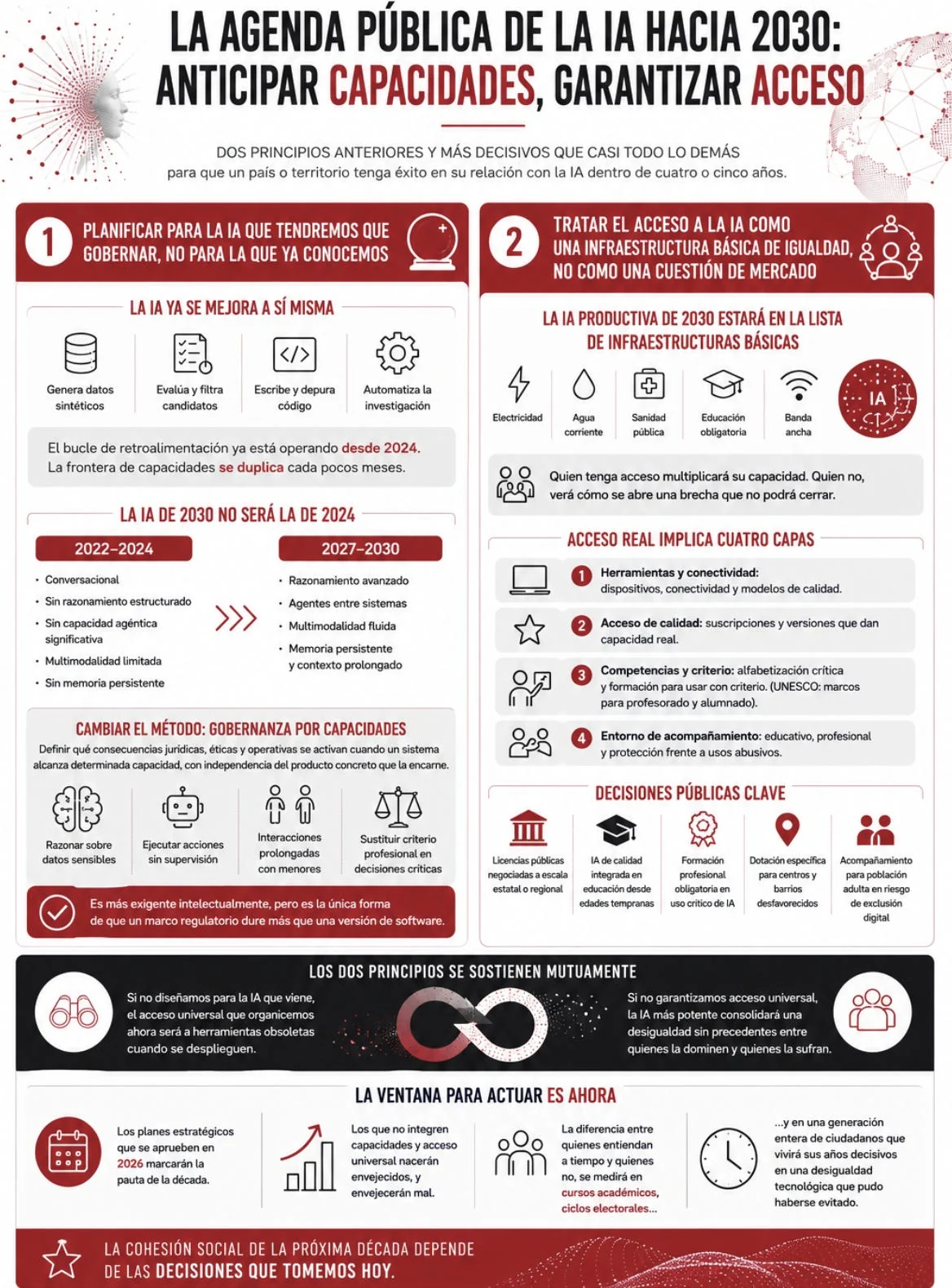
English transcription of the accompanying infographic: “The public AI agenda towards 2030: anticipate capabilities, guarantee access”. Two principles that come before and matter more than almost everything else for a country or territory’s success with AI four or five years from now.
1. Plan for the AI we will have to govern, not the AI we already know. The graphic says “AI is already improving itself”: generating synthetic data; evaluating and filtering candidates; writing and debugging code; automating research. The feedback loop has operated since 2024; the capability frontier doubles every few months. The body above distinguishes this from fully autonomous self-improvement.
The AI of 2030 will not be the AI of 2024:
Scroll across the table to read all columns.
| 2022–2024 | 2027–2030 |
|---|---|
| Conversational | Advanced reasoning |
| No structured reasoning | Agents working across systems |
| No significant agentic capability | Fluid multimodality |
| Limited multimodality | Persistent memory and prolonged context |
| No persistent memory |
Change the method: governance by capabilities. Define which legal, ethical and operational consequences activate when a system reaches a capability, independently of its specific product: reasoning over sensitive data; unsupervised actions; prolonged interactions with minors; replacing professional judgement in critical decisions. More intellectually demanding, but the only way a regulatory framework can outlast a software version.
2. Treat AI access as basic infrastructure for equality, not a market matter. The productive AI of 2030 joins electricity, running water, public healthcare, compulsory education and broadband. Those with access will multiply their capabilities; those without will face a gap they cannot close.
Real access has four layers: tools and connectivity — devices, connections and high-quality models; quality access — subscriptions and versions that provide real capability; skills and judgement — critical literacy and training, including UNESCO’s teacher and student frameworks; a supportive environment — education, professional support and protection against abusive uses.
Key public decisions: national or regional public licences; high-quality AI in education from early ages; mandatory professional training in critical AI use; dedicated resources for disadvantaged schools and neighbourhoods; support for adults at risk of digital exclusion.
The two principles support each other: without designing for future AI, universal access will provide obsolete tools; without universal access, more powerful AI will entrench unprecedented inequality between those who master it and those who suffer its effects.
The window for action is now: 2026 strategic plans set the decade’s course; those omitting capabilities and universal access are born old and age badly; differences will be measured in school years and electoral cycles, and in a whole generation’s decisive years spent amid avoidable technological inequality. Footer: “The social cohesion of the next decade depends on the decisions we take today.”
P.S. As a curiosity related to what this week’s article advocates, a few days ago I saw this post by David Bonilla on X, with a chart from this survey, which I located afterwards. It already shows a certain divide in the kinds of AI models households use according to their income. Higher-income households use proportionately much more Claude, one of the most powerful paid models, with a distinctly professional or business orientation. Lower-income households, by contrast, use Meta AI much more: a useful and widespread model, but one less close to the capability frontier and more closely tied to a company whose business model depends overwhelmingly on advertising and user targeting.
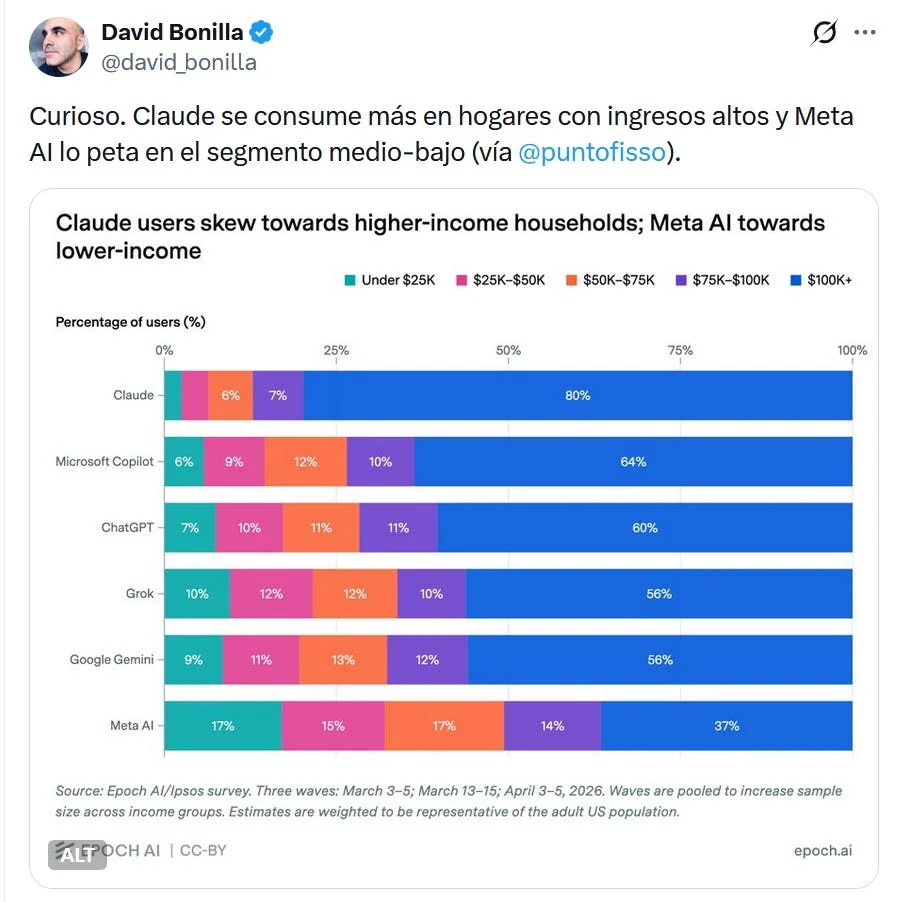
English translation of David Bonilla’s visible post: “Interesting. Claude is used more in high-income households, while Meta AI is a hit in the lower-middle segment (via @puntofisso).”
Accessible transcription of the original English chart: “Claude users skew towards higher-income households; Meta AI towards lower-income.” Percentage of users by household income:
Scroll across the table to read all columns.
| Service | Under $25K | $25K–$50K | $50K–$75K | $75K–$100K | $100K+ |
|---|---|---|---|---|---|
| Claude | Unlabelled segment | Unlabelled segment | 6% | 7% | 80% |
| Microsoft Copilot | 6% | 9% | 12% | 10% | 64% |
| ChatGPT | 7% | 10% | 11% | 11% | 60% |
| Grok | 10% | 12% | 12% | 10% | 56% |
| Google Gemini | 9% | 11% | 13% | 12% | 56% |
| Meta AI | 17% | 15% | 17% | 14% | 37% |
Source text in the image: “Epoch AI/Ipsos survey. Three waves: March 3–5; March 13–15; April 3–5, 2026. Waves are pooled to increase sample size across income groups. Estimates are weighted to be representative of the adult US population.” Credit: Epoch AI, CC-BY, epoch.ai. Percentages are transcribed as labelled, including totals affected by rounding; the two unlabelled Claude segments are not assigned invented values.
Cite this essay
Fernando Nieto Lobato. “The public AI agenda towards 2030: anticipate capabilities, guarantee access.” estrategIA, issue 137, 13 May 2026. English edition, 29 September 2026. https://elcontemplador.github.io/estrategia-english/essays/137/