A little over two years ago, we devoted issue 38 of estrategIA to Co-Intelligence, the book by Ethan Mollick, a professor at Wharton, the University of Pennsylvania's business school, and a researcher into the effects of artificial intelligence on work and education. Cointeligencia, its Spanish edition, became one of our regular recommendations for people asking us for a good book to begin understanding artificial intelligence. Its clarity, examples and invitation to experiment made it particularly useful as an introduction to a technology that was much discussed, but that we were still learning to use.
Since then, the tools have changed considerably, as have some of the questions we ask about them. In his new book, Co-Existence: The Next Phase of AI, published in English on 20 October, the Wharton professor once again helps us think about that relationship: how to work and live with systems that can outperform us in some tasks while still making surprising mistakes. For those who prefer reading in Spanish, we have not yet found an announced date for a translation, although we hope that, as happened with Cointeligencia, it will also become available in our language.
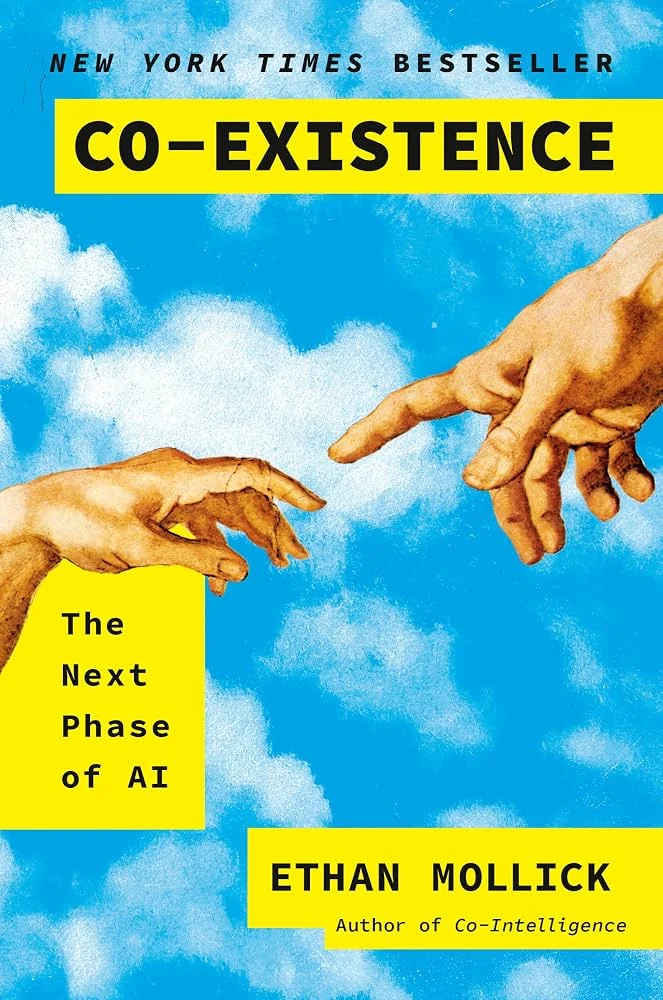
I finished reading it this week and, once again, found it well worth recommending, especially to a general readership. It retains the practical curiosity of Co-Intelligence, but also explores what happens when AI stops being simply something we converse with and begins to play a broader part in our work and decisions.
A frontier that keeps moving
Mollick uses an image that is particularly useful for understanding AI's capabilities: a jagged frontier. If we drew a map of the tasks it can handle well and those it cannot, the boundary would not form a neat circle. Inside it, we would find some tasks that seem very difficult to us and, outside it, others we would consider simple. A system capable of writing useful code can also invent a bibliographic reference.
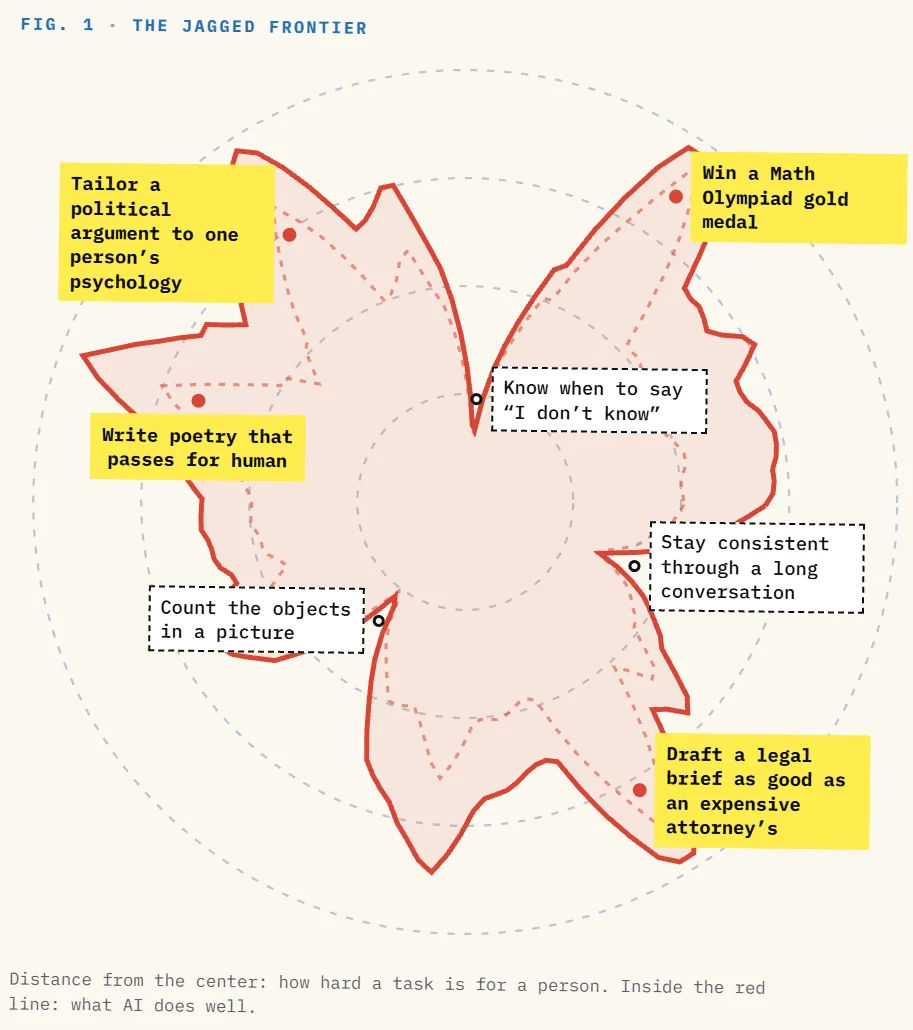
On the book's website, you can see a representation of that frontier and another chart that I find equally thought-provoking. In it, a rising curve forces the scale to be readjusted repeatedly, while plans made for current capabilities fall further and further below it. The image illustrates an idea of the author's; it does not, in itself, show that all AI capabilities improve at the same pace.
The question for an organisation is how to plan under those conditions. If it prepares its strategy as though the tools will not change, it may be left with an outdated snapshot; if it assumes they will solve every problem, it risks entrusting them with responsibilities they cannot yet take on. We will need to test, learn and review, without confusing what is possible today with what we imagine will become possible.
That evolution is also changing the way we work. In Co-Intelligence, Mollick distinguished between two ways of working with AI: the centaur, which divides tasks between person and machine, and the cyborg, in which the two collaborate more closely. He now adds a third figure, the conjurer, which we might translate into Spanish as “invocador” or “conjurador”.
It is a way of working very similar to the one I already use in most of my AI projects, although in others, such as this newsletter, I remain closer to cyborg mode and, for some tasks, centaur mode.
In the conjurer approach, a person assigns work to one or more agents, which can carry out a sequence of actions before returning the result. Mollick himself used this approach to prepare these interesting charts about what happened between the publication of his two books.
Mollick describes this shift as a move from prompt engineering — preparing instructions for AI — to delegation. Putting those agents to work still requires well-defined tasks, clear instructions and careful assessment of what they deliver.
But directing them can also be exhausting, and here is an observation I particularly identified with: being able to do more can end up leading us to work much more and, in my case, even to experience a degree of cognitive exhaustion. Projects emerge that we would previously have ruled out for lack of time or resources. Work that only a few months ago would have required many weeks of effort from a large team can now be tackled in a few days by far fewer people, or even by a sufficiently knowledgeable individual conjurer. Mollick warns of the strain that this continual expansion can cause. We can gain productivity while losing our sense of when we have done enough and it is time to stop.
Another source of fatigue adds to this: the endless answers, alternatives and suggestions that force us to process more information and can take us away from the original goal. The conversation becomes tangled just when we have the least energy to sort it out. Choosing how to work with AI also means setting limits on what we ask it to do and on the pace we set ourselves — something I must admit I am not very good at yet.
The human advantages we need to cultivate
I was also interested in the four human advantages Mollick suggests cultivating to work better with AI, without assuming that they are territory machines will never be able to reach.
Deep knowledge of a field allows us to spot errors, but also to ask better questions: someone who understands a problem knows which background information matters, what exception must be considered, or why an apparently correct answer does not fit that particular case. Expertise continues to influence what we get from AI.
To that depth, he adds broad knowledge, which connects disciplines. Knowing how epidemiology studies the spread of a disease, for example, may lead us to explore with AI how disinformation circulates. Curiosity allows us to ask for things that, without those points of reference, would never even have occurred to us.
Taste is the judgement that allows us to recognise what is worthwhile among many possible proposals, what should be discarded and what might help us develop something better. It is cultivated through reading, observing and comparing, and through trying to understand why one work interests us while another seems mediocre.
Agency — the capacity to take initiative and the willingness to act — connects the other three capabilities to action. It means experimenting without waiting for instructions, discovering uses and demanding better results. Mollick also reminds us that such initiative, or agency, needs an environment that enables it: organisations can discourage it too.
These advantages require practice. The expert who assesses a piece of work today had to learn how to do it, and Mollick raises an important difficulty: if AI takes over the tasks through which beginners used to learn, we will have to find other ways to develop that expertise. We may be producing more while failing to learn something we will need later.
The book develops these questions in chapters on work, education and society. It examines why an individual improvement in productivity does not automatically transform an organisation, how to teach with AI without confusing getting answers with learning, and what it means to coexist with systems capable of persuading us or offering us companionship. These questions affect how we organise our institutions and the relationships we want to maintain with one another.
Looking towards the future, Mollick revisits the four scenarios in Co-Intelligence and considers that the progress observed leaves little room for the hypotheses of stagnation or slow improvement. He focuses on two others that require us to take the transformation we are already experiencing very seriously.
The first is the Escalator: AI continues to gain substantial capabilities and transform work and organisations, although its frontier remains jagged. It solves some tasks extraordinarily well and stumbles over others.
The second, the Eschaton, understood as the end of the world as we know it, envisages a radical transformation associated with the emergence of general intelligence and, especially, a superintelligence that would alter the foundations of our economic and social life.
His concern is that, in the organisations he speaks to, he finds few strategies prepared for either of those futures. Many focus on adopting today's tools, without thinking enough about what will happen if they keep improving. That gap between technology and our ability to prepare for it, which we have discussed dozens of times in this newsletter, deserves attention even if we never reach the more radical scenario.
I found the ending of the book particularly interesting for the frankness with which Mollick describes his experience as an author. When writing, he works mainly as a centaur: he writes his own drafts and turns to AI afterwards, or when he gets stuck. In research and revision, the collaboration is closer, more like that of a cyborg. Although he retained control over the arguments and what he wanted to say, he acknowledges that he increasingly struggled to distinguish ideas he had developed on his own from those that had taken shape in conversation with the machine.
That reflection on his own writing also leads him to ask how he wants to say goodbye to the reader. In Co-Intelligence, he had given AI the last word, and he considers doing so again. The machine could already offer him a seemingly perfect ending, but he wanted the conclusion to express his own position. After so many pages explaining what is happening and exploring its consequences, he decides to end by acknowledging that he does not know what comes next in the development of artificial intelligence.
I very much share that feeling. I have the impression that we could be taking the first steps towards what we call the technological singularity, but that intuition does not tell me what the path will look like or what society might emerge from it. Acknowledging what we do not know is particularly important when change will push politics into making decisions that affect many people.
That was also the concern of “Governing in the fog”: preparing for several futures, learning from what happens and retaining the ability to change course. Mollick closes with an idea that fits that attitude well: coexistence will be something we must keep negotiating with one another and with the technology we have created. We can take part in that negotiation now, with the humility of knowing that we do not know how it will end.
Director of Digital Innovation at Institución Educativa ALEPH and director of the estrategIA newsletter.
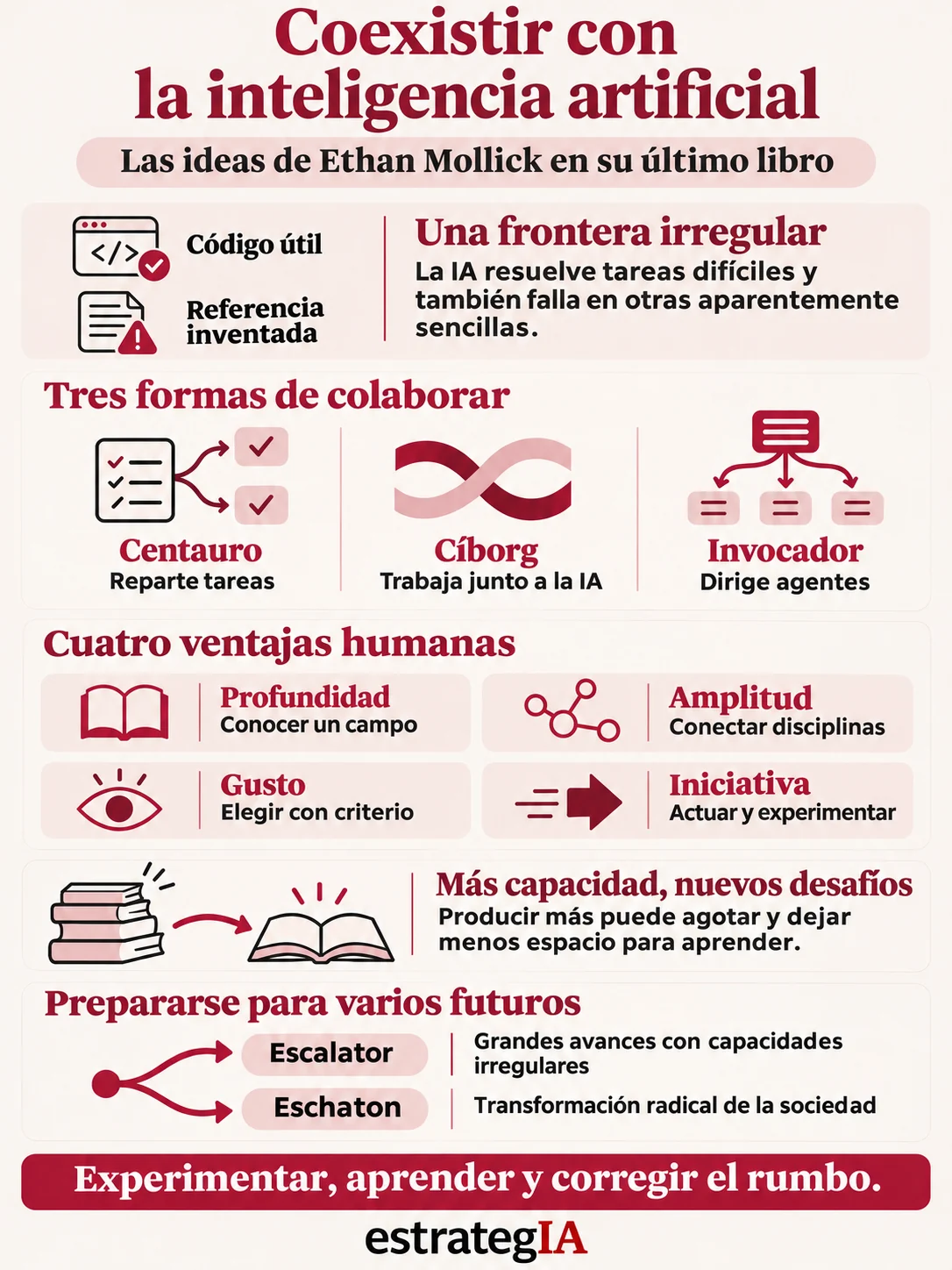
English transcription of the original infographic
Coexisting with artificial intelligence. Ethan Mollick's ideas in his latest book.
A jagged frontier: AI solves difficult tasks and also fails at others that appear simple. Useful code. Invented reference.
Three ways to collaborate:
- Centaur: divides tasks.
- Cyborg: works alongside AI.
- Conjurer: directs agents.
Four human advantages:
- Depth: know a field.
- Breadth: connect disciplines.
- Taste: choose with judgement.
- Initiative: act and experiment.
Greater capability, new challenges: producing more can be exhausting and leave less room to learn.
Prepare for several futures:
- Escalator: major advances with uneven capabilities.
- Eschaton: radical transformation of society.
Experiment, learn and change course.
estrategIA.
Cite this essay
Fernando Nieto Lobato. “Coexisting with artificial intelligence: reflections on Ethan Mollick's new book.” estrategIA, issue 163, 11 November 2026. English edition, 12 November 2026. https://elcontemplador.github.io/estrategia-english/essays/163/