‘AGI has arrived.’ Jensen Huang, NVIDIA’s founder and chief executive, wrote those words on 6 September 2026, three days after OpenAI, the company behind ChatGPT, unveiled GPT-6 Astra. Greg Brockman, OpenAI’s president and co-founder, had already suggested that Astra could mark the arrival of artificial general intelligence: AI capable of learning and handling very different tasks with flexibility comparable to a human’s.
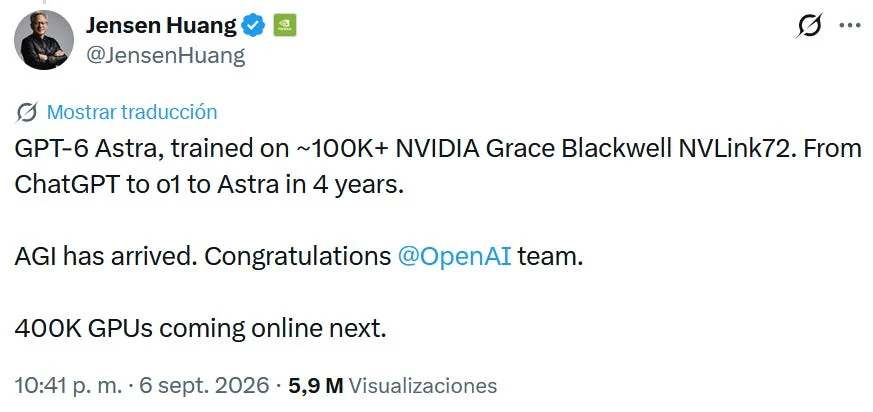
Text of the original English-language post shown in the screenshot, by Jensen Huang (@JensenHuang):
GPT-6 Astra, trained on ~100K+ NVIDIA Grace Blackwell NVLink72. From ChatGPT to o1 to Astra in 4 years.
AGI has arrived. Congratulations @OpenAI team.
400K GPUs coming online next.
The screenshot displays 10:41 p.m., 6 September 2026, and 5.9 million views. Its Spanish interface link reads ‘Show translation’.
Huang added a detail that was far from minor: Astra had been trained using more than 100,000 GPUs, the chips that perform those calculations, and another 400,000 would soon come online.
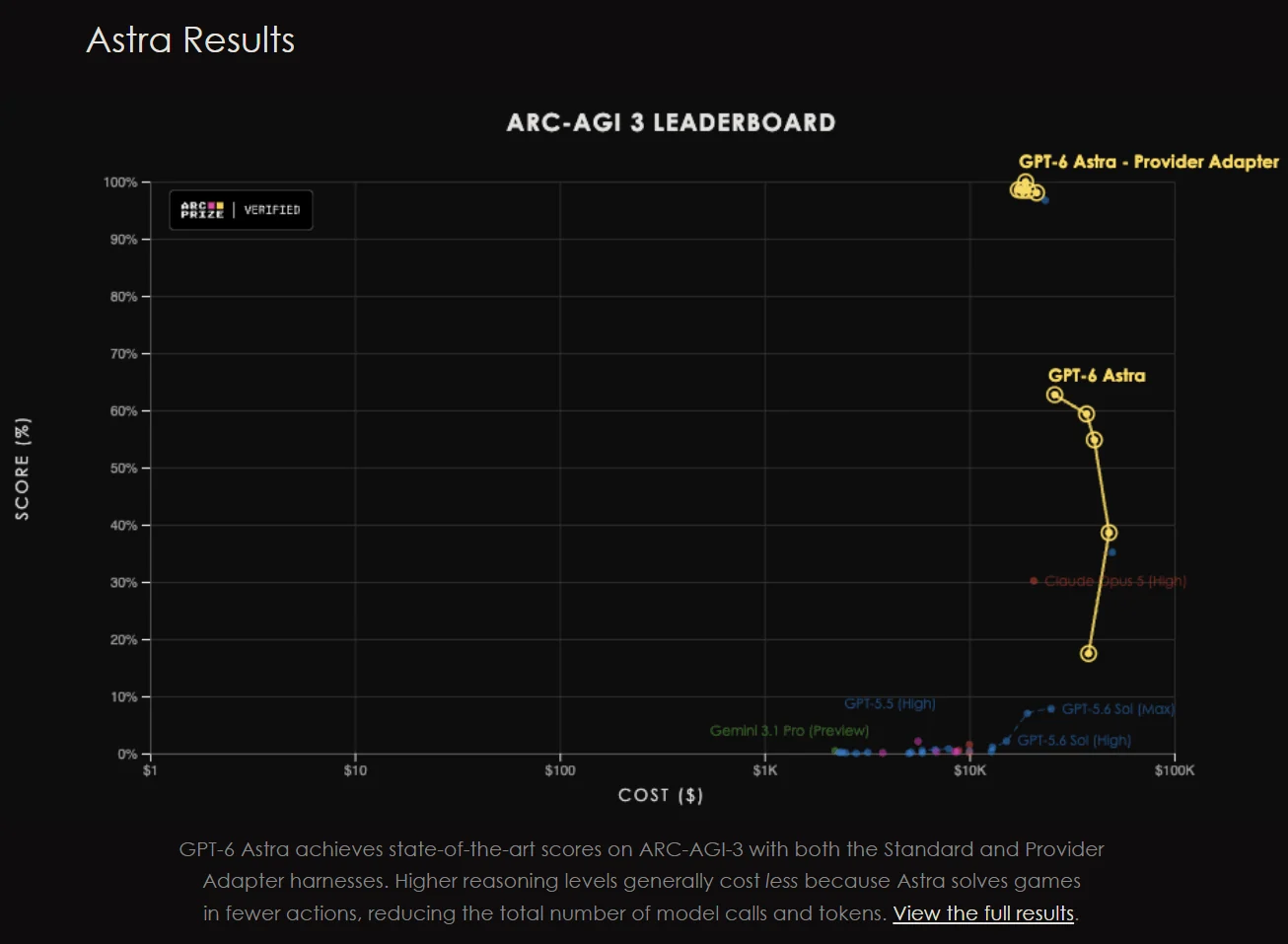
Greg Kamradt, president of ARC Prize, a foundation that evaluates the intelligence of models, describes it as ‘the best model we have tested’. Its ARC-AGI-3 test confronts systems with unfamiliar environments and tasks that are relatively straightforward for humans but highly complex for machines, whose rules they must discover in order to solve them. Astra scores 62.7% in its standard configuration and reaches 99.9% in another that retains its reasoning between steps. The foundation itself cautions that these extraordinary results — which have saturated a fairly complex benchmark in a matter of months and are far ahead of the competition — do not, on their own, demonstrate that AGI has been achieved.
Text alternative for the benchmark chart
The original English chart is headed ‘Astra Results’ and ‘ARC-AGI 3 LEADERBOARD’, with an ‘ARC Prize — Verified’ badge. It plots score, from 0% to 100%, against dollar cost on a logarithmic horizontal axis marked $1, $10, $100, $1K, $10K and $100K. These are historical results reproduced by the article, not a current comparison.
The highlighted yellow ‘GPT-6 Astra — Provider Adapter’ points lie close to 100%, at costs in the tens of thousands of dollars. A separate yellow ‘GPT-6 Astra’ curve has points at roughly 18%, 39%, 55%, 59% and 63%, also in the tens of thousands. Other visible labels include ‘Claude Opus 5 (High)’ near 30%, ‘GPT-5.6 Sol (Max)’ below 10%, ‘GPT-5.6 Sol (High)’ near the bottom, ‘GPT-5.5 (High)’ and ‘Gemini 3.1 Pro (Preview)’. The chart does not print exact numerical values beside individual points; these positions are approximate visual readings, and several points are unlabelled.
The original caption reads:
GPT-6 Astra achieves state-of-the-art scores on ARC-AGI-3 with both the Standard and Provider Adapter harnesses. Higher reasoning levels generally cost less because Astra solves games in fewer actions, reducing the total number of model calls and tokens. View the full results.
The chart’s model labels are retained as displayed, including where they differ from names in the article’s prose.
OpenAI shows Astra using software, analysing data and building applications that it then tests and corrects. On 6 September, the company also claimed another significant milestone: the level of an automated ‘research intern’, capable of completing, under human direction, tasks that would take a researcher several days.
Competition for AI primacy is also a contest over timing. In the two days before Astra, Anthropic’s Fable 5.1, Google’s Gemini 3.8 Flash and Meta’s Muse Spark 1.3 were unveiled. My reading, shared by most analysts, is that they all wanted to attract attention before Astra took the spotlight.
Whether this is already AGI will continue to generate plenty of debate — and not just about the name and the many existing definitions of artificial general intelligence, but also about which tasks it can solve, how reliably and how much supervision it needs. At estrategIA, after quickly establishing that this was a clearly superior model to those we had previously used, we wanted to test how it responded when asked to build a project and incorporate our corrections along the way.
In some three or four hours working with the model, we created La ribera del Molino, an interactive demo built around a municipal decision. A council wants to restore its riverside promenade and build twenty homes on higher ground. It must decide whether to reserve the lower area for a floodable park or add ten more homes protected by a wall. What does each option offer, and what happens when the river rises?
English text alternative for the riverside screenshot
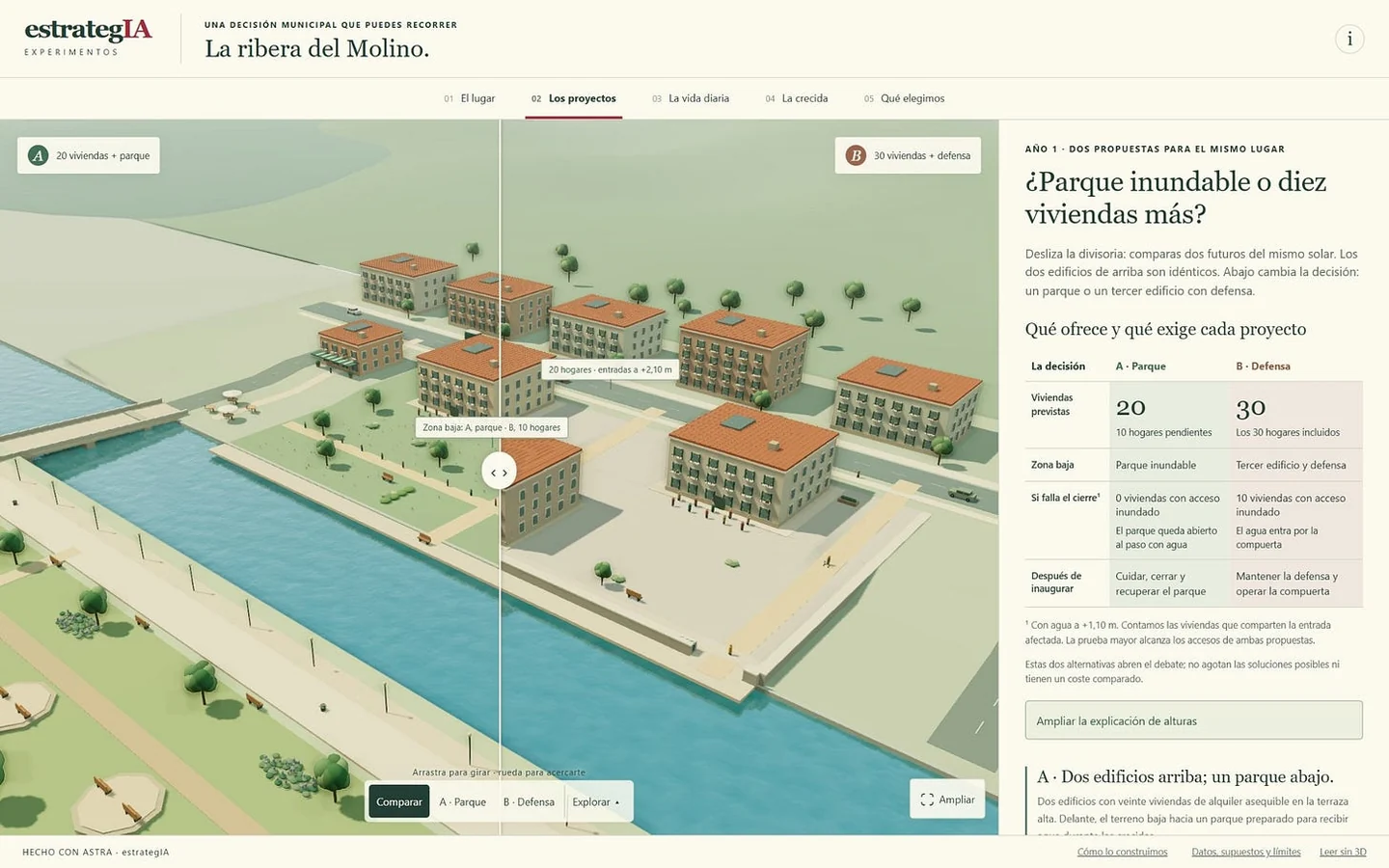
estrategIA Experiments — A municipal decision you can explore: La ribera del Molino (The Mill Riverside). Navigation: 01 The place; 02 The projects; 03 Everyday life; 04 The flood; 05 What we choose.
The split-screen scene compares A: 20 homes + park with B: 30 homes + flood defence. Scene labels: ‘20 homes — entrances at +2.10 m’ and ‘Lower area: A, park · B, 10 homes’. Controls: ‘Drag to rotate · wheel to zoom’; ‘Compare’; ‘A · Park’; ‘B · Flood defence’; ‘Explore’; ‘Enlarge’.
Year 1 — Two proposals for the same place. Floodable park or ten more homes? Move the divider to compare two futures for the same plot. The two buildings on higher ground are identical. The decision changes the lower ground: a park or a third building with flood defences.
What each project offers and requires
Scroll across the table to read all columns.
| The decision | A · Park | B · Flood defence |
|---|---|---|
| Planned homes | 20; 10 households still waiting | 30; all 30 households included |
| Lower area | Floodable park | Third building and flood defence |
| If the closure fails¹ | 0 homes with flooded access; the park remains open to passage with water present | 10 homes with flooded access; water enters through the floodgate |
| After opening | Look after, close and restore the park | Maintain the flood defence and operate the floodgate |
¹ With water at +1.10 m. The count covers homes sharing the affected entrance. The larger test reaches the access points of both proposals.
These two options open the debate; they do not exhaust the possible solutions and do not include a cost comparison. Button: ‘Expand the explanation of elevations’.
A partially visible panel reads ‘A · Two buildings above; a park below.’ Its visible text describes two buildings with twenty affordable rental homes on the upper terrace, with the ground in front descending towards a park designed to receive water; the rest is cropped.
Footer: ‘Made with Astra · estrategIA’; ‘How we built it’; ‘Data, assumptions and limits’; ‘Read without 3D’.
This is a screenshot of the fictional demo, not a validated assessment of a real site. The interface text is translated as shown; the original illustration and its limitations remain visible.
You can explore both banks, compare the projects, trigger floods and discover the perspectives of four characters: Nora is looking for a home; Carmen needs accessibility; Samir runs a café; Leo handles maintenance.
We did it by talking to Astra in Codex, OpenAI’s application for working with code. The model programmed the scene, interface and rules; I defined the purpose and requested corrections. The first version was almost an entire town, much more impressive at first glance, but it told us very little. I asked it to explore a specific narrative, rather than function mainly as a technical demo, and to concentrate everything on the riverside. I wanted readers to understand a particular decision, its advantages and the problems it could create, and afterwards to remember more than a pretty town.
I also asked the previous model, GPT-5.6 Sol, for an audit. In an early version, the depicted elevations did not explain clearly why the water affected the two proposals differently. The terrain, levels and explanation had to be revised. A convincing image can also tell the story of a decision badly.
Our riverside is a fictional case, with scripted voices and simplified rules. Applying it to a real municipality would require data and technical validation: it can help explain alternatives, but it does not replace a hydraulic study or a public consultation. Direction and review were included in those hours. It is also available in estrategIA Lab.
Many examples of projects made with GPT-6 Astra that have appeared over the past few days are worth a visit. Developer Matt Shumer has shown a civilisation whose inhabitants converse and collaborate, as well as an extraordinary recreation of Manhattan that is still under construction. Ethan Mollick, a Wharton professor and one of our reference experts, has used GPT-6 to create a recreation of the Library of Alexandria, with spaces to explore and texts to consult.
What interests me most about our simple experiment is that, in just a few hours, we turned an idea about a municipal problem into something other people can explore and discuss. That opens up possibilities for those who know a neighbourhood, public service or organisation well but cannot code — or who have never had the time, budget or team to test an idea they have spent years explaining.
We invite you to explore the riverside and consider which project in your own work would deserve a similar trial. Perhaps a decision that is hard to explain, underused data or a proposal that needs to be made visible. While the AGI debate continues, we can already choose one of our projects and test how far we can take it with Astra. Beyond the debate about AGI, that may be the most useful question of the moment.
Director of Digital Innovation at Institución Educativa ALEPH and editor of the estrategIA newsletter
Translation note: Huang’s quotation is reproduced from the original English visible in the retained screenshot. Kamradt’s short quotation is translated from the Spanish article; its exact original English wording has not been independently established here. Launch claims, benchmark results and relative dates retain the context of the original publication on 9 September 2026.
Cite this essay
Fernando Nieto Lobato. “Astra: a new scale of intelligence and power.” estrategIA, issue 154, 9 September 2026. English edition, 29 September 2026. https://elcontemplador.github.io/estrategia-english/essays/154/