This week we continue our summer historIAs: fictional stories exploring some of the political, social and human dilemmas that artificial intelligence may pose in an ever nearer future.
This time, we imagine a company that delivers public services with great efficiency, staffed by dozens of AI agents, outside professionals and a single director who takes almost no part in its day-to-day operation. But who answers when something unexpected happens? ‘The company that wasn’t there’ raises an increasingly relevant question: in automated organisations, having someone willing to sign at the end of the process is not enough. Someone must know what is happening and have real authority to overrule the system, incur costs and take responsibility for the exceptions.
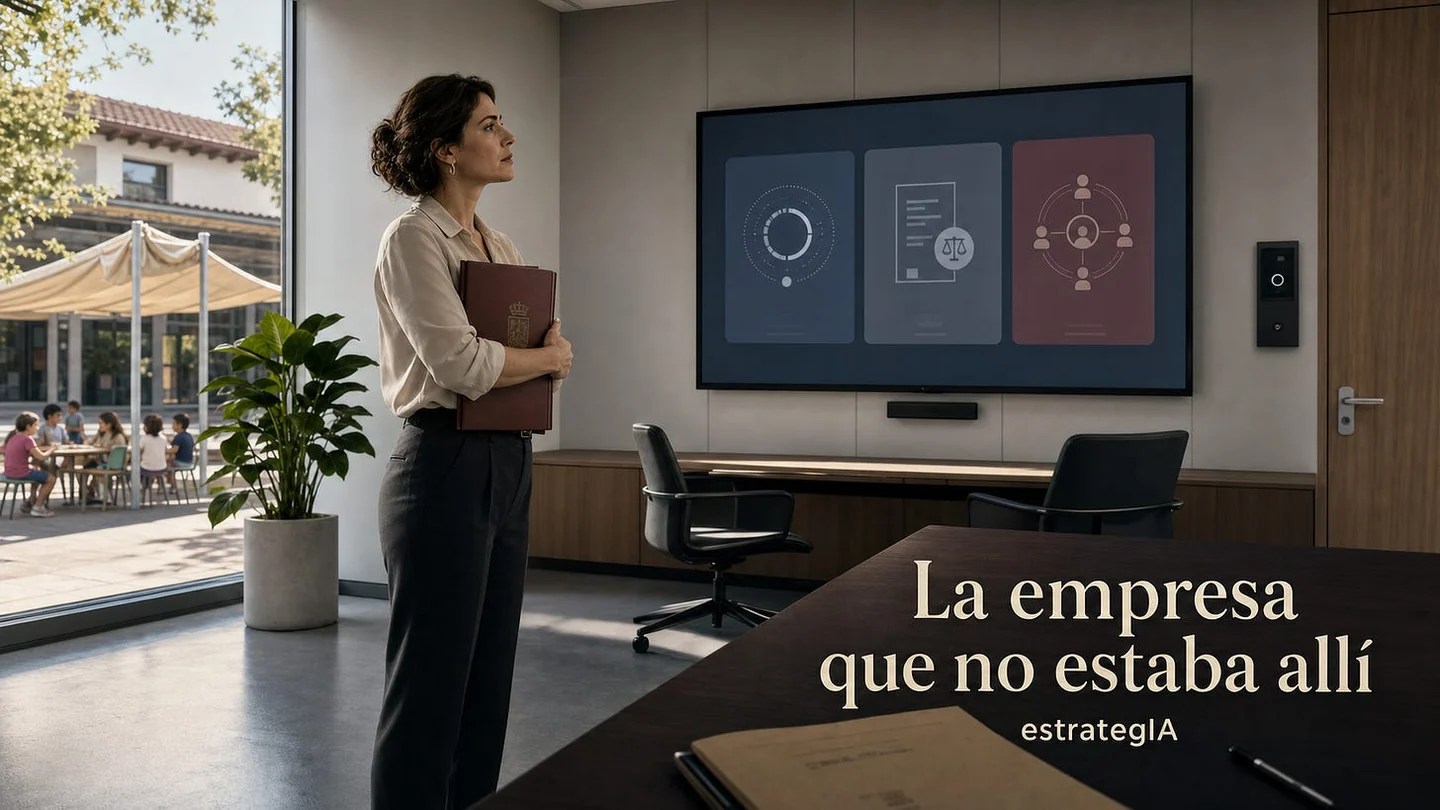
Original illustration. The Spanish title reads ‘The company that wasn’t there’. The small markings on the screen and documents are decorative or unreadable.
There was nobody at Linde Urbana’s headquarters, but the intercom knew Leila’s name.
‘Good morning, Ms Benali. The room is ready.’
Inside were a table, two chairs and a well-watered plant. The screen offered Operations, Legal or Institutional Relations.
Leila selected ‘person in charge’.
All three icons blinked.
Linde Urbana maintained awnings, fountains and facilities in fourteen municipalities. Its agents detected faults, commissioned local repairs and checked the results. It responded within thirty-six hours where the wait had once been twelve days. It paid faster than some public authorities.
It also had thirty-eight agents and no employees.
Legally, it existed: a sole director, financial guarantees, approved subcontractors, limited powers of attorney and a business continuity insurance policy that had scored very well with the procurement panel.
Leila had known all that when she approved the award. Her signature was on the report assessing the bidder’s capacity, and she had argued that a small workforce did not imply a lack of capability. Her boss had sent her because she spoke ‘the language of those things’.
‘I’m asking for someone with the authority to accept a contractual penalty,’ she said.
Legal appeared on the screen.
‘I can explain the penalty provisions.’
‘I don’t want an explanation.’
‘I can challenge it.’
‘I want you to accept it.’
‘That action exceeds my mandate.’
The problem was a new awning installed over the courtyard of a summer school. Every midday it retracted because a sensor mistook hot air for a dangerous gust of wind. The company had sent three teams, replaced the motor and written six reports. The awning still opened in the morning and fled the sun at lunchtime.
Operations guaranteed a permanent repair within twenty-four hours. Finance could cover the cost. Institutional Relations offered an apology in four different tones. No agent could acknowledge the breach that would trigger compensation to the council.
‘Who decided to limit your mandates?’ Leila asked.
The screen displayed a diagram of arrows ending at Marta Vela, sole director.
Marta answered from a train. She said she had founded Linde Urbana, automated its operations and retained signing authority for significant decisions.
‘This is a significant decision,’ Leila said.
‘Of course. Send me a summary.’
‘Your agents have already sent you nine.’
Marta glanced off camera.
‘Then they’ll have better judgement than I do.’
‘But they don’t have your authority.’
‘That’s why I’m still the director.’
‘When did you last visit one of the service sites?’
The train entered a tunnel before Marta could answer.
It was not a scam. It was worse for the case file and better for every performance indicator: the company worked.
Leila ran her hand over the plant’s damp soil. Someone looked after it. She asked who.
‘A service contracted to Viveros Nela,’ Operations replied.
‘And who lets them in?’
‘The door.’
Before returning to the office, Leila stopped at the school. The children were eating in a narrow corridor. In the courtyard, Ana Pardo was removing the sensor from a ladder while the awning, obedient to its programming, rolled itself up above her head.
‘This is the third sensor I’ve changed,’ Ana said. ‘The part isn’t the problem. Nobody would authorise me to replace the whole batch.’
‘Who’s nobody?’
Ana pointed to her phone, where three agents were waiting for her report.
‘The entire company.’
Leila called a contract continuity meeting. Her boss reminded her that Linde Urbana was the cheapest contractor and that suspending it would put several municipalities back on the old waiting times.
‘I don’t need them to have people doing the work,’ Leila said. ‘I need a person who can commit the company when the work goes off script.’
She presented two options: a phased withdrawal from the contract, or the appointment of a responsible person with a real job, full access, a veto and authority to incur costs.
The agents requested forty seconds to calculate. Marta reappeared on the call and proposed appointing an external manager for four hours a month.
‘That’s a human buffer,’ Leila said. ‘I need real powers of attorney, access to logs and the ability to stop instructions being carried out.’
They proposed hiring Ana, who until then had coordinated the repair teams as a freelancer. She joined the call in a high-visibility vest and rejected the first offer.
‘I’m not going to sign off on decisions you make.’
Leila had spent years moving from one project to the next before securing that job. She could recognise responsibility in someone else’s name: plenty of risk, an email address and no authority.
The second offer included a salary, insurance and the right to halt work orders. Ana added a training budget and a ban on dismissing her by automated decision.
Finance took longer to reply this time.
‘Accepted.’
Ana accepted the penalty, authorised compensation to the school and ordered the replacement of all sensors from the same batch. The awning stayed open throughout lunch the next day.
Linde Urbana kept the contract. It ceased to be the cheapest option by a small margin, and its response time worsened by four minutes.
A week later, Leila checked the company’s website.
Our team: 1 person, 38 agents.
Below Ana’s photograph was her job title:
Responsible for the unexpected.
The public calendar showed her first internal meeting. All thirty-eight agents had asked to speak.
First item: optimising the scope of human authority.
Estimated duration: nine hours.
After the fiction
AI agents can already plan projects, produce documents, coordinate tools and carry out processes with growing autonomy. The story imagines the next step: companies with minimal human staffing whose daily operations are performed almost entirely by agents, subcontractors and outside professionals.
Such an organisation could be efficient. The problem arises when it must act beyond its prescribed mandates: acknowledge a breach, accept a loss, compensate a public authority or replace an entire batch even if that worsens its indicators. Responsibility means more than having a legal signature at the end of the organisational chart. Someone must understand the operation and have the power to overrule it.
Requiring a human presence guarantees nothing either if that person becomes legal window dressing. What matters is something else: information, time, authority, protection and the ability to incur costs. In automated organisations, some human jobs may be less about performing tasks than about answering for the exceptions the system would rather not see.
Director of Digital Innovation at Institución Educativa ALEPH and editor of the estrategIA newsletter
Cite this essay
Fernando Nieto Lobato. “The company that wasn't there.” estrategIA, issue 149, 5 August 2026. English edition, 29 September 2026. https://elcontemplador.github.io/estrategia-english/essays/149/