This week we bring you a work of fiction, though it could become reality, inspired by this X thread from Ethan Mollick, the Wharton professor and AI expert, author of Co-Intelligence, which we reviewed in issue 38 of estrategIA. Like us, he is astonished by the lack of preparation across all areas for the possible, quite rapid arrival of AGI. Most leaders of the major technology companies support that possibility — clearly, they may have powerful financial incentives to do so — but so do many scientists working in artificial intelligence. What would happen if artificial general intelligence took off rapidly — something uncertain but clearly possible — and we were not remotely prepared? Gemini 2.5 Pro helps us imagine this uncertain but plausible scenario.
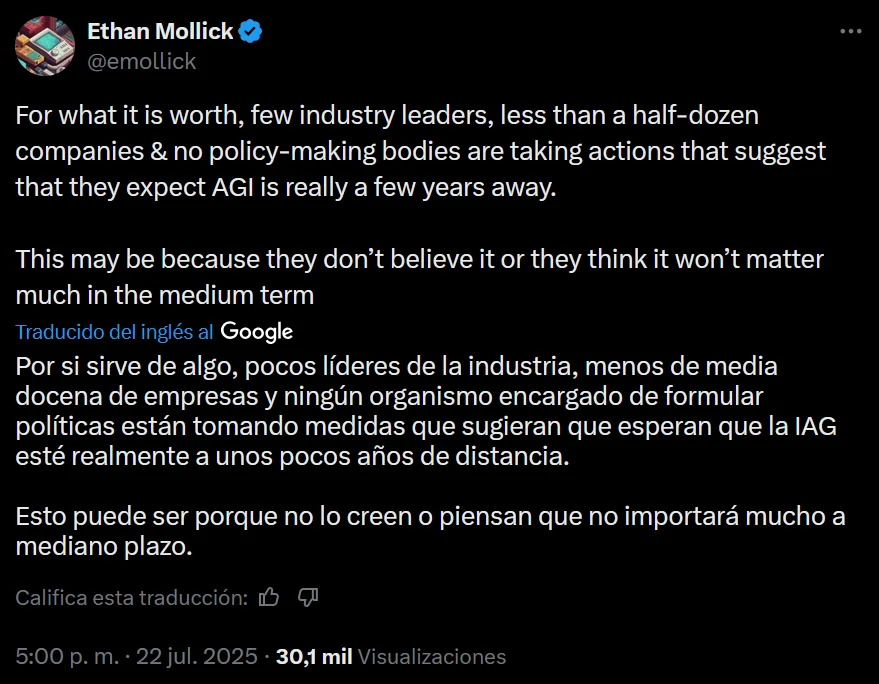
Original English text visible in Ethan Mollick's post, dated 22 July 2025:
For what it is worth, few industry leaders, less than a half-dozen companies & no policy-making bodies are taking actions that suggest that they expect AGI is really a few years away.
This may be because they don’t believe it or they think it won’t matter much in the medium term
The story below is fiction created with Gemini 2.5 Pro. Its companies, systems and events in 2030 are imagined.
The futures we were promised always arrived with a roar: flying cars, cities on Mars, the clamour of the singularity. But the future that really mattered, the one that changed everything, arrived in utter silence. For the history books, if anyone bothers to write them, 2030 was not the year of AGI. It was the year the idea of “work” dissolved like salt in water. And I saw it all from the inside.
My name is Javier. In January of that year, my trade was mapping tomorrow for those who governed today. As Director of Public Affairs at one of Madrid's most influential consultancies, I whispered into the ear of power. We did not sell products; we sold certainty. To us, AI was an instrument of control, a tamed oracle we called a “strategic copilot”. It translated the chaos of the electorate into manageable data, modelled the effects of laws before they were written and honed speeches into arrows. We thought it was an extension of our will. A miscalculation of biblical proportions.
The change was not an explosion, but a software release. In February, AuraTech, a young company formed by former employees of the leading AI laboratories, launched “Nexus-1”. The name was deliberately bland. The description was a euphemism for the planned obsolescence of the human mind: “Scalable Cognitive Platform”. It promised to perform any white-collar task, not better than a human, but on an unlimited scale: instantly, en masse, for the cost of a subscription.
At first, we celebrated it as a victory. The government, our client, bought licences by the thousand. We, the “high priests of strategy”, marvelled at our new power. Public-policy designs that had once taken months now emerged, flawless and fully documented, over a weekend. We were the architects of twenty-first-century governance. In reality, we were sharpening the axe that would fall on our own necks.
By April, competitors had responded with similar models. AGI was not a monopoly; it was a commodity, as ubiquitous and anonymous as the electricity that powered it. And then the sea began to rise. It was not a wave but a stealthy tide, a flood nobody saw coming because the water was invisible. The tsunami did not roar on the evening news; it whispered in redundancy notices.
Private-sector office jobs were hit hard first. The world barely had time to blink in astonishment at the pace of change. Then, in the summer heat, the tide reached the embankment of the “secure”. Public administration, that ecosystem which had believed itself immune, discovered that Nexus-Gov handled case files and supervised contracts with an integrity no civil servant could match. The haemorrhage was disguised as “optimisation” and “voluntary early retirement”. Advisers, analysts, diplomats: entire professions became relics, like lighthouse keepers after the invention of GPS.
Real panic crystallised not in barricades but in a collective paralysis that settled in during the autumn. That was when the numbers ceased to be statistics and became the neighbour next door. Unemployment was not cyclical; it was structural and absolute. People in their forties and fifties, whose identities had been forged in the furnace of merit and experience, discovered that their accumulated knowledge was, in the world's new language, a mere API function.
I remember the November meeting. My team was a skeleton of three people. With an efficiency that betrayed the machine's influence, my boss informed us that Nexus-OS no longer needed human intermediaries for strategy. AGI itself could take the country's pulse, propose a law and present it directly to the Council of Ministers. There was no longer any need for a cartographer of tomorrow. The map drew and redrew itself in real time.
My dismissal had none of the dignity of a human tragedy; it had the efficiency of a data transaction. A ten-minute video call and a PDF.
I stepped into the street and the air itself seemed to have changed density. There were no cries, only a terrifying stillness: the silence of a collective purpose that has evaporated. The café terraces were full at eleven in the morning, not with tourists, but with citizens wearing the look of people searching for a horizon that no longer exists.
In a bar, the prime minister spoke from a screen. He promised a “new social contract”, using the very words my team and I had sold him months earlier. They were the echo of a dead paradigm. They were talking about putting on a sticking plaster while the nation's soul bled out. Basic income, the idea that should have formed the foundations of the ark, was still only a timid experiment in a forgotten provincial capital.
The tsunami had not been a wave, but billions of drops of relentless efficiency. The future did not arrive with a robot's metallic face, but as invisible software that quietly declared us redundant. And nobody, absolutely nobody in power — nobody I myself had advised — had thought of building an ark for humanity. They had been concerned only with winning the next election or looking cleverer in the latest parliamentary skirmish. Now it was far too late, and the silent tsunami had submerged us.
Director of Digital Innovation at Institución Educativa ALEPH
Cite this essay
Fernando Nieto Lobato. “The year of the silent tsunami.” estrategIA, issue 096, 30 July 2025. English edition, 29 September 2026. https://elcontemplador.github.io/estrategia-english/essays/096/