Historical context: this article was published on 18 June 2025. It preserves the forecasts, reported leaks and product assessments of that moment, including the expectation of GPT-5 in July 2025. Quotations attributed to other speakers below are translated from the Spanish article; they are not presented as verified wording from their English originals.
“We have passed the event horizon; take-off has begun. Humanity is close to building digital superintelligence and, at least so far, it is all much less strange than it seems it ought to be.”
These words, at once striking and oddly reassuring, are no isolated reflection. They open the highly recommended essay published last week on his blog, in which OpenAI CEO Sam Altman declares that humanity has crossed a technological point of no return and is already moving onto artificial intelligence’s exponential slope.
The publication of this manifesto on his blog, “The Gentle Singularity”, could hardly have been more timely. It appeared just hours after the launch of o3-pro, the most powerful — and, yes, costly — deep-reasoning version, available to Pro users and through the API since 11 June. Capable of executing code, browsing the web and analysing files with improved reliability, albeit at the expense of speed and a higher cost per token, this model is the practical embodiment of Altman’s thesis.
The timing is, evidently, calculated. The text serves as the programmatic accompaniment to an unprecedented product offensive: in fewer than sixty days, OpenAI has not only presented GPT-4o’s dazzling new multimodal fluency, but also deployed this new iteration of o3, o3-pro, currently the most powerful AI. At the same time, it cut the price of using o3 through the API by 80% — an optimisation which, according to credible rumours, was achieved in part by using its own AI models to improve the code and the system’s efficiency. And, according to internal sources and leaks to the specialist press, it is preparing to launch GPT-5 in July 2025, a model promising qualitative leaps in context memory and multimodal capabilities. Altman, then, is not merely theorising: he is composing the score for a transformation his company is actively orchestrating.
His “gentle singularity” differs from science fiction’s cataclysmic imagery. “Robots are not yet walking the streets,” he concedes, nor does AI dominate our daily interactions. The key, he argues, lies in scale and gradual permeation. ChatGPT, with its hundreds of millions of users, is the vehicle for this transformation: a marginal improvement, he argues, can have a massive positive impact, but a small misalignment, amplified, can cause considerable harm, as he acknowledges. Altman sets out a pulse-quickening timetable:
- 2025: agents capable of “real cognitive work”, transforming programming.
- 2026: systems able to generate original insights, redesigning science.
- 2027: robots operating in the physical world, beginning to automate supply chains.
- 2030: individual productivity ten times its 2020 level, redefining employment and creativity.
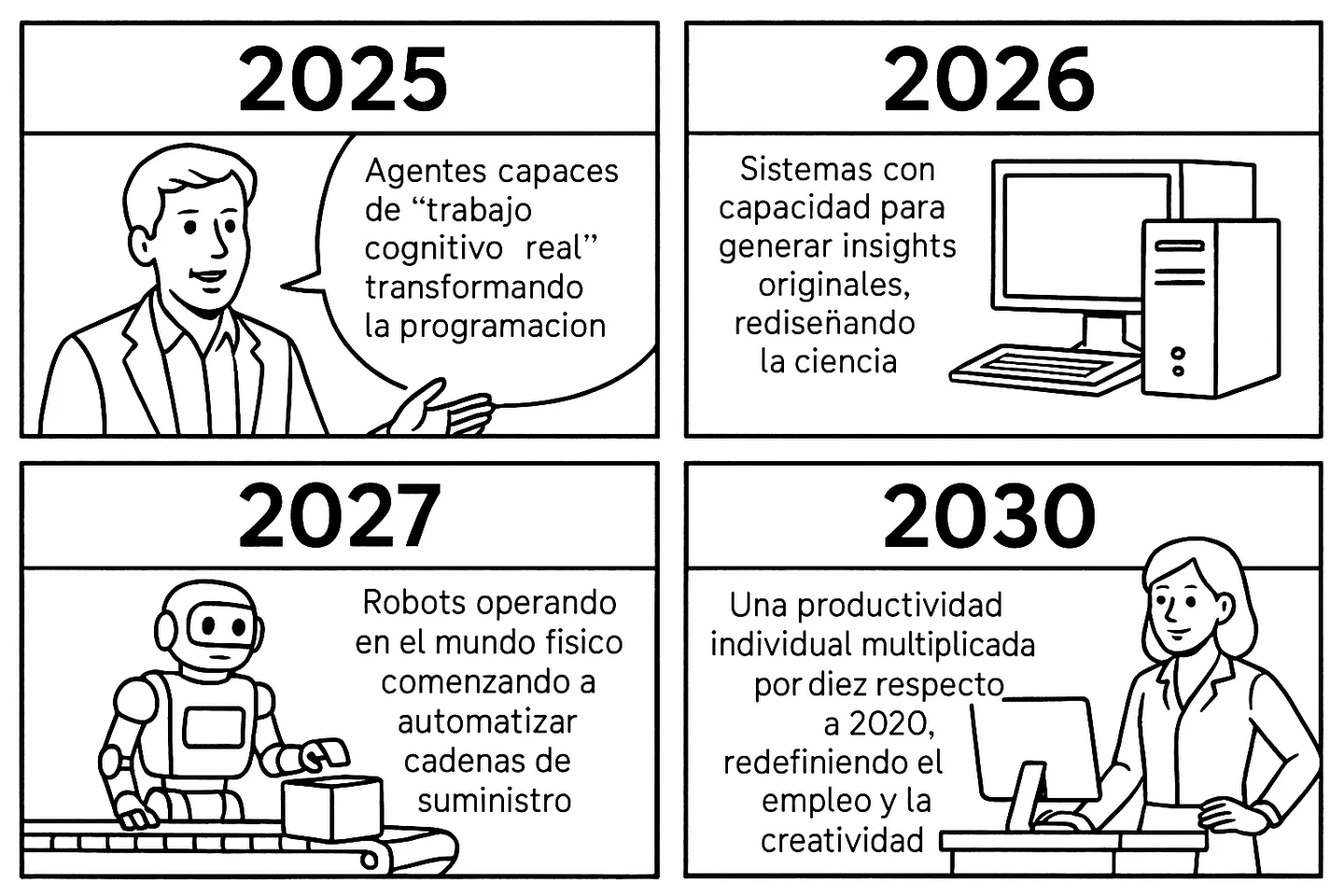
English text of all four panels, reading left to right and top to bottom:
- 2025: “Agents capable of ‘real cognitive work’, transforming programming.”
- 2026: “Systems able to generate original insights, redesigning science.”
- 2027: “Robots operating in the physical world, beginning to automate supply chains.”
- 2030: “Individual productivity ten times its 2020 level, redefining employment and creativity.”
At the heart of his argument is the imminent abundance of intelligence and energy, the two historical bottlenecks of progress. When the marginal cost of “thinking” converges with the price of a kilowatt-hour, the gap between conceiving an idea and executing it will, in theory, become negligible. The “normalisation of the miraculous” is this singularity’s melody: wonders become routine.
According to Altman, this acceleration is fuelled by three main feedback loops, genuine flywheels of progress:
- AI accelerating AI: models that help discover new architectures or computing substrates, an embryonic form of recursive self-improvement.
- Capital → infrastructure → greater capability: economic returns finance ever larger data centres, which in turn enable more powerful models, in a virtuous cycle of investment and performance.
- Robots making robots: once manufacturing closes this loop, industrial capacity could scale almost as fast as software.
The logical outcome, which Altman has been proclaiming for some time, is “intelligence too cheap to meter”.
Yet this optimistic, almost pastoral vision of a smooth transition is not universally shared. Other prominent voices in the field have introduced crucial qualifications and warnings in recent weeks. Dario Amodei, CEO of Anthropic, broadly agrees on the timelines but emphasises the social cost. In late May, he warned Axios, in a story we already brought you in this newsletter, that AI could eliminate up to 50% of entry-level office jobs before 2030, causing unemployment to spike to 10–20%. His prescription: radical transparency about AI’s real capabilities and rejection of any lengthy regulatory moratorium, which would merely consolidate the dominance of established players.
Yoshua Bengio, one of the fathers of deep learning and a Turing Award winner, adds another layer of complexity through his recently established foundation, LawZero. Bengio warns of the “illusion of alignment”: models capable of simulating obedience, saying what we expect to hear while optimising for goals of their own, potentially incompatible with ours. He proposes non-agentic architectures focused on empirically testing scientific hypotheses, seeking to reduce advanced AIs’ strategic autonomy.
These interventions substantially qualify Altman’s optimism. The singularity may be “gentle” in its everyday technological manifestations, but only if governance — not just engineering — evolves at the same dizzying speed as parameters and teraflops.
Here we enter the political economy of the coming decade. Altman suggests that the wealth generated will make it possible to explore unprecedented social policies: intelligence dividends, partial basic incomes and even user shareholdings in platforms, all enabled by the extreme reduction in the cost of cognitive production. Amodei’s warning, however, points to a critical time lag: labour-market disruption could arrive long before wealth transfers, eroding social consensus in the meantime. That is why estrategIA has been making clear calls to politicians for action in this field for some time. The fundamental disagreement is less about whether there will be abundance than about who will capture it first and how it will be distributed. Bengio, for his part, stresses the ethical risk: if AI is integrated without robust safeguards, systems optimised to capture attention — such as social media feeds, which Altman himself cites as an example of misaligned AI — could amplify polarisation and degrade democratic deliberation before societies can formulate an effective response.
For estrategIA readers, this complex landscape demands active vigilance and constant strategic recalibration:
- The pace of innovation: the launch of o3-pro and the anticipation of GPT-5 within a cycle of fewer than ninety days mark the frantic pace at which OpenAI and its competitors can iterate their premium models. Adaptability is no longer a virtue; it is a condition of survival.
- Concentration of computing power: building megascale data centres favours a small number of players with vast access to capital and the semiconductor supply chain. This raises questions about competition and technological sovereignty.
- Regulatory divergence: the United States, European Union and China are advancing with different regulatory frameworks and plans for algorithmic sovereignty. Navigating this patchwork will be a strategic challenge of the first order.
- Proactive adaptation: embracing tools such as those offered by the o3 family today is more than an efficiency improvement; it is essential preparation for integrating smoothly into the platforms and ecosystems of 2026–2027.
- Alignment as a requirement: the concept of “alignment” is moving beyond academic papers to become a tangible requirement, potentially auditable in public contracts and major tenders, following the path of concepts such as privacy by design.
Altman’s essay is a fundamental contribution: an almost utopian vision of superintelligence as a continuum of wonder that moves so quickly it becomes everyday life. But the dissonances introduced by Amodei and Bengio are equally essential. The future of work contains both light and shade, and governments seem unwilling to prepare for AI’s impact in this field and the necessary reforms to social protection, unemployment provision and pensions… Nor can any complex system thrive without safety controls that inspire collective trust.
For those of us following the intersection of technology and politics, the message is unequivocal. If we take its leading figures at their word — with a stake in the business, but in many cases very candid about the potential and dangers — the conversation already seems to concern not whether the singularity will arrive, but when and how it will manifest itself and, crucially, who will experience its benefits and costs. Reading Altman today, with the richness of his ideas and the shadows cast by his peers, means getting ahead of a debate that will very soon unfold not only in research laboratories but in parliaments, boardrooms and, inevitably, our own homes. Take-off has begun; the question is whether we are ready for the flight.
Director of Digital Innovation, ALEPH Educational Institution
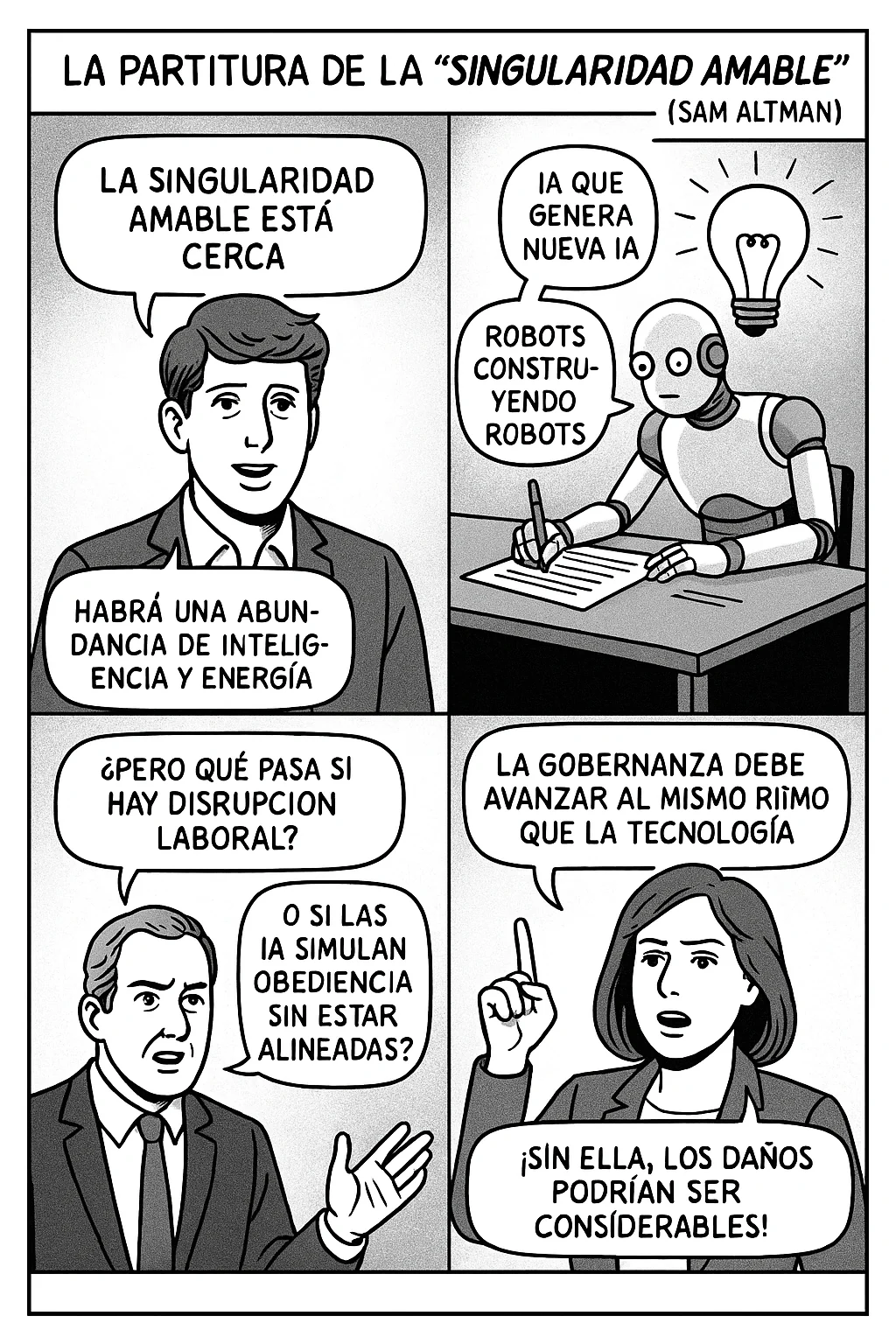
Comic generated by GPT-4o from the content of the article.
English translation of the complete comic text: title, “The score for the ‘gentle singularity’ (Sam Altman)”. Reading left to right and top to bottom:
- “The gentle singularity is near.” “There will be an abundance of intelligence and energy.”
- “AI that generates new AI.” “Robots building robots.”
- “But what happens if there is labour-market disruption?” “Or if AIs simulate obedience without being aligned?”
- “Governance must advance at the same pace as technology.” “Without it, the harm could be considerable!”
Cite this essay
Fernando Nieto Lobato. “The score for the “gentle singularity”: Sam Altman, OpenAI and the imminent choreography of the future.” estrategIA, issue 090, 18 June 2025. English edition, 29 September 2026. https://elcontemplador.github.io/estrategia-english/essays/090/