Archive note: this essay was published on 1 January 2025. Its forecasts and policy arguments are preserved in their original context. The Tony Blair quotations below are translated from the Spanish article, except for the sentence about government and process, which already appeared in English in the source. The description of Hinton as “this year’s” Nobel laureate is retained from the source despite its January 2025 publication date.
Artificial intelligence is not simply a technological tool; in all likelihood, it will drive a revolution — at least comparable in scope to the agricultural or industrial revolutions — that will completely reshape society, the economy and politics over the coming decades. At a time when 2025 could, in light of developments as fascinating as o3, mark the beginning of the arrival of artificial general intelligence (AGI), political leaders must take bold, courageous decisions to prepare societies for a highly probable, though not certain, near future in which change will unfold at breakneck speed.
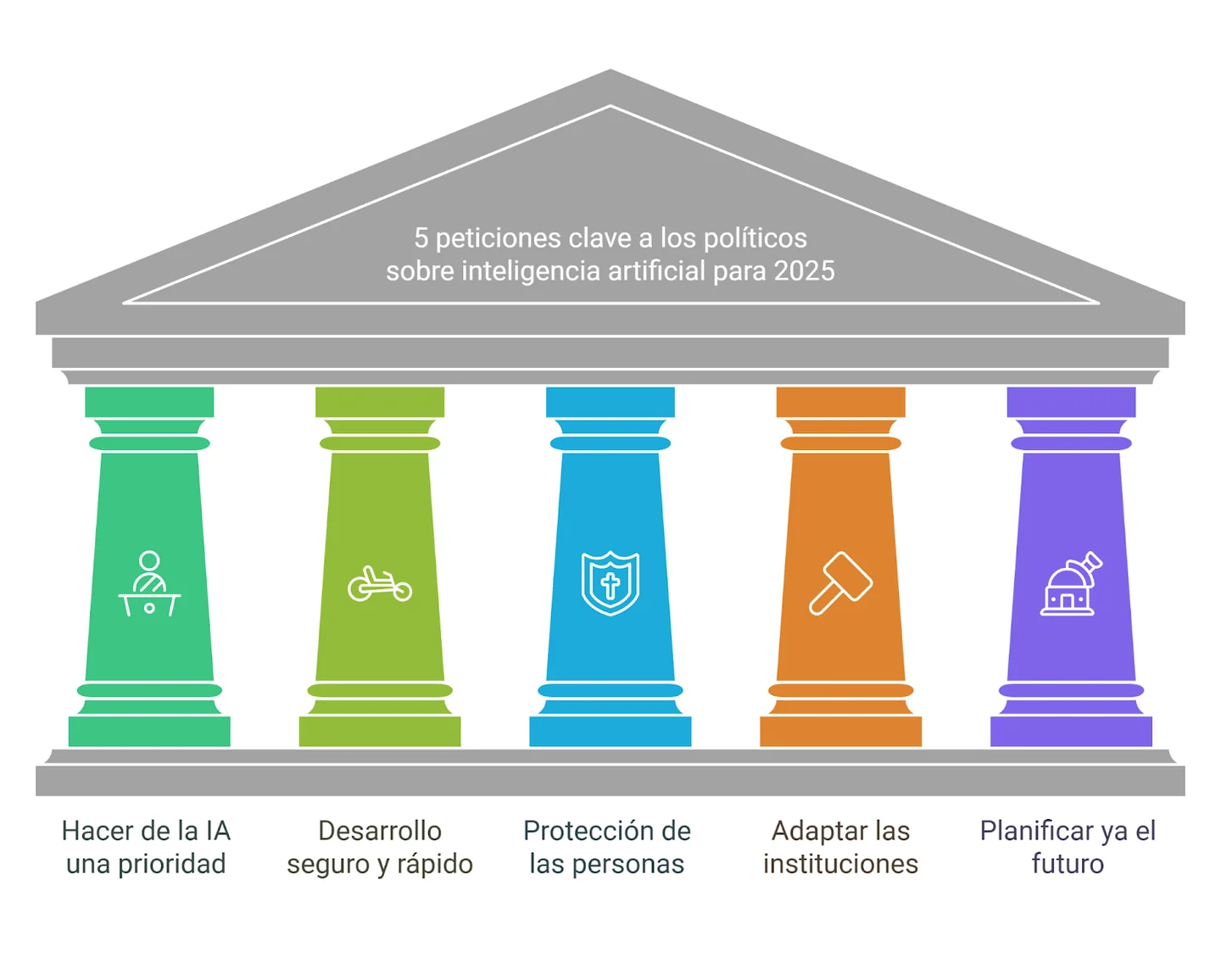
Original diagram: “Five key requests to politicians on artificial intelligence for 2025”. Its pillars are: make AI a priority; develop it safely and quickly; protect people; adapt institutions; and start planning for the future now.
These are five fundamental requests that we at estrategIA put to them, drawing on the knowledge gained from following this subject closely, week by week, to address this historic challenge.
1. Make artificial intelligence a priority
It should probably be “the priority”, given its innovative potential and exponential pace of development, but I would already settle for politicians treating it as something important. Very few are aware of the transformations that are very likely coming. One of those who has expressed this best is former British prime minister Tony Blair, who declared several months ago that “artificial intelligence means there has never been a better time to govern”, for reasons such as these:
There is absolutely no doubt that we are in an era of transformation. Things that were previously impossible will become possible; advances that would have taken decades will happen in a few years or even months; the value we can add, the efficiency improvements we can achieve and the radical improvements in outcomes we can secure could be truly revolutionary.
Over the coming years, AI will affect every field of science, the economy and society in ways we cannot yet even begin to imagine. Failing to make it a priority in 2025 would be a catastrophe, and seeing how entangled our representatives are in their “same old” disputes and problems does not inspire much optimism. Countries or regions that properly grasp the scale of change and the priority AI requires will enjoy a distinctive advantage for a long time, because of the field’s own accelerating character: over the next few years, perhaps beginning as early as 2025, AIs themselves will train and improve the next generations of artificial intelligence, accelerating development still further. This is a crucial distinction from every other technology in history and must not be underestimated.
This calls for comprehensive policies with international coordination, as well as training for political leaders and senior technical staff in public administration. Prioritising AI is not enough: politicians need at least a basic understanding of its technical, ethical and social foundations. Continuing education for politicians, civil servants and advisers could be crucial to improving decision-making quickly. The public sector also needs to commit firmly to making AI development a priority. Understanding, regulating and legislating are not enough: we need to develop, promote and apply AI in politics and government, and make it easier for businesses in the sector to emerge and grow in our countries and regions.
2. Promote safe AI development — as quickly as safety allows
Safety in AI development is crucial, but so is moving quickly to benefit from it. As Oxford professor Nick Bostrom points out in this video clip, which we strongly recommend, every day we delay the responsible implementation of these technologies, we unnecessarily prolong human suffering.
Humanity has a moral imperative to help people as soon as possible, and that should lead to responsible acceleration. Speed should come from the conviction that AI can alleviate suffering. In healthcare, for example, applying AI to early diagnosis, drug discovery or the optimisation of health systems will very probably save millions of lives. Delaying these benefits out of fear, without sound justification, can be seen as a moral failure towards citizens.
This must be compatible with developing safe AI that takes account of the needs of society as a whole and of every individual, rather than only the interests of the powerful or large corporations, which might be tempted to appropriate both AI and its fruits, producing a deeply unequal society, as this year’s Nobel Prize in Physics laureate Geoffrey Hinton warns. Democratising AI and access to it is therefore also essential. Some proposals even seek to ensure that every citizen has a state-guaranteed allocation of computing capacity, because it could become as basic a need, and as decisive a source of advantage, as access to running water, electricity or the internet is today.
3. Protect people, not jobs
We no longer have night watchmen, lamplighters or horse-drawn carriage drivers as we did at the end of the nineteenth century. We have been through repeated industrial restructuring, much of it in Spain, unfortunately, extraordinarily painful and unsuccessful because of the approach taken.
History teaches us that protecting obsolete jobs or anachronistic institutions is inefficient and does not work in the medium term. Instead of trying to preserve a twentieth-century employment system, we should focus on protecting people by guaranteeing their dignity and basic living conditions.
During the industrial revolution, many restructuring efforts failed because maintaining jobs took precedence over preparing people for new realities. Today, measures such as universal basic income (UBI) offer a more modern and effective way to support the transition — which could be deeply traumatic because of its speed — towards a post-scarcity world in which AI-powered machines do most of the work, while scientific innovation and new technological developments make products and services vastly more affordable.
It seems vital for politicians to begin studying measures in 2025 that, because they are novel and technically complex to design and implement, cannot be improvised overnight when, as we anticipate, large-scale job destruction begins within a few years. We would highlight two particularly urgent priorities:
-
Introduce universal basic income when AIs and robots begin performing jobs on a massive scale — something that will happen over the coming years and decades — as an economic safety net and a guarantee of equality that, at the very least, covers the population’s basic needs. It would also release people’s creative capacity from the yoke of paid work, which, unfortunately, is not an activity that most humans find satisfying. It is also fairer than alternatives that might protect those already in work but leave unprotected people who are unemployed or lose their jobs to automation, and who would find it very difficult to obtain paid employment in a context in which AIs become better, more efficient and cheaper every year. Universal basic income focuses on preserving everyone’s dignity on a universal basis and is very likely — whatever final model is adopted, since there are many ways to implement and finance it — to be the best transitional solution during the initial arrival of AGI and the development of artificial superintelligence (ASI).
-
Redesign education to prepare people for a future in which human skills complement AI and possible new jobs emerge in new and different areas. It must also prepare us mentally for life in a society in which much of our identity is no longer defined, as it is today, by paid work — work that AIs and robots will in the vast majority of cases perform better.
Economic history shows that trying to maintain anachronistic jobs is inefficient and often doomed to failure. Instead of sustaining the employment structures of the past, politics must safeguard people’s wellbeing, rather than perpetuate inefficient jobs or structures that will disappear sooner or later. It must begin studying and adopting new solutions to a situation completely unlike anything we have experienced.
4. Be willing to “break things”: many surviving nineteenth-century institutions, or older ones, will not work well, and changing or removing them will be essential
Closely linked to the previous point, this recommendation could also draw directly on another pertinent observation by former Labour prime minister Tony Blair:
“Government is all about process, and AI is all about automating process.”
Many areas of public administration could be largely automated, greatly improving efficiency and generating budget savings that could be used to protect citizens more broadly through proposals such as universal basic income. Such measures will become feasible partly thanks to these efficiency gains and the enormous savings in administrative structures.
Today’s bureaucracy and institutional machinery, inherited from the Industrial Revolution, could become obsolete in the face of AGI’s dynamism. Tony Blair stresses that AI can automate government processes, rendering many existing structures slow, expensive and ineffective. This new reality, which will arrive very quickly over the coming years, raises the following requirements:
Institutional redesign: we need to rethink governance, from more agile parliaments and ministries to flexible oversight agencies capable of responding to emerging problems.
Automation of administrative processes: digital government has been the first step; AI makes it possible to go much further. Automating tedious, repetitive tasks would not only save money but also allow resources to be redirected towards more personalised social services. This will mean reassessing roles, hierarchies and responsibilities in the civil service. The European Union already offers a very clear example of the survival of an institution that is “obsolete” for its purpose: several European countries still require notarial procedures to set up a company. This is provoking a fierce response on social media from entrepreneurs’ associations calling for procedures suited to the year we live in and the technology available, as already exist elsewhere, including in many EU countries such as Estonia.
5. Start planning for the future now: do not pass the problem on to the next government
It is impossible to address a transformation as enormous as the one AI will bring to our lives in the period ahead without thinking, for once, about the next ten years, rather than the ten months that may remain in a parliamentary term or the ten weeks of an election campaign.
The transformation that artificial intelligence will bring requires bold measures that cannot be improvised or put in place in a fortnight; the entire welfare state in Europe and many other countries will probably need to be redefined. The timescales of this technology and the companies driving it are nothing like those to which governments and public administrations are accustomed.
Exploring measures such as universal basic income or similar arrangements is crucial, in anticipation of the likely automation of the vast majority of jobs. UBI could guarantee everyone’s subsistence and grow in purchasing power as scientific and technological advances reduce the cost of products and services. Alternatives to the simpler, more direct option of a cash income include giving citizens a stake in public AI companies or organisations, or guaranteeing access to resources such as computing time or robots that work on their behalf. Properly implemented, these measures could lead to a post-scarcity society with a significantly higher quality of life than today, while mitigating the enormous problem of rising inequality that AI’s advance makes possible as human labour becomes increasingly irrelevant.
At the same time, redesigning the tax system is essential to adapt it to this new reality. AI will generate enormous corporate profits that must be taxed proportionately, while taxes on labour income in their current form will become far less important — whether agents or robots should be taxed is a separate question. This new tax framework must not only guarantee fairness but also encourage innovation and universal access to AI’s benefits.
The social contract between citizens and the state will need to be updated to ensure that the fruits of AI are shared fairly. Governments’ legitimacy will depend on their ability to protect people, rather than obsolete employment or administrative structures, and to manage change with foresight, always putting collective wellbeing before particular interests.
A final reflection
The arrival of AGI — assuming it materialises within a very few years, as everything currently seems to suggest, although science and technology offer no dogmas or absolute certainty, and we must work with the available evidence, which clearly points in this direction — demands a radical transformation in how governments act. The five requests set out here revolve around the same idea: AI and AGI are not simply additional tools, but transformative forces that require a profound rethinking of political priorities, structures and ways of working. Prioritising AI, developing it safely but quickly, protecting people ahead of outdated institutions, being willing to redesign the state and public administration, and planning for the long term form an ambitious but necessary framework for action.
Politics cannot confine itself to obstructing technological change or watching it passively. It must take its place at the centre of events, anticipating risks, seizing opportunities and, above all, making human dignity and global wellbeing the ultimate guiding principles of public action. Only then, as we reach the end of this decade, will we be able to say that the AI revolution has been steered towards a fairer, more prosperous and more humane future.
Fernando Nieto Lobato
Director of Digital Innovation, Institución Educativa ALEPH
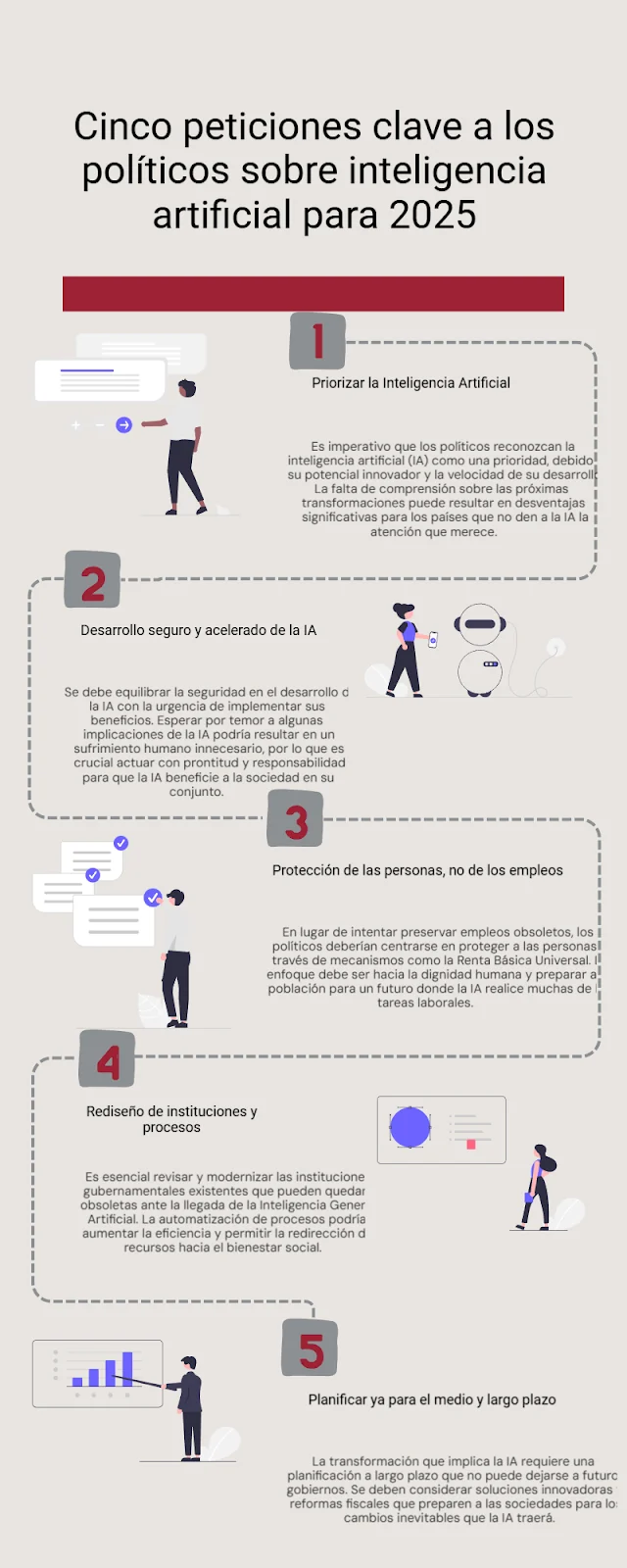
English reading guide to the original infographic, “Five key requests to politicians on artificial intelligence for 2025”. Some lines are clipped at the right edge of the original image; the complete argument is available in the article above.
- Prioritise artificial intelligence. Politicians must recognise AI’s innovative potential and pace of development. Failing to understand the coming transformations could leave countries at a significant disadvantage.
- Develop AI safely and at speed. Balance safety with the urgency of delivering benefits. Delay driven by fear can cause unnecessary human suffering; prompt, responsible action should benefit society as a whole.
- Protect people, not jobs. Focus on human dignity and measures such as universal basic income, while preparing people for a future in which AI performs many work tasks.
- Redesign institutions and processes. Review and modernise government institutions that could become obsolete with AGI. Automation could increase efficiency and redirect resources towards social wellbeing.
- Plan now for the medium and long term. Do not leave long-term planning to future governments. Consider innovative measures and tax reforms to prepare society for the changes AI will bring.
Cite this essay
Fernando Nieto Lobato. “Five essential priorities for politicians facing the AI revolution in 2025 and beyond.” estrategIA, issue 066, 1 January 2025. English edition, 29 September 2026. https://elcontemplador.github.io/estrategia-english/essays/066/