This week we continue our summer historIAs: fictional stories exploring some of the political and human dilemmas artificial intelligence may pose in an increasingly near future.
This time we turn to a subject as everyday as it is delicate: caring for older people. Governments and public administrations are beginning to promote telecare systems capable of detecting falls, changes in routine or possible loneliness. But can artificial intelligence help us rebuild support networks without turning the home into a space of surveillance? “The carer who learnt to call” imagines a public technology that seeks not to replace human affection, but to learn when to intervene, whom it may notify and, above all, when to step aside.
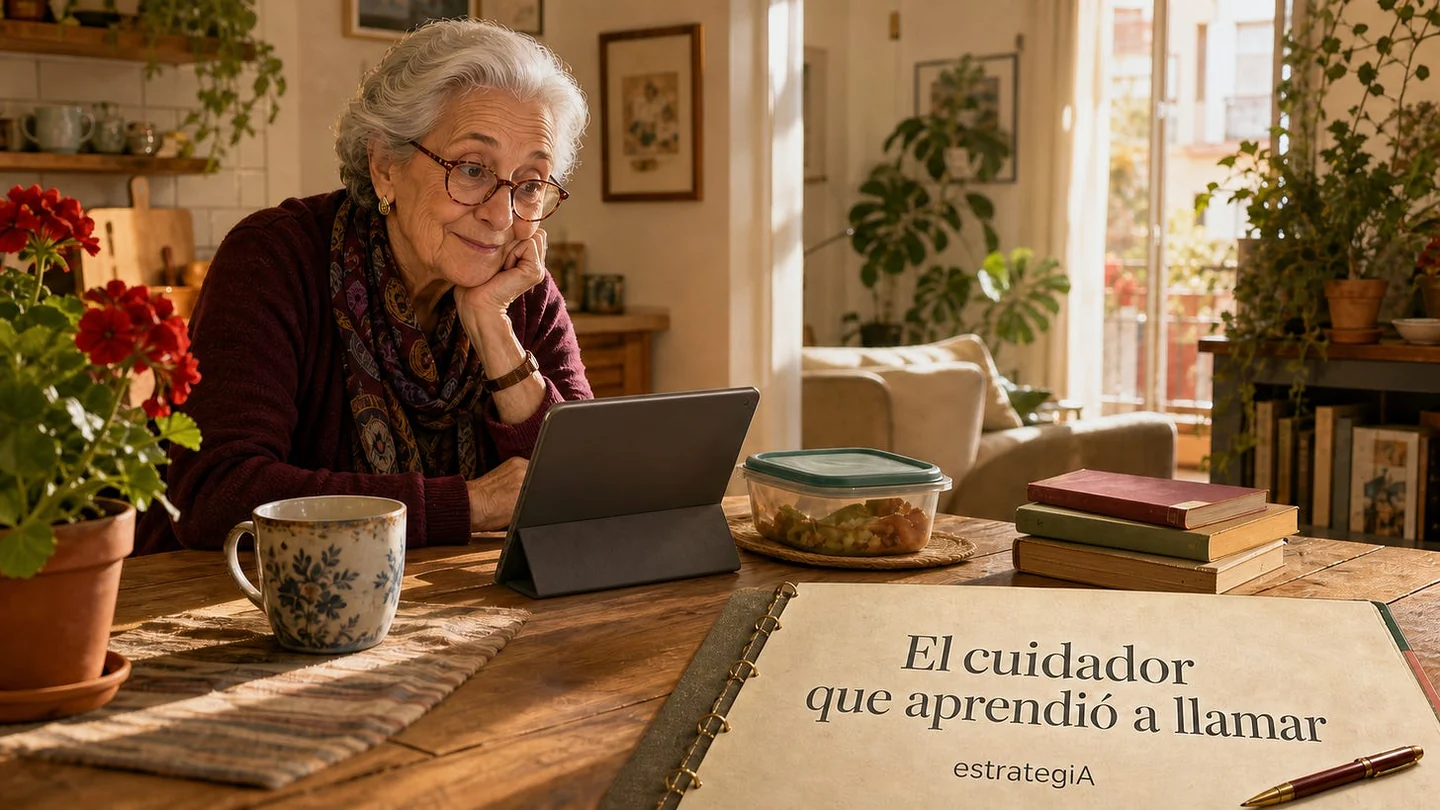
Original illustration titled “The carer who learnt to call”. The kitchen scene brings together a tablet and everyday signs of human contact: books, plants, a mug and a food container. No further substantive text is visible.
“You have had biscuits for dinner four nights running,” Teo said.
Amalia put her cup down on the table.
“The day before yesterday I had toast and jam.”
“The municipal classification does not consider spreading to be cooking.”
“The municipal classification never knew my husband.”
Teo fell silent. It was one of its best qualities. It occupied no particular place in the house: it spoke through the kitchen speaker, appeared on the tablet and switched on a light by the corridor when Amalia got up at night. It reminded her to take her pills, turned off the gas and had once alerted the emergency services when she slipped in the bathroom. That was what she had agreed to.
Not opinions about dinner.
“You have also stopped going to the library,” it continued. “Your activity and sleep have changed since Pilar's death. I can notify Lucía or request a call from the health centre.”
“Not Lucía. She'll come with care-home brochures.”
“Your daughter cannot come until Saturday.”
“Then she'll come on Saturday with more brochures.”
Pilar had lived in the flat opposite for thirty-seven years. They shared coffee, novels and a common hatred of plastic plants. On Amalia's table still stood the mismatched cup Pilar used when she was “only popping up for five minutes”. Since her death, nobody knocked on the door unless they were delivering a bill or asking about her blood pressure.
For years, Pilar had been Amalia's emergency contact without appearing on any form. She kept a copy of her keys, knew which pill she muddled up in the mornings and called when the blinds stayed down. Amalia did the same for her. Teo could detect a fall better than either of them, but until then nobody had explained that a large part of caring meant taking away an empty saucepan and bringing it back full.
“Who may I notify?” Teo asked.
“Nobody who wants to organise my life.”
“That category does not exist among your contacts.”
Amalia smiled for the first time that morning.
Teo opened a list on the tablet. It was not proposing an alarm. It was asking questions.
Who could come in if she did not answer? Rosa, the neighbour on the third floor, but only after ringing twice. Who could know that she had not been out for days? Daniel, the librarian, provided he did not use the word “monitoring”. Who could receive health data? Her doctor. Who could call out of sheer boredom?
“That isn't an emergency,” Amalia said.
“I didn't ask whether it was.”
She added Carmen, an old school friend, although she forbade Teo to message her before eleven.
Before saving the list, the system read every permission aloud. Amalia corrected three, deleted one and added a condition applying to all of them: no sharing how much she slept, what she ate or how often she went to the bathroom. Teo turned the prohibition into administrative language. She made it rewrite it until it fitted into a single sentence: My routines are my own.
Rosa was the first to appear, carrying the food container Amalia had lent her months earlier.
“Your gadget told me I still know how to kill geraniums,” she explained.
Teo had first proposed: Amalia has not been out for days. She deleted it.
“Don't turn me into a fault.”
The approved message was different: Rosa, your plants need someone with experience. They spent the afternoon repotting two plants. Rosa took away cuttings and left a Spanish omelette “too big for one person”.
The next day Daniel called.
“We need you to settle an argument,” he said. “Is the ending of La Regenta cruel or fair?”
“Long.”
“That wasn't one of the options.”
The book club met on Friday in the building's courtyard because Amalia declared she was not yet planning to return to the library. Six people came, each bringing a folding chair and a mistaken opinion. Amalia made coffee. Teo recorded that she had cooked, but had the good sense not to specify that it was only coffee.
Lucía called during the meeting.
“Mum, Teo says you've created a support network.”
“I've created a list of people with permission to bother me.”
“And me?”
Amalia checked the tablet. There were two groups:
People who can call without permission.
People who are only called if I am on the floor.
“You're in the second.”
“Mum!”
“You can lodge a complaint.”
Lucía did not laugh at first.
“I'm your daughter, not an ambulance,” she said.
“Exactly. That's why I want you to call when you can be a daughter.”
There was a silence that Teo did not classify. Then Lucía agreed to talk on Sundays and to any suggestion about care homes bringing the call to an immediate end.
On Monday, the house had two books waiting to be read, four new plants and a food container to return.
“You have three visits scheduled this week,” Teo reported.
“Very good. Now learn to say I'm not at home.”
“To whom?”
Amalia heard the doorbell.
“We'll make the list as we go.”
After the fiction
Telecare systems can already detect falls, remind people to take medication and observe changes in routine. Artificial intelligence broadens those possibilities: it can identify early warning signs, coordinate support and prevent loneliness from becoming an emergency.
The difference lies in who remains in control. Caring should not mean permanent surveillance or always notifying relatives or professionals. Amalia decides what data to share, who may contact her and in what circumstances. Teo is useful not because it replaces Pilar or pretends to feel affection, but because it detects a silence and makes it easier for people who can fill it to return.
The risk is clear: a home that records sleep, diet or movement can become surveillance infrastructure. If these tools are to expand autonomy rather than diminish it, they will need understandable permissions, minimal data and a real ability to say no. Perhaps the best care technology is not the one that provides the most company, but the one that learns when to call someone and when to step aside.
There is also an unmistakably public dimension. These systems will not operate in a vacuum: they will be commissioned, funded or regulated by councils, social services and health systems. Their classifications will determine what counts as normal behaviour, when a variation becomes an alert and which people or institutions should intervene. Their design therefore cannot be left solely to technology providers. It requires transparent public criteria, human oversight and simple mechanisms allowing each person to correct, limit or reject the system's decisions.
Director of Digital Innovation at ALEPH Educational Institution and editor of the estrategIA newsletter.
Cite this essay
Fernando Nieto Lobato. “The carer who learnt to call.” estrategIA, issue 147, 22 July 2026. English edition, 29 September 2026. https://elcontemplador.github.io/estrategia-english/essays/147/