Archive note: this article describes Sora’s announcement in February 2024 and the expectations and concerns it raised at the time.
Last Thursday, 15 February, OpenAI unveiled Sora. This headline, by Marcos Merino in Genbeta, may best capture the impact of the new model: “Don’t believe anything you see: OpenAI has a new AI that generates realistic videos. This is Sora”.
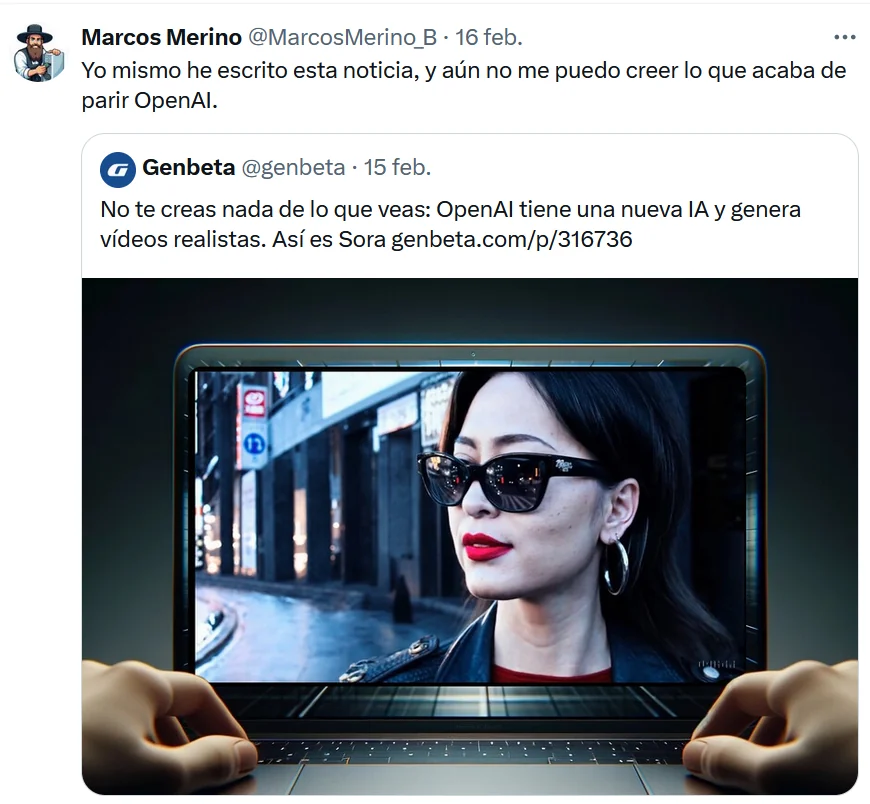
Screenshot translation: on 16 February, Marcos Merino writes, “I wrote this news story myself, and I still can’t believe what OpenAI has just produced.” He shares Genbeta’s 15 February post with the headline translated above.
Hundreds of technology journalists and AI experts expressed a similar feeling in their articles and on social media. Although advances in AI video generation seemed to be one of the clear trends for 2024, what OpenAI presented far surpasses the current state of the art and seems to come from the future, as DotCSV said in his live reaction to the launch. This is a video-generation tool that can create lengthy scenes, compared with the few seconds previously possible with any competing option. It is so powerful that OpenAI is holding back its market release because of the inherent danger of mass-producing professional-quality deepfakes.
The best thing is to see the videos it can create for yourselves first, either on OpenAI’s Sora website or in this YouTube compilation. The music is not part of the videos: for now, the model does not work with audio, although our recommendation of the week shows what ElevenLabs has swiftly released to accompany Sora.
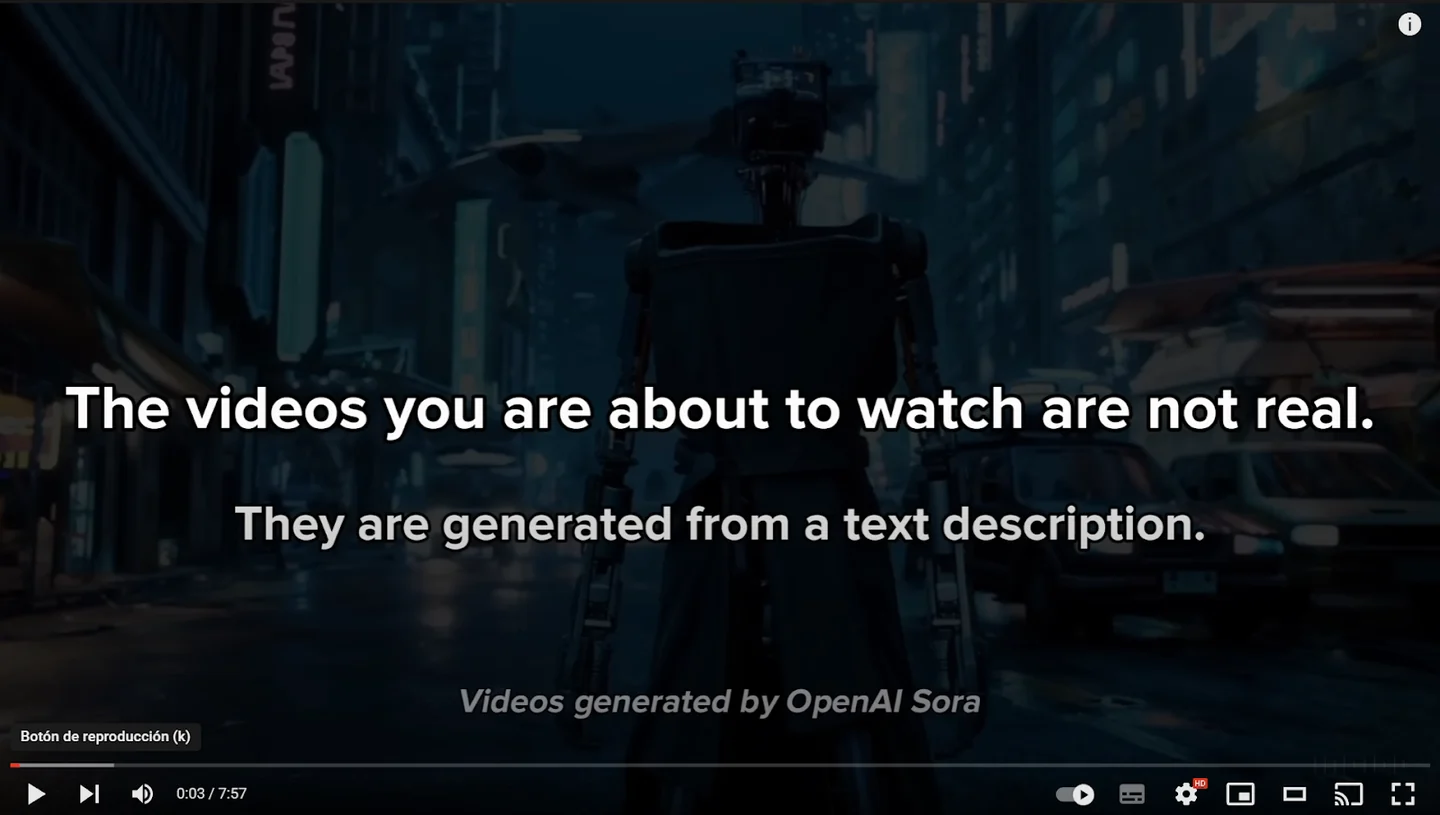
Image text: “The videos you are about to watch are not real. They are generated from a text description. Videos generated by OpenAI Sora.”
Having seen its capabilities, let us briefly analyse what Sora means and its implications, including for politics.
In today’s AI landscape, OpenAI’s unveiling of Sora represents a qualitative leap in the capacity to generate digital content. Able to transform textual descriptions into realistic, complex videos, the model promises to revolutionise the creative industries while also raising new challenges and opportunities in politics and elections.
Sora’s technical capabilities and advances
Sora stands apart from its predecessors and competitors through its ability to create videos up to a minute long with unprecedented photorealism and fidelity to textual instructions. Using a transformer architecture and diffusion processes, it works with “visual patches” to generate content that not only meets the user’s requirements but also demonstrates an emerging understanding of cinematic grammar. This is a significant technical advance, allowing complex, emotional visual narratives to be created from simple text.
Political and electoral implications
Sora’s ability to generate convincing, emotionally resonant visual content from text raises important considerations for politics and elections. On the one hand, it offers powerful tools for political communication and election campaigning, enabling candidates and parties to create highly personalised, emotionally engaging campaign material without the costs associated with traditional production.
However, these same capabilities create significant concerns about disinformation and electoral manipulation. The ability to generate realistic videos can be exploited to create political deepfakes, further complicating the already difficult task of discerning truth in public debate. This could have a profound impact on electoral integrity, particularly at a time when false information spreads rapidly through social media.
Recognising these risks, OpenAI is implementing safeguards as well as delaying public access to the model, including restrictions on the kinds of content Sora can generate and tools to identify AI-created videos. Yet the challenge of disinformation goes beyond technical capabilities and requires a coordinated response involving society as a whole, including social media platforms and regulators.
Moreover, Sora’s emergence underlines the need to educate the public about artificial intelligence and its capabilities, encouraging healthy scepticism towards digital content and promoting source verification as standard practice when consuming information.
As Sora and similar technologies continue to develop, creators, regulators and the public must work together to maximise these tools’ benefits while mitigating their risks. This includes developing rules and policies that promote transparency and accountability in AI-generated content, alongside continued research into methods for detecting deepfakes and other forms of disinformation.
As if all that were not enough, Sora also appears to take AI’s capacity to understand worlds and physics a step further. To understand this concept and the possibilities opened up by world simulation, we recommend this video by Xavier Mitjana.
Fernando Nieto Lobato
Director of Digital Innovation at Institución Educativa ALEPH
Cite this essay
Fernando Nieto Lobato. “Sora: a leap forward in realistic AI video that calls for a coordinated social response.” estrategIA, issue 021, 21 February 2024. English edition, 29 September 2026. https://elcontemplador.github.io/estrategia-english/essays/021/