English edition note: this article continues an April 2024 academic experiment involving a fictional party and candidate. The campaign prompts, model responses and mock designs are preserved as historical material. Quotations are translated from Spanish unless the source already supplies English wording.
Having created the party, Europa Estoica Unida, two weeks ago, and the candidate, Elena Vidal, in the previous newsletter, in this issue we are going to work with artificial intelligence on some key initial elements of an electoral campaign. This will let us test its current capabilities at this still early stage of generative AI’s development.
1. Defining the campaign’s main objectives
With the still general information we have — naturally far less than a real political party project would have about itself or its direct competitors, although we will probably conduct some very interesting experiments on that in future issues — we are going to ask the AI to generate the campaign’s main objectives. In this case, we are using the latest deployed GPT-4 Turbo model through ChatGPT, first giving it the key information we previously generated about the party, principally its mission, vision and values and its main policy proposals:
Think step by step. Act as a leading political marketing expert and establish the main electoral campaign objectives of the (fictional) party “Europa Estoica Unida” for the European Parliament elections. Below, I provide information on the party’s mission, vision and values, as well as its main proposals.
1. Promoting the vision of a resilient, united Europe
Objective: to raise awareness of the Stoic principles of wisdom, justice and self-control as foundations for better European governance and cooperation.
Strategies:
- Use multiple media platforms, including social media, televised debates and rallies in different Member States, to promote the benefits of a more united and resilient Europe.
- Create stories and messages illustrating how these principles can solve specific problems facing European citizens, such as inequality and climate change.
2. Presenting clear and distinctive policy proposals
Objective: to communicate effectively the party’s proposals for addressing specific problems such as climate change, social justice, digitalisation and diplomacy.
Strategies:
- Develop information leaflets, videos and detailed presentations of each proposal for distribution both online and at campaign events.
- Organise discussion panels and forums with experts who can discuss the proposals’ merits and feasibility, demonstrating their alignment with Stoic values and their potential impact on Europeans’ everyday lives.
3. Encouraging participation and dialogue with voters
Objective: to create an ongoing dialogue with the electorate to understand their concerns and reflect their voices in the party’s policies.
Strategies:
- Implement an active listening campaign through digital tools and face-to-face meetings, allowing voters to express their opinions and needs.
- Use the data collected to adjust and personalise campaign messages, ensuring that they resonate with local and regional concerns.
4. Building an image of ethical, competent leadership
Objective: to position the party’s candidates as ethical and competent leaders who can guide Europe towards a fairer and more sustainable future.
Strategies:
- Highlight candidates’ biographies and skills, focusing on their experience and commitment to Stoic principles.
- Organise image campaigns showing the candidates in situations requiring wisdom, justice and self-control, connecting their personal characteristics with the party’s values.
5. Maximising visibility and electoral impact
Objective: to ensure a strong and consistent presence across all available media and platforms to maximise the campaign’s reach and influence.
Strategies:
- Develop an integrated media strategy combining traditional advertising with digital strategies, including SEO, content marketing and specific social media campaigns.
- Collaborate with influencers and opinion leaders who share Stoic values to amplify the party’s message.
By implementing these objectives and strategies, Europa Estoica Unida can establish an effective electoral campaign that promotes its values and proposals while also motivating voters to support a shared vision of a more resilient and united European future under Stoic principles.
2. Key campaign messages
We followed the previous response directly with this request:
Based on that information, and acting as a leading political consultant, I want you to define what the key campaign messages should be.
Based on Europa Estoica Unida’s mission, vision, values and proposals, it is essential to develop key messages that resonate with voters and effectively communicate the party’s principles and goals. Here are the key messages that should form the core of the electoral campaign:
- “Building a resilient and sustainable Europe.”
This message emphasises the party’s commitment to environmental sustainability and resilience to climate change. It highlights the proposed European Climate Resilience Pact and communicates the urgency of acting wisely and with moderation to protect Europe’s future.
- “Justice and equity for everyone in Europe.”
This highlights the party’s focus on reducing inequality and promoting social justice through initiatives such as the European Social Justice and Economic Equity Initiative. It appeals to a sense of justice and equity, emphasising that every European citizen deserves equal opportunities and fair treatment.
- “Encouraging temperance in the digital age.”
With digitalisation increasingly influencing everyday life, this key message highlights the importance of mindful and responsible use of technology. The Europe United for Digital Temperance Programme is presented as a solution for balancing the benefits of digitalisation with protecting citizens’ privacy and mental health.
- “Promoting peace and dialogue in Europe and beyond.”
This message focuses on Europe’s role as a global leader in diplomacy and peace, linked to the Stoic Diplomacy and Peace Forum. It reinforces the idea that Europe can and should be an effective mediator in international conflicts, using Stoic wisdom and courage to encourage global understanding and cooperation.
- “United in diversity: celebrating our rich cultural heritage.”
This reflects the party’s cosmopolitan values and its commitment to promoting unity by recognising and celebrating Europe’s cultural diversity. The European Alliance for Community Cohesion is promoted as an initiative to encourage understanding and exchange among Europe’s peoples, thereby strengthening social cohesion.
- “Deciding with foresight for our common wellbeing.”
This message underlines the party’s commitment to decision-making based on wisdom and a long-term perspective. It is essential for communicating that Europa Estoica Unida’s policies and actions are designed to ensure future generations’ wellbeing and the continent’s long-term sustainability.
These messages should be communicated through different channels and in various formats, and also adapted to the specific local contexts of different Member States to ensure that the campaign is relevant and effective at a pan-European level. In this way, Europa Estoica Unida will be able to establish an emotional and rational connection with voters, increasing its visibility and electoral support.
3. Talking points on a specific issue
To explore a particular aspect in more depth, we decided to ask GPT-4 for a specific set of pro-European talking points to “fight” the anti-European stance of many populist parties and many citizens’ disaffection with the European Union. As the previous response suggests, this could be a key message for a pro-European party such as Europa Estoica Unida. This is the response it proposed:
Anti-European sentiment and growing scepticism towards the European Union are significant challenges that can be effectively addressed in Europa Estoica Unida’s campaign. The strategy should focus on revitalising perceptions of the EU as an entity that benefits its citizens and is essential to their common wellbeing. Below, I develop a detailed set of talking points that can help counter anti-European sentiment and promote a hopeful pro-European message:
Step 1: identifying the main concerns
Before formulating any message, it is crucial to understand the underlying causes of disaffection and scepticism. These often include perceptions of excessive bureaucracy, a lack of representation, economic concerns and a sense of lost national sovereignty.
Step 2: reaffirming the EU’s values and benefits
Key arguments:
- Peace and stability: reaffirm that the EU has been a pillar of peace in Europe since its creation, preventing conflicts between nations with a history of confrontation.
- Shared prosperity: highlight how the EU has helped raise living standards through the single market and cohesion policies benefiting all regions, including less developed ones.
- Solidarity in times of crisis: examples of how the EU has handled crises, such as the coordinated response to the COVID-19 pandemic, demonstrating the importance of cooperation beyond the nation state.
- Mobility and rights: underline freedom of movement and the right to live, study and work in any Member State as a tangible advantage for all Europeans.
Step 3: countering the anti-European narrative
Communication strategies:
- Debunking myths: use data and statistics to refute false or exaggerated claims about the EU promoted by anti-European parties.
- Personal stories: share accounts from citizens who have benefited directly from EU programmes such as Erasmus+, regional development funds and others.
- Historical comparisons: remind voters of the challenges and conflicts in Europe’s past so they appreciate the achievements and stability the EU offers.
Step 4: proposals for a more effective and democratic EU
Europa Estoica Unida’s proposals:
- Institutional reform: propose improvements in the transparency and efficiency of European institutions to make them more accessible and understandable to ordinary citizens.
- Greater citizen inclusion: encourage citizens’ direct participation in political decisions through initiatives such as public consultations and citizens’ panels.
- A local approach: demonstrate how the EU can adapt to each region’s specific needs, reinforcing the idea that the Union works for all its members.
Step 5: launching a message of hope and unity
Final message:
“United in diversity: together, we can build a stronger, fairer and more resilient Europe. Europa Estoica Unida commits to leading with wisdom, justice and self-control to ensure a prosperous and peaceful future for everyone.”
Step 6: an integrated communication campaign
Implement a campaign using all available media — social media, television, radio and print — to spread these messages. Organise events in different Member States where Europa Estoica Unida’s leaders can speak directly with citizens, listen to their concerns and explain how the EU and the party can address them effectively.
These talking points, based on understanding, clarifying and communicating the European Union’s values and benefits, are designed to counter anti-European sentiment and strengthen a sense of belonging and hope among European citizens.
4. A campaign poster
We will now try to create a campaign poster using AI. In this case, we began with the AI integrated into Canva, a tool for which we have the Pro version.
We went to Magic Design with AI, which in our experience offers considerably more options when Canva is set to English — something we have repeatedly encountered in many AI tools. Since it suggests entering a request of about five words for an AI creation, we simply asked for an electoral campaign poster for “Europa Estoica Unida”. This was its initial generic response, with several design examples:
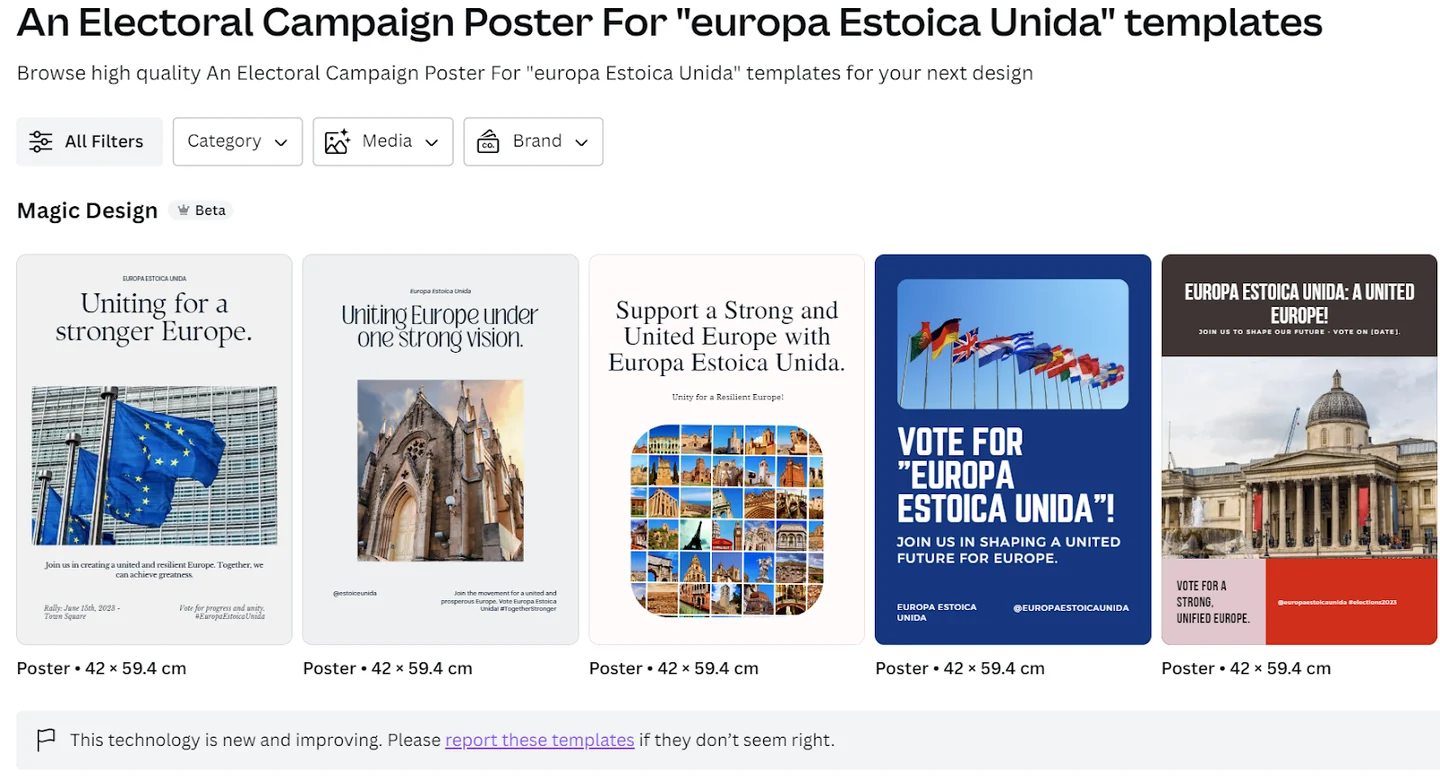
Text in the five original English-language mock posters, left to right:
- “Uniting for a stronger Europe.” “Join us in creating a united and resilient Europe. Together, we can achieve greatness.” The small print supplies a generated rally date, “June 15th, 2023 — Town Square”, and “Vote for progress and unity. #EuropaEstoicaUnida”.
- “Uniting Europe under one strong vision.” “Join the movement for a united and prosperous Europe. Vote Europa Estoica Unida! #TogetherStronger”.
- “Support a Strong and United Europe with Europa Estoica Unida.” “Unity for a Resilient Europe!”
- “Vote for ‘Europa Estoica Unida’!” “Join us in shaping a united future for Europe.”
- “Europa Estoica Unida: a united Europe!” “Join us to shape our future — vote on [date].” “Vote for a strong, unified Europe.” The template includes “#elections2023”.
These are generated mock-ups, including their dates and placeholders, not announcements of real events.
We found that we could also upload a custom image and a brand’s visual identity. For this simple test, we directly used the ALEPH Educational Institution’s own brand identity, which we had already configured.
The results are not yet good and remain a long way from what a good designer would produce. However, in a few seconds it offers numerous possible options — the image only shows the first ones — from which to start a design. That could help, for example, in local election campaigns often run with very few resources and no option of hiring a designer.
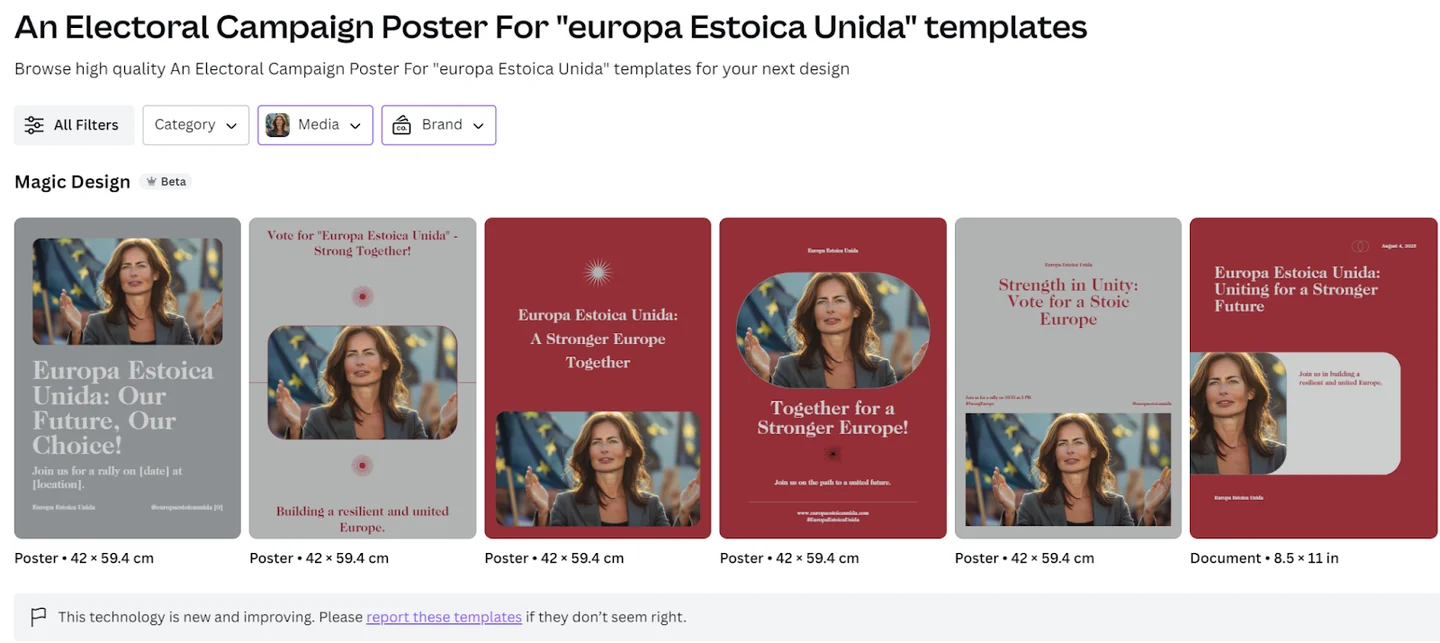
Text in the six original English-language mock-ups, left to right:
- “Europa Estoica Unida: Our Future, Our Choice!” “Join us for a rally on [date] at [location].”
- “Vote for ‘Europa Estoica Unida’ — Strong Together!” “Building a resilient and united Europe.”
- “Europa Estoica Unida: A Stronger Europe Together”.
- “Together for a Stronger Europe!” “Join us on the path to a united future.”
- “Strength in Unity: Vote for a Stoic Europe”. The small print supplies “Join us for a rally on 10/15 at 5 PM” and “#StrongEurope”.
- “Europa Estoica Unida: Uniting for a Stronger Future”. “Join us in building a resilient and united Europe.” The template supplies “August 4, 2023”.
The generated dates and rally details are retained as mock-up content.
Once you choose one of the hundreds of designs it generates automatically, the tool lets you open it for customisation and even includes an AI writing option to “improve” the wording.
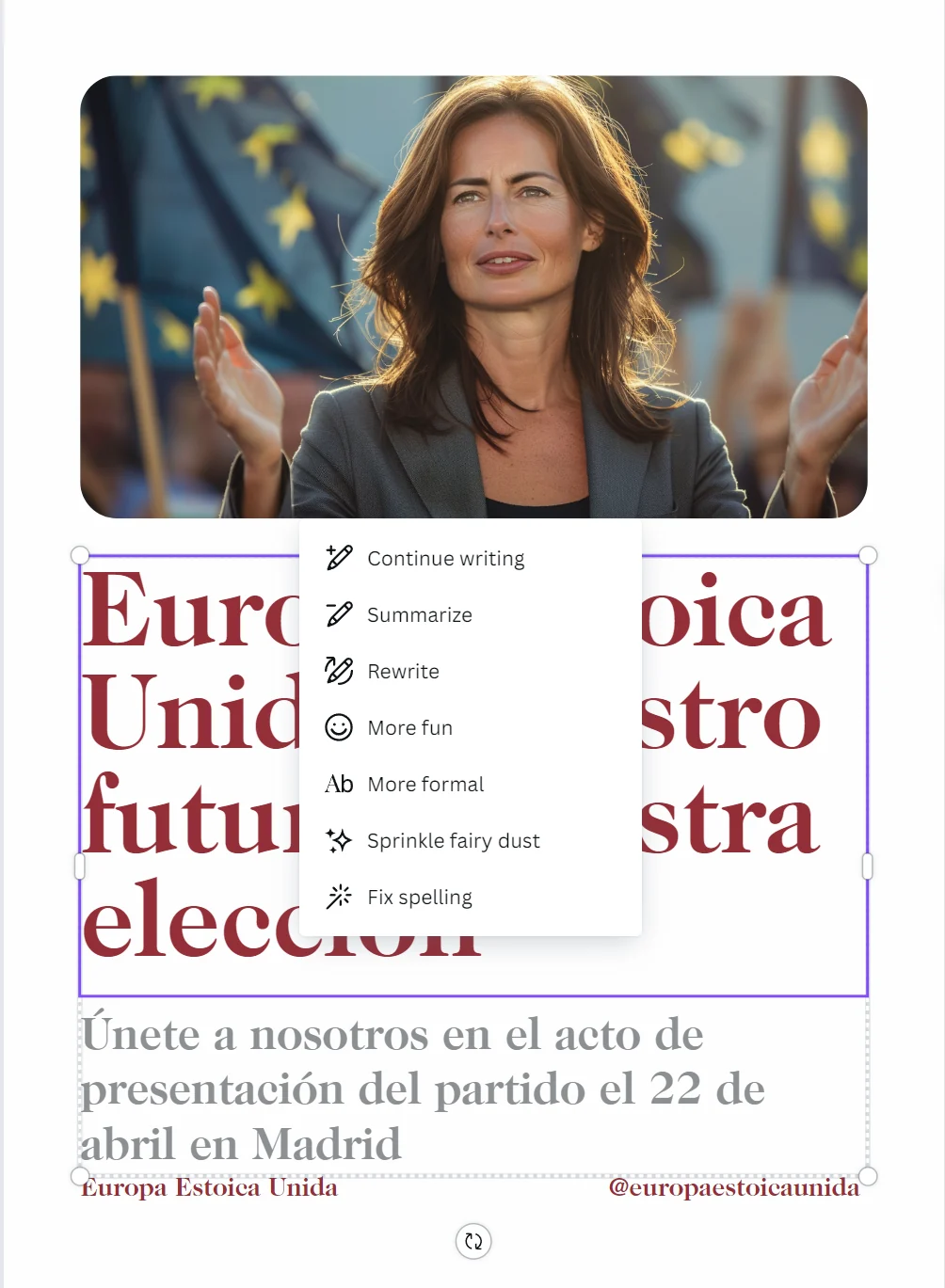
Original editing screenshot. The AI writing menu offers “Continue writing”, “Summarize”, “Rewrite”, “More fun”, “More formal”, “Sprinkle fairy dust” and “Fix spelling”. The Spanish poster beneath is translated in the next caption.
We made a few small changes to the poster to put the information in Spanish, and in less than a minute we had the result: very simple, but quick. The tool will undoubtedly improve over the coming months and years to create more interesting designs. At present, however, unlike other areas such as text, image generation or even music, which we will look at next, it is still quite far from professional quality. Even so, it can offer interesting options and propose multiple creative treatments that provide a good starting point for something quick, simple and, naturally, very cheap.
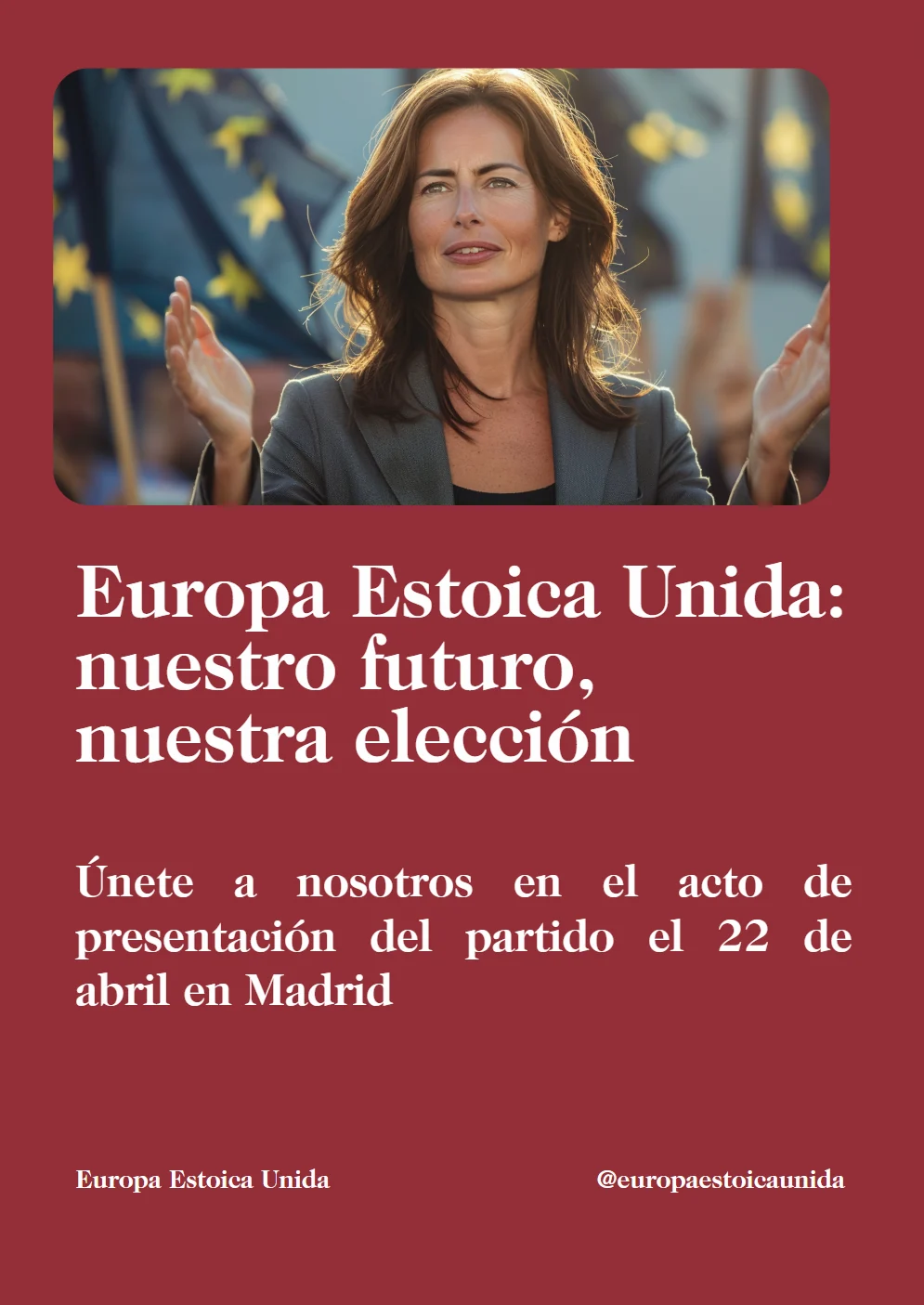
English translation of the Spanish mock poster: “Europa Estoica Unida: our future, our choice. Join us at the party’s launch event on 22 April in Madrid.” Footer: “Europa Estoica Unida” and “@europaestoicaunida”. This is an illustration from the fictional-party experiment.
Besides Canva, we also decided to try a fairly well-known free option Microsoft launched last year:
Microsoft Designer — Stunning designs in a flash
We gave it a description, and it used generative AI to offer options for completing the text…
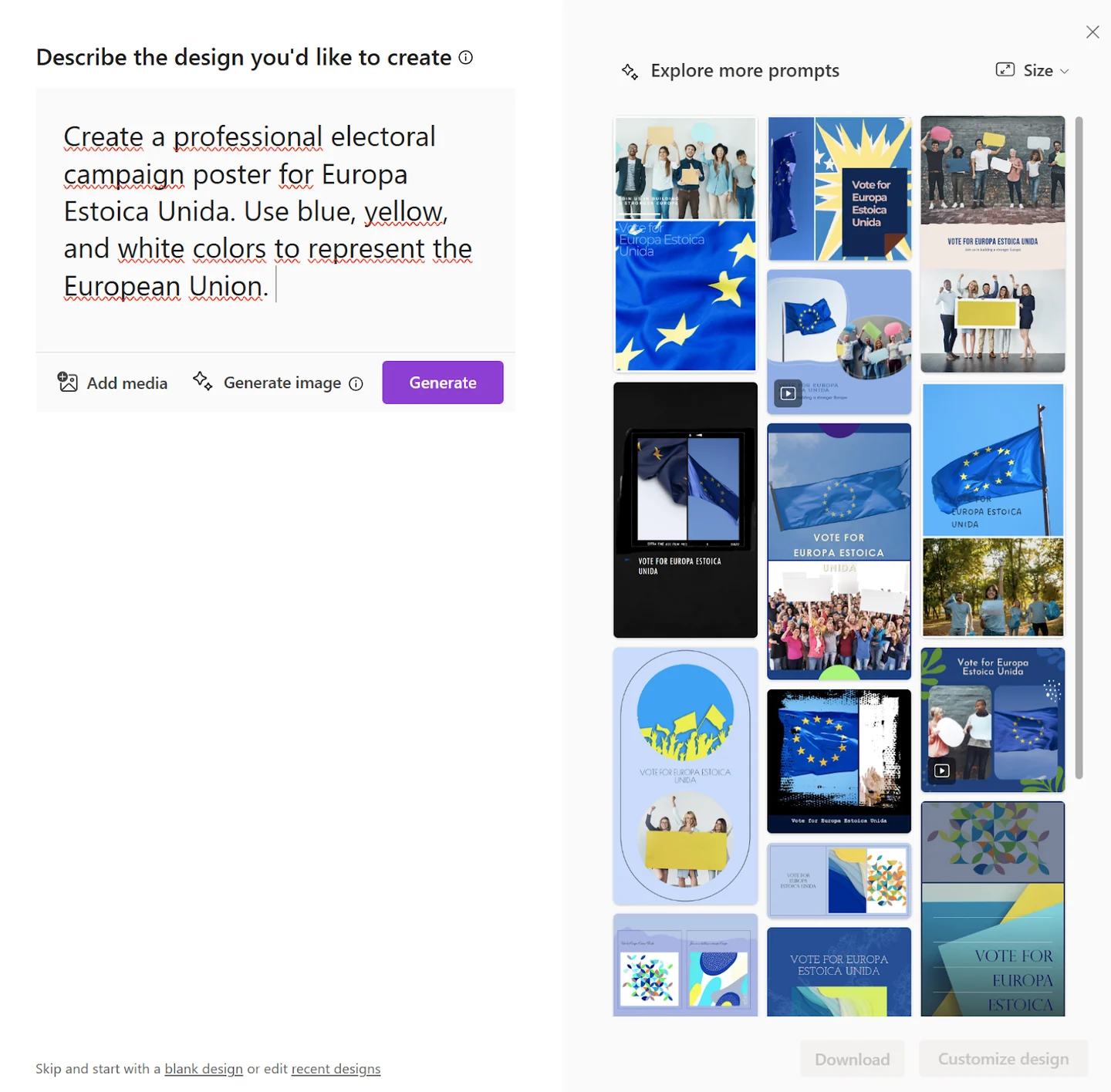
Original English prompt visible in the screenshot: “Create a professional electoral campaign poster for Europa Estoica Unida. Use blue, yellow, and white colors to represent the European Union.” The mock designs principally repeat “Vote for Europa Estoica Unida” and “Join us in building a stronger Europe”, alongside European flags, groups of people and geometric graphics.
The general designs are probably rather more “bland” than Canva’s, although it offers a wide variety of formats and also lets you upload your own images.
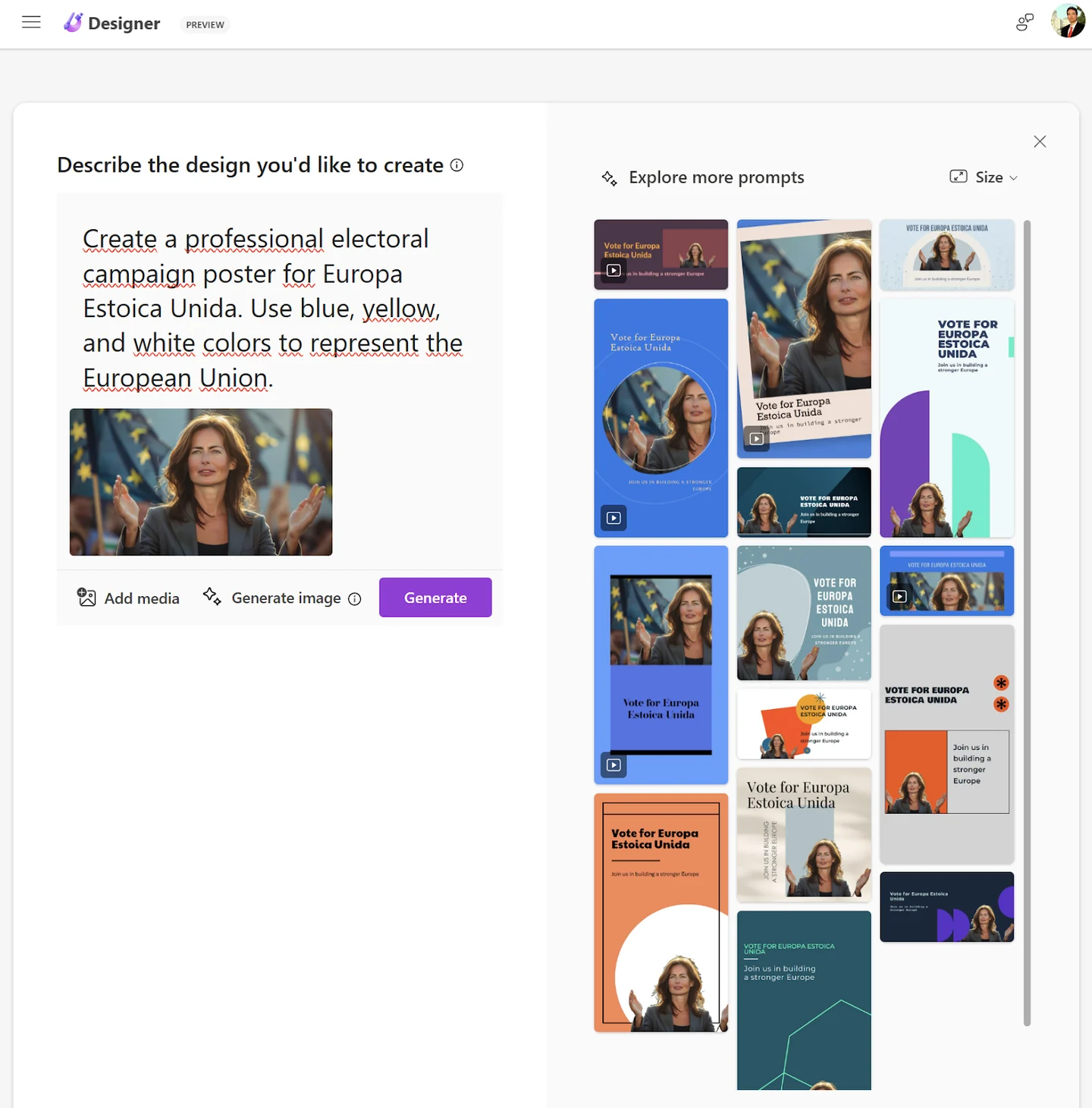
The same English prompt, now accompanied by the fictional candidate’s image. The generated layouts repeat “Vote for Europa Estoica Unida” and “Join us in building a stronger Europe” in different formats.
Again, in less than a minute, it gives us a fairly limited result, but one that can suggest ideas or serve as a basis for more professional work later.
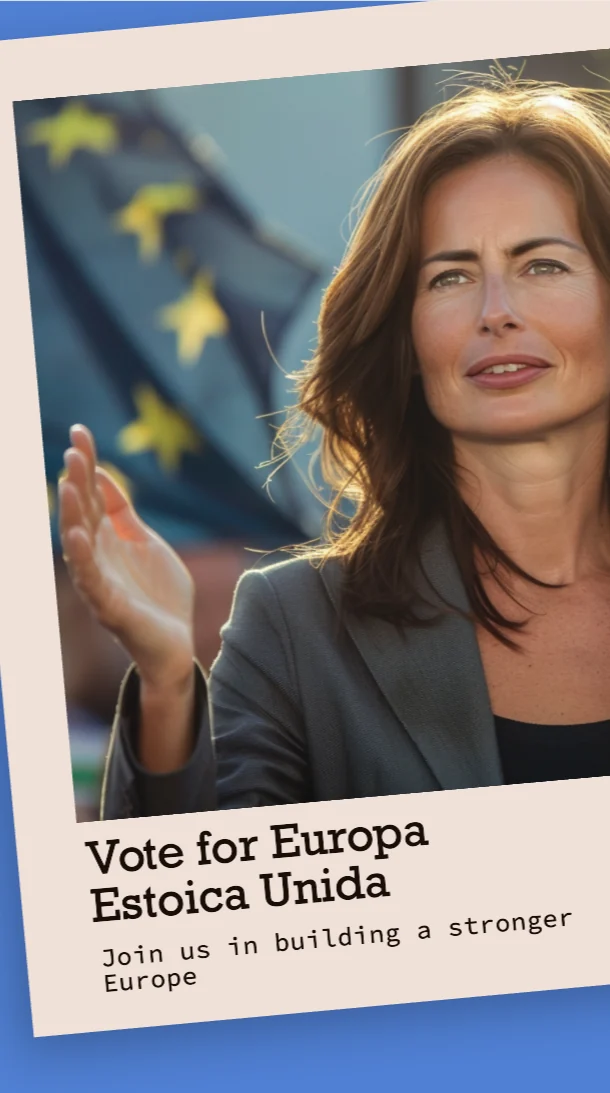
Original English poster text: “Vote for Europa Estoica Unida. Join us in building a stronger Europe.” The portrait is the AI-generated fictional candidate.
In design, at least with the tools we have tried — there are probably others, including some more sophisticated or better tuned to what we attempted — AI still has a long way to go to achieve professional-quality results. We should remember, though, that we are still taking the first steps with generative artificial intelligence, which will very probably enable excellent results within just a few years.
5. Campaign songs
Here, by contrast, AIs have made an enormous leap in recent weeks, with numerous new music-generation applications launching. Among them, version 3 of Suno stands out, and especially Udio, probably with superior musical quality. They can generate songs that are already going viral worldwide despite still being products at a very early stage of development.
Both allow you to select musical styles and, in their advanced modes, which remain free, enter custom lyrics. We asked GPT-4 for several short lyrics, because Udio still has a fairly tight duration limit of around 30 seconds. Then, despite our complete lack of specialist musical training, we played around with different styles to produce campaign songs for Europa Estoica Unida in just a few minutes, such as these:
Suno:
Rock: https://suno.com/song/ae7fa9c0-dc2f-4457-bbda-57c9bfde7067
Atmospheric funk: https://suno.com/song/afcb9d48-da8f-47b6-bb95-fc010203cc19
Udio:
Pop rock: https://www.udio.com/songs/vb259gXDN6CBdaJ1VEeWSU
Electronic dance version: https://www.udio.com/songs/gMfJf1mS6fUw4RGsToH9TF
With greater musical knowledge and more time to generate many more options, there is no doubt that a fairly decent campaign song could already be created today. It would clearly not yet be professional, although it could provide a basis for one, with ideas that could be developed. It would also be possible to generate many “minor”, occasional songs to share on social media, highlighting elements of our campaign or responding to rivals’ campaigns. For a small party, or an independent candidate even in a small municipality, it is no longer outlandish to suggest campaigning with music, thanks to these tools that are still starting out. Udio launched in beta on 10 April, less than 15 days ago.
Next week’s newsletter coincides with 1 May, International Workers’ Day, and we will bring you a special issue on the subject. We will pause the “electoral campaign with AI” issues, returning to them later because there are still some very interesting questions we want to explore.
Fernando Nieto Lobato
Director of Digital Innovation at the ALEPH Educational Institution
Cite this essay
Fernando Nieto Lobato. “Continuing our experiment in creating and developing an AI-generated political party for the European Parliament elections.” estrategIA, issue 030, 24 April 2024. English edition, 29 September 2026. https://elcontemplador.github.io/estrategia-english/essays/030/