Original editorial note: This week, we have used another open-source text-to-speech model, MeloTTS, to record the main article and the news separately as audio.
English edition note: the preserved source does not include playable audio. The Roosevelt quotation and quoted expressions attributed to Khan below are translated from the Spanish article; their original English wording has not been independently checked. The book’s English title is retained.
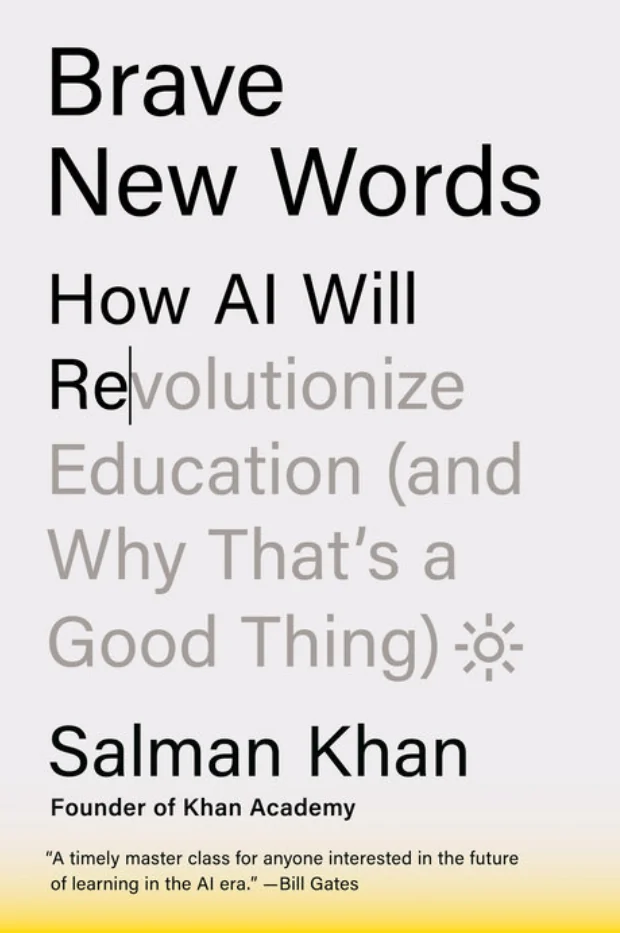
Original cover of Salman Khan’s Brave New Words: How AI Will Revolutionize Education (and Why That’s a Good Thing), identifying him as the founder of Khan Academy. The cover’s English endorsement reads: “A timely master class for anyone interested in the future of learning in the AI era.” — Bill Gates.
Education is the foundation of a prosperous society and a strong democracy. As Franklin D. Roosevelt said: “Democracy cannot succeed unless those who express their choice are prepared to do so. The true safeguard of democracy, therefore, is education.” In this era of rapid technological progress, artificial intelligence is about to revolutionise how we teach and learn, and we must embrace this change with courage and wisdom.
This is the powerful premise of the new book by Salman Khan, founder of Khan Academy, entitled Brave New Words: How AI Will Revolutionize Education (and Why That’s a Good Thing). In this volume, published last week, Khan uses a compelling narrative and insightful vision to explore how AI can transform education for the better, democratising access to knowledge and personalising learning on an unprecedented scale. I highly recommend reading it to anyone interested in a field as wide-ranging and important as education, and even more so to teachers or parents. But if I had to summarise a few of its key concepts very briefly, they would be these:
The potential of artificial intelligence tutors
At the heart of Khan’s argument is the concept of “AI tutors”: advanced artificial intelligence systems that can act as personalised mentors for each student. Khan begins the book by describing a personal experience in which he and his daughter Diya used one of these tutors to co-write a fictional story.
These AI tutors, powered by models such as GPT-4, to which Khan and the team at his educational NGO had access months before its release, can analyse each student’s unique learning style, identify their strengths and weaknesses, and adapt instruction accordingly. We are probably close to a world in which every child has access to a virtual tutor that can answer their questions, explain complex concepts in multiple ways and provide real-time feedback as they progress — something that will undoubtedly transform education forever.
Democratising access to knowledge
One of the most compelling aspects of Khan’s book is its focus on using AI to close the gap in access to high-quality education, a goal his non-profit organisation, Khan Academy, has pursued for years. Today, too many students, particularly in disadvantaged communities, lack the resources and support they need to succeed academically. AI tutors can level the playing field, offering a personalised and enriched learning experience to any student with an internet connection.
The author imagines a “global classroom” in which students worldwide can access the best educational resources, regardless of their geographical location or socioeconomic circumstances. This democratisation of knowledge would benefit individual students and also drive economic and social progress by cultivating a better-educated and more skilled workforce.
Empowering educators
Despite initial concerns that AI would replace teachers, Khan paints a future in which technology “gives educators superpowers” instead. AI tutors can take on some of the more tedious tasks, such as marking exams and monitoring students’ progress, freeing teachers to concentrate on personalised teaching and creating innovative educational models.
AI can also help educators plan more effective lessons, identify learning gaps early and provide additional support to students who need it. This collaboration between humans and AI has the potential to revitalise teaching as a profession, attract more talent and allow educators to focus on their passion for inspiring young minds.
Ethical concerns
Of course, any technological advance on this scale brings legitimate concerns about privacy, bias and safety. Khan devotes an entire chapter to addressing these concerns, advocating a “guardian angel” approach to AI in education.
AI systems must be designed with transparency, equity and students’ privacy as their top priorities. Algorithms must be continually audited to detect and mitigate bias, and students’ data must be protected with robust security measures. Khan also emphasises the importance of digital literacy, ensuring that students understand how AI works and how to interact with it safely and ethically.
The crucial role of politics in education
Although the book focuses primarily on AI’s direct potential in the classroom, it also highlights the crucial role that government leaders and policymakers must play in using this technology effectively and equitably.
Political leaders must prioritise equitable access to technology and educational resources, ensuring that all communities have the opportunity to benefit from AI tutors. They must also establish regulatory frameworks and policies promoting ethics, transparency and privacy protection in the use of AI in education.
Assessment and admissions systems must also be rethought to adapt to an AI-enhanced educational environment, ensuring that assessments are accurate, fair and focused on measuring real learning rather than simply memorisation.
AI and the future of work
Finally, the book’s final part, Part IX, deserves special mention for its interest. Here, the author goes beyond education to explore the possible consequences of the AI revolution for work, advocating the creation of a post-scarcity society like the one portrayed in Star Trek. Khan acknowledges the widespread fear that AI will replace jobs, citing IBM’s decision to pause recruitment for office roles that AI could eventually perform. However, he believes AI will create new jobs and increase demand for highly skilled professionals able to harness its power.
Salman Khan argues that the future of work will require “centaurs”: individuals who combine human skills with AI, becoming more efficient and productive. He emphasises the importance of deep skills in specific fields, alongside business experience across multiple domains, to use AI effectively.
Khan then explores AI’s impact on the job-placement process. He imagines a future in which AI agents represent people, negotiating with employers, finding job opportunities and even conducting preliminary interviews. This AI-driven system would be more efficient, consistent and potentially less biased than current recruitment practices.
Khan concludes his book with a powerful call for “educated courage”: the courage to embrace AI’s potential while mitigating its risks. He emphasises the urgency of using AI for good, advocating responsible development and regulation to ensure a future in which AI empowers humanity rather than displacing it. Ultimately, the author envisages a world where everyone can thrive in an AI-infused economy, driven by deep skills, entrepreneurship and collaboration enhanced by artificial intelligence.
Note: besides reading the book, we recommend this video demonstrating GPT-4o’s capabilities, in which Salman Khan and his son try the model on an iPad, so you can see a multimodal AI tutor’s capabilities in action. We also suggest visiting Khan Academy to experience Khanmigo, its AI assistant designed specifically for education, for yourself.
Fernando Nieto Lobato
Director of Digital Innovation at the ALEPH Educational Institution
Cite this essay
Fernando Nieto Lobato. “The potential of artificial intelligence in education: a look at Salman Khan’s Brave New Words: How AI Will Revolutionize Education (and Why That’s a Good Thing).” estrategIA, issue 034, 22 May 2024. English edition, 29 September 2026. https://elcontemplador.github.io/estrategia-english/essays/034/