AI's impact on the labour market is one of the key aspects of the social transformation this new technology may bring. Even now, while it is still at an early stage, we are beginning to see very significant effects that will probably prove to be only a small indication of the transformation awaiting us in a few years. A very recent Harvard study, whose preliminary paper was published on 31 August 2025, reveals a significant “seniority bias” caused by AI: companies adopting generative artificial intelligence are slowing the recruitment of newcomers and favouring senior staff. In this article, we try to explore the issue in greater depth and explain why, if this trend is confirmed, political action now may be crucial.
The first rung of the career ladder is becoming narrower and more slippery. If you feel that starting work is harder than ever, it is not just an impression. This preliminary Harvard University study, by Guy Lichtinger and Seyed Mahdi Hosseini, gives the phenomenon a name and puts numbers to it: “seniority-biased technological change”.
Put simply, when a company genuinely integrates generative AI into its processes, it tends to hire fewer junior staff while maintaining or even strengthening its senior teams. Technology is not only changing what we study or what work we do, but also the age at which we can begin doing it.
The study is devastating for two reasons:
- Its scale is enormous: it analyses around 62 million CVs and job advertisements across 285,000 companies between 2015 and 2025.
- It measures actual AI adoption: it does not rely on surveys but identifies companies actively seeking staff to implement technologies such as large language models (LLMs), retrieval-augmented generation (RAG) systems or AI agents. These are the “plumbers” of the new digital era, and only 3.7% of the firms analysed already employ them.
The gap widens sharply: what do the data say?
Until 2022, junior and senior workforces grew in parallel. But with the explosion of LLMs in 2023, everything changed. In companies investing in AI, junior recruitment is plummeting, while senior recruitment continues to grow.
The figures are clear:
- The number of junior employees in these companies falls by 7.7% compared with companies that do not adopt AI.
- Comparing the proportions of juniors and seniors within the same company, the gap reaches almost 12%.
And here is the key: this is not about dismissals, but about not hiring. The study reveals that the main reason for the decline is that innovative companies hire an average of 3.7 fewer juniors per quarter. The entry doors are closing.
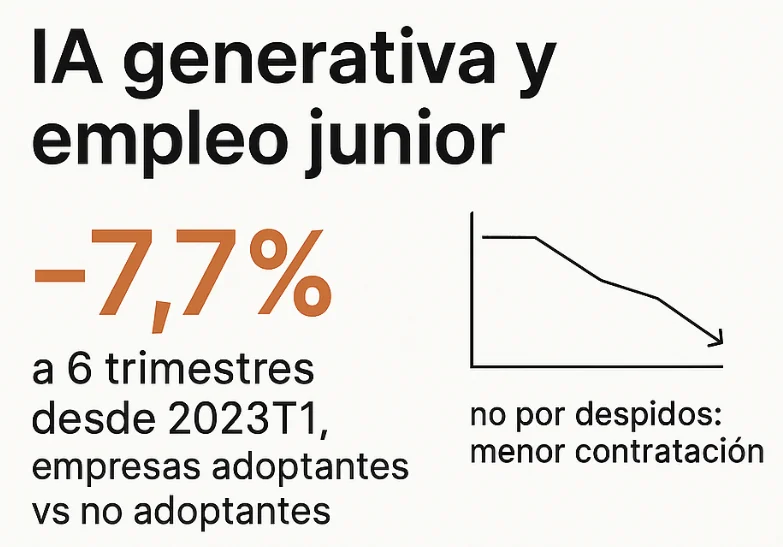
Infographic text, translated: “Generative AI and junior employment”; “−7.7% six quarters on from 2023 Q1, adopting versus non-adopting firms”; “Not dismissals: less hiring”. The downward line is illustrative, with no numeric axis.
Paradoxically, juniors who are already inside see their promotions accelerate slightly. The logic is compelling: AI automates the most routine tasks—the ones interns and newcomers used to do—so companies prefer to accelerate the training of people who already know the organisation rather than bring in someone new.
This pattern recurs in almost every sector, but is particularly brutal in wholesale and retail trade, where junior hiring falls by almost 40%.
Not all juniors are alike: the “U-shaped curve” of opportunity
One fascinating finding is that the impact is not the same for everyone. The study traces a “U-shaped curve” according to the university attended:
- The worst affected: graduates of middle-ranking universities, classified as “solid” or “strong”.
- Less affected at the extremes: graduates of elite universities (tier 1) are better protected, since their prestige acts as a signal of high productivity. Graduates of less prestigious universities (tiers 4–5) also suffer less, because their starting salaries are lower and they represent less of a “risk” for the company.
The message is subtle but powerful: AI does not indiscriminately crush young people. It reshapes demand, penalising above all the large middle class of university graduates.
Why is this a problem for everyone?
The first years of work are vital. This is when most of a lifetime's wage growth takes place. If that first step narrows, social mobility and the value of a university degree could suffer permanently.
Nor is this a problem that can be solved directly by working fewer hours. In a country such as Spain, where Congress is currently debating a reduction in working hours, we could find ourselves in a scenario in which senior teams, supercharged by AI, work fewer hours but still do not need junior support. The bottleneck in access to the labour market would remain, and this measure would not be especially effective.
An action plan to avoid losing the next generation
The answer is not to hold technology back, but to create new routes in. The authors and the wider context suggest several ideas:
- Work-linked AI training: create nine- to twelve-month programmes in which juniors not only use AI but learn to design, integrate and evaluate it—for example, by creating RAG systems and applying guardrails.
- Incentives for “smart” hiring: offer financial incentives to companies that hire juniors for AI evaluation and governance tasks, not just repetitive production.
- Public microcredentials: flexible, officially recognised certifications in applied AI skills, including safety, privacy and evaluation.
- Transparency in automation: simple audits to ensure that companies are not replacing their entire pipeline of new talent, but accelerating the progress of those already inside.
- Safety nets: if, as seems likely, the problem persists or grows as AI capabilities evolve, instruments such as universal basic income or unemployment insurance linked to training may become necessary. These instruments of guaranteed income and rights to intensive training cushion the generational blow and facilitate reskilling.
The real challenge: to transform, not replace
For the moment, generative AI is not coming to “eliminate” entry-level work, but to redefine it. By automating repetitive tasks, it demands that even the youngest workers contribute judgement, design capabilities and supervision.
We can leave the market to adjust on its own, accepting an enormous cost in inequality and wasted talent even at this first stage of AI's global rollout. Or we can begin redesigning training, incentives and careers for this new era and structuring social protection measures for all citizens. The challenge is not to hold technology back, but to build a different career ladder: perhaps more demanding, but much sturdier and centred on the distinctive value that, for now, only humans can contribute.
Beyond this important specific case, which, if confirmed, could have a decisive impact on young people, it is essential to consider both the direct and the second-order effects of AI's rapid evolution, so that policies proposed today do not collide with the reality of the near future. Politics generally works with calculations and visions based on the reality of recent decades, without even considering—at least publicly—other possible scenarios, such as the rapid take-off of artificial general intelligence (AGI) anticipated by many scientists, in which all those calculations collapse like a house of cards. We may find ourselves living in a world where problems such as pension sustainability, access to housing or the labour market have to be approached from a completely different perspective in less than a decade.
Director of Digital Innovation at Institución Educativa ALEPH and director of estrategIA
Lichtinger, G., & Hosseini Maasoum, S. M. (2025). Generative AI as Seniority-Biased Technological Change: Evidence from U.S. Résumé and Job Posting Data (Preliminary, 35 pp., 31 August 2025). SSRN Working Paper. DOI: 10.2139/ssrn.5425555 — SSRN: https://ssrn.com/abstract=5425555
Cite this essay
Fernando Nieto Lobato. “Is entry-level work disappearing? How generative AI is changing the rules—and how politics can respond.” estrategIA, issue 103, 17 September 2025. English edition, 29 September 2026. https://elcontemplador.github.io/estrategia-english/essays/103/