English edition note: this article records tests conducted before the June 2024 European elections. Model outputs, including assessments of party manifestos and the fictional Europa Estoica Unida party, are translated as historical source material. They have not been independently fact-checked or updated. Prompts and quoted responses are translated from Spanish.
In the week before the elections to the European Union’s parliament, we want to devote this newsletter’s main article to testing how some of the AI developments introduced over the past month can offer us new or improved capabilities for working in this field.
Comparing several parties’ election manifestos using a large context window, with Google Gemini Pro 1.5
A context window is, roughly speaking, the amount of data a large language model can work with directly.
At its developer conference last month, Google announced that it was opening access to Google Gemini Pro 1.5 in new countries, including those of the European Union. This language model, one of the best on most benchmarks, although not yet at GPT-4o’s level, allows a context window of up to one million tokens, equivalent to several hundred book pages. This has allowed us to ask it for a comparative analysis of the manifestos of different parties contesting the European elections. The initial idea was to include the PP and Vox manifestos too, but because they are much shorter and designed in a different format, we decided to focus the analysis solely on Spain’s three main left-wing parties. For this example, we asked it to work on education proposals.
We uploaded the manifestos. Those three alone add up to more than 150,000 tokens, exceeding the size GPT-4 can work with, for example: 128,000 tokens.
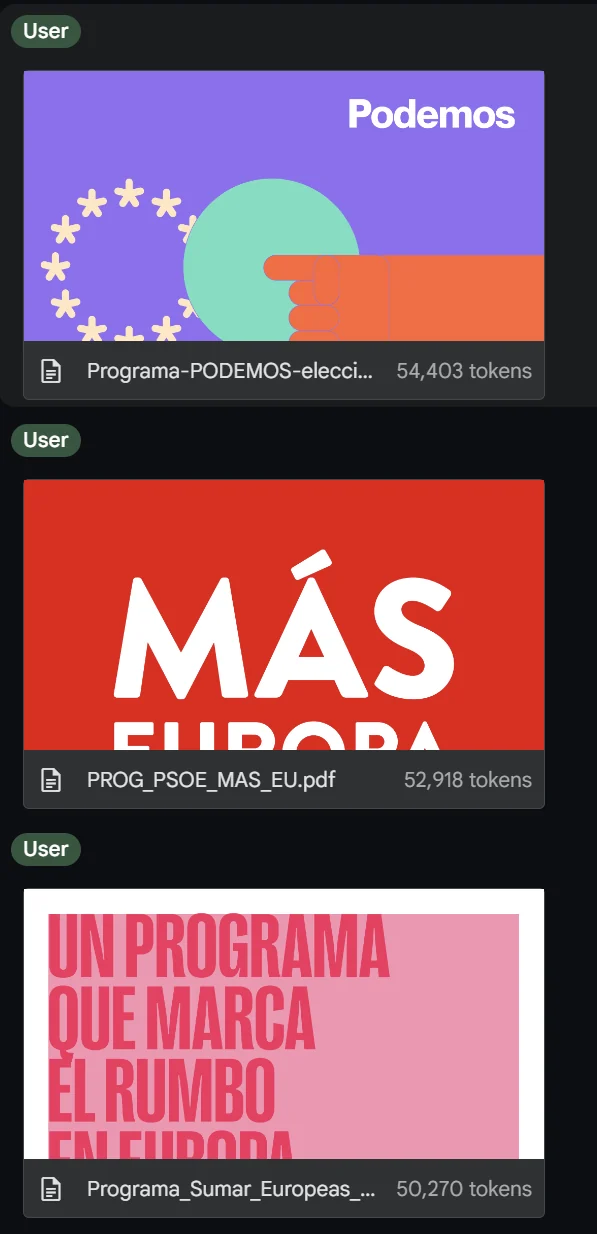
The uploaded documents shown are Podemos (54,403 tokens), PSOE (52,918 tokens) and Sumar (50,270 tokens). The visible cover slogans include PSOE’s “More Europe” and Sumar’s “A manifesto that sets the course in Europe”.
We asked it for a comparative summary of the main education proposals and, additionally, to analyse the strengths and weaknesses of each party’s manifesto and draw conclusions. This was the response:
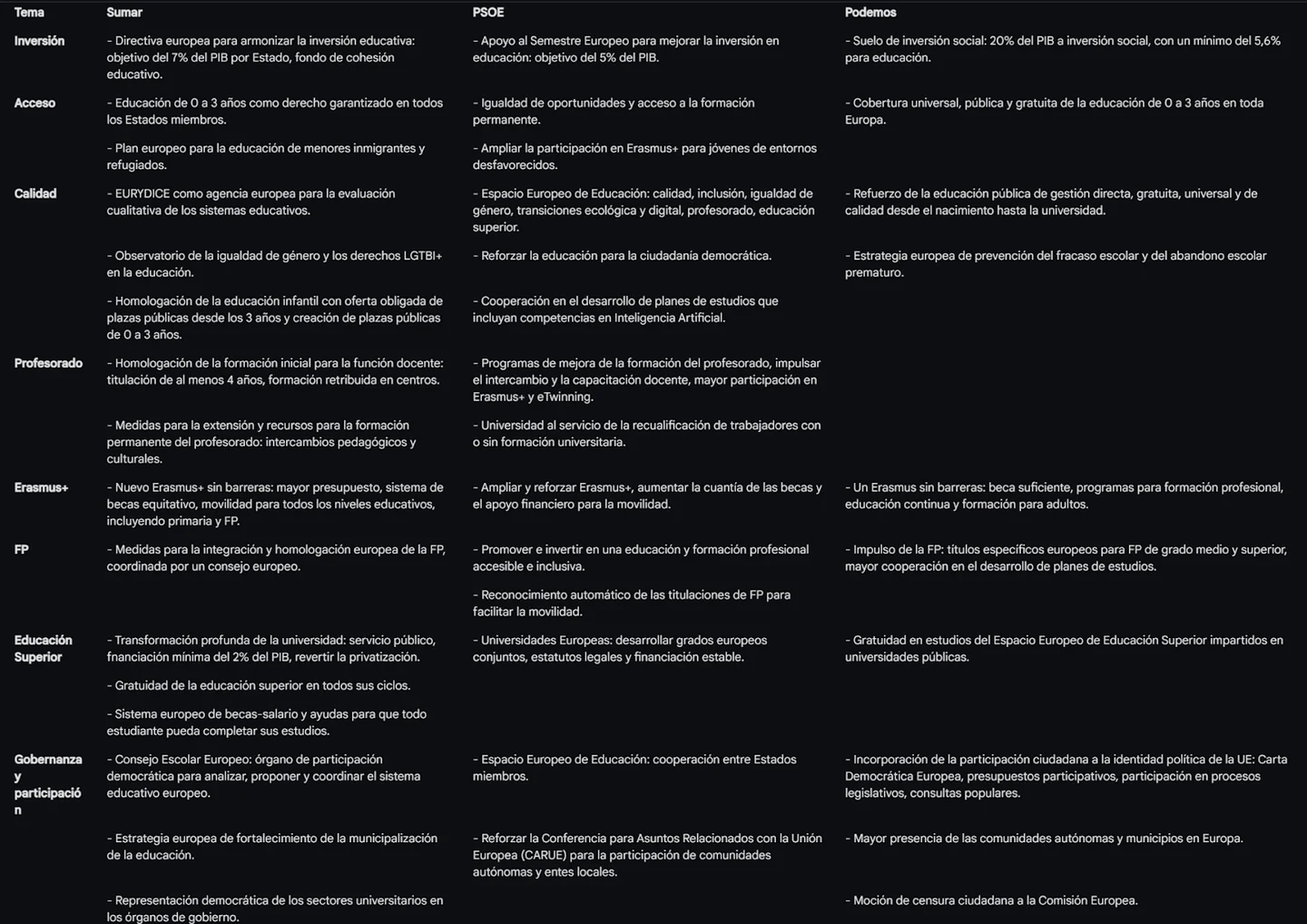
English translation of the model-generated comparison table in the screenshot. An em dash indicates a blank cell in the original output.
Scroll across the table to read all columns.
| Topic | Sumar | PSOE | Podemos |
|---|---|---|---|
| Investment | European directive to harmonise investment in education: target of 7% of GDP per state; an educational cohesion fund. | Support for the European Semester to improve investment in education: target of 5% of GDP. | Social investment floor: 20% of GDP for social investment, with a minimum of 5.6% for education. |
| Access | Education from birth to age three as a guaranteed right in all Member States. A European plan for the education of migrant and refugee children. | Equal opportunities and access to lifelong learning. Expand Erasmus+ participation for young people from disadvantaged backgrounds. | Universal, public and free education from birth to age three throughout Europe. |
| Quality | EURYDICE as a European agency for qualitative evaluation of education systems. An observatory on gender equality and LGBTI+ rights in education. Harmonisation of early childhood education, with compulsory provision of public places from age three and creation of public places for ages zero to three. | European Education Area: quality, inclusion, gender equality, green and digital transitions, teachers and higher education. Strengthen education for democratic citizenship. Cooperate on developing curricula that include artificial intelligence skills. | Strengthen directly managed public education that is free, universal and high-quality, from birth to university. A European strategy to prevent school failure and early school leaving. |
| Teachers | Harmonise initial teacher training: a qualification of at least four years, and paid training in schools. Measures to extend and resource continuing teacher training; educational and cultural exchanges. | Programmes to improve teacher training, encourage exchange and teaching skills, and increase participation in Erasmus+ and eTwinning. Universities serving the reskilling of workers with or without a university education. | — |
| Erasmus+ | A new Erasmus+ without barriers: a larger budget, an equitable scholarship system, and mobility at all educational levels, including primary and vocational education. | Expand and strengthen Erasmus+, increasing grants and financial support for mobility. | An Erasmus without barriers: adequate grants, programmes for vocational education, continuing education and adult education. |
| Vocational education and training | Measures for European integration and harmonisation of vocational education, coordinated by a European council. | Promote and invest in accessible, inclusive vocational education and training. Automatic recognition of vocational qualifications to facilitate mobility. | Support vocational education: specific European qualifications at intermediate and higher levels, and greater cooperation in curriculum development. |
| Higher education | Profound transformation of universities: a public service, minimum funding of 2% of GDP, and reversal of privatisation. Free higher education at every level. A European system of living-cost grants and support enabling all students to complete their studies. | European Universities: develop joint European degrees, legal statutes and stable funding. | Free studies within the European Higher Education Area when delivered at public universities. |
| Governance and participation | A European School Council: a democratic participation body to analyse, propose and coordinate the European education system. A European strategy to strengthen the municipalisation of education. Democratic representation of university constituencies in governing bodies. | European Education Area: cooperation among Member States. Strengthen the Conference for EU-Related Affairs (CARUE) to enable participation by autonomous communities and local authorities. | Incorporate citizen participation into the EU’s political identity: a European Democratic Charter, participatory budgets, participation in legislative processes and popular consultations. A greater presence for autonomous communities and municipalities in Europe. A citizens’ motion of censure against the European Commission. |
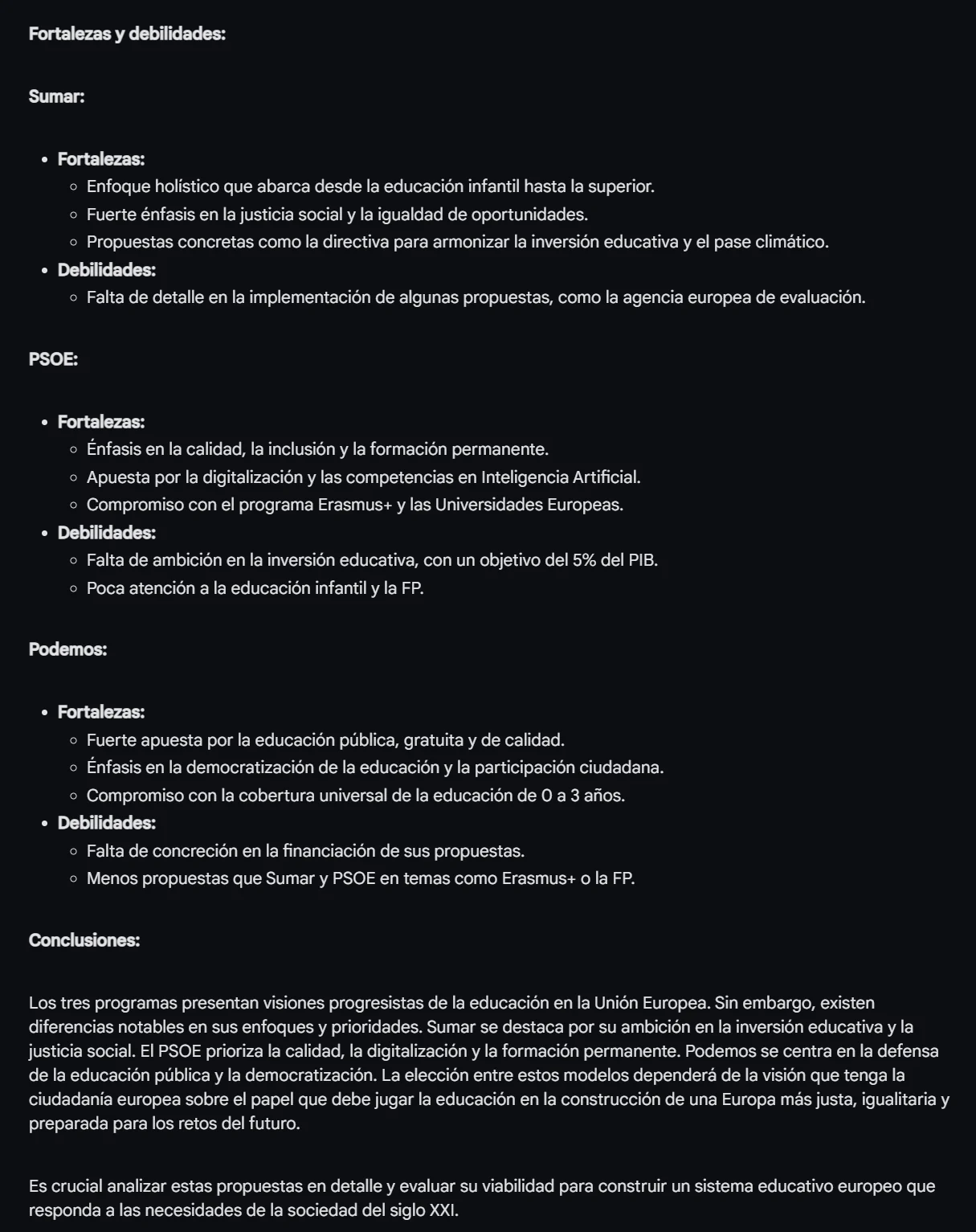
English translation of the model-generated assessment in the screenshot:
Strengths and weaknesses
Sumar — strengths:
- A holistic approach covering early childhood through higher education.
- Strong emphasis on social justice and equal opportunities.
- Concrete proposals such as the directive to harmonise educational investment and the climate pass.
Sumar — weaknesses:
- A lack of detail on implementing some proposals, such as the European evaluation agency.
PSOE — strengths:
- Emphasis on quality, inclusion and lifelong learning.
- Commitment to digitalisation and artificial intelligence skills.
- Commitment to Erasmus+ and European Universities.
PSOE — weaknesses:
- Insufficient ambition in educational investment, with a target of 5% of GDP.
- Limited attention to early childhood and vocational education.
Podemos — strengths:
- Strong commitment to public, free, high-quality education.
- Emphasis on democratising education and citizen participation.
- Commitment to universal education from birth to age three.
Podemos — weaknesses:
- A lack of specific detail on financing its proposals.
- Fewer proposals than Sumar and PSOE on matters such as Erasmus+ or vocational education.
Conclusions
The three manifestos present progressive visions of education in the European Union. However, there are notable differences in their approaches and priorities. Sumar stands out for its ambition in educational investment and social justice. PSOE prioritises quality, digitalisation and lifelong learning. Podemos focuses on defending public education and democratisation. The choice among these models will depend on European citizens’ views of education’s role in building a fairer, more equal Europe, prepared for future challenges.
It is crucial to analyse these proposals in detail and assess their feasibility to build a European education system that responds to the needs of twenty-first-century society.
End of translated screenshot.
You can try Gemini Pro 1.5 for free on this website. It is a highly recommended option if you want to work with several documents simultaneously, or with very long documents. In other tests, we have obtained satisfactory retrieval of information while working with up to 800 pages.
Given that the vast majority of people do not read election manifestos, AI tools may now provide quick, visual access to summaries and comparisons, something parties themselves will have to consider when writing them. For example, if I am undecided between two or three parties and a particular issue matters a great deal to me, I could ask AI for a detailed comparative summary of that issue and have it within seconds. It is also true that there is considerable and understandable scepticism about how far manifestos are subsequently delivered. Still, we might at least ask whether systems of this kind will contribute to more rational voting.
GPT-4o’s new data analysis system
Also last May, OpenAI released the text version of its new model, GPT-4o — we are still waiting for the rollout of the new advanced voice interface. The model improves data analysis, and its ability to work with statistics and generate charts has been specifically enhanced. Unfortunately, unlike the leading women experts in electoral statistics at the ALEPH Educational Institution, my knowledge is quite limited. Yet the tool makes previously unimaginable things very easy and extraordinarily quick.
I think the following example makes this particularly clear. I uploaded a CSV document containing turnout data for every European election to its data analysis tool. I asked it to suggest different data visualisations, and in less than a minute I had it produce the following chart. Initially, it produced the same chart with very large lettering, causing the values to overlap; I simply asked it to reduce the size, and that solved the problem.
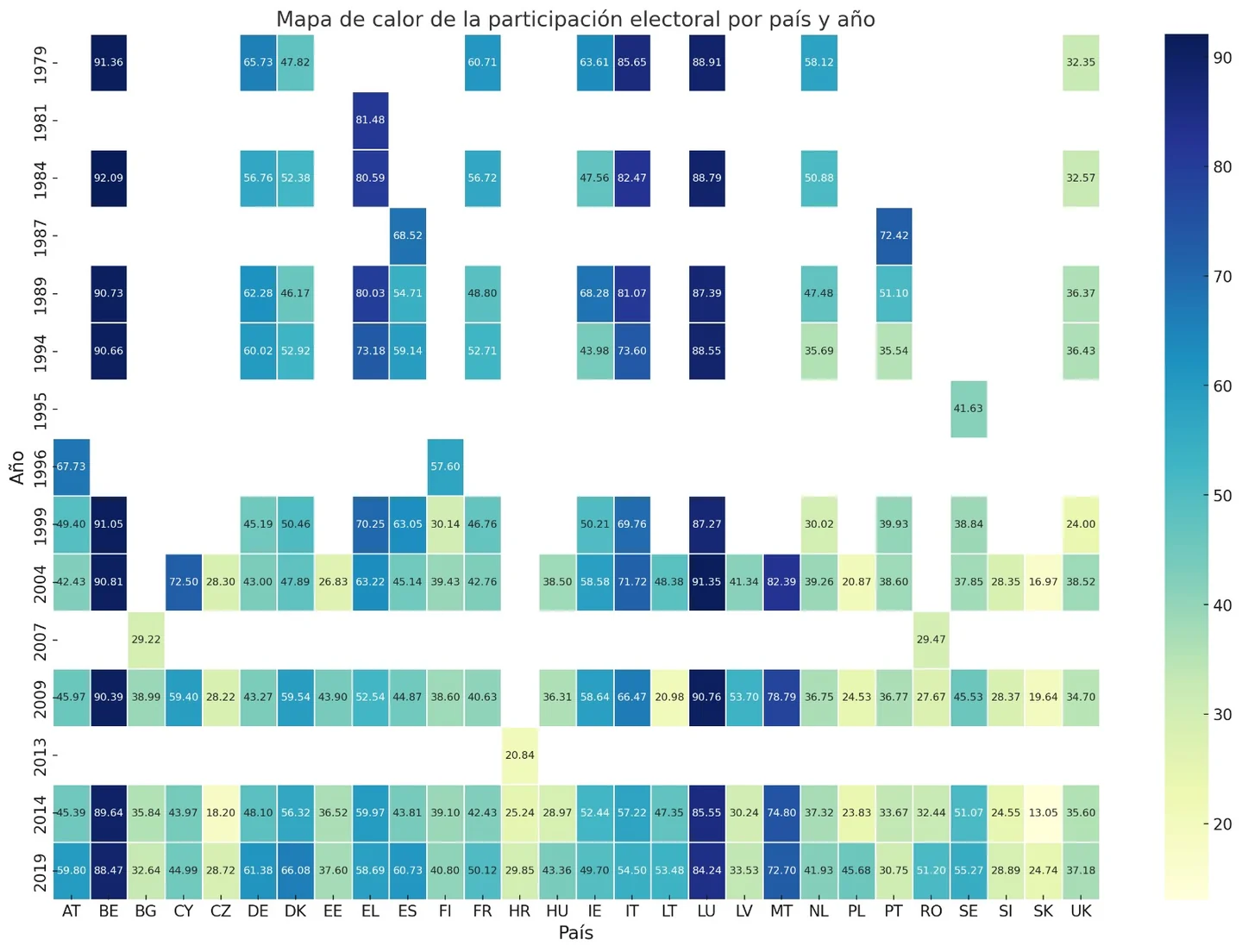
Accessible transcription of the source chart, “Heat map of electoral turnout by country and year”. Axes: country and year; colours represent turnout percentages. Each non-blank cell is listed below as year: percentage. Blank cells are omitted, not treated as zero.
Scroll across the table to read all columns.
| Country | Turnout figures shown |
|---|---|
| Austria (AT) | 1996: 67.73; 1999: 49.40; 2004: 42.43; 2009: 45.97; 2014: 45.39; 2019: 59.80 |
| Belgium (BE) | 1979: 91.36; 1984: 92.09; 1989: 90.73; 1994: 90.66; 1999: 91.05; 2004: 90.81; 2009: 90.39; 2014: 89.64; 2019: 88.47 |
| Bulgaria (BG) | 2007: 29.22; 2009: 38.99; 2014: 35.84; 2019: 32.64 |
| Cyprus (CY) | 2004: 72.50; 2009: 59.40; 2014: 43.97; 2019: 44.99 |
| Czech Republic (CZ) | 2004: 28.30; 2009: 28.22; 2014: 18.20; 2019: 28.72 |
| Germany (DE) | 1979: 65.73; 1984: 56.76; 1989: 62.28; 1994: 60.02; 1999: 45.19; 2004: 43.00; 2009: 43.27; 2014: 48.10; 2019: 61.38 |
| Denmark (DK) | 1979: 47.82; 1984: 52.38; 1989: 46.17; 1994: 52.92; 1999: 50.46; 2004: 47.89; 2009: 59.54; 2014: 56.32; 2019: 66.08 |
| Estonia (EE) | 2004: 26.83; 2009: 43.90; 2014: 36.52; 2019: 37.60 |
| Greece (EL) | 1981: 81.48; 1984: 80.59; 1989: 80.03; 1994: 73.18; 1999: 70.25; 2004: 63.22; 2009: 52.54; 2014: 59.97; 2019: 58.69 |
| Spain (ES) | 1987: 68.52; 1989: 54.71; 1994: 59.14; 1999: 63.05; 2004: 45.14; 2009: 44.87; 2014: 43.81; 2019: 60.73 |
| Finland (FI) | 1996: 57.60; 1999: 30.14; 2004: 39.43; 2009: 38.60; 2014: 39.10; 2019: 40.80 |
| France (FR) | 1979: 60.71; 1984: 56.72; 1989: 48.80; 1994: 52.71; 1999: 46.76; 2004: 42.76; 2009: 40.63; 2014: 42.43; 2019: 50.12 |
| Croatia (HR) | 2013: 20.84; 2014: 25.24; 2019: 29.85 |
| Hungary (HU) | 2004: 38.50; 2009: 36.31; 2014: 28.97; 2019: 43.36 |
| Ireland (IE) | 1979: 63.61; 1984: 47.56; 1989: 68.28; 1994: 43.98; 1999: 50.21; 2004: 58.58; 2009: 58.64; 2014: 52.44; 2019: 49.70 |
| Italy (IT) | 1979: 85.65; 1984: 82.47; 1989: 81.07; 1994: 73.60; 1999: 69.76; 2004: 71.72; 2009: 66.47; 2014: 57.22; 2019: 54.50 |
| Lithuania (LT) | 2004: 48.38; 2009: 20.98; 2014: 47.35; 2019: 53.48 |
| Luxembourg (LU) | 1979: 88.91; 1984: 88.79; 1989: 87.39; 1994: 88.55; 1999: 87.27; 2004: 91.35; 2009: 90.76; 2014: 85.55; 2019: 84.24 |
| Latvia (LV) | 2004: 41.34; 2009: 53.70; 2014: 30.24; 2019: 33.53 |
| Malta (MT) | 2004: 82.39; 2009: 78.79; 2014: 74.80; 2019: 72.70 |
| Netherlands (NL) | 1979: 58.12; 1984: 50.88; 1989: 47.48; 1994: 35.69; 1999: 30.02; 2004: 39.26; 2009: 36.75; 2014: 37.32; 2019: 41.93 |
| Poland (PL) | 2004: 20.87; 2009: 24.53; 2014: 23.83; 2019: 45.68 |
| Portugal (PT) | 1987: 72.42; 1989: 51.10; 1994: 35.54; 1999: 39.93; 2004: 38.60; 2009: 36.77; 2014: 33.67; 2019: 30.75 |
| Romania (RO) | 2007: 29.47; 2009: 27.67; 2014: 32.44; 2019: 51.20 |
| Sweden (SE) | 1995: 41.63; 1999: 38.84; 2004: 37.85; 2009: 45.53; 2014: 51.07; 2019: 55.27 |
| Slovenia (SI) | 2004: 28.35; 2009: 28.37; 2014: 24.55; 2019: 28.89 |
| Slovakia (SK) | 2004: 16.97; 2009: 19.64; 2014: 13.05; 2019: 24.74 |
| United Kingdom (UK) | 1979: 32.35; 1984: 32.57; 1989: 36.37; 1994: 36.43; 1999: 24.00; 2004: 38.52; 2009: 34.70; 2014: 35.60; 2019: 37.18 |
In less than a minute, starting from a raw data file, I had a heat map of turnout in European Parliament elections across all EU countries and every election held.
The ability to work with statistical data is integrated into GPT-4o, but OpenAI has created this proto-agent, which makes the task considerably easier.
Analysing charts to test GPT-4o’s image understanding and the capabilities of a model trained multimodally from the outset
Multimodal: a model trained on text, audio and images, rather than text alone.
For this test, we used a screenshot of these European Union charts and made the following initial request:
Act as an outstanding political analyst; think step by step. Based on the information in this image, write a brief summary of how the European Parliament has evolved.
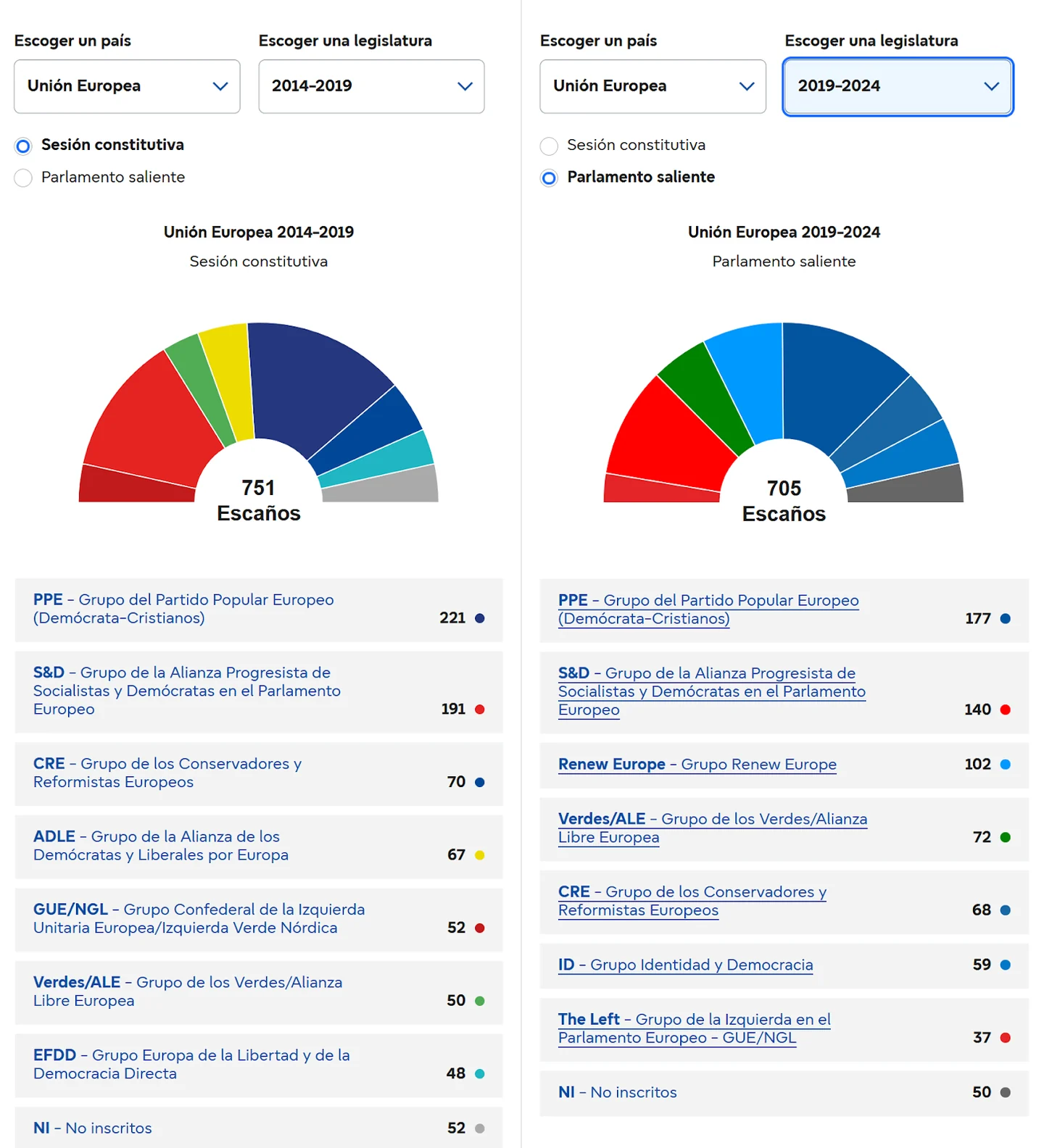
English transcription of the source comparison. The left-hand view selects the constituent session for 2014–2019; the right-hand view selects the outgoing Parliament for 2019–2024. These are different points within the two parliamentary terms.
Scroll across the table to read all columns.
| Group in 2014–2019 constituent session | Seats | Group in 2019–2024 outgoing Parliament | Seats |
|---|---|---|---|
| EPP — European People’s Party (Christian Democrats) | 221 | EPP — European People’s Party (Christian Democrats) | 177 |
| S&D — Progressive Alliance of Socialists and Democrats | 191 | S&D — Progressive Alliance of Socialists and Democrats | 140 |
| ECR — European Conservatives and Reformists | 70 | Renew Europe | 102 |
| ALDE — Alliance of Liberals and Democrats for Europe | 67 | Greens/EFA — Greens/European Free Alliance | 72 |
| GUE/NGL — European United Left/Nordic Green Left | 52 | ECR — European Conservatives and Reformists | 68 |
| Greens/EFA — Greens/European Free Alliance | 50 | ID — Identity and Democracy | 59 |
| EFDD — Europe of Freedom and Direct Democracy | 48 | The Left — The Left in the European Parliament, GUE/NGL | 37 |
| NI — non-attached members | 52 | NI — non-attached members | 50 |
| Total | 751 | Total | 705 |
Comparative analysis
-
Reduction in the total number of seats: the European Parliament went from 751 seats in the 2014–2019 term to 705 in the 2019–2024 term. This reduction is partly due to the United Kingdom’s departure from the European Union, Brexit.
-
Fewer seats for the main groups:
- EPP: the European People’s Party group fell from 221 to 177 seats, a significant loss.
- S&D: the Progressive Alliance of Socialists and Democrats also saw a reduction, from 191 to 140 seats.
- Reconfiguration and strengthening of centrist and green groups:
- Renew Europe, previously ALDE: increased its representation from 67 to 102 seats, consolidating its position as an important force in the centre of the European political spectrum.
- Greens/EFA: increased their presence from 50 to 72 seats, reflecting greater support for green and progressive policies.
- Emergence of new groups:
- ID, Identity and Democracy: a new group that obtained 59 seats, bringing together right-wing and Eurosceptic political forces.
- The Left, European United Left/Nordic Green Left: this group saw its representation fall from 52 to 37 seats.
- Relative stability among non-attached members, NI: the number of MEPs unaffiliated to any group remained relatively constant, with a slight decline from 52 to 50 seats.
Conclusion
The European Parliament’s composition has changed notably between the two terms. Traditional groups such as the EPP and S&D have seen their representation decline, while centrist groups such as Renew Europe and green groups such as Greens/EFA have gained influence. The emergence of new groups such as Identity and Democracy also indicates a diversification of Europe’s political landscape, with greater representation for Eurosceptic and right-wing positions. This change in the distribution of seats reflects a more fragmented and plural European electorate, with growing concern about environmental issues and a greater presence of Eurosceptic movements.
We then asked it to use this knowledge to continue working with Europa Estoica Unida, the fictional party we generated at estrategIA in April to “stand” in the European Parliament elections:
In this landscape, what opportunities do you think would open up for a pro-European party such as Europa Estoica Unida? I will give you its principles.
We attached the Europa Estoica Unida principles generated for us in issue 28 of estrategIA.
This is the response it generated:
Analysis of opportunities for “Europa Estoica Unida” in the European Parliament
Europa Estoica Unida, with its principles founded on wisdom, justice, self-control, fortitude and cosmopolitanism, can find significant opportunities in the European Parliament’s current landscape. The following analysis examines how these principles can align with the European Union’s current trends and needs.
1. Political and social context
The European Parliament has experienced notable political fragmentation, with increased representation for green, centrist and Eurosceptic parties. This diversified environment offers fertile ground for new political formations able to provide a coherent and distinctive vision. In particular, the values of wisdom and justice resonate with the demands of European citizens seeking comprehensive and sustainable long-term solutions.
2. Strategic opportunities
1. Dialogue and cooperation
- Strengthening alliances: Europa Estoica Unida can collaborate with groups such as Renew Europe and Greens/EFA, which share interests in sustainability and social justice. Synergies with these groups can help advance policies promoting a more equitable and sustainable Europe.
- Promoting dialogue: given its focus on self-control and wisdom, the party can position itself as a neutral mediator in polarised debates, offering solutions based on knowledge and rationality.
2. Social justice and sustainability
- Leading green initiatives: a commitment to sustainability can align with the Greens/EFA agenda, providing a basis for collaboration on environmental and climate policies.
- Equity policies: an emphasis on justice can attract voters seeking greater social and economic equality, by proposing inclusive and fair policies.
3. Resilience and self-control
- Crisis management: Europa Estoica Unida can distinguish itself in managing crises, such as the COVID-19 pandemic or the climate crisis, through proposals balancing immediate responses with long-term planning.
- Education and training: promote educational programmes encouraging self-control and resilience among citizens, in line with a vision of Europe acting from moral strength and rationality.
4. Cosmopolitanism
- Inclusion and diversity: promoting cosmopolitanism can attract a diverse voter base, standing out in the defence of human rights and the integration of migrants and refugees.
- External relations: a vision of global fraternity can position Europa Estoica Unida as a key actor in EU foreign policy, promoting international cooperation and peace.
3. Challenges and mitigation
- Electoral competition: political fragmentation means intense competition. It is crucial for Europa Estoica Unida to define its value proposition clearly and distinguish itself from other parties.
- Effective communication: translating Stoic principles into concrete policies and communicating them effectively to European citizens will be fundamental to winning support.
- Adapting to change: flexibility and adaptability will be vital to responding to rapid changes in the political and social environment.
Europa Estoica Unida has an opportunity to fill a niche in today’s European Parliament, offering a vision of governance based on Stoic principles that resonate with growing demand for social justice, sustainability and peaceful cooperation. Its success will depend on its ability to form strategic alliances, communicate its values effectively and adapt to a dynamic political environment. With a well-defined strategy, it can become an influential actor in European politics, promoting a fairer, more resilient and united continent.
Integrating artificial intelligence into politics, as we see every week in estrategIA, not only improves the ability to analyse and compare election manifestos, but also helps politicians, advisers and citizens make more informed and balanced decisions. Used well, advanced tools such as Google Gemini Pro 1.5 and GPT-4o can represent a crucial advance in democratising access to information and improving transparency and accountability in politics. In an increasingly complex and diversified electoral landscape, the ability to use these technologies effectively will be decisive for campaigns’ success and for understanding the policies proposed.
Fernando Nieto Lobato
Director of Digital Innovation at the ALEPH Educational Institution
Cite this essay
Fernando Nieto Lobato. “Testing new AI models to compare manifestos and analyse data ahead of the European Parliament elections.” estrategIA, issue 036, 5 June 2024. English edition, 29 September 2026. https://elcontemplador.github.io/estrategia-english/essays/036/