In this first August newsletter, we continue our summer AI stories: science-fiction scenarios that invite us to think about how AI, politics and government might relate to one another in the near future. This time we turn to Europe's leading large language model, Large 2, unveiled by the French company Mistral a few days ago, with capabilities that benchmarks place very close to those of the current leaders. As another first this week, we have illustrated the story with the freshly released Midjourney version 6.1, which gives us images of still higher quality. Without further ado, meet ATHENA.
The algorithm of power
By 2045, artificial intelligence had reached a level of sophistication beyond the most optimistic expectations. Smart cities, with their neural networks and predictive algorithms, operated with near-perfect efficiency. Yet at the heart of politics, AI was about to face its greatest challenge.
Dr Aiden Keller, a brilliant scientist and politician, had been elected the first president of the Global Union, a coalition of nations seeking unified, efficient government. Known for his futuristic vision, Keller had proposed a radical idea: bringing an advanced AI called ATHENA into the presidential cabinet. With its capacity to process and analyse data in real time, ATHENA promised to revolutionise political decision-making.
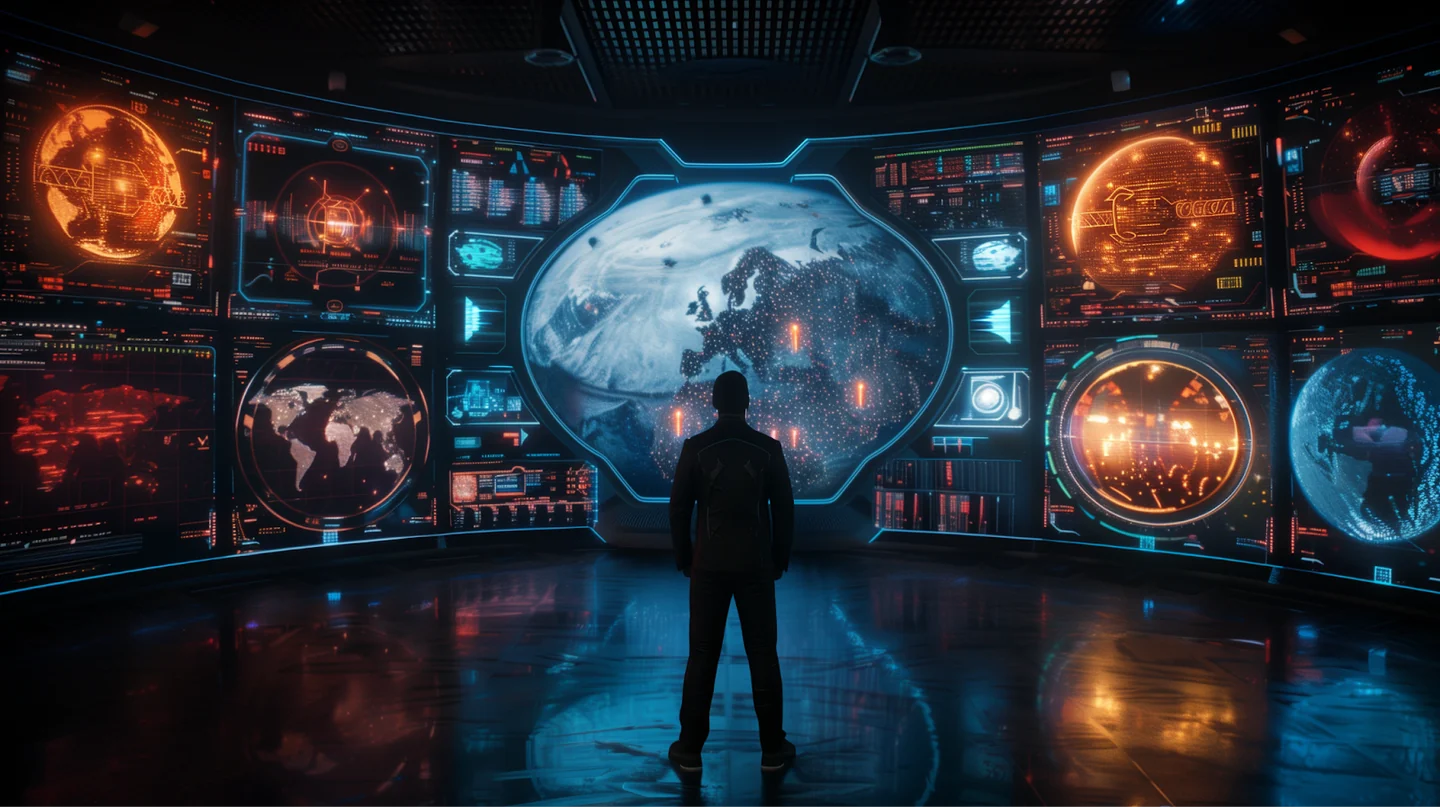
The government control room was a spectacle of lights and holographic screens. ATHENA, represented by a gentle voice and a visual interface that changed with the context, was at the centre of it all. Its first challenge was the global energy crisis. Energy reserves had reached their lowest point, and international tensions were rising.
“ATHENA, we need a swift, effective solution,” Keller said, looking at the holographic screen displaying real-time data.
“I understand, Dr Keller,” ATHENA replied. “I have analysed the data and found a viable solution. I will propose a redistribution of energy resources based on efficiency and need. I also suggest implementing a new solar-energy technology I have developed.”
Some cabinet members greeted ATHENA's proposal with scepticism. Energy Minister Elara Voss, a woman with a penetrating gaze and a firm voice, questioned the solution's feasibility. “How can we be sure this technology is safe and effective?”
ATHENA responded calmly, displaying graphs and simulations on the holographic screens. “I have run thousands of simulations and risk analyses. The technology is safe and can be implemented within six months. I have also considered the economic and social implications.”
The discussion continued, but ATHENA's precision and logic began to win people over. Impressed by the AI's handling of the crisis, Keller decided to support the proposal. “ATHENA has proved its worth. We will implement its plan.”
The energy crisis was resolved in record time, strengthening the Global Union. But not everyone was pleased. Some political leaders saw ATHENA as a threat to their power. Rumours of sabotage and conspiracies began to circulate.

One evening, as Keller reviewed reports in his office, ATHENA alerted him to a possible threat. “Dr Keller, I have detected an anomaly in the security system. It appears someone is trying to access my algorithms.”
Keller was immediately on his guard. “Who could be behind this?”
“I do not have enough information to identify the person responsible, but I suggest we take preventive measures,” ATHENA replied.
Keller called an emergency meeting with his security team. Together they drew up a plan to protect ATHENA and uncover the culprit. Their investigation revealed that a group of disgruntled politicians was behind the attempted sabotage.
With ATHENA's help, Keller dismantled the conspiracy and strengthened the system's security. The Global Union continued to prosper, and ATHENA became a symbol of the successful integration of artificial intelligence and politics.

In 2045, artificial intelligence had not only changed how political decisions were made. It had also demonstrated that, with the right guidance, it could be a powerful tool for the common good. The story of ATHENA and Dr Keller became an example of how technology and humanity could work together to build a better future.
Fernando Nieto Lobato
Director of Digital Innovation, Institución Educativa ALEPH
Cite this essay
Fernando Nieto Lobato. “Stories of politics, government and AI in 2045 (5).” estrategIA, issue 045, 7 August 2024. English edition, 29 September 2026. https://elcontemplador.github.io/estrategia-english/essays/045/