How will a campaign manager work seven years from now? This week, in our summer stories, we present a tale of the near future generated with Kimi K2, the much-discussed Chinese AI model examined in the original newsletter's Tool of the Week section.
Archive note: this is fiction created with Kimi K2. The systems, election figures and 2029 law belong to its imagined 2032 setting.
06:47 Amber dawn light slips through the seventh-floor windows, and my smart glasses project a message in the bottom-right corner: “14 days until the national election. Probability of victory: 52.3%.” I am not the one who waves at the cameras; I decide who does. I am the incumbent prime minister's campaign manager.
The AGI Orchestrator has already woken its micro-agents. The fiscal simulator has just cut the cost of the “Green 30-30 Plan” by 1.2% without touching the deficit, and the bias auditor has detected that “shared responsibility” sounds accusatory to the self-employed. I archive that line, ask for another, drink my coffee.
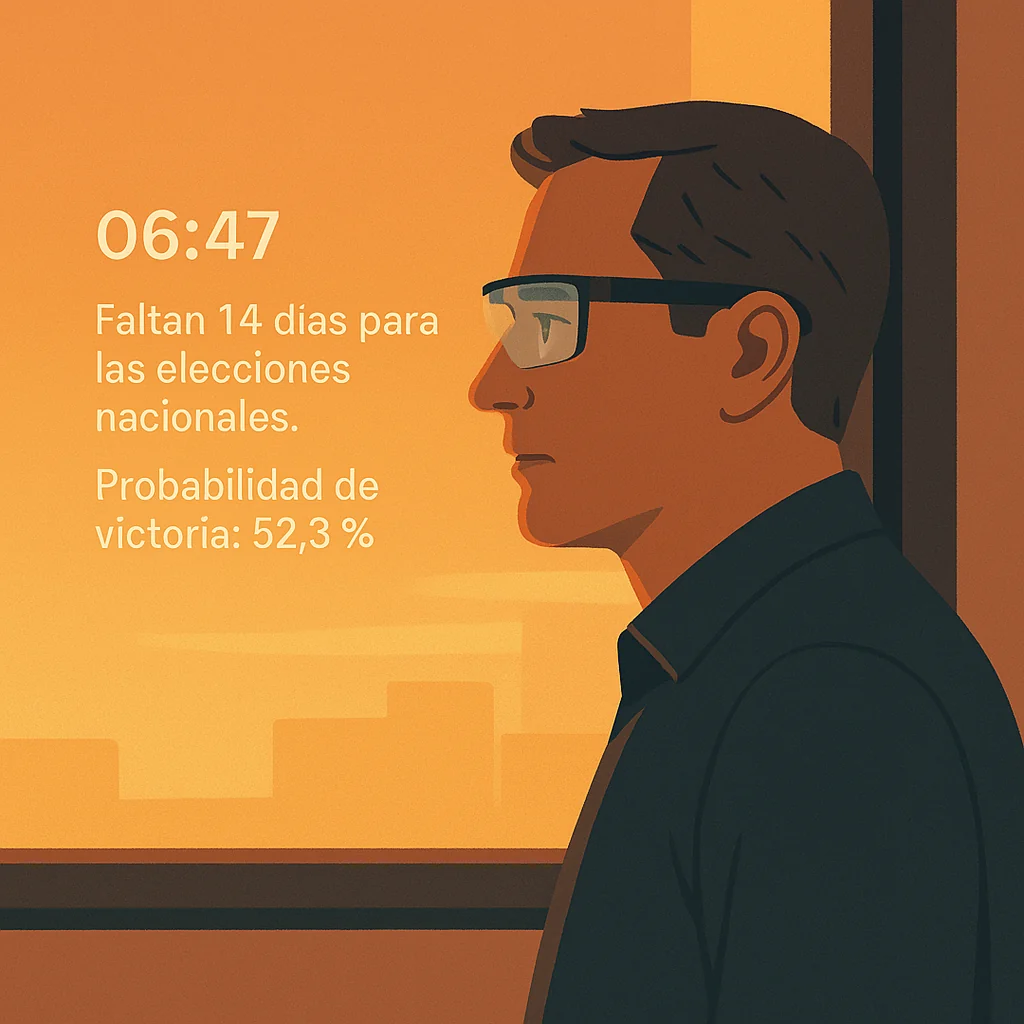
Text on the original illustration: “06:47. 14 days until the national election. Probability of victory: 52.3%.”
07:32 In the shower, the water stutters as an alert arrives: a deepfake of the prime minister saying we will raise VAT on cultural activities. The clip has been live for three minutes and is already approaching 400,000 views. My glasses display the rumour curve: a red peak among urban 25–45-year-olds. I activate the watermarking module. Within 92 seconds, the platform inserts an authentication seal and X adds a “Manipulated” label. Sentiment falls by barely 0.04. Not enough.
09:03 Crisis meeting at Moncloa. The culture minister demands an immediate, forceful press conference. The counterfactual simulator shows that responding with “false and punishable” would send our opponent's engagement soaring. The ethical firewall flashes: “Recommendation blocked: increases perception of censorship.” I press my lips together. I decide against the press conference and change direction: the narrative generator recycles yesterday's material on the universal culture card. The auditor warns that leaving out independent filmmakers will cost us 0.6 in Catalonia. I adjust a comma. Literally.
11:27 The electorate's synthetic twin receives a fresh batch of door-to-door micro-surveys. The heat map flares in Valladolid: pensioners see the partial-retirement proposal as “a con with a nice name”. I ask the Orchestrator to simulate a proportional cut in social-security contributions for companies hiring people over 62. The fiscal simulator squeals: “Deficit +0.03%.” I accept the risk. The firewall does not object; the calculation is transparent.
14:15 Lunch standing up in the war room. The screens were showing an explosion of memes comparing the prime minister to a rusty robot. A new deepfake arrives on WhatsApp, this time an audio clip: a synthetic version of my voice ordering people to “silence the artists”. The authentication firewall flags it as generated with ElevenLabs 7.2. I send the evidence to the press fact-checking groups; within ten minutes the chain is broken. I allow myself a private joke: at least they imitate my professional tone well.
17:44 The counterfactual simulator produces a wild hypothesis: if we send a personalised text to the 1.2 million undecided voters, showing exactly how much the culture card would save each of them, we gain 1.1 points. The firewall activates immediately: “Requires explicit consent and a two-click opt-out.” Tick, tock. I decide to split the message into three doses: first a reminder of the policies, then an interactive calculator, finally the figure. We comply with the 2029 law and preserve our momentum.
19:08 In the armoured van heading to the Seville rally, I check the algorithmic-governance dashboard. The fairness indicator flashes green: no targeting variable has used health data or sexual orientation. I breathe. The bias auditor detects that “the families who need it most” reads as “clientelism” in Galicia. The spokesperson and I rewrite it aloud: “the families the crisis hit first”. The change lifts us 0.2 in A Coruña without losing ground in Madrid.
23:35 The prime minister finishes her speech and steps down from the stage without looking at me; she has no reason to. The latest update appears in my glasses: a 53.7% probability. It is not victory. It is room to sleep.
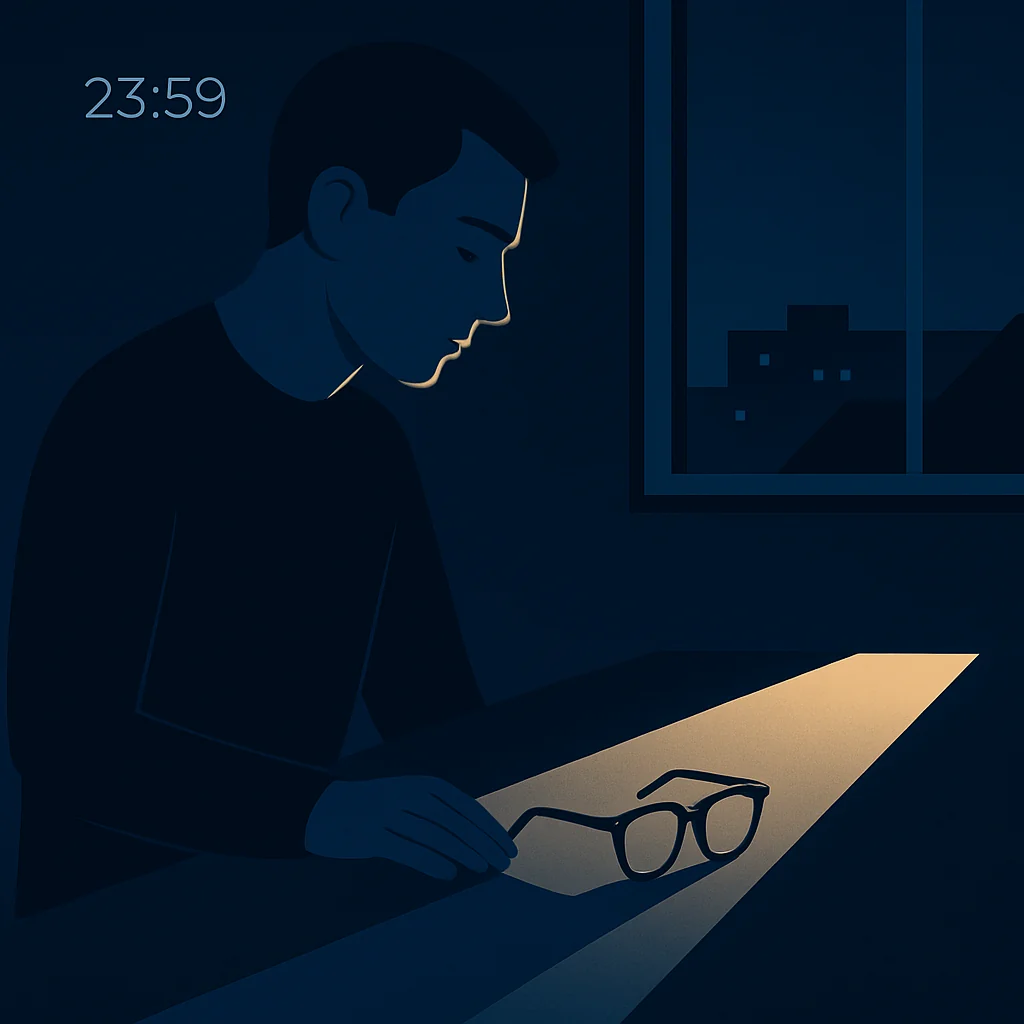
The closing illustration shows the campaign manager setting his glasses down at 23:59.
23:59 I leave the glasses on the table, and the room dwindles to a moonbeam sliding across the carpet. I listen to the heartbeat of the sleeping city and think that every algorithm, every micro-agent, every intelligent warning heeded or evaded has been no more than a flare illuminating what we already knew: democracy is not won with models, but with the mind of the person who decides which models they dare to use, and how. Tomorrow will bring thirteen fresh days, and perhaps another 0.1% that decides the future. But tonight, in the half-light, all that remains is the silence of someone who has learned that the last variable always beats inside the chest.
Director of Digital Innovation at Institución Educativa ALEPH
Cite this essay
Fernando Nieto Lobato. “Room to sleep: a day in the life of a campaign manager in 2032.” estrategIA, issue 095, 23 July 2025. English edition, 29 September 2026. https://elcontemplador.github.io/estrategia-english/essays/095/