We are especially pleased to welcome Ignacio Martín Granados as this week's guest author. The director and editor of estrategIA have known him for a decade and a half. Martín Granados is a political scientist and a prominent member of the Political Communication Association (ACOP), with such extensive experience in political and institutional communication that even summarising it would be difficult. He is also a distinguished lecturer on various postgraduate programmes.
Bringing that practical perspective and experience of public management, Nacho has written “Campaigns in the age of AI: global lessons from 2024”, a clear and necessary account of how AI is transforming political communication—with its opportunities and risks—and what we can learn from the most recent electoral processes.
The use of artificial intelligence tools has grown considerably in recent years, and businesses, institutions and individuals routinely incorporate AI-based solutions into their activities. Although official statistics are very difficult to obtain, the fact is that in barely five years AI has gone from a futuristic concept to a mainstream technology increasingly integrated into everyday life, with its number of users growing fivefold.
If AI is present in every sphere, its use in politics has also spread. In political communication, AI optimises campaign management by making it easier to segment audiences and personalise messages; enables real-time analysis of public opinion and trends; automates the creation of content, including texts and videos; and makes interaction with citizens possible through chatbots, among other functions.
The report The Role of Generative AI Use in 2024 Elections Worldwide, published this summer by the International Panel on the Information Environment (IPIE), an independent scientific organisation based in Switzerland, shows that generative artificial intelligence—the kind that generates original content—was used in multiple ways during the 2024 elections. To map global trends, IPIE created a database of incidents recording all cases of political AI use in 2024 reported by the media, gathering information on who used it, how and for what purpose.
Based on an original dataset of 215 incidents in the 50 countries that held national elections in 2024, the study reveals that:
- 80% of countries recorded AI-related incidents.
- 90% of incidents involved content creation: audio messages, images, videos and social media posts.
- 46% of incidents had no identified origin; 25% were produced by candidates and parties; 20% by foreign actors, all for malicious purposes, with examples including Russia, China and Iran; and the remaining 9% by other sources.
- More than two-thirds of incidents—69%—played a harmful role in electoral integrity, compared with just 16% serving positive purposes, such as translation or accessibility.
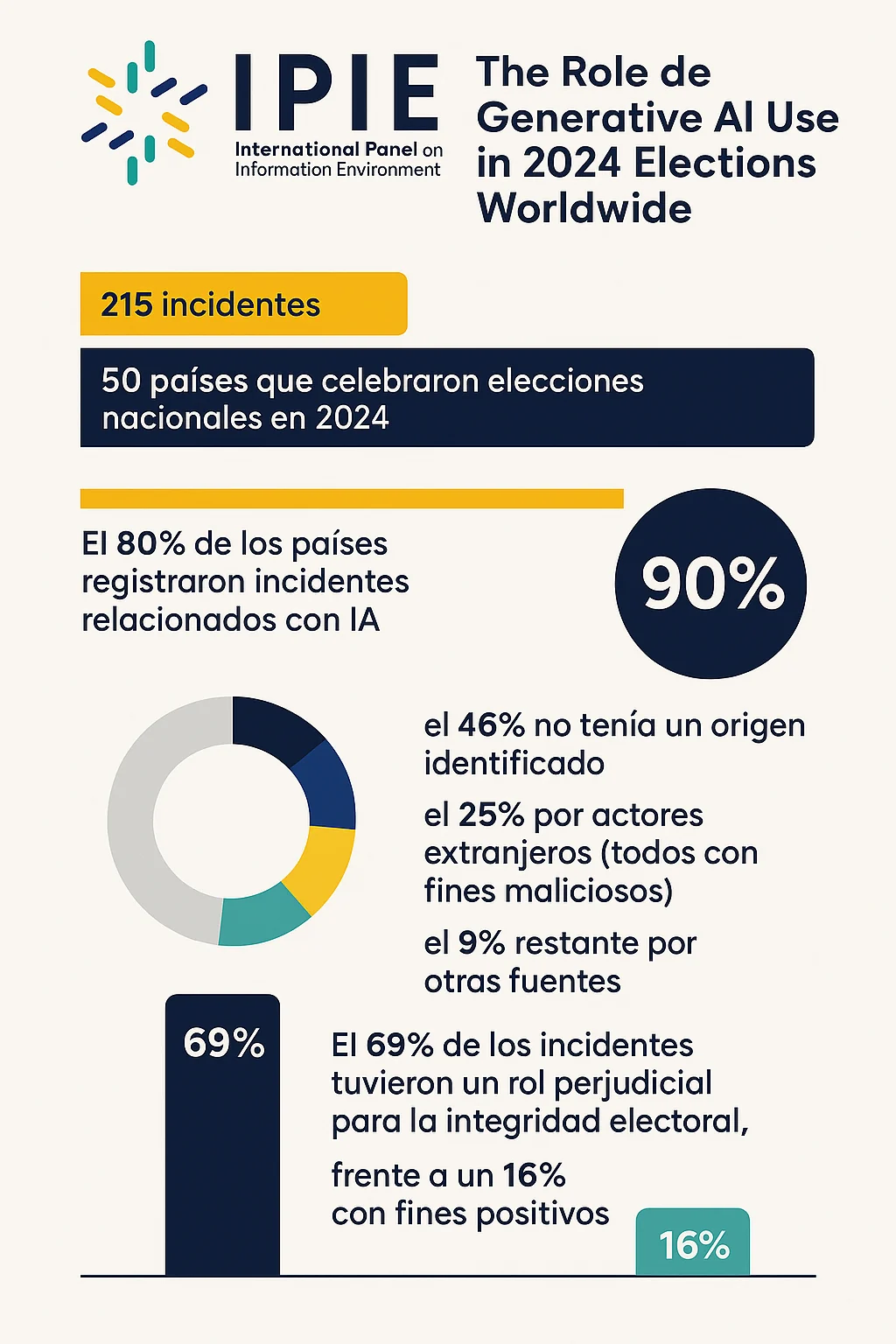
Infographic text, translated: “IPIE — International Panel on Information Environment”; “The Role of Generative AI Use in 2024 Elections Worldwide”; “215 incidents”; “50 countries that held national elections in 2024”; “80% of countries recorded AI-related incidents”; “90%”; “46% had no identified origin”; “25% by foreign actors (all for malicious purposes)”; “the remaining 9% by other sources”; “69% of incidents played a harmful role in electoral integrity, compared with 16% serving positive purposes”.
Archive note: the original graphic attributes 25% to foreign actors, whereas the article attributes 20% to them and 25% to candidates and parties. The graphic also leaves its “90%” badge unlabelled; the article identifies that figure as content creation. Both the original image and the article's wording are preserved here without silently resolving the discrepancy.
The report provides specific cases. India and the United States, for example, recorded the highest number of incidents, at 30 each, and in India cloned politicians' voices were used to make mass calls to voters. In Romania, a sophisticated AI manipulation campaign even led to the annulment of the presidential election results. In Mexico, AI was used to harass and delegitimise the two female presidential candidates. The risks highlighted include the so-called “liar's dividend”—the ability to discredit real evidence by claiming that it is a deepfake—and the disproportionate vulnerability of women in politics to smear campaigns using manipulated images or audio.
Lessons from the report
In its conclusions, IPIE draws the following lessons:
- The impact of generative AI on political communication: AI is already transforming how messages and narratives are designed, enabling personalised content at scale that increases microtargeting and, at the same time, the risks of manipulation.
- Threats to public trust: the creation of disinformation and deepfakes undermines the credibility of democratic processes; the difficulty of distinguishing authentic material from artificially generated content erodes trust in the media, candidates and institutions.
- Regulatory and ethical gaps: existing regulatory frameworks are failing to keep pace with advances in AI. There is tension between innovation and democratic protection, making clear rules on transparency, traceability and AI use in campaigns necessary.
- Citizen resilience and media literacy: critical media education and the development of verification skills are essential to strengthen society against algorithmic manipulation and prevent fabricated narratives from influencing the vote.
- The responsibility of parties, platforms and the media: parties and candidates must ensure that AI is used ethically; digital platforms must improve the detection and labelling of synthetic content; and the media must strengthen verification and transparency.
- The future agenda: recommendations include studying the psychological and behavioural effects of exposure to AI-created messages in greater depth; comparing international contexts, since the impact varies with political culture, polarisation and institutional trust; and investigating positive uses of AI to improve citizen participation and public deliberation.
In conclusion, generative AI offers politics powerful tools to improve campaign effectiveness and connect better with citizens, but it also poses real risks to democratic integrity if used without limits or controls. This report is proof of that. Before it is too late, it is therefore essential that all of us—candidates and parties, regulatory authorities and governments, platforms, the media and civil society—recognise the dangers it entails. Only by combining responsible governance with ethical policies and civic education can we benefit from AI without sacrificing public trust or the quality of democratic debate. Otherwise, AI will begin to wear democracy away until nothing remains.
Political scientist and member of the Political Communication Association (ACOP).
Cite this essay
Ignacio Martín Granados. “Campaigns in the age of AI: global lessons from 2024.” estrategIA, issue 102, 10 September 2025. English edition, 29 September 2026. https://elcontemplador.github.io/estrategia-english/essays/102/