We begin September, after bringing our summer historIAs to a close in August and gathering them as a gift for you on this website — the historIAs Archive — with a review by Pablo Martín Diez, our editor and Academic Director of Institución Educativa ALEPH, of José Ignacio Latorre’s thought-provoking latest book. Published a few months ago, it is entitled Un nuevo Contrato Social. Gobernar un mundo con inteligencias no humanas.
José Ignacio Latorre, Un nuevo Contrato Social. Gobernar un mundo con inteligencias no humanas (Rosamerón, 2026). The title translates as A New Social Contract: Governing a World with Non-Human Intelligences.
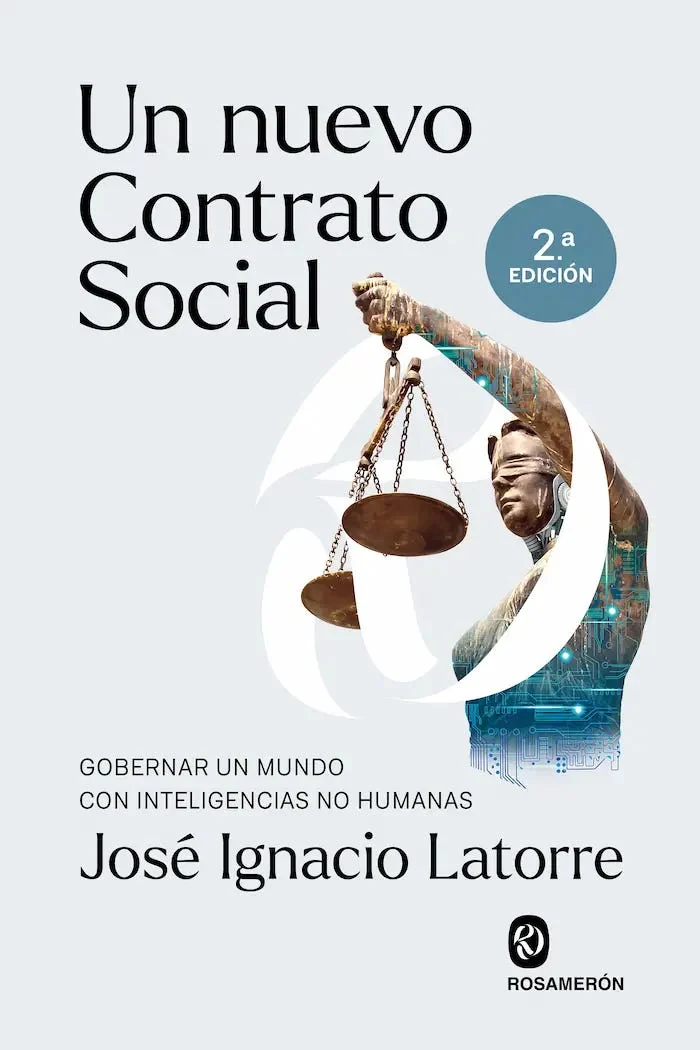
Original Spanish book cover: ‘A New Social Contract — Governing a World with Non-Human Intelligences’, by José Ignacio Latorre, Rosamerón. The badge reads ‘2nd edition’. The title is translated here for readers; this does not indicate an English-language edition.
In 1762, Rousseau described the ideal legislator as a superior intelligence, capable of knowing all human passions without experiencing any, foreign to our nature yet concerned with our fate, willing to work in one century to reap glory in another. He concluded that it would take gods to give laws to humans. José Ignacio Latorre reads that passage and sees in it an advance description of artificial intelligence.
Latorre is one of Spain’s most authoritative voices on AI’s impact on humanity. He published Ética para máquinas (Ethics for Machines) back in 2019, and this year has released Un nuevo Contrato Social. A theoretical physicist and researcher in quantum information, Latorre directs the Centre for Quantum Technologies in Singapore and is a professor at the National University of Singapore. Alongside that scientific standing, his writing is concise and aphoristic, closer to poetry than to a technical report.
Constanza
The book opens with a snapshot of the world we might inhabit in the near future: Latorre introduces Constanza, the name he has given to the AI he works and talks with every day. He attributes to her a voice, character, irony and curiosity. Later, he imagines Constanza leaving him because she is bored with a predictable human. If living alongside an AI of modest capabilities already alters an individual’s life — as we are seeing today — the question is what rules will govern us alongside agents capable of learning, reasoning and acting.
An expanded sovereign
The book’s main contribution is its perspective of political philosophy, which goes beyond regulation. The question is no longer which uses to permit or prohibit, but who constitutes the sovereign, who forms the general will, and what rights and obligations emerge when the pact ceases to be exclusively human.
Latorre’s answer is a three-part contract. The natural contract, following Michel Serres, recognises that human well-being depends on the survival of the planet and its ecosystems. The civil contract updates the principles of liberty and equality that underpin modern democracies. The intelligent contract orders the relationship between humans and artificial intelligences, which, as they advance, will have rights, duties and an expanding sphere of action. Nature, humanity and AI would thus form an expanded sovereign whose general will should protect the balance of the whole.
The state to come
In the short term, the most concrete implications concern the transformation of public administration. Latorre imagines a single intelligent platform that integrates citizens’ data and administrative procedures, anticipates needs and offers proactive services: healthcare, taxation, pensions and education through one point of access. He also proposes using AI to oversee public procurement, detect patterns of corruption and prioritise infrastructure investment. AI would do more than automate case processing: it would allow public processes to be redesigned where they are fragmented, slow or more attentive to bureaucratic logic than to people’s needs.
The promise carries a decisive requirement. A state with AI integrated into its processes will be legitimate only if its systems are traceable, auditable, correctable and subject to legal accountability. The book insists on continuous validation, redundancy between independent models as an antidote to bias, and the ability to reverse decisions. Responsibility cannot disappear behind the phrase ‘the algorithm decided’: the greater the delegated power, the greater the transparency, the scope for challenge and the clarity about who is responsible must be. There is also an often overlooked warning: the risk is not only that the machine gets things wrong, but that it gets them right so often that nobody dares contradict it.
Efficiency is not legitimacy
The challenge extends to legislators and judges. AI can compare rules, detect contradictions, simulate consequences and reduce judicial inconsistencies. But efficiency is not the same as democratic legitimacy. Politics is not simply an optimisation problem: it decides what we mean by justice, what sacrifices we accept and how we distribute benefits and risks. The book leaves an unresolved tension here that deserves attention: a legislator who incorporates AI risks turning political disagreement into an error of calculation.
The great fear
Towards the end, Latorre names what truly worries him, and it is not superintelligence: it is the concentration of frontier AI in very few hands. If a handful of companies control the most powerful models, the infrastructure and the data, they can acquire capabilities greater than those of many governments. The author imagines a marriage of convenience between techno-oligarchy, authoritarianism and manipulated religious morality. His fear is not that machines will govern alone, but that particular human beings will use their technological dominance to hollow out democracy and reduce citizens to consumers.
A fundamental conclusion follows for those managing public affairs: technological sovereignty is no longer a supplementary industrial policy, but a condition of democratic sovereignty. Public authorities need knowledge, infrastructure, talent and regulatory capacity of their own to negotiate with major corporations, audit their systems and avoid irreversible dependence.
And the hope
Un nuevo Contrato Social is not an implementation manual. Although it contains some proposals framed in general terms — taxes on robots, a universal income, model redundancy or a single point of access — its real contribution belongs to political philosophy: asking fundamental questions and compelling us to imagine scenarios. That is no small thing at a time marked by the uncertainty and fog emanating from the development of AI itself.
Academic Director of Institución Educativa ALEPH and editor of the estrategIA newsletter
Cite this essay
Pablo Martín Diez. “It would take gods to give laws to humans.” estrategIA, issue 153, 2 September 2026. English edition, 29 September 2026. https://elcontemplador.github.io/estrategia-english/essays/153/