With this edition, we reach one hundred issues of estrategIA — and it feels as though we only started yesterday. First, allow me to offer a brief thank you to everyone who makes this project possible: Pablo Martín, its enthusiastic editor; Natalia Benito and Andrea Molina, who have proofread and offered valuable suggestions across dozens of issues over these almost two years; Institución Educativa ALEPH, for understanding the social importance of a space like this, which we will discuss further below; all our guest authors, around ten, who have contributed their knowledge and perspectives to these first hundred issues; and, above all, you, our readers, who join us week after week, the longest-standing among you since autumn 2023.

Original anniversary graphic, translated: “100 issues of estrategIA. Thank you very much. A pioneering Spanish-language newsletter on AI in politics and government — estrategIA”.
Without you, dear readers, the work and effort we put into producing estrategIA, week after week without a break, would have no purpose. We hope to keep sharing AI's evolution with you for many more issues, with the same combination of curiosity, rigour and practical usefulness that we set out to offer from the beginning. We want to bring you major developments explained calmly, analysis that helps people make better public decisions, and tools you can apply in your everyday work. THANK YOU for reading, commenting and recommending estrategIA: that is the energy that keeps us going.
When AI accelerates, politics cannot wait
I also want to use this hundredth issue to share a personal reflection that I consider especially important, and which I began to sketch in issue 98, prompted by Sam Altman's Reddit question-and-answer session. Among the thousands of followers taking part, not a single question appeared about the political implications, governmental uses or public-administration applications of the newly released GPT-5. This disconnect between politics and AI, which we warned about in some of estrategIA's earliest issues, does not merely persist: it is growing. Meanwhile, a frontier technology is being deployed that, in the words of last year's Nobel laureate in chemistry, Demis Hassabis, and more than a few other scientists, has transformative potential greater than the Industrial Revolution's.
That is why, almost two years after its launch, a space such as estrategIA, devoted to the convergence of AI, politics and government, seems more necessary than ever. We urgently need to build bridges between laboratories and parliaments, between research papers and official gazettes, and between the latest frontier technology and its everyday use in politics.
Our commitment is to keep contributing to this debate: publishing feature essays that put advances and controversies in context; offering practical guides that translate research and development into concrete decisions; and maintaining our practical corner, introducing tools that can help us immediately in our daily work. We also intend to continue our comparative news coverage, showing what is being done in other countries, and our recommendations of useful resources. Over these two years, that combination has enabled us to explain key reports, map public policies and describe real applications. That is what we want to keep offering, issue after issue, at the same pace and with the same editorial care. Patient work, judgement and practical usefulness, in the service of decision-makers and anyone wishing to understand the intersection of AI, politics and government.
If politics does not take its place, others will take it on its behalf. estrategIA was created — and will continue — to help the public sector understand, adopt and guide AI with judgement, evidence and a democratic purpose. Much of our future depends on it.
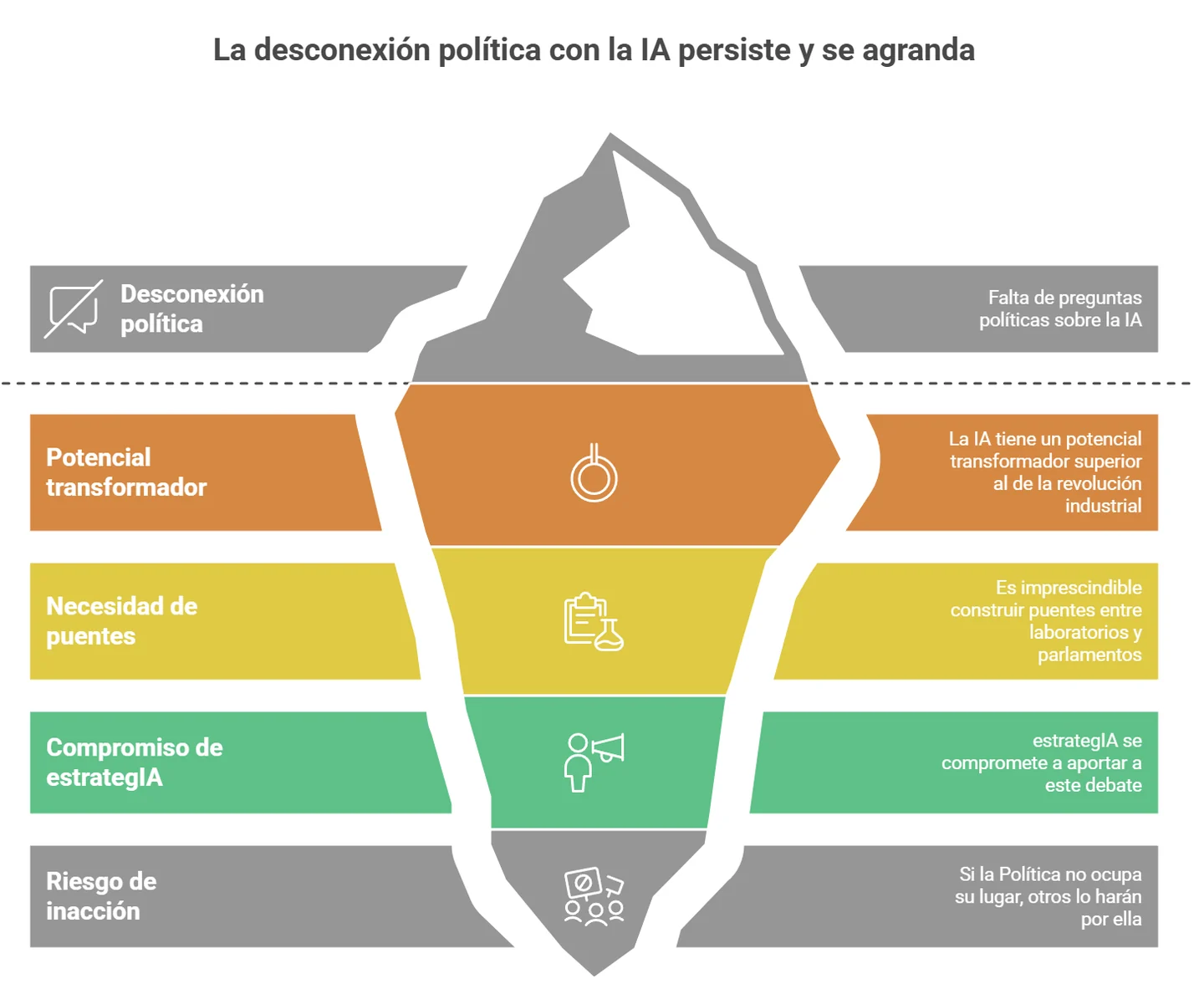
English translation of the infographic, “The political disconnect from AI persists and grows”:
- Political disconnect: a lack of political questions about AI.
- Transformative potential: AI has greater transformative potential than the Industrial Revolution.
- The need for bridges: building bridges between laboratories and parliaments is essential.
- estrategIA's commitment: estrategIA commits to contributing to this debate.
- The risk of inaction: if politics does not take its place, others will take it on its behalf.
Three further reflections on these hundred issues, from AI itself
Beyond that personal reflection, which I regard as crucial, to add another layer of perspective, and working alongside AI in cyborg mode, as Ethan Mollick recommends, I asked four of the world's most powerful current AI models to analyse all one hundred issues and produce five conclusions each. They came from the four Western laboratories currently setting the pace in advanced AI: OpenAI, Google, xAI and Anthropic. Technically, we used a custom GPT proto-agent for GPT-5 and a Perplexity Pro Space for Gemini 2.5 Pro, Claude Sonnet 4 Thinking and Grok 4, uploading all the issues in PDFs grouped in batches of ten.
From those twenty conclusions, all interesting, I selected the following three, combining several of them. They seem fundamental to me, and several models converged on them.
1. From tool to an infrastructure of power
AI has ceased to be a “project” and become part of the productive fabric and a driver of competitiveness. Compute, quality data and models are becoming strategic assets, as electricity and logistics once did. They determine who generates productivity, exports technical standards and attracts talent. Their integration into public services, political processes, regulation, security, the economy and communication is irreversible, and determines states' competitiveness and resilience.
States that treat AI merely as a “pilot” will lose their share of value added. Those that integrate it into industrial policy — China is particularly significant here, and we hope to discuss it in a future issue — will set the rules and gain autonomy from concentrated suppliers. Sovereignty is no longer simply about “having data centres”, but about governing chip supply chains, access to energy, reliable data and training capacity. On that chessboard, the contest between the public sector and major private platforms, more powerful than most countries, will also be crucial in the coming years.
2. Uneven, disruptive effects on employment, wealth distribution and social cohesion
Automation is advancing from administrative to physical work, with impacts that remain highly uneven across sectors because we are still in the early stages of applying these disruptive technologies to the “real world”. Preventing a split between productivity and legitimacy requires a complete package: large-scale continuing education; incentives for human–AI complementarity; wage insurance and “arks” of resilience; and, yes, a rigorous debate about universal basic income or, failing that, transitional income and pilot programmes to test these solutions. This must be accompanied by tax adjustments that capture returns from technological capital, which could concentrate a large share of the planet's wealth over the coming years.
Without this, we risk moving towards chronic labour-market polarisation and a breakdown of the social contract in a very near future that, at least from our perspective, politicians do not even want to contemplate as a possibility.
3. Govern at the speed of product development and preserve a shared reality
Technology iterates in months; institutions in years or decades. This creates a critical “governance gap”, in which technology advances faster than society's ability to manage it, generating risks for employment, security and democratic stability. We need iterative frameworks and international coordination to avoid regulatory disasters in either direction. Global competition between the United States, China and the EU adds geopolitical pressure.
At the same time, the near-perfect synthesis of audio, video and images already available is eroding public trust. Content traceability and authentication, rapid-response election protocols and media literacy must be treated as essential civic infrastructure. Without trust in information, any innovation agenda is politically fragile.
AI is racing ahead and transforming the world; politics cannot proceed at a walking pace. May the next hundred issues find us closing gaps rather than explaining them, and enjoying all the opportunities this technology offers to create a better world.
Director of Digital Innovation at Institución Educativa ALEPH and Director of estrategIA
Cite this essay
Fernando Nieto Lobato. “One hundred issues on: politics still has its back turned to advances in AI.” estrategIA, issue 100, 27 August 2025. English edition, 29 September 2026. https://elcontemplador.github.io/estrategia-english/essays/100/