This week we are pleased to announce that the newsletter’s main article, which provides an essential framework for implementing AI properly in government, is by Roxana Mazzola, director of the Programme of Studies on Inequalities and Public Policy within AEPP at FLACSO Argentina and an international consultant in innovation and citizen participation at the Inter-American Development Bank (IDB), working with Latin American countries.
From endless paperwork to agile public administration
It is a familiar scene in Latin America: citizens standing in endless queues, offices overflowing with paper files and computer systems that cannot communicate with one another. While the world moves forward, a significant part of our public administration continues to operate with twentieth-century tools and ways of thinking. The urgency of modernisation is palpable, and artificial intelligence (AI) appears to offer the great promise of a revolution in public services. Yet there is a real risk: trying to leap into AI without first laying the necessary digital foundations.
We often hear that everyone wants to bring AI into public administration, and it is a laudable ambition. We imagine predictive algorithms that optimise resource allocation, chatbots that answer citizens' questions around the clock, or systems that detect fraud in milliseconds. But it is crucial to understand that AI must be more than a chatbot or an isolated project. It must be an integral, cross-cutting part of public administration: the layer of intelligence that improves decision-making, anticipates problems and personalises services across every area of the state. The speed of technological progress, and the efficiency we have already demonstrated in specific areas, demand that we integrate AI into all our practices while accelerating digital transformation, so that we are not left behind.
To do this effectively and sustainably, we must understand that AI is not a magic fix. It is the natural evolution of a much broader and more fundamental strategy: the digital transformation of the public sector.
Why AI in government must be part of a robust digital transformation
Digital transformation in the public sector is the process of fundamentally reimagining and redesigning processes, culture and the citizen experience through digital technologies. It means moving from analogue to digital, from isolated to integrated, and from rigid to agile.
Consider a municipal chatbot designed to let people report fallen trees or ask about administrative procedures. How can we develop an effective virtual assistant unless we already have, or are building alongside it, the following?
- Systematic, digitised processes: the chatbot needs access to clear, structured information. If procedures are not standardised, if each department interprets them differently, or if the requirements exist only in a printed leaflet, the chatbot will lack reliable data to work with.
- Integrated knowledge bases: to train an AI model, we need to feed it large volumes of high-quality data. This means cataloguing frequently asked questions (FAQs), official answers, procedural instructions and solutions to common problems in accessible digital formats. Without this, the chatbot will not learn properly.
- Interoperability between systems: if a citizen asks about the status of a building permit, the chatbot should be able to consult the urban planning, finance and land registry databases securely. If these systems do not “talk” to one another, the chatbot will remain isolated and its usefulness will be minimal.
Without these digital foundations, the chatbot will have little effectiveness. It will end up as an expensive technological curiosity that redirects 90% of enquiries to a human agent or replies, “Sorry, I don't understand the question”, creating more frustration than solutions.
The challenge is more than technological: state capacity to close the gaps
As Oscar Oszlak's book El Estado en la era exponencial (The state in the exponential age) warns, the fundamental challenge goes beyond technology and concerns state capacity: the pressing need for states to develop the capabilities to navigate disruption and close structural gaps. For this digital transformation to be realistic, inclusive and effective, it is essential to assess and strengthen those capabilities urgently.
This academic diagnosis is borne out and given concrete form when set against practical experience at three levels of government: national, subnational and international. From that perspective, we can see that the gulf between political decisions and their implementation is being perpetuated and deepened, rather than reduced. The root cause is the absence of strategic, sustained investment in strengthening state capacity, and the lack of thorough analysis that honestly diagnoses the existing gaps before solutions are designed.
Today, this longstanding implementation challenge finds its most critical expression in data governance. It is here that the slowness and rigidity of linear bureaucracy collide head-on with the speed of exponential technology, making clear the urgent need to modernise not only the state's tools, but above all its processes and capabilities.
The human and political factors in closing the gaps
The Inter-American Development Bank (IDB) identifies the main bottleneck as the “human factor”, rather than software: the lack of technical and managerial capabilities within the state to manage complex technology projects (IDB, 2020). This reflects the inability of traditional systems to adapt to a paradigm that demands agility, experimentation and continuous learning.
Weak data foundations compound the problem. Interoperability, the ability of systems to “talk” to one another, is an essential pillar of a connected state. Yet an IDB study found that only 11 of the region's 32 countries had a high-level digital government initiative that included interoperability as a central component (IDB, 2020). Without integrated, high-quality data, any AI algorithm will be blind and potentially biased, perpetuating inertia rather than generating intelligent solutions.
Data governance is also an urgent priority. The Economic Commission for Latin America and the Caribbean (ECLAC) warns that the region must develop robust legal frameworks to protect citizens' privacy and govern the ethical use of AI, ensuring that its implementation “does not reproduce or amplify discriminatory biases” (ECLAC, 2022). Implementing AI on fragile foundations and with twentieth-century ways of thinking is more than inefficient: it is deeply risky and undermines public trust.
Another key point is that a digital transformation plan must start by considering gaps in access to and use of online services, existing institutional capabilities and information systems, among other factors. It cannot be an ideal plan detached from reality; it must be an adaptive roadmap that consciously takes the Latin American context into account:
- Closing exponential gaps: digital transformation and AI must be designed to include, not exclude. Ensuring access and digital literacy for all citizens is vital if these advances are not to deepen inequality.
- Strengthening institutional capabilities: internal talent is the most valuable asset. You cannot manage what you do not understand. It is essential to invest in training public servants and to foster a culture of innovation, agility and data use, breaking down the silos and aversion to risk that characterise the traditional state.
- Data governance to strengthen public trust: a digitised administration generates enormous volumes of data. Robust frameworks for personal data protection, cybersecurity and the ethical use of AI are imperative. This is more than a legal requirement: it is the foundation for building the legitimacy of, and public trust in, the twenty-first-century state.
AI as part of the process, rather than the first step
Artificial intelligence is undoubtedly the future of public administration. But it needs to be incorporated into the various processes of digital transformation. Successful digital transformation is 90% management change and 10% technology. Public leaders should focus their energies on mapping and digitising processes, cleaning and integrating their data, training their teams and creating an interoperable technological architecture. At the Programme of Studies on Inequalities and Public Policy within AEPP at FLACSO Argentina, we believe this is the path from the isolated fantasy of an ineffective chatbot to the concrete reality of intelligent, agile, people-centred government.
Roxana holds a doctorate in Social Sciences from the University of Buenos Aires (UBA) and a master's degree in Administration and Public Policy from the University of San Andrés, and is a political scientist trained at UBA. She directs the Programme of Studies on Inequalities and Public Policy within AEPP at FLACSO Argentina and is an international consultant in Innovation and Citizen Participation at the IDB for Latin American countries.
Contact: rmazzola@flacso.org.ar
References:
- Oszlak, O. (2020). El Estado en la era exponencial. INAP.
- IDB (2020). El Estado en la era digital: prioridades para una transformación ágil, efectiva e inclusiva.
- ECLAC (2022). Digitalización y desarrollo sostenible en América Latina y el Caribe.
Based on the article, Gemini has generated a simple infographic for us, addressing some of its key points:
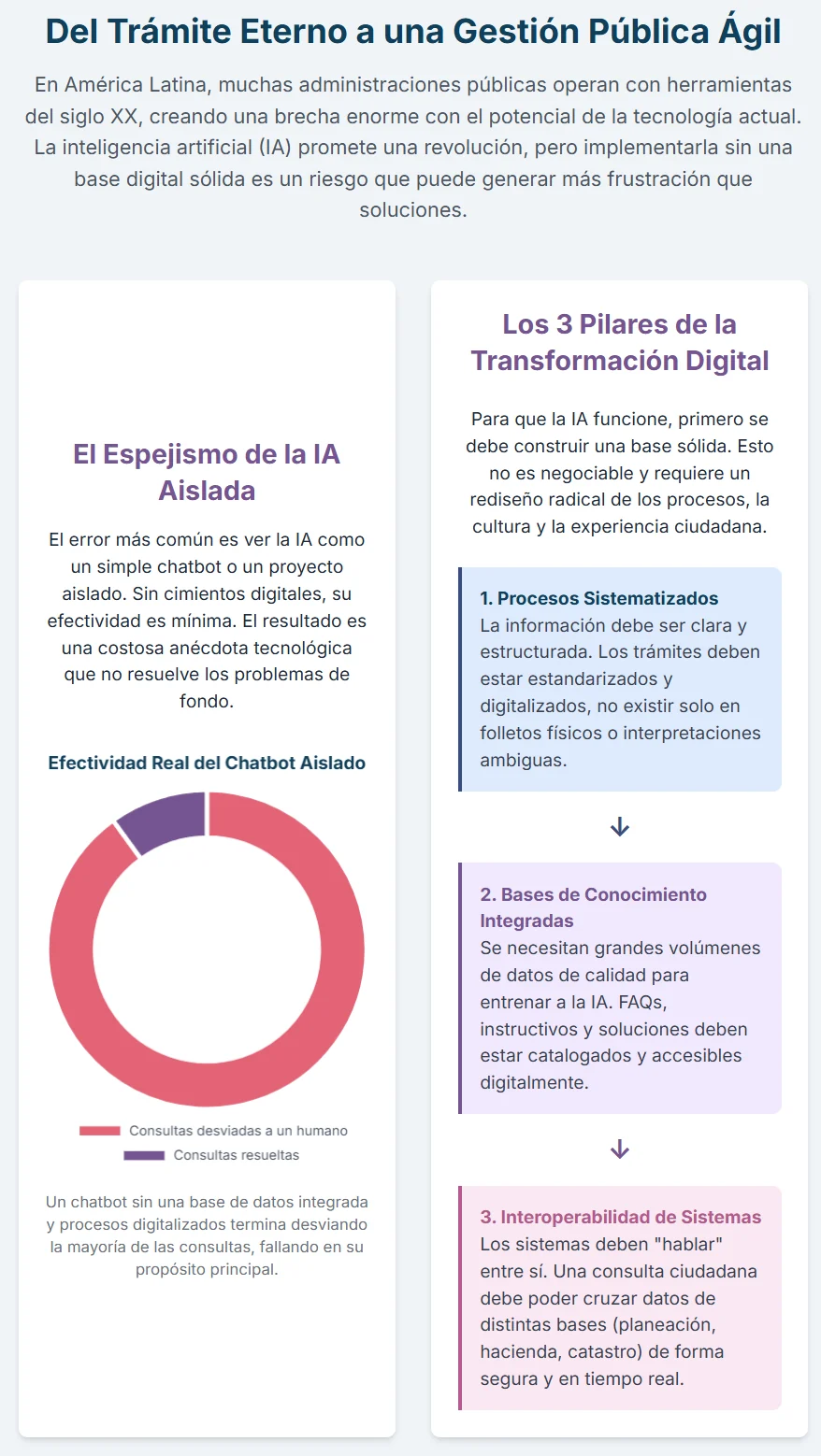
English text of the accompanying graphic:
From endless paperwork to agile public administration
In Latin America, many public administrations operate with twentieth-century tools, creating an enormous gap between their practices and the potential of today's technology. Artificial intelligence (AI) promises a revolution, but implementing it without a solid digital foundation is a risk that may produce more frustration than solutions.
The illusion of AI in isolation. The most common mistake is to see AI as a simple chatbot or an isolated project. Without digital foundations, it has minimal effectiveness. The result is an expensive technological curiosity that fails to solve the underlying problems.
Actual effectiveness of a standalone chatbot. The chart contrasts “Enquiries referred to a human” with “Enquiries resolved”. A chatbot without an integrated database and digitised processes ends up redirecting most enquiries, failing in its main purpose.
The three pillars of digital transformation. For AI to work, a solid foundation must first be built. This is non-negotiable and requires a fundamental redesign of processes, culture and the citizen experience.
- Systematic processes. Information must be clear and structured. Procedures must be standardised and digitised, rather than existing only in printed leaflets or ambiguous interpretations.
- Integrated knowledge bases. Training AI requires large volumes of high-quality data. FAQs, instructions and solutions must be catalogued and digitally accessible.
- System interoperability. Systems must “talk” to one another. A citizen enquiry must be able to draw together data from different databases, such as planning, finance and land registry records, securely and in real time.
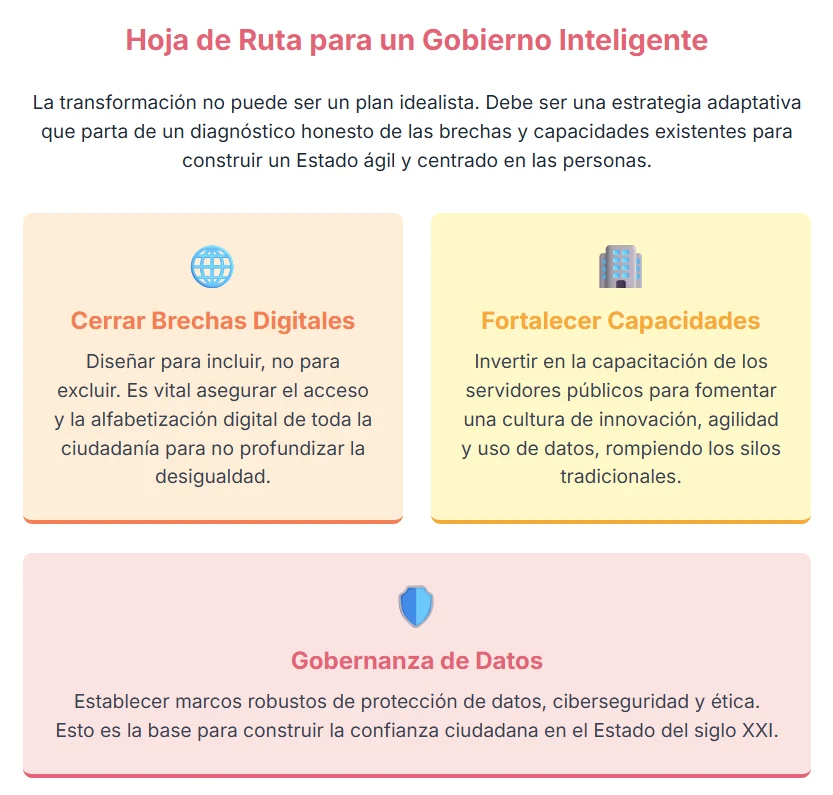
English text of the accompanying graphic:
Roadmap for intelligent government
Transformation cannot be an idealistic plan. It must be an adaptive strategy that starts with an honest diagnosis of existing gaps and capabilities, to build an agile, people-centred state.
- Closing digital divides. Design to include, not exclude. Ensuring access and digital literacy for all citizens is vital to avoid deepening inequality.
- Strengthening capabilities. Invest in training public servants to foster a culture of innovation, agility and data use, breaking down traditional silos.
- Data governance. Establish robust frameworks for data protection, cybersecurity and ethics. This is the foundation for building public trust in the twenty-first-century state.
Cite this essay
Roxana Mazzola. “AI in the state: why digital transformation must come first.” estrategIA, issue 104, 24 September 2025. English edition, 29 September 2026. https://elcontemplador.github.io/estrategia-english/essays/104/