Reflections from CONAED Mexico 2025
Another profession on the therapist's couch. AI is having a powerful impact across many sectors, but education may be among those whose nineteenth-century foundations have shaken fastest under the challenge of large language models. These models call into question factors that have defined education for a very long time.
A World Bank report indicates that 65% of teachers see AI as an opportunity, but an overwhelming 80% admit that their institutions lack clear guidelines on its use. Meanwhile, 65% of university students believe they know more about AI than their teachers, according to a Cengage Group study. These figures understandably leave teachers feeling unsteady, and may lead to a crisis of pedagogical legitimacy: how can we get students to listen to and trust their teacher, while developing critical judgement and retaining their creativity and ability to work independently, without surrendering much of their cognitive capacity to AI's benefits?
No country is immune to this upheaval in education and, especially, in the teacher's role. Many institutions are examining how education should evolve in response. Jorge Santiago, President of Institución Educativa ALEPH, and I had the opportunity to travel to Mexico and contribute to this discussion at the Third National Congress on Education, CONAED, entitled “Artificial intelligence: education's challenges in relation to the human condition” and organised by the Consejo Nacional de Centros de Actualización del Magisterio, CONACAM, the national council of teacher development centres.
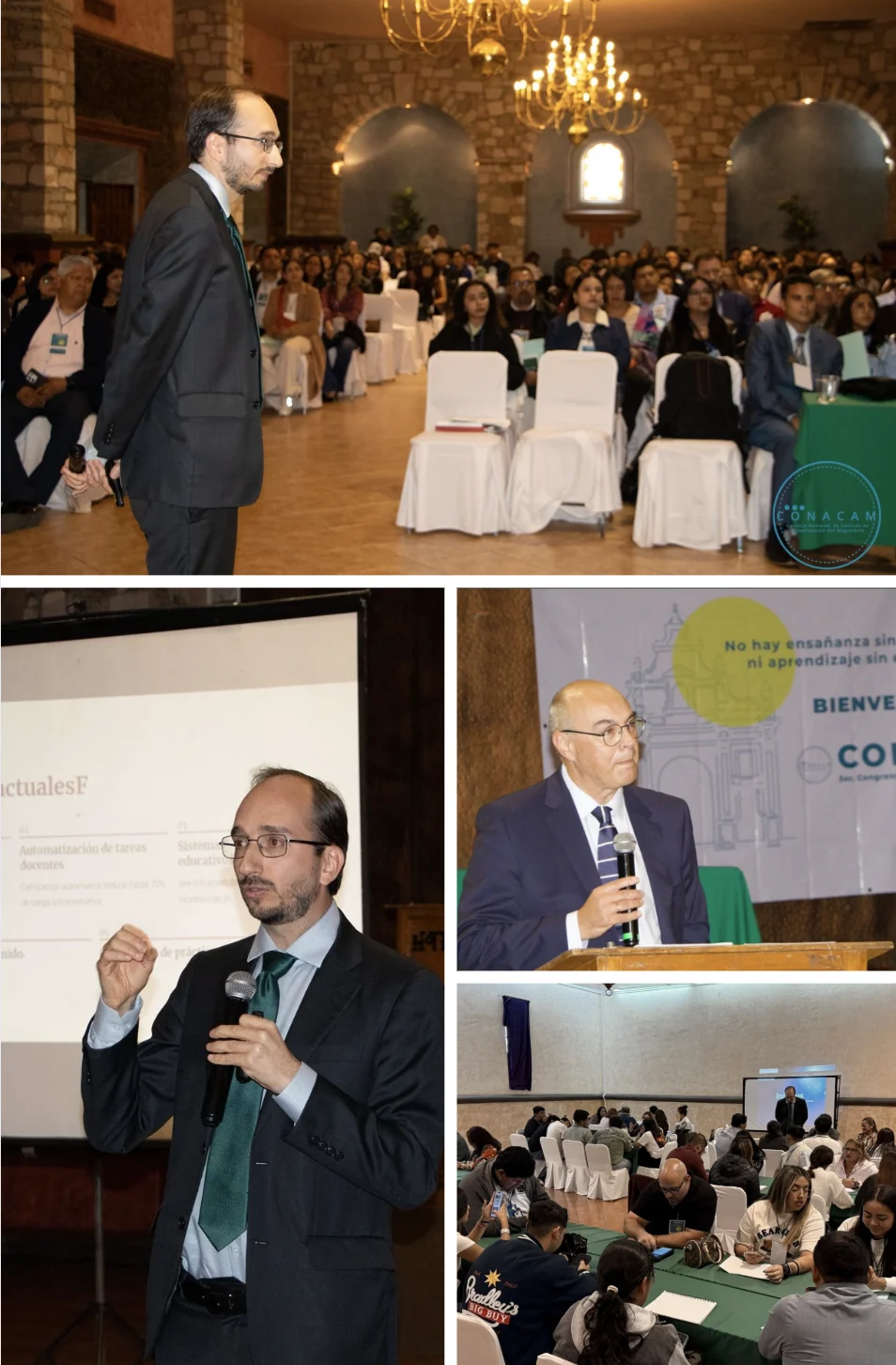
Conference photographs from the original article. Background slide and banner text is partly cropped or indistinct; those fragments are not reconstructed.
Through contributions from speakers such as Harvey Spencer, CEO of the Latin American Agency for Evaluation and Public Policy, and workshops on AI in classrooms, the congress addressed key questions about education's necessary transformation.
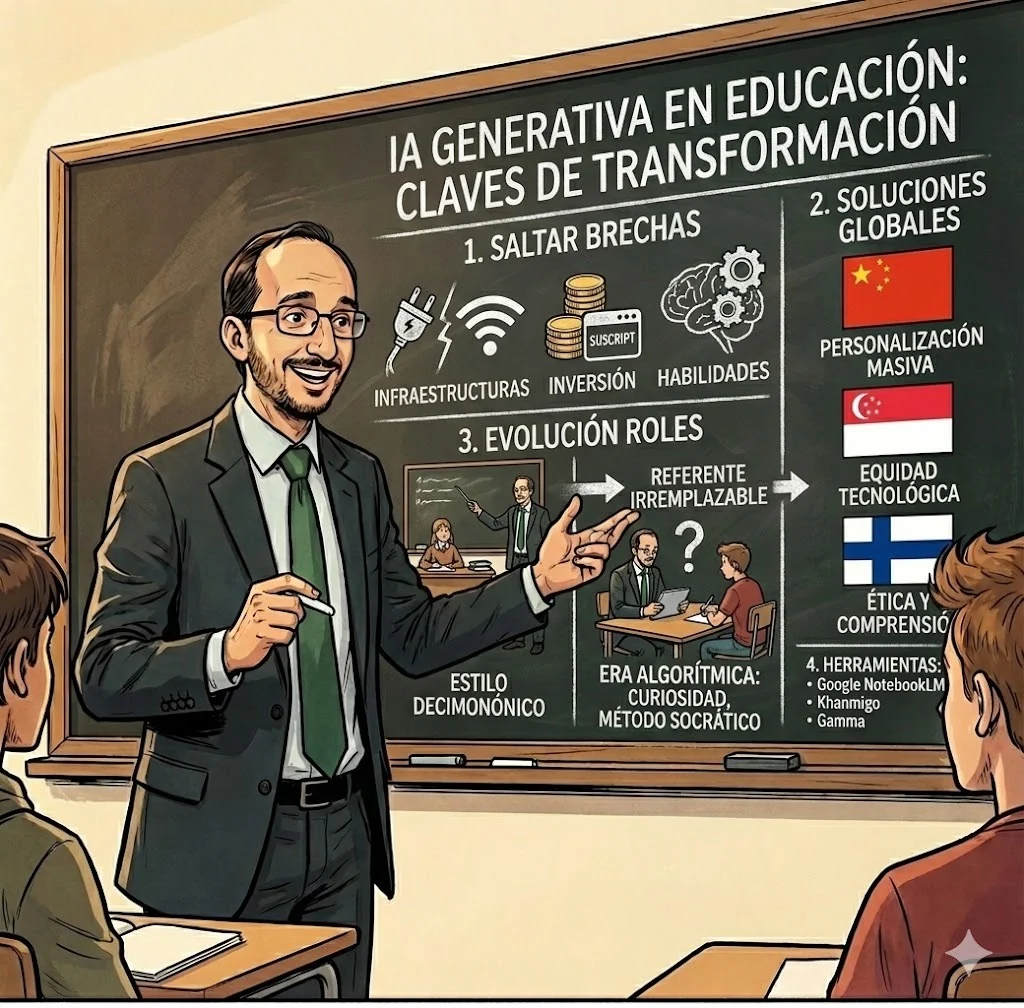
English translation of the board, “Generative AI in education: keys to transformation”:
- Bridging divides: infrastructure, investment and skills.
- Global solutions: China, mass personalisation; Singapore, technological equity; Finland, ethics and understanding.
- Evolving roles: the teacher as an irreplaceable role model. From nineteenth-century teaching to the algorithmic era: curiosity and the Socratic method.
- Tools: Google NotebookLM, Khanmigo and Gamma.
1. Bridging the divides
Integrating AI brings challenges that go beyond plagiarism — although the “crisis of authorship” is real and forces us to rethink what assessment means. We could list many challenges, but perhaps the most essential are these:
- The infrastructure divide: there is little point discussing AI tools in teaching or major automation projects if an area lacks an adequate internet connection or the electricity to power data centres, or even ordinary computers.
- The investment divide: educational institutions must invest in subscriptions to AI applications for both teachers and students. Free tools are not enough if we aspire to intensive, professional use.
- The skills divide: teaching quality will be significantly affected as AI evolves, creating a substantial difference between teachers who know how to make use of AI and those who do not.
2. Pay attention to other countries’ solutions
Every country has its own characteristics, but learning about and sharing international experiences can help improve education at home.
- China: the New Generation Artificial Intelligence Development Plan aims to make China the world's leading AI power by 2030 and to integrate AI throughout the education system. Beijing has embraced mass personalisation through systems such as Squirrel AI, which breaks knowledge down into thousands of points and precisely diagnoses gaps in a student's understanding, achieving substantial improvements in learning.
- Singapore: its national Student Learning Space platform integrates government-validated AI tools, ensuring that every child has access to the same quality of technology, regardless of their school.
- Finland: true to their humanist approach, the Finns are concerned with understanding rather than obsessed with efficiency. Their Elements of AI course seeks to help the whole population understand what AI is, prioritising ethics over the tool itself.
3. Evolving roles
In the congress's opening lecture, I began by asking the audience: “Who here is a teacher, or is studying to become one, because a teacher made a lasting impression on you?” It was wonderful to see three hundred hands rise at once. The teacher's real value has never been merely to transmit information, but to serve as a role model and make a lasting impression on the student. In my view, AI cannot replace that.
However, AI's growing capabilities require us as teachers to transform our methods, and require the education system to move from its nineteenth-century approach into the algorithmic era. Otherwise, we do run the risk of becoming less and less significant to students, and therefore replaceable.
Nor do we need to reinvent the wheel. We need to return to questions — the Socratic method — encourage students’ curiosity more than ever so that they are not satisfied with a mere ChatGPT answer, and unleash all our passion for teaching to motivate them to become critical, autonomous and free citizens.
The student must move to the centre of the classroom. We must innovate in methods that integrate AI in ways appropriate to each age group. In China, for example, primary-school pupils do not use AI directly, but work with it through their teacher. We will certainly make many mistakes, but none would be as serious as banning its use or underestimating the dizzying changes under way.
4. AI tools for the classroom
Beyond these philosophical debates, the congress devoted considerable time to workshops on using AI tools in education. Here are some that have already been discussed in depth in this newsletter:
- Google NotebookLM: it allows users to upload sources, such as a subject's textbook, and produce audio summaries, explanatory videos, infographics, presentations, tests and flashcards. As an interesting example, at the congress we made a comic about the Grito de Hidalgo, Hidalgo's call for Mexican independence.
- Khanmigo — Khan Academy: rather than giving students the answer, it asks questions so that they reach the solution themselves. It also offers materials adapted to the state curricula of different Latin American countries.
- Gamma: an application for creating presentations. It can design slides from supplied text, or extract a document's content to present only its essential points.
What is a teacher for?
One teacher attending the congress remarked that Umberto Eco's reflections in his 2007 article De qué sirve el profesor — “What is a teacher for?” — about the internet age still apply to AI. Yet AI is very different from the Great Mother of all encyclopaedias, as he described the internet. Eco argues that teachers must select quality information and connect different areas of knowledge, but AI can already perform those tasks more precisely.
There is, however, a third factor that remains distinctive and encourages group learning and socialisation: “What makes a good class is not the transmission of data upon data, but the establishment of a constant dialogue, a confrontation of opinions.”
Translation note: Eco's title and quoted words are translated from the Spanish wording reproduced in the source; an original English version has not been verified.
Alongside this socialising dialogue, I believe the teacher's greatest virtue in the AI era should be the ability to spark curiosity, which in turn strengthens children's desire to nourish their civic spirit — critical judgement, autonomy and freedom. With successes and mistakes, stumbles and discoveries, teachers will surely continue to make a lasting difference to their students’ lives.
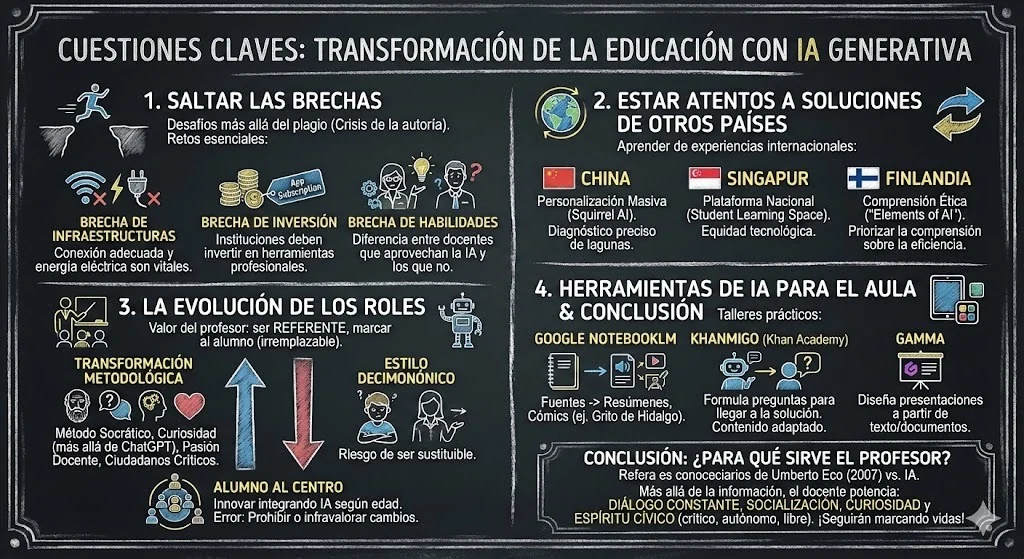
English translation of the infographic, “Key questions: transforming education with generative AI”:
- Bridging the divides. Challenges beyond plagiarism and the crisis of authorship. Essential challenges: the infrastructure divide — adequate connectivity and electricity are vital; the investment divide — institutions must invest in professional tools; the skills divide — differences between teachers who make use of AI and those who do not.
- Pay attention to other countries’ solutions. Learn from international experience. China: mass personalisation through Squirrel AI, with precise diagnosis of gaps. Singapore: the national Student Learning Space platform and technological equity. Finland: ethical understanding through Elements of AI, prioritising understanding over efficiency.
- Evolving roles. The teacher's value: being a role model and making a lasting impression on the student — irreplaceable. Methodological transformation: the Socratic method, curiosity beyond ChatGPT, passion for teaching and critical citizens. The nineteenth-century approach risks becoming replaceable. Put the student at the centre: innovate by integrating AI according to age. The mistake would be to ban it or underestimate change.
- AI tools for the classroom and conclusion. Practical workshops: Google NotebookLM turns sources into summaries and comics, such as the Grito de Hidalgo example; Khanmigo, from Khan Academy, asks questions to help students reach a solution and offers adapted content; Gamma designs presentations from text and documents.
- Conclusion: what is a teacher for? Reflections on Umberto Eco in 2007 in relation to AI. Beyond information, the teacher promotes constant dialogue, socialisation, curiosity and civic spirit: critical, autonomous and free. Teachers will continue to change lives.
Academic Director of Institución Educativa ALEPH
Cite this essay
Pablo Martín Diez. “AI's impact on education: a rebirth or the end of the teacher?.” estrategIA, issue 114, 3 December 2025. English edition, 29 September 2026. https://elcontemplador.github.io/estrategia-english/essays/114/