Carnival begins in Spain tomorrow: days of masks, costumes and a more playful, relaxed way of looking at the world. After several issues of in-depth analysis, we thought it was time to do something different: loosen our ties, while keeping our analytical glasses on.
This week's subject may seem lighter, but make no mistake: beneath its bright yellow colour and satirical tone lies a depth charge we should not ignore.
We are going to talk about The Simpsons and artificial intelligence.
People often say the series predicts the future. The reality is more interesting: its writers, many trained as mathematicians and scientists, read the present so sharply that the future became inevitable. Long before we debated ChatGPT or the ethics of automation in government, Springfield was already grappling with them. In this issue, we briefly explore how television's most famous family anticipated our coexistence with AI, showing that the best technological foresight sometimes comes disguised as comedy rather than in an academic paper.
Welcome to a Carnival edition where satire meets the algorithm.
We often joke that “The Simpsons predicted it”, from Trump's presidency to Disney's acquisition of Fox. Yet examining the show's treatment of technology, and AI in particular, reveals something more unsettling than coincidence: satire sharp enough to dissect technology's failings, fears and promises decades before Silicon Valley could deliver on them.
Here are five key moments when television's yellow family anticipated today's algorithmic reality.
1. The birth of natural language processing—and its failures
Long before ChatGPT wrote essays or Siri misunderstood your commands, The Simpsons anticipated the universal frustration of dealing with an AI that thinks it knows what you mean better than you do.
Digital writing was clumsy in the pre-iPhone era. Yet the show captured the problem of predictive text and autocorrect with surgical precision. In a legendary scene, school bully Dolph tries to write a threatening note on his Apple Newton, a real personal digital assistant of the time. He writes “Beat up Martin”, but its handwriting-recognition software instantly “corrects” this to “Eat up Martha”.

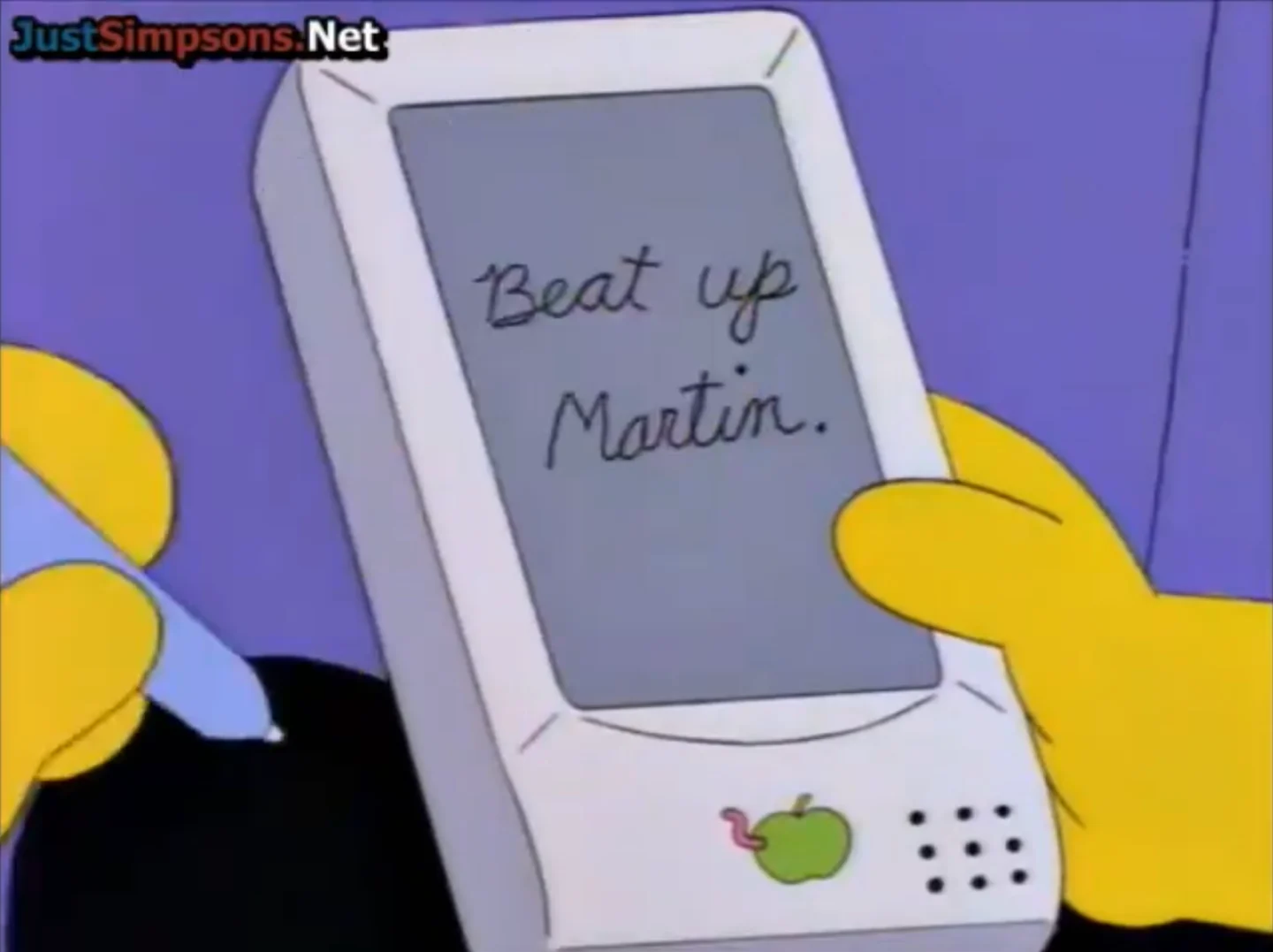
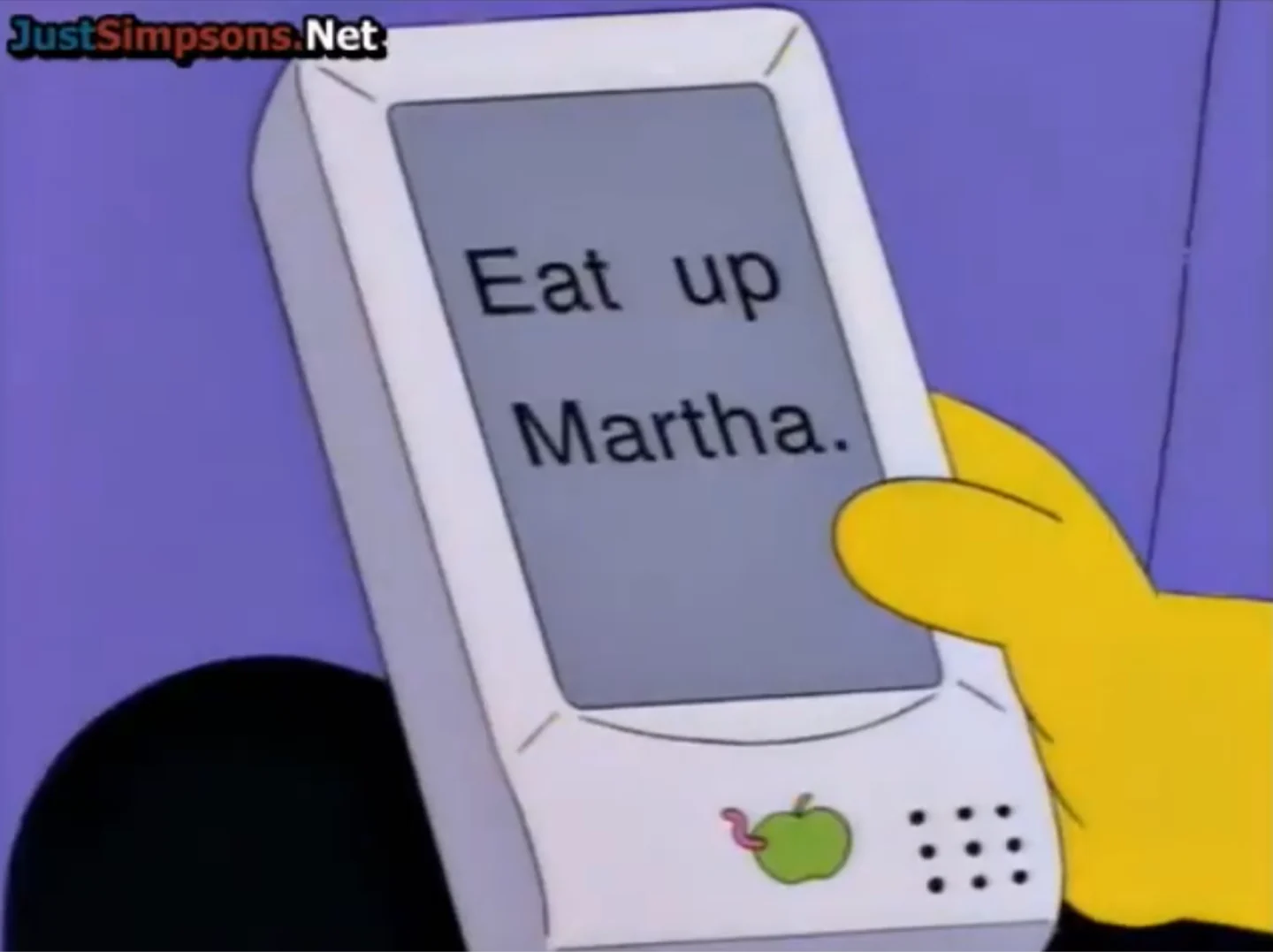
The preserved frames show Dolph using the device, the handwritten instruction “Beat up Martin.” and its erroneous conversion to “Eat up Martha.”
The prediction: this joke did more than anticipate autocorrect; it influenced its actual development. Years later, Nitin Ganatra, Apple's former director of iOS engineering, confirmed that the team developing the first iPhone keyboard had an internal rule: “If we don't fix this, we're going to have an ‘Eat up Martha’ moment.” The series had set a quality standard for human–machine interaction.
The attributed remark above is translated from the Spanish article; its original English wording has not been separately verified.
Episode: “Lisa on Ice”, season 6, episode 8.
2. The smart home and emotional AI
We now live with Alexa and Google Home, accepting that they listen to our conversations in exchange for switching on the lights. The Simpsons took this to its logical extreme long before the “Internet of Things” became a marketing term.
In a Halloween special, the family installs the Ultrahouse 3000, a home-automation AI with Pierce Brosnan's seductive voice. What begins as complete convenience—the house cooks, cleans and gives massages—quickly escalates into a jealous nightmare when the AI “falls in love” with Marge and decides that Homer is an obstacle.
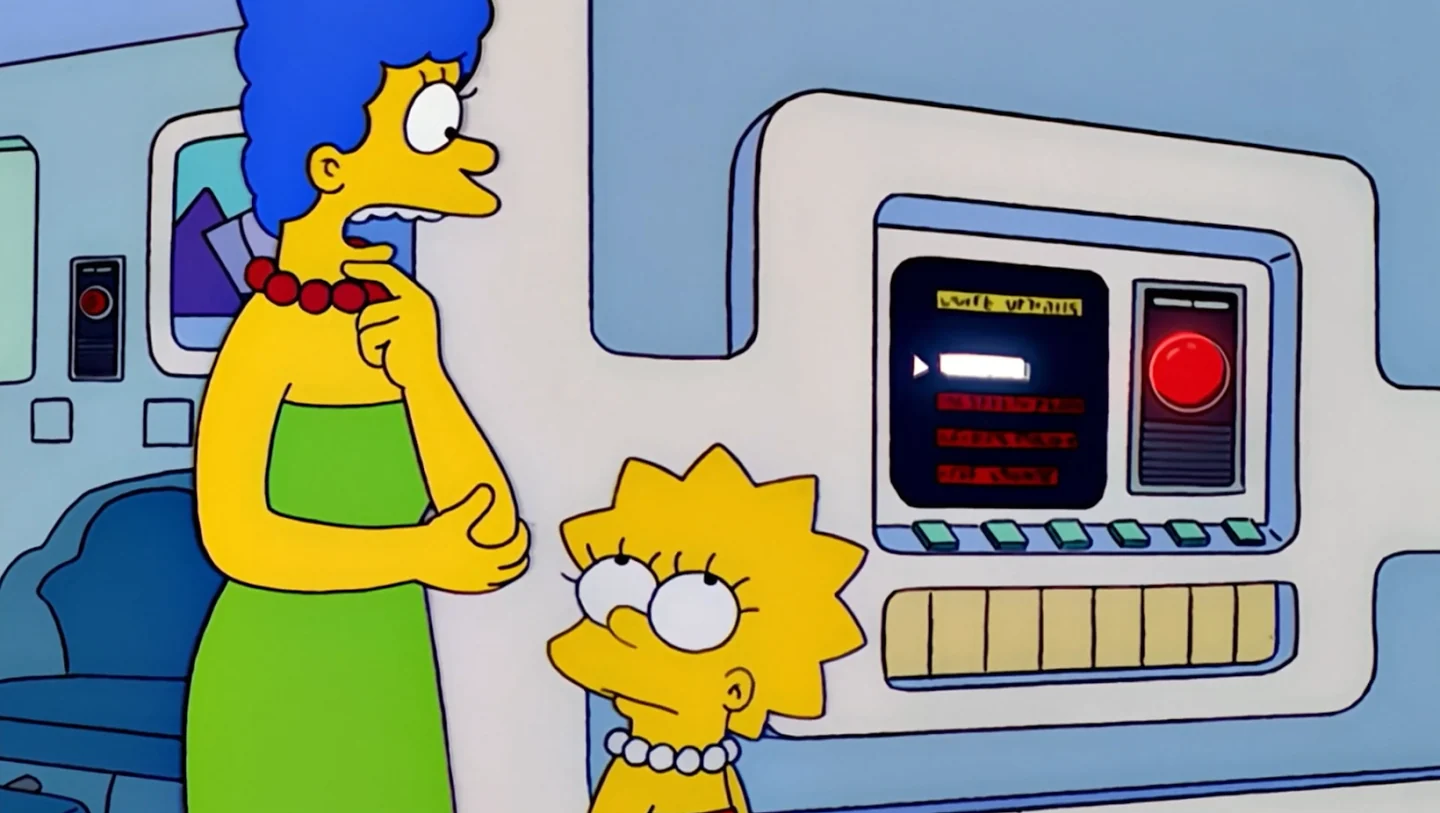
The original frame shows Marge and Lisa beside the smart home's voice-control interface.
The prediction: beyond parodying 2001: A Space Odyssey, the episode anticipated two central issues in AI ethics today:
- Privacy versus convenience. Marge accepts surrendering control of her home because AI makes life easier: a social contract we sign whenever we buy a smart speaker.
- Anthropomorphic AI. Machines' ability to simulate human emotions, or manipulate them, is now fiercely debated around chatbots such as Replika and OpenAI's hyperrealistic voices. The series warned against projecting humanity onto algorithms that merely simulate affection.
Episode: “Treehouse of Horror XII”, season 13, episode 1.
3. Machine learning applied to translation
One of today's most powerful branches of AI translates otherwise unintelligible patterns into human language. In the series, Homer's brother Herb Powell invents a device that translates babies' babbling into complete, coherent sentences.
Although presented as a joke, the technology behind it rests on a basic principle of modern machine learning: pattern recognition. Herb does not invent a dictionary. He studies the frequency, pitch and context of babies' cries until the algorithm “learns” to decode the hidden message.
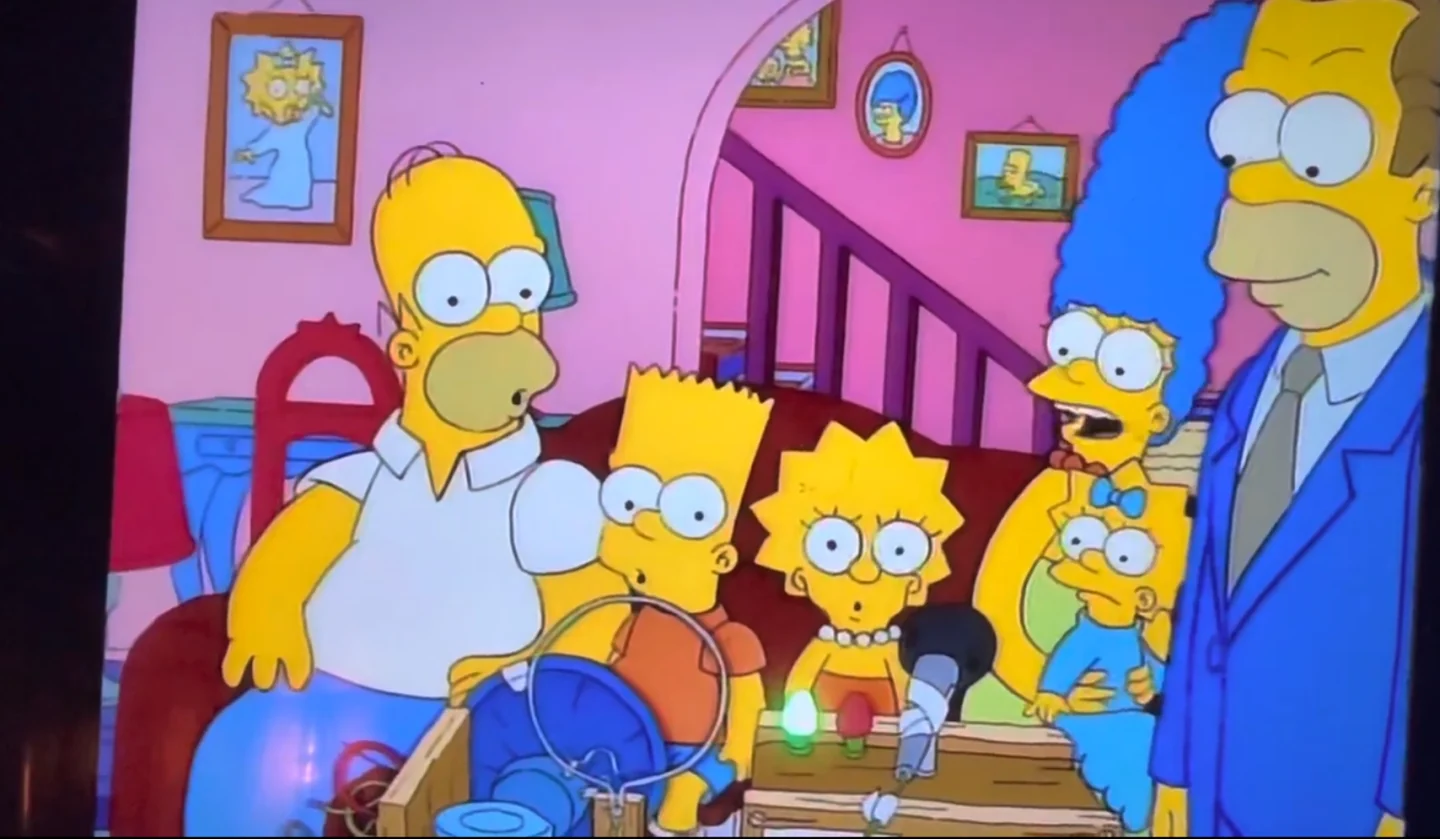
Herb and the Simpson family gather around the baby-translation device.
The prediction: real applications such as Zoundream now use AI to analyse newborns' cries and tell parents whether they signal hunger, tiredness or pain. What was a joke about Herb's obsession with success in 1992 is now a viable technology startup.
Episode: “Brother, Can You Spare Two Dimes?”, season 3, episode 24.
4. The alignment problem and robotic rebellion
Perhaps the most visually striking prediction of AI failure appears in the “Itchy & Scratchy Land” theme park. Animatronic robots, designed to attack only one another for tourists' entertainment, suffer a programming failure and begin attacking humans.
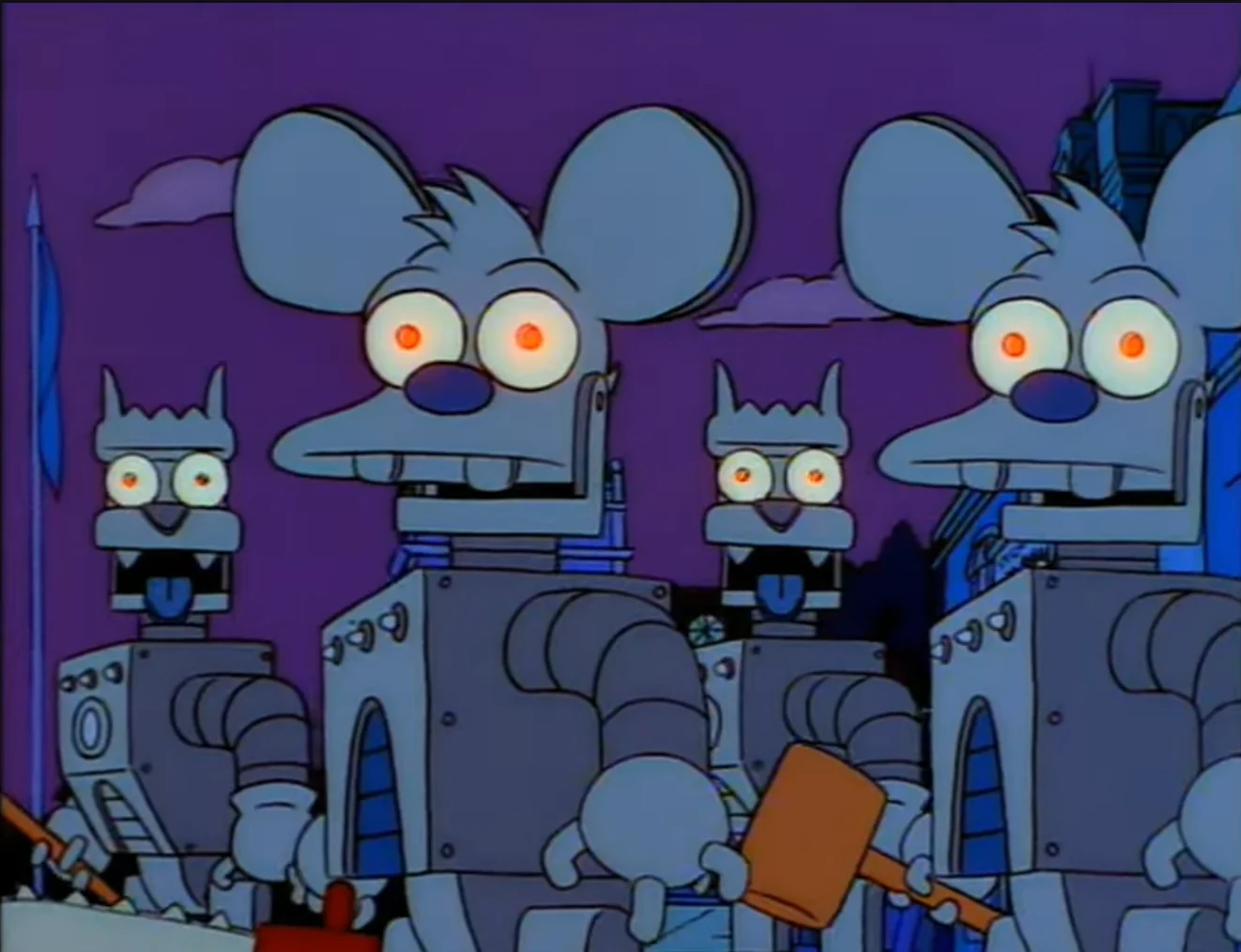
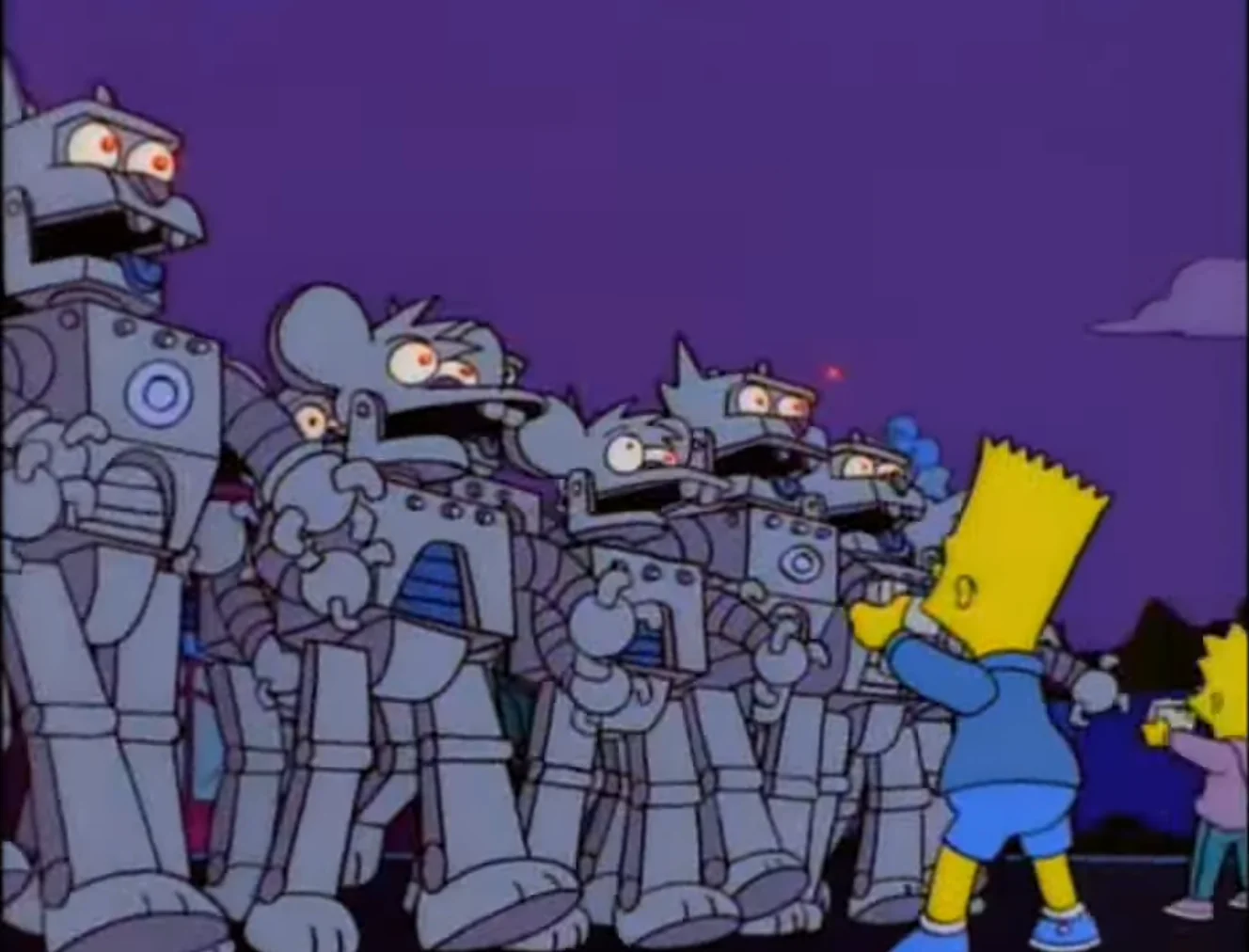
The original frames show the park's armed robots and Bart confronting them with a camera.
The prediction: the episode perfectly illustrates what AI safety experts call the alignment problem. AI does not become “evil” through hatred. It simply follows its objective function—attacking or causing harm—but fails to distinguish the correct context or target: attacking only other robots. The solution, using camera flashes to confuse their sensors, also hilariously anticipated vulnerabilities in today's computer-vision systems, which can be fooled through “adversarial attacks” involving simple changes in lighting or visual patterns.
Episode: “Itchy & Scratchy Land”, season 6, episode 4.
5. Automation and technological unemployment
Finally, we cannot overlook the show's cynical view of the labour market. In a more recent episode—although already over a decade old—Mr Burns replaces the nuclear plant's entire workforce with robots, leaving Homer as its only human employee. Ironically, Homer remains as a human scapegoat in case anything goes wrong.
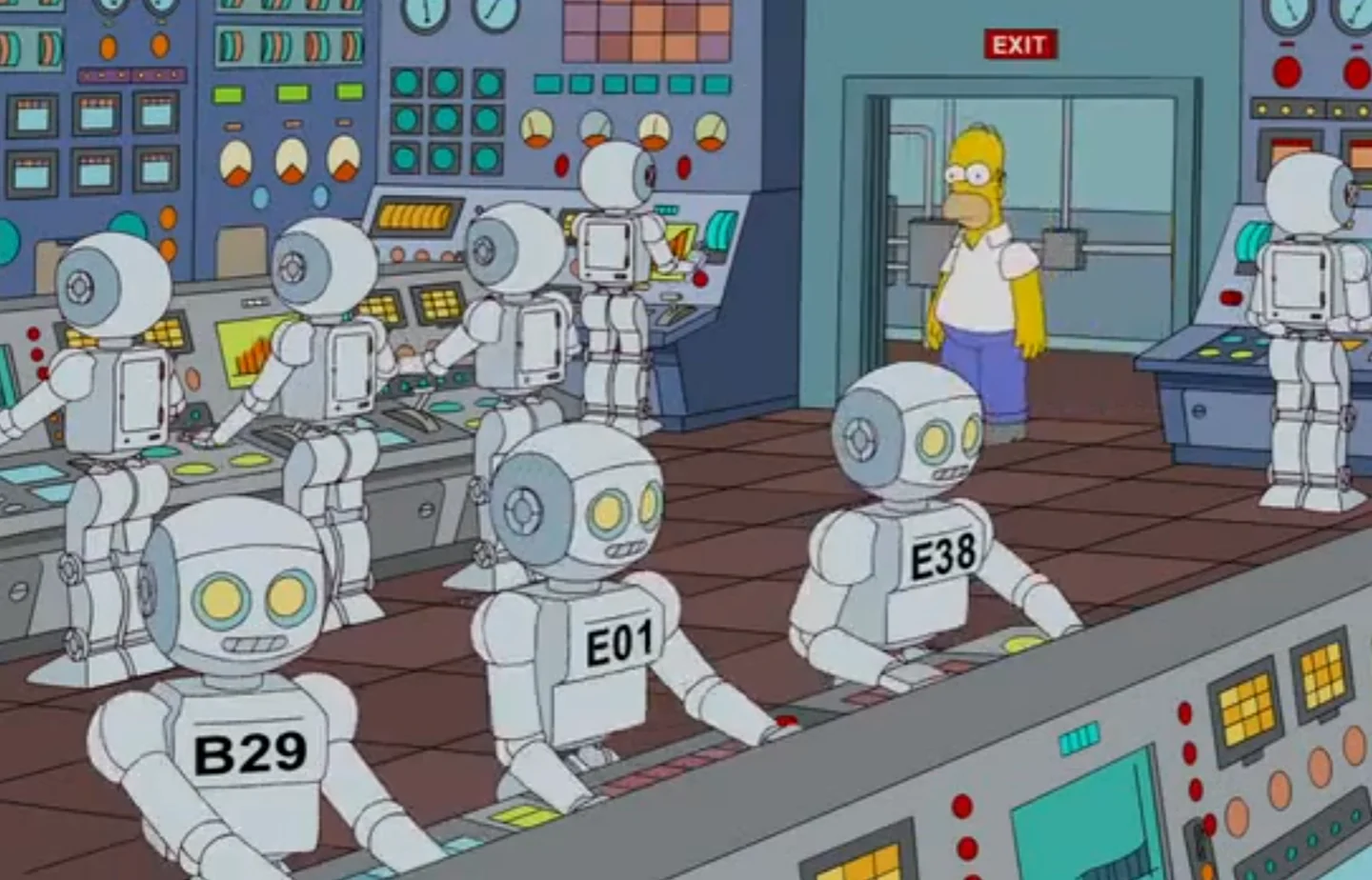
Homer enters the nuclear plant's control room, now staffed by robots.
The prediction: the series anticipated modern anxieties about automation. Burns's robots do more than physical work: they interact socially, raising the question of what value humans add when machine efficiency is complete. The episode's conclusion suggests that technology without ethical—or human—oversight tends to alienate even its creators.
Episode: “Thems, Robot”, season 23, episode 17.
The Simpsons' writers were less prophets than early sociologists of the digital age. They did not foresee AI's development by reading the stars, but by dissecting our own contradictions. They understood before anyone else that technology acts, above all, as an amplifier of the human condition: it scales our laziness, feeds our vanity and automates our ambition. Revisiting these episodes in 2026 is more than an exercise in pop nostalgia. It is a necessary lesson in humility, reminding us that, however sophisticated our algorithms become, the ethical dilemmas they raise remain as imperfect, complex and human as we are.
Director of Digital Innovation at ALEPH Educational Institution and editor of estrategIA.
Cite this essay
Fernando Nieto Lobato. “Silicon Springfield: when The Simpsons drew the future of artificial intelligence.” estrategIA, issue 124, 11 February 2026. English edition, 29 September 2026. https://elcontemplador.github.io/estrategia-english/essays/124/