Today's issue is rather special. By a considerable margin, it brings together more authors than any we have published so far. It is written by a group of Fundación Botín participants who stood out in the government simulation run by ALEPH Educational Institution as part of the Programme for Strengthening the Public Service in Latin America. Since 2010, this initiative has brought together 30 young Ibero-Americans in each edition, preparing them to help strengthen the region's institutions in the near future. It is a particularly interesting programme which, for readers who may be interested, has just opened applications for its next edition.
In recent years, working closely with the programme's academic director, Ignacio Verón, ALEPH Educational Institution has provided practical training and supported participants in developing their final projects. We thought it would be valuable to give them the opportunity to research artificial intelligence in Latin America and share what they learnt in the following estrategIA article.
AI enters the campaign—and changes the rules
Technological innovation is moving rapidly and is already part of political and democratic processes. In Latin America, electoral integrity is determined not only at physical ballot boxes, but also in an increasingly influential digital environment.
AI did not create disinformation, but it has intensified its reach. False content can now be generated automatically, messages personalised at scale and manipulated material, such as deepfakes, produced with unprecedented sophistication.
The underlying problem is substantial: electoral disinformation is becoming more frequent, more sophisticated and harder to control, especially where regulatory systems still follow analogue-era assumptions. Growing dependence on digital platforms and the opacity of the algorithms organising the information we see compound the problem.
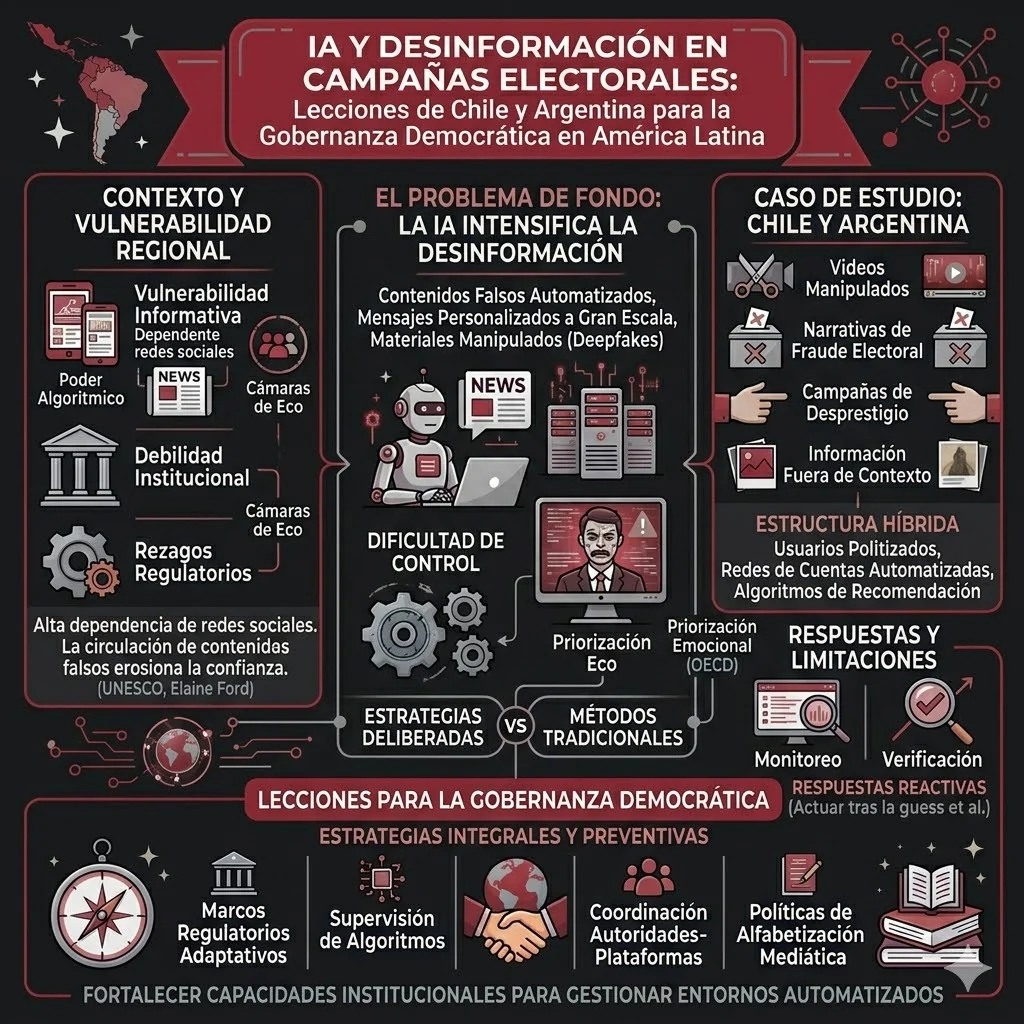
English reading of the original infographic, “AI and disinformation in electoral campaigns: lessons from Chile and Argentina for democratic governance in Latin America”:
- Regional context and vulnerability: informational vulnerability, dependence on social media, algorithmic power, echo chambers, institutional weakness and regulatory gaps. The image links the circulation of false content with eroding trust, referring to UNESCO and Elaine Ford.
- The underlying problem: AI intensifies disinformation through automated false content, messages personalised at scale and manipulated material or deepfakes. Control becomes difficult as deliberate strategies confront traditional methods. The image also labels echo-related and emotional prioritisation, referring to the OECD.
- Chile and Argentina: manipulated videos, electoral-fraud narratives, smear campaigns and information taken out of context. A hybrid structure combines politicised users, networks of automated accounts and recommendation algorithms.
- Responses and limitations: monitoring and verification exist, but responses remain reactive. A small parenthetical line beneath “Reactive responses” is malformed in the original and is not reconstructed.
- Lessons for democratic governance: comprehensive preventive strategies, adaptive regulation, algorithm oversight, coordination between authorities and platforms, and sustained media-literacy policies. The closing message calls for stronger institutional capacity to manage automated information environments.
Disinformation is also not accidental. It involves deliberate strategies to weaken political opponents or reinforce particular narratives. Chile and Argentina are especially relevant cases: they are advanced in digitalisation, but also exposed to these dynamics.
Moreover, many digital platforms operate business models centred on capturing users' attention. This can encourage polarisation, radicalisation and social fragmentation, weakening democratic consensus.
Why is Latin America particularly vulnerable?
AI's impact on elections cannot be understood without considering the regional context. In Latin America, the problem becomes critical through the convergence of three factors: informational vulnerability, institutional weakness and regulatory gaps.
First, there is heavy reliance on social media as a primary source of political information. According to UNESCO, the circulation of false content during elections can alter public perceptions and erode democratic trust.
Second, as Elaine Ford (2019), a Peruvian political scientist and director of the NGO Democracia Digital, argues, digital platforms are not neutral spaces. They are environments mediated by algorithms that influence public deliberation. In politically polarised contexts, this amplifies “echo chambers”, where people consume only information aligned with their beliefs.
Added to this is what Francisco Balaguer Callejón (2022), Professor of Constitutional Law at the University of Granada, calls “algorithmic power”: a form of influence operating without direct democratic control. Opaque criteria for prioritising content create inequalities that current regulatory frameworks cannot effectively oversee.
The challenge, therefore, is not solely technological. It requires stronger institutions, updated regulation and digital literacy. Otherwise, AI will continue to amplify structural problems such as institutional distrust and polarisation.
Chile and Argentina: what is happening in practice?
Recent developments in Chile and Argentina reveal common patterns in disinformation during electoral campaigns.
The principal types of content detected include:
- Manipulated or altered videos.
- Unfounded narratives of electoral fraud.
- Smear campaigns against candidates.
- True information presented out of context.
AI has also enabled automated production of false content and highly precise targeting of political messages.
The problem concerns not only production, but circulation. Various studies show that this material spreads more readily through ideologically homogeneous networks, reinforcing existing beliefs; see Calvo and Aruguete, 2020. Nor does that spread occur spontaneously.
The actors involved are not isolated. They form a hybrid structure combining:
- Highly politicised users.
- Coordinated networks of automated accounts.
- Digital platforms with recommendation algorithms.
Those algorithms prioritise engagement, often favouring emotional or polarising content irrespective of its truthfulness; see OECD, 2023.
Institutional responses have also emerged. In Chile, the Electoral Service has promoted monitoring and digital civic-education strategies. Argentina's National Electoral Chamber has followed a similar approach.
Independent initiatives such as FastCheck.cl and Chequeado have likewise played a key role in verification. Evidence suggests that corrections can reduce the persistence of false beliefs if circulated in time; see Guess et al., 2020.
Despite these advances, a problem remains: many responses are still reactive, taking effect only after disinformation has gone viral.
What Latin America can learn
These cases suggest several lessons for the region.
First, AI-amplified disinformation should not be understood simply as a technical problem. Above all, it is a challenge of democratic governance affecting institutional trust, public deliberation and electoral legitimacy.
Second, comprehensive preventive strategies are needed, including:
- Adaptive regulatory frameworks.
- Effective oversight of algorithms.
- Coordination between authorities and digital platforms.
- Sustained media-literacy policies.
Finally, Latin America's challenge is clear: strengthen institutional capacity to manage increasingly automated information environments. Electoral integrity depends no longer solely on traditional procedures, but also on how the digital ecosystem is regulated and governed.
Further reading
To explore some of the concepts discussed here:
- On algorithmic power's impact on democracy: Balaguer Callejón, F. (2022), La Constitución del algoritmo [The Constitution of the Algorithm], Fundación Manuel Giménez Abad.
- On digital platforms' role in public deliberation: Ford, E. (2019), El reto de la democracia digital: hacia una ciudadanía interconectada [The Challenge of Digital Democracy: Towards an Interconnected Citizenry].
- On strategies to counter electoral disinformation: UNESCO (2023), Cómo contrarrestar la desinformación electoral: guía práctica para organizaciones y cuerpos electorales [How to Counter Electoral Disinformation: A Practical Guide for Electoral Organisations and Bodies].
Bracketed English titles are translations for this edition, not verified English-language publication titles. Reference dates and links are retained as printed in the Spanish article.
Martín Telleria, lawyer.
María Fernanda Pech Novelo, graduate in administrative engineering.
Steeven Johannes Flor Pio, law graduate (Bachiller en Derecho).
Genesis Dejaneyra Cadenasso Correa, advanced student in law, notarial studies and political science.
Maria Antônia de Medeiros Dantas Costa, researcher and secretary at the Federal Public Defender's Office.
Valentina Silva Schmidt, graduate in medicine.
Katherine Lizeth Bernal Santos, business engineer.
Samuel José Vega Martínez, student of law and public administration.
Cite this essay
Martín Telleria; María Fernanda Pech Novelo; Steeven Johannes Flor Pio; Genesis Dejaneyra Cadenasso Correa; Maria Antônia de Medeiros Dantas Costa; Valentina Silva Schmidt; Katherine Lizeth Bernal Santos; Samuel José Vega Martínez. “Artificial intelligence and electoral disinformation: lessons from Chile and Argentina for democratic governance in Latin America.” estrategIA, issue 130, 25 March 2026. English edition, 29 September 2026. https://elcontemplador.github.io/estrategia-english/essays/130/