Translation note: the quotations attributed to Eugen Richter and Bismarck, and the wording of Genesis 3:19, are translated from the Spanish article. They are not presented as independently verified English quotations or as text from a specified English Bible edition.
This week's main article deliberately adopts a different frame from the prevailing one. It does not deny the risks of automation. It questions whether we should continue treating human employment as an end in itself when technology may begin to make it possible to separate work, income and dignity. The fact that some people find a deep vocation in their profession—I am fortunate to be among them—does not make that experience universal. Nor does it justify organising all of social life around the obligation to work in order to survive, when technology may offer new alternatives in the coming years. The fundamental question is not whether AI will transform work, but whether we will distribute fairly the material freedom it could create.
The dominant framing of artificial intelligence, which fills the press with catastrophic headlines, uncritically repeats a dogma: if AI destroys jobs, we face a catastrophe. That framing confuses a means with an end. For centuries, paid work has been the main route to an income. It does not follow that it must remain the organising principle of human life when machines are taking on a growing share of the tasks that once demanded our effort. The question is not how to defend employment at any cost, but how to protect people when employment is no longer necessary. That is the discussion we should be having as the next wave approaches.
The illusion of the happy worker
The panic about automation runs up against an uncomfortable reality. Gallup's State of the Global Workplace 2025 report, based on surveys in more than 160 countries, finds that only 21% of workers worldwide are engaged at work. Some 62% are not engaged—popularly labelled “quiet quitting”—and 17% are actively disengaged. That disconnection cost $438 billion in lost productivity in 2024 alone.
Europe's figures are worse: just 13% engagement, the lowest of any region, alongside 73% of workers who are not engaged and 15% who are actively disengaged. Engagement stands at 8% in France, 9% in Spain and 10% in Italy. This does not prove that most people hate their jobs, but it does show that a huge proportion experience work with detachment, resignation or exhaustion. Add to this the fact that 56% of Spanish employees report ending their working day with high levels of stress, according to ManpowerGroup's 2025 Talent Barometer, and the conclusion is clear: a very substantial proportion of people tolerate their work out of economic necessity, not as a vocation. Defending the preservation of those tasks at all costs is not defending workers; it is defending a structure that no longer works for the majority.
We have already left the fields behind
It is worth recalling something elementary. In Spain, 42% of the population worked in agriculture in 1960; today, barely 4% do. In the United States, the share fell from 60% in 1850 to 2% today, while total output multiplied. We do not call that process a catastrophe; we call it structural transformation. It brought displacement and social pain, but nobody would wish to return to a world in which most people spent their lives bent over from dawn to dusk. And that transition took place without any safety net comparable to what we could design today. We do not mourn the loss of back-breaking labour; we debate how its benefits were shared. That is precisely the question AI raises again: not whether machines will do work, but who receives the dividends from that work.
Retirement as a window onto the future
The usual counterargument, beyond economics, is that without employment people lose their purpose. Research on retirement substantially qualifies that claim. In the United States, the MassMutual Retirement Happiness Study (2024) found that 67% of retirees reported being happier since they stopped working. A 2025 European meta-analysis covering 32 studies confirmed a significant positive effect of retirement on well-being, and another review involving more than 557,000 people concluded that retirement reduces the risk of depression by around 20%. The crucial distinction is voluntary versus forced: when people choose and their income is secure, most redefine their sense of purpose beyond the obligation to work. This is not conclusive evidence about a future post-work society, but it does undermine the intuition that the absence of paid employment necessarily brings emptiness.
It is no accident that the Spanish word for retirement, jubilación, comes from the Latin iubilare: to shout for joy. Of course, some people do not want to retire and find an irreplaceable source of purpose in their profession. The argument is not to ban work or insist that it should disappear, but to make it optional, now that a powerful new technology, together with robotics, is beginning to lay the foundations for that possibility. That is precisely why the key is not to eliminate work, but to guarantee income.
What retirement shows is that, with financial stability, most people do not lapse into inertia: they reorganise their lives meaningfully. For several decades, moreover, a significant share of jobs will still have to be done by humans, from care work to the supervision of complex systems. They will be taken on mainly by people who find a vocation in them or want a higher income. That is exactly the hypothesis being explored by basic income pilots.
The problem is distribution, not technology
We should remember that every major system of social protection met with the same scepticism. When Bismarck introduced Germany's first retirement pensions in the 1880s, much of the liberal opposition denounced them as a step towards dependence on the state. The economist and parliamentarian Eugen Richter went so far as to describe the development as “not socialist, but communist”. Bismarck himself answered such criticism with a mixture of pragmatism and disdain: “Call it socialism or whatever you like; it makes no difference to me.” Decades later, Franklin Roosevelt faced very similar accusations when establishing Social Security in the United States. Today, nobody seriously questions the right to a pension. Basic income now occupies the same uncomfortable position that pensions occupied 140 years ago: an idea that seems impossible until it no longer does.
It is true that AI will also create jobs we cannot currently imagine, as every previous technological revolution has done. But there is a crucial distinction: unlike the loom or the internal combustion engine, AI is the first technology capable of improving its own capabilities. That means the productivity gains it enables will be cumulative rather than one-off. In many sectors, the amount of human work needed to sustain production will fall faster than consumption can absorb—perhaps with the exception of areas such as healthcare and care work, where unmet demand is enormous.
In that context, mechanisms such as basic income are not only a matter of justice. They are also a way to sustain demand and prevent the economic system itself from contracting for lack of consumers with spending power. This does not mean the transition will be immediate or linear, but it does require us to reconsider the foundations of the present system.
Denying that AI could have a painful impact on employment would be naive. But the central issue is not slowing automation; it is capturing and redistributing its productivity gains. Universal basic income pilots—albeit conducted in a very different context from the one we will face in the coming years—confirm this with evidence rather than theory. In Finland (2017–2018), recipients experienced better mental health without leaving the labour market. The large US study by OpenResearch revealed a crucial nuance: recipients of guaranteed income worked somewhat less on average, but were 10% more likely to look for work and showed a stronger preference for meaningful jobs. Material security did not remove agency; it reduced desperation and expanded people's ability to choose. Ireland's recent basic income programme for artists completed the picture: more time devoted to creative work, less anxiety and an estimated social return of €1.39 for every euro invested.
How could we finance the transition?
Two approaches are already being seriously considered, and a third is beginning to gain ground. The first is to tax the exceptional gains from automation: the robot tax that Bill Gates proposed in 2017, complex to design but difficult to dismiss as a principle of distributive justice. The second is to capture rents from AI's energy and data infrastructure. The International Energy Agency projects that data centres' electricity consumption will double to around 945 TWh in 2030, from 415 TWh in 2024. If the new economy rests on shared, finite resources, it makes sense for some of that value to return to society. The third approach, still lacking mature mechanisms, may be the most powerful in terms of justice: a data dividend. Large AI models were not trained in a vacuum. They were fed millions of articles, blogs, photographs, forum posts and lines of code produced by ordinary people over decades. That content was used on a vast scale without a clear compensation scheme. A data dividend would not be a state handout, but something closer to overdue royalties on the collective intellectual capital we have all contributed. California explicitly put forward the idea in 2019, inspired by the Alaska Permanent Fund, and Jaron Lanier has spent a decade arguing that data is unpaid labour. Implementation is complex, but the principle is difficult to dispute.
A renaissance of vocation
Consider a translator of Chinese trapped today in the monotony of translating technical manuals for vacuum cleaners and other technology products into Spanish to make ends meet. With their needs met and AI handling the mechanical part, that person could choose to translate classical Chinese poetry, teach or start a business. The point is not that everyone will become an artist. The argument is both more modest and more powerful: a society rich in automation can allow many more people to organise their lives around vocations, care or projects of their own, rather than solely around whatever the market urgently pays for.
There is another effect that the discourse of fear entirely overlooks: separating survival from employment could unleash the largest wave of entrepreneurship in history. Today, most people do not start businesses because the cost of failure is unbearable. Without a material cushion, innovation is a privilege for those who already have wealth or networks. A sufficient guaranteed income, combined with increasingly affordable AI tools, would open the door to thousands of people who would use that same artificial intelligence to build businesses, solve problems and create wealth from creativity rather than desperation. Real economic freedom is not only the ability to consume; it is also the ability to take risks without putting survival at stake.
The biblical phrase “you shall earn your bread by the sweat of your brow” (Genesis 3:19) is not an eternal commandment about vocation: it was conceived as a consequence of original sin, not as a model of a fulfilled life. Classical thought understood this perfectly well. For the Stoic tradition and thinkers such as Seneca, the true human tragedy was not the absence of work, but the squandering of our scarce lifetime on empty occupations that distance us from self-mastery. Otium—time for personal cultivation, reason and civic virtue—was the natural condition of the free citizen, while negotium—business, literally the negation of leisure—was barely tolerated as a necessary servitude.
It was much later that history took a perverse turn. Max Weber masterfully documented how the Protestant ethic and emerging industrial capitalism turned that consequence into the highest social virtue. Suddenly, productive exhaustion—something those of us who are rather addicted to work know quite a bit about—became a moral imperative. Bertrand Russell had already rebelled against this deception in 1932. In calling for a four-hour working day, he lucidly denounced the veneration of unceasing work as, at bottom, the morality of slaves.
For two centuries, that moral inversion held because technology still required human labour on a massive scale. Today, for the first time in history, we are beginning to have the technological capacity to reverse that anomaly and make our liberation real—although the pace at which AI takes over tasks remains uncertain and will depend on political choices as well as technical advances. The only thing we still lack is the institutional architecture to ensure that the immense dividends of automation reach society as a whole, rather than only the companies developing the technology. The question that will define our time is not whether artificial intelligence will take our work away. The real crossroads is much deeper: if AI, together with robotics, removes the need for compulsory human effort over the coming years and decades, will we use that achievement to expand freedom for the majority, or entrench ourselves in defending jobs that no longer add value while wealth becomes even more concentrated? An algorithm will not decide the difference between a dystopia of exclusion and the rebirth of a free society. We will.
Director of Digital Innovation at Institución Educativa ALEPH and editor of estrategIA
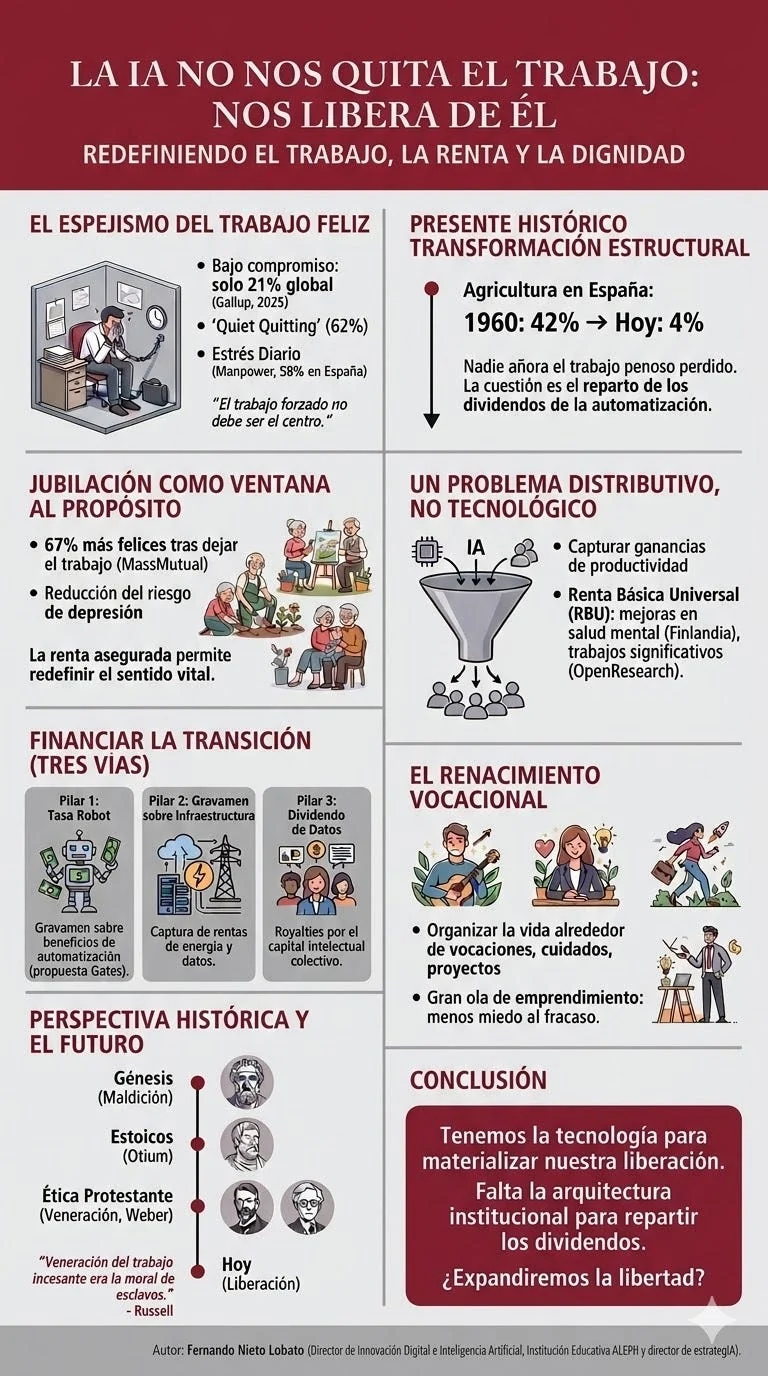
English text alternative for the infographic
AI is not taking our work away: it is freeing us from it. Redefining work, income and dignity.
The illusion of happy work
- Low engagement: just 21% worldwide (Gallup, 2025).
- ‘Quiet quitting’: 62%.
- Daily stress: 58% in Spain (Manpower).¹
‘Compulsory work should not be at the centre.’
Historical present — structural transformation
Agriculture in Spain: 42% in 1960 → 4% today. Nobody misses the arduous work that has disappeared. The question is how the dividends of automation are shared.
Retirement as a window onto purpose
- 67% report being happier after leaving work (MassMutual).²
- Reduced risk of depression.
A secure income makes it possible to redefine one’s sense of purpose.
A problem of distribution, not technology
The diagram shows AI feeding into a funnel that distributes its output among people.
- Capture productivity gains.
- Universal basic income (UBI): improvements in mental health (Finland); meaningful work (OpenResearch).
Financing the transition: three approaches
Scroll across the table to read all columns.
| Pillar | Proposal |
|---|---|
| 1. Robot tax | A tax on gains from automation — the Gates proposal. |
| 2. Infrastructure levy | Capture rents from energy and data. |
| 3. Data dividend | Royalties on collective intellectual capital. |
A renaissance of vocation
- Organise life around vocations, care and projects.
- A great wave of entrepreneurship: less fear of failure.
Historical perspective and the future
The timeline reads: Genesis — a curse; Stoics — otium; Protestant ethic — veneration, Weber; today — liberation.
‘Veneration of unceasing work was the morality of slaves.’ — Russell³
Conclusion
We have the technology to make our liberation real. What is missing is the institutional architecture to share the dividends.
Will we expand freedom?
Author credit in the graphic: Fernando Nieto Lobato, Director of Digital Innovation and Artificial Intelligence at Institución Educativa ALEPH and editor of estrategIA.
Notes on the original graphic:
¹ The graphic gives 58% for stress in Spain; the article gives 56%. Both figures are retained in their respective places. This translation does not resolve the discrepancy or independently verify either figure.
² The graphic’s compressed wording is ‘67% happier after leaving work’. The article explains that 67% of retirees report being happier; it does not describe a 67% increase in happiness. The English alternative makes that distinction explicit.
³ The wording attributed to Russell is translated from the Spanish graphic, not reproduced from an independently verified English quotation. ‘Today’ retains the context of the original article’s publication in April 2026. The graphic condenses the argument; the body retains its qualifications about the pace of automation and the conditions for a transition.
Cite this essay
Fernando Nieto Lobato. “AI is not taking our work away. It is freeing us from it..” estrategIA, issue 132, 8 April 2026. English edition, 29 September 2026. https://elcontemplador.github.io/estrategia-english/essays/132/