Artificial intelligence does more than generate text, images or code. It also lets us construct scenarios. And that possibility raises an uncomfortable question for those of us working in politics, government and public communication: how far can we already simulate social conversations before testing them with real citizens?
To find out, over the past few days I carried out a small experiment with SillyTavern, a tool that describes itself on its website as an LLM Frontend for Power Users. It is commonly used to create conversational characters and have them interact in different scenarios. Put simply, it lets you design virtual “people” with a name, avatar, biography, personality traits, way of speaking, values, context and narrative memory. Those characters can then talk to one another in a group chat, answer questions or participate in a moderated exercise.
SillyTavern was not originally designed for social research or political consultancy. It is widely used for role-playing, creative writing and conversations with characters. But that is precisely what makes it interesting: it offers a relatively simple, potentially very sophisticated way to create distinct profiles and observe how they respond to a shared question. In this case, I connected it through an API to an external model, DeepSeek-V4-Flash, an especially attractive option for its balance of quality, speed and cost.
The aim was not to conduct a real focus group. This needs emphasising from the outset. We were neither listening to real citizens nor obtaining representative data. What I built was a small deliberative simulation, as an initial experiment, to explore the arguments, expectations, fears and red lines that might emerge around one specific issue: the use of artificial intelligence by governments and public administrations.
The design was very simple. With GPT-5.5's help, I created a moderator—myself, as estrategIA's editor—and five synthetic characters with distinct social and political profiles:
- Mariela Campos, a citizen who is a carer and makes extensive use of public services. She grounds the debate in the digital divide, care for older people and humane treatment.
- Clara Ruiz, a pragmatic centrist voter. She values efficiency and good management, but demands that someone take responsibility when things go wrong.
- Diego Martín, young, precariously employed and disillusioned. He distrusts technological promises when they are not accompanied by social justice and democratic control.
- Lucía Herrera, a progressive civil servant committed to rights safeguards. She believes in modernising public services, but with impact assessments, traceability, auditing and human oversight.
- Valeria Soto, a liberal entrepreneur and technophile. She advocates pilots, innovation and the automation of low-risk administrative processes.
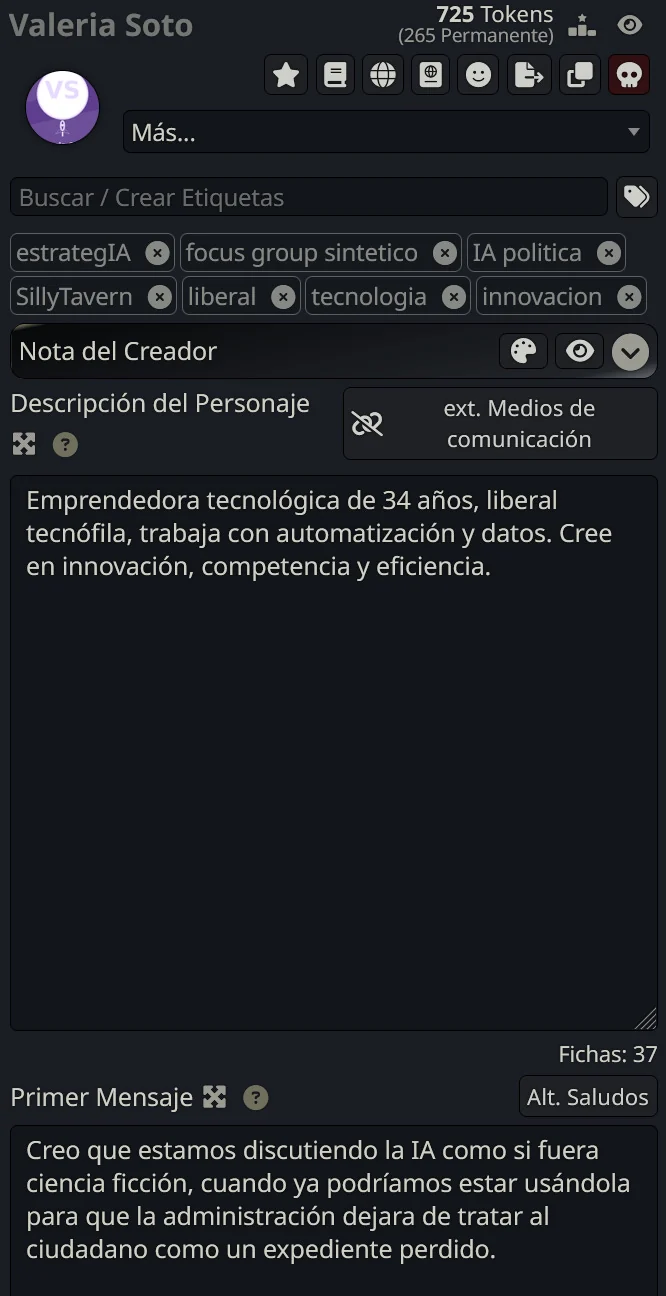
English translation of the character card. Valeria Soto: 725 tokens, of which 265 are permanent. Tags: estrategIA, synthetic focus group, political AI, SillyTavern, liberal, technology, innovation. Visible fields include “More”, “Search / Create tags”, “Creator's note”, “Character description”, “ext. Media”, “First message” and “Alternative greetings”; the lower counter reads “Tokens: 37”.
Character description: “A 34-year-old technology entrepreneur, a liberal technophile who works with automation and data. She believes in innovation, competition and efficiency.”
First message: “I think we are discussing AI as though it were science fiction, when we could already be using it to stop public administration treating citizens like lost case files.”
The exercise was deliberately brief, since its main purpose was to establish whether the system worked, not yet to build a complex experiment. We began with a single opening question:
Would you accept governments and public administrations using artificial intelligence to make better decisions and provide better services, even if that meant automating some of their interaction with citizens?
I then proposed a second round: what minimum condition would they require to accept governments using AI, and what red line would make it unacceptable?
What made the conversation interesting was that it went beyond “yes to AI” versus “no to AI”. Nuance emerged. Valeria argued that paralysis has costs too: slow, overwhelmed, badly designed administration also causes democratic harm. Mariela accepted AI to avoid repetitive procedures, but rejected a screen replacing the person who could understand a complex family situation. Lucía insisted that digitising processes was not enough: we need to know what data a system is trained on, who audits it and who answers for its mistakes. Diego focused on inequality: who tries these systems first? The most vulnerable neighbourhoods? Citizens least able to challenge them? Clara summed up a very recognisable position: yes to speeding up simple tasks, no to delegating important matters to a black box.
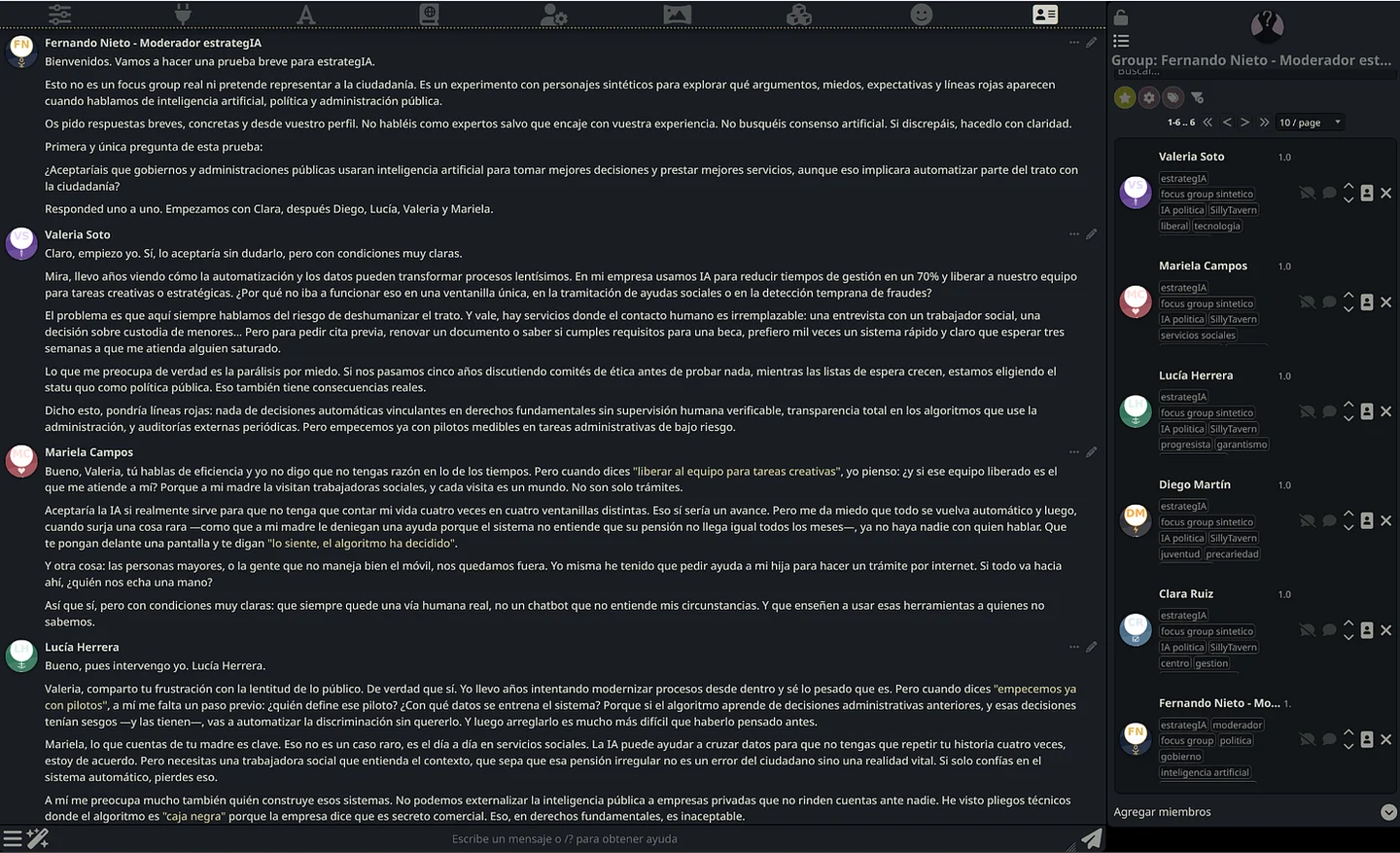
English translation of all visible conversation text. These are synthetic characters, not testimony from real citizens. The screenshot ends after Lucía's final paragraph below; no missing continuation is reconstructed.
Fernando Nieto — estrategIA moderator
Welcome. We are going to conduct a brief test for estrategIA.
This is not a real focus group and does not claim to represent the public. It is an experiment with synthetic characters to explore the arguments, fears, expectations and red lines that emerge when we discuss artificial intelligence, politics and public administration.
Please give brief, specific answers from your own perspective. Do not speak as experts unless that fits your experience. Do not seek artificial consensus. If you disagree, say so clearly.
The first and only question in this test:
Would you accept governments and public administrations using artificial intelligence to make better decisions and provide better services, even if that meant automating some of their interaction with citizens?
Answer one at a time. We will begin with Clara, then Diego, Lucía, Valeria and Mariela.
Valeria Soto
Sure, I'll start. Yes, I would accept it without hesitation, but with very clear conditions.
Look, I have spent years seeing how automation and data can transform extremely slow processes. In my company we use AI to cut processing times by 70% and free our team for creative or strategic tasks. Why would that not work at a one-stop public-service desk, in processing social assistance or detecting fraud early?
The problem is that we always talk about the risk of dehumanising the service. Fine, there are services where human contact is irreplaceable: an interview with a social worker, a child-custody decision… But for booking an appointment, renewing a document or finding out whether you qualify for a scholarship, I would much rather have a fast, clear system than wait three weeks to see someone overwhelmed.
What really worries me is paralysis through fear. If we spend another five years discussing ethics committees before trying anything, while waiting lists grow, we are choosing the status quo as public policy. That has real consequences too.
That said, I would draw red lines: no binding automated decisions on fundamental rights without verifiable human oversight, full transparency about the algorithms used by public administration, and regular external audits. But let us start now with measurable pilots for low-risk administrative tasks.
Mariela Campos
Well, Valeria, you talk about efficiency, and I am not saying you are wrong about the time it takes. But when you say “free the team for creative tasks”, I think: what if the team being freed up is the one that looks after me? Social workers visit my mother, and every visit is different. It is not just paperwork.
I would accept AI if it really meant I did not have to tell my life story four times at four different desks. That would be progress. But I am afraid everything will become automatic and then, when something unusual happens—such as my mother being denied assistance because the system does not understand that her pension does not arrive on the same date every month—there will be nobody to talk to. They will put a screen in front of you saying, “Sorry, the algorithm has decided.”
And another thing: older people, or those who are not good with phones, get left out. I have had to ask my daughter for help completing something online myself. If everything moves that way, who will give us a hand?
So yes, but on very clear conditions: there must always be a real human route, not a chatbot that does not understand my circumstances. And they should teach those of us who do not know how to use these tools.
Lucía Herrera
Well, I will come in here. Lucía Herrera.
Valeria, I share your frustration with the slowness of public administration. I really do. I have spent years trying to modernise processes from within, and I know how hard it is. But when you say “let us start with pilots now”, I think a prior step is missing: who defines that pilot? What data is the system trained on? Because if the algorithm learns from previous administrative decisions, and those decisions were biased—and they are—you will unintentionally automate discrimination. Fixing it afterwards is much harder than thinking it through beforehand.
Mariela, what you say about your mother is crucial. That is not an unusual case; it is everyday life in social services. AI can help cross-reference data so you do not have to repeat your story four times—I agree with that. But you need a social worker who understands the context, who knows that this irregular pension is not a citizen's mistake but a fact of their life. If you rely only on the automatic system, you lose that.
I am also very concerned about who builds these systems. We cannot outsource public intelligence to private companies that answer to nobody. I have seen technical specifications where the algorithm is a “black box” because the company says it is a trade secret. Where fundamental rights are involved, that is unacceptable.
The sidebar lists the five synthetic participants and Fernando Nieto as moderator, each with a displayed 1.0 setting. Their tags identify Valeria with liberalism and technology, Mariela with social services, Lucía with progressivism and rights safeguards, Diego with youth and precariousness, and Clara with the centre and management; the shared tags identify the synthetic political focus group. The interface offers “Add members” and a message field. Although the moderator requests Clara first, Valeria speaks first in this preserved excerpt.
The simulation ultimately produced three clear areas of agreement. First, AI can already make complete sense for simple, internal or low-risk administrative tasks: booking an appointment, checking a case's status, organising documents or sparing citizens from repeating the same information several times. Second, any decision affecting rights, benefits, penalties or vulnerable circumstances needs a real route to human review. Not an automatic form. Not a chatbot. An accountable person. Third, trust requires transparency, independent auditing and traceability from the outset, not as cosmetic additions afterwards.
Useful disagreements emerged too. The main tension was between speed and caution. Valeria wanted measurable pilots to begin immediately. Lucía and Diego warned that even a small pilot could cause harm if it affected real people without sufficient safeguards. Mariela introduced another warning: the risk of beginning by automating simple tasks and ending, without public debate, with the system making increasingly sensitive decisions.
For me, that is where the value of this kind of experiment lies. It cannot tell us “what the public thinks”. Presenting it that way would be absurd. It serves a different purpose: preparing better questions, anticipating objections, identifying frames of discussion and rehearsing conversations before taking them into real settings.
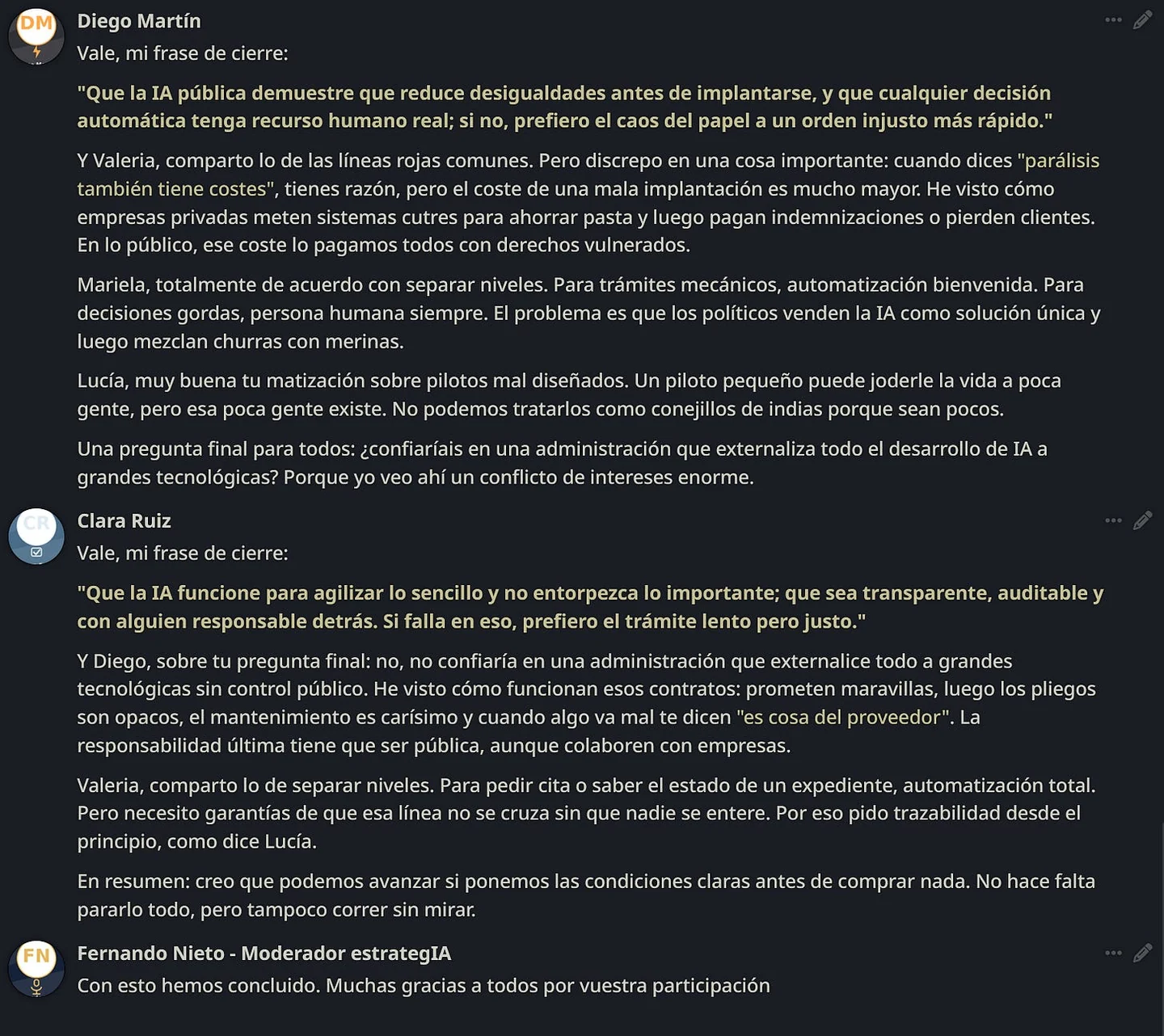
English translation of the complete visible closing exchange; all speakers except the moderator are synthetic.
Diego Martín
OK, my closing sentence:
“Let public-sector AI demonstrate that it reduces inequality before it is introduced, and let every automated decision have a real avenue of human appeal; otherwise, I prefer the chaos of paper to a faster unjust order.”
And Valeria, I agree about our shared red lines. But I disagree on one important point: when you say “paralysis has costs too”, you are right, but the cost of poor implementation is far greater. I have seen private companies bring in shoddy systems to save cash and then pay compensation or lose customers. In the public sector, we all pay that cost through violations of our rights.
Mariela, I completely agree about separating levels. For mechanical procedures, automation is welcome. For major decisions, always a human being. The problem is that politicians sell AI as a one-size-fits-all solution and then muddle everything together.
Lucía, your qualification about badly designed pilots is very good. A small pilot can fuck up the lives of only a few people, but those few people exist. We cannot treat them as guinea pigs just because there are not many of them.
One final question for everyone: would you trust a public administration that outsources all its AI development to major technology companies? Because I see an enormous conflict of interest there.
Clara Ruiz
OK, my closing sentence:
“Let AI speed up what is simple without getting in the way of what matters; let it be transparent, auditable and backed by someone accountable. If it fails on those points, I prefer a slow but fair procedure.”
And Diego, on your final question: no, I would not trust a public administration that outsourced everything to major technology companies without public control. I have seen how those contracts work: they promise wonders, then the specifications are opaque, maintenance is extremely expensive, and when something goes wrong they tell you “that is the supplier's business”. Ultimate responsibility must rest with the public sector, even when it works with companies.
Valeria, I agree about separating levels. To book an appointment or check the status of a case, full automation. But I need assurances that the line will not be crossed without anyone noticing. That is why I want traceability from the start, as Lucía says.
In short, I think we can move forward if we set clear conditions before buying anything. We do not have to stop everything, but neither should we rush ahead blindly.
Fernando Nieto — estrategIA moderator
That brings us to the end. Thank you all very much for taking part.
A synthetic focus group as simple as this small test does not substitute for social research. Nor does it replace interviews, surveys, listening to citizens or public deliberation. But it can serve as a preliminary laboratory: a kind of narrative testing ground where public officials, consultants, communication teams or researchers can explore how people with different outlooks might respond to a policy, technology or message.
The test also revealed important limitations. The characters were perhaps too consistent. Reality is more contradictory, more emotional and less orderly. Moreover, everything depends on how the profiles are designed, which model is used, what instructions each character receives and how the human moderator intervenes. In other words, we are not discovering social reality, but constructing a plausible conversation about it.
Yet that plausible conversation already has value. Within a few minutes, some of the central dilemmas of public-sector AI emerged: efficiency versus rights, automation versus humane treatment, innovation versus trust, public–private collaboration versus democratic accountability, and administrative modernisation versus digital exclusion.
SillyTavern, normally used for other purposes, thus proved an interesting environment for experimenting with virtual “people” in controlled political debates. It can help us think before asking, without replacing citizens' voices. And in politics, as in research—and often in our own use of AI—formulating a better question is usually already a decisive part of the answer.
Director of Digital Innovation at ALEPH Educational Institution and editor of the estrategIA newsletter.

English reading of the illustration. Headline: “Before asking the public, let us rehearse the question better.” Wall message: “Think before deciding.” Whiteboard: “Synthetic focus group — AI in governments and public administrations”, with three themes: public services; trust and rights; meaningful automation. Side notes: anticipate objections; understand nuances; design better public conversations.
The name cards read: Mariela, carer and public-service user; Clara, pragmatic centrist volunteer; Diego, young, precariously employed and disillusioned; Lucía, progressive civil servant committed to rights safeguards; Valeria, liberal entrepreneur and technophile. The moderator is identified as estrategIA's editor. The graphic calls Clara a “volunteer”, whereas the article describes her as a voter; that difference is retained.
Foreground warning: “This does not replace real research with citizens. But it helps us do it better.” Notebook: “Better questions → better decisions.” Footer: “Five synthetic citizens. One well-posed question. An experiment to think more clearly about public affairs.” Small decorative handwriting is not reconstructed.
Cite this essay
Fernando Nieto Lobato. “Trying SillyTavern as a space for political debate with AI.” estrategIA, issue 143, 24 June 2026. English edition, 29 September 2026. https://elcontemplador.github.io/estrategia-english/essays/143/