Continuing an annual tradition stretching back more than two decades, Time magazine has selected and published its list of the best inventions of 2023. Among this year's choices, a series of inventions in artificial intelligence capture the imagination and offer fresh perspectives on how AI could shape our shared future in the near term. Below, we focus on three inventions of particular direct relevance to politics and, especially, government, highlighting their potential to tackle critical problems facing our societies. We leave aside other AI projects on the list that we have already discussed, such as GPT-4 and DALL-E 3, and those whose applications lie well beyond this newsletter's main focus.
Detecting wildfires: ALERTCalifornia
One of the most critical challenges of climate change is the increasing frequency and intensity of wildfires. The University of California, together with the California Department of Forestry and Fire Protection (CAL FIRE) and industry partner Digital Path, has developed ALERTCalifornia, an AI system that significantly improves wildfire detection and response. Using a network of more than 1,050 cameras, the system can identify fires in their early stages with very high accuracy, thereby optimising resource allocation and evacuation procedures. Since its deployment in September 2023, the tool has proved particularly effective at detecting fires early in remote locations and at night. In its first two months, the system correctly identified 77 fires before anyone called the emergency services.
Protecting wildlife: TrailGuard AI
Poaching is a chronic problem affecting biodiversity in many parts of the world. TrailGuard AI is an AI system created by the US environmental organisation Resolve in collaboration with Intel. Designed to combat poaching in protected areas of India and Africa, the system uses compact cameras and machine learning algorithms to detect illegal activity and notify the authorities in real time. During testing, the system contributed to the arrest of more than 30 poachers. As well as facilitating arrests, TrailGuard AI improves intelligence on illicit poaching networks, helping to combat the illegal wildlife trade. The technology is compact enough to be easily concealed along trails, and work is under way to make it as affordable as possible so that it can be used widely in wildlife reserves.
Urban security: drone detection with Dedrone
As drones proliferate in urban airspace, the need for an effective detection and mitigation system has grown significantly. Dedrone has launched “City-Wide Drone Detection”, a system that acts as a virtual shield around designated areas, such as cities or critical facilities. In one concrete example, the Catalan police in Barcelona have already deployed this technology, demonstrating its applicability in a European setting. The system has been compared to air traffic control for drones, something that did not previously exist. The product is designed to neutralise threats and keep airspace safe, providing critical information such as the drone's altitude, flight path and pilot's location. It is presented as a comprehensive solution for detecting and mitigating drones in urban and business environments.
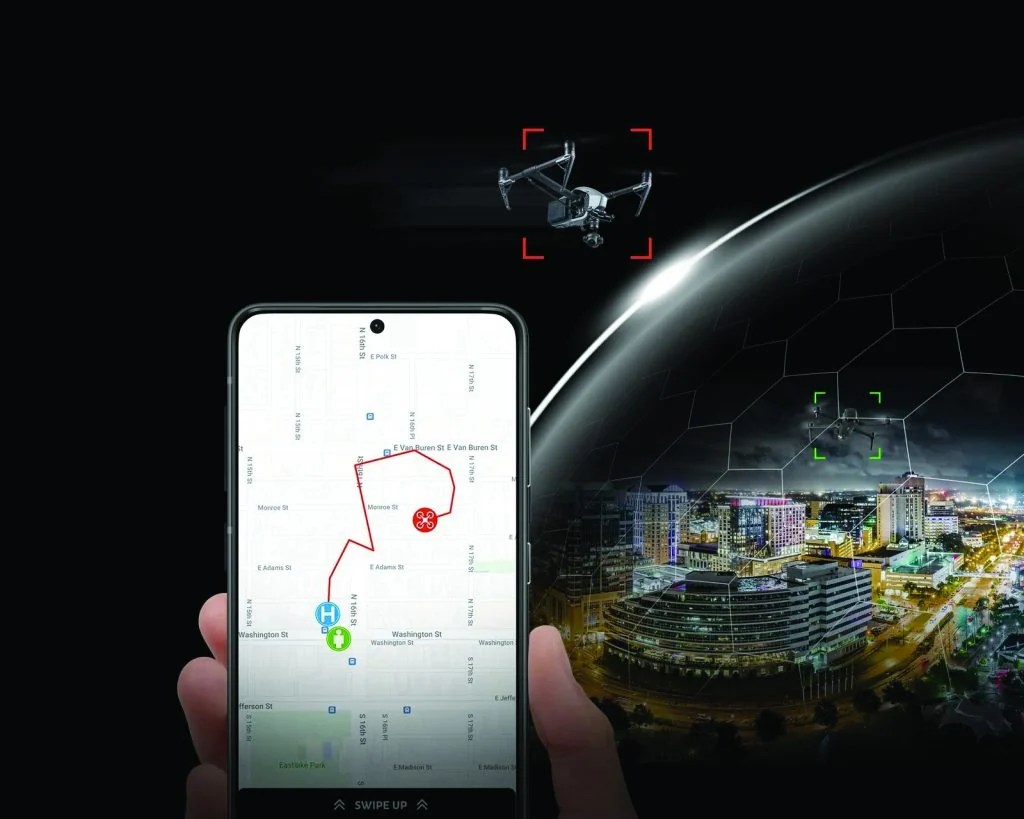
Illustration reproduced from the Spanish article: monitoring drones and their routes in an urban setting.
As these notable AI inventions selected by Time suggest, 2023 is shaping up to be a turning point in the application of artificial intelligence to critical public safety and environmental challenges. From early wildfire detection to combating poaching and regulating drone traffic in cities, AI innovations are providing tangible, effective solutions. These initiatives demonstrate not only the maturity of machine learning algorithms, but also how interdisciplinary collaboration between academia, industry and government institutions can produce significant results. However, as we continue to integrate these tools into our social and environmental infrastructure, it is essential, as we have discussed in previous newsletters, to maintain a critical approach that considers the ethical and political implications of their use, so that applying technology always serves collective well-being and long-term sustainability.
Fernando Nieto Lobato
Director of Digital Innovation, Institución Educativa ALEPH
Cite this essay
Fernando Nieto Lobato. “AI innovations transforming public safety and the environment: Time's chosen inventions of 2023.” estrategIA, issue 005, 1 November 2023. English edition, 29 September 2026. https://elcontemplador.github.io/estrategia-english/essays/005/