Last week, on 1 and 2 November, the United Kingdom hosted a highly significant gathering on artificial intelligence: the UK AI Safety Summit. It took place at Bletchley Park, a site rich in symbolism as one of the birthplaces of modern computing during the Second World War, and brought together representatives of 28 countries and leading technology companies. Its main achievement was the signing of the Bletchley Declaration on AI Safety, a commitment intended to manage and mitigate AI risks and ensure its safe and responsible development and deployment.
The AI Safety Summit's main objective was to address the risks of artificial intelligence at the frontier of development and discuss how a united global effort could mitigate them. The first day featured talks by business leaders and academics aimed at deepening understanding of the most advanced AI. Participants included renowned institutions such as the Alan Turing Institute, Stanford University and the Ada Lovelace Institute. Technology leaders from companies including Google, Microsoft, IBM and SpaceX also attended, with Elon Musk himself present, alongside OpenAI CEO Sam Altman and prominent political figures such as European Commission President Ursula von der Leyen and US Vice President Kamala Harris.
The meeting's main achievement was the signing of the Bletchley Declaration, which states that developers of advanced AI technologies bear a significant responsibility for ensuring the safety of their systems. This commitment emphasises the need for a shared understanding of AI risks and promotes collaboration on safety research. British Prime Minister Rishi Sunak described the declaration's signing as a historic achievement and highlighted the UK's leading role in this field.
Opinions on the declaration were divided, however. For example, Martha Bennett, a vice president at Forrester, suggested that, although symbolically important, it lacked substantive detail on how to regulate AI effectively.
One of the most notable outcomes was agreement on a new framework for safety testing of advanced AI models. The framework aims to give governments a greater role in evaluations before and after deployment, moving away from the idea that technology companies alone should be responsible for these tests.
In the UK, a new AI Safety Institute will conduct these evaluations, working with the Alan Turing Institute to assess new forms of frontier AI carefully. In addition, the distinguished computer scientist Yoshua Bengio will lead the preparation of a report on the current state of the science in advanced AI.
The UK government appears to have sought a balance between the importance of AI safety and the business opportunity it offers the country. The remarks of Science and Technology Secretary Michelle Donelan highlighted the extraordinary opportunities AI could offer in areas such as the NHS (National Health Service), transport and the fight against climate change.
In contrast to the British position, the United States announced several measures, notably the creation of an AI Safety Institute and an executive order requiring AI companies to notify the federal government when training potentially dangerous models. Biden approved an executive order on AI a few hours before the summit began, as we reported in last week's newsletter.
Although the possibility that AI might displace or even threaten humanity remains a matter of debate, there is a palpable consensus about the danger of disinformation amplified by AI. The concern is that malicious use of generative AI could seriously manipulate elections in different countries.
Alongside discussion of AI's short- and long-term risks, the summit revealed a marked difference of opinion between open-source and closed-source approaches to AI research. While some argue that the code for advanced AI models should not be freely distributed because of its dangers, the open-source community counters that a monopoly on AI research by profit-driven companies could produce harmful outcomes, and argues that opening up models can accelerate safety research. Jess Whittlestone, head of AI policy at the Centre for Long-Term Resilience, said that the debate remained complex. Although there was agreement on the need to seek more nuanced solutions beyond the open/closed-source divide, differences persisted over how to put those solutions into practice and prioritise them.
Reactions to the summit varied. Praise from figures such as Darktrace CEO Poppy Gustafsson contrasted with warnings that perceptions of AI could be distorted, with suggestions that vested interests might be fuelling alarm about catastrophic scenarios. Moreover, despite the call for cooperation, it seems clear that each nation is pursuing leadership in AI. Perhaps the most vivid illustration of this was the cartoon Elon Musk himself shared during the summit:
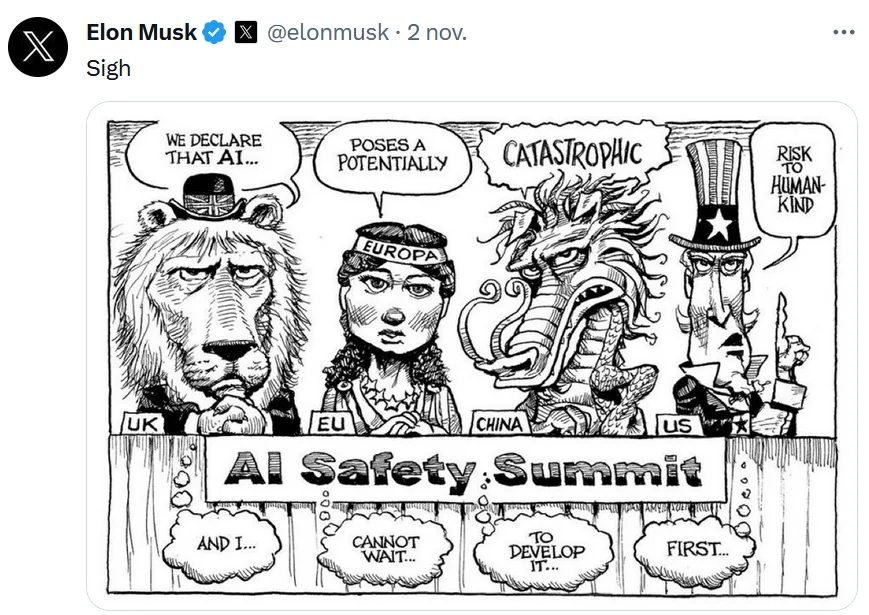
Text in the original English-language cartoon, reproduced in the Spanish article: the figures labelled UK, EU, China and US jointly say, “We declare that AI… poses a potentially… catastrophic… risk to humankind”, while their thought bubbles read, “And I… cannot wait… to develop it… first…”. They stand behind a sign reading “AI Safety Summit”. Musk's accompanying post reads “Sigh”.
The UK AI Safety Summit has been a significant milestone in the global AI landscape. Although it produced concrete achievements, such as the signing of the Bletchley Declaration and the establishment of a testing framework, it remains to be seen how these initiatives will translate into practical, collaborative action internationally. Managing the risks associated with AI is essential, and it is encouraging to see world leaders and technology companies taking this responsibility seriously. The willingness is there; effective implementation and cooperation, however, are the next major challenge in this new era of artificial intelligence.
Fernando Nieto Lobato
Director of Digital Innovation, Institución Educativa ALEPH
Cite this essay
Fernando Nieto Lobato. “The first major international AI safety summit: seeking harmony between progress and precaution.” estrategIA, issue 006, 8 November 2023. English edition, 29 September 2026. https://elcontemplador.github.io/estrategia-english/essays/006/