Not even ChatGPT could count how many times the term “artificial intelligence” was mentioned during the Seventh International Congress on Political Communication, organised by the Political Communication Association (ACOP) and held in Málaga from 19 to 21 September. AI featured in almost every panel and discussion, particularly when addressing its impact on the proliferation of disinformation and on the everyday practice of political consultancy and communication.
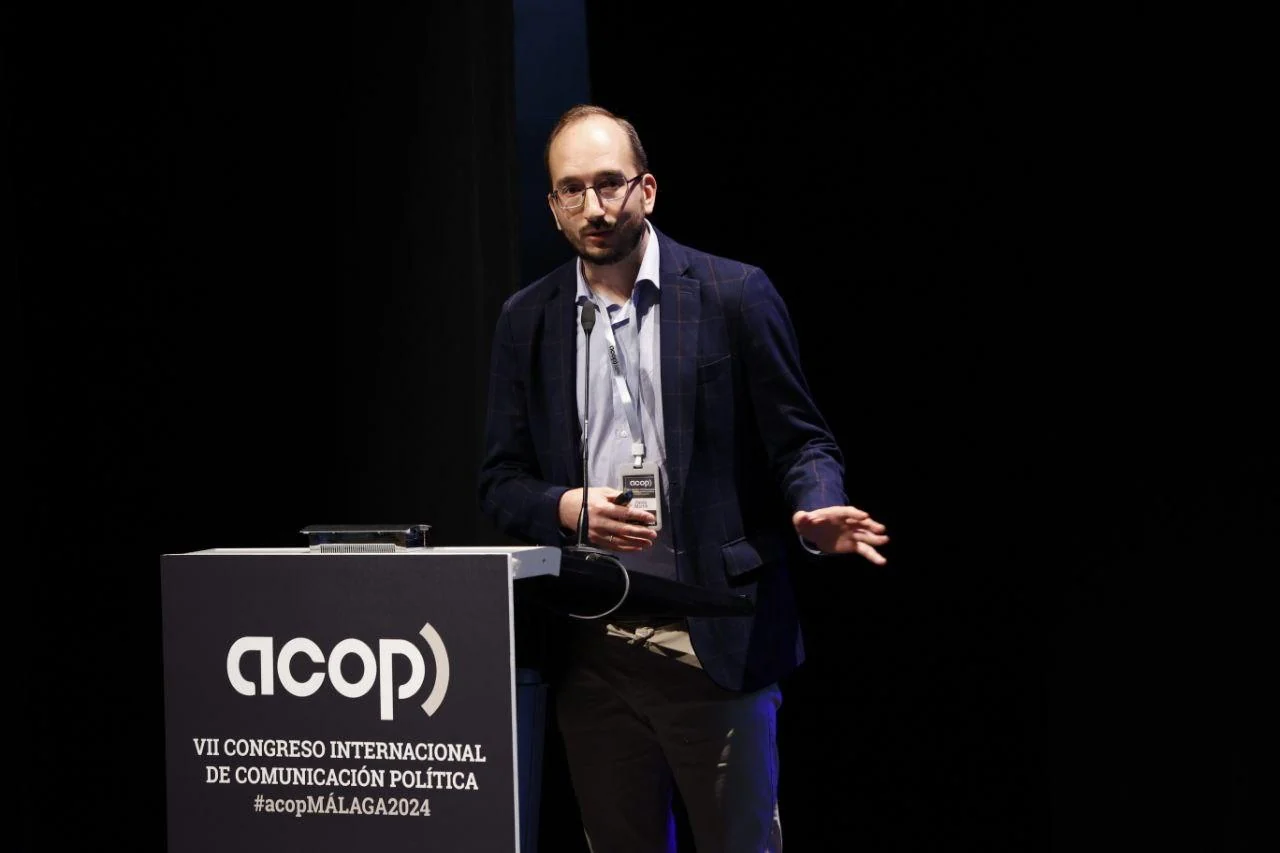
At the congress lectern. Its wording reads: “Seventh International Congress on Political Communication”, with the hashtag #acopMÁLAGA2024.
In the academic panel “AI, technologies and campaigns”, Gabriela Ortega, Fernando Nieto and I presented our research on AI’s impact on political communication. The study was based on an experiment conducted in this very newsletter, in issues 28, 29, 30 and 36, in which we created and promoted a fictional political party ahead of the recent European elections. Throughout this work, we explored how generative AI tools, such as GPT-4-type language models and image generators such as Midjourney, can play key roles in many aspects of political communication. From creating party identities to drafting speeches and designing campaign strategies, AI demonstrates unprecedented potential.
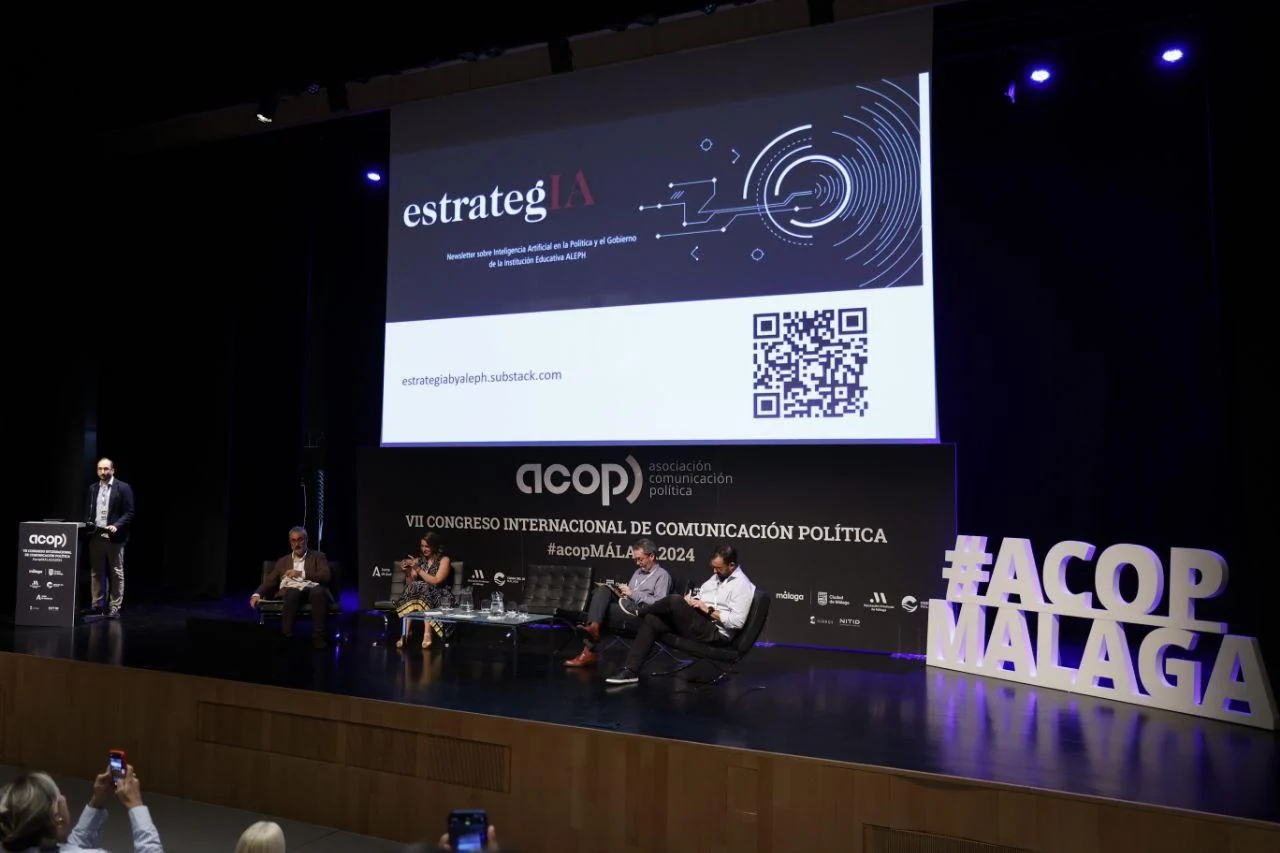
The panel with an estrategIA slide on screen. The slide describes it as the ALEPH Educational Institution’s “Newsletter on artificial intelligence in politics and government” and displays estrategiabyaleph.substack.com and a QR code.
Our research focused not only on these tools’ innovative capabilities, but also on the ethical challenges they pose. Dependence on generative technologies can influence public perceptions, affecting authenticity in politics. While AI offers fascinating opportunities to transform politics, it also raises serious questions that academics, political strategists and regulators must consider.
The changing shape of disinformation
One of the most frequently raised concerns throughout the congress was disinformation exacerbated by AI. Bruno Patino, president of ARTE France, drew an interesting analogy in his contribution, recalling a passage from his book Submersion: he compared Don Quixote, whose overexposure to chivalric literature caused him to lose his grasp of reality, with our society today. Drawing on Patino’s book, lecturer and journalist Carmela Ríos warned that an excess of AI-generated content, combined with disinformation, could lead us into a similar situation: living in an unreal world while our minds and bodies suffer the consequences in reality. According to Patino, the key will be to build credible institutions capable of earning citizens’ trust, rather than trying to combat every piece of false information.
Positive and negative uses of AI in political communication
Ignacio Martín Granados, former editor of ACOP’s magazine, offered an overview of current AI uses in political communication, highlighting both risks and benefits. On the one hand, he identified the proliferation of false content, algorithmic discrimination and increased social polarisation as the main dangers. On the other, he highlighted how AI can improve decision-making through data mining, personalise messages for specific audiences and, more broadly, open up new opportunities for political communication.
A path still to be travelled: integrating generative AI deeply into political communication
Another panellist, Francisco Cristófol, a professor at Loyola University, addressed the paradox that many communications offices in Andalusia’s political institutions are barely aware of generative AI tools, let alone using them. Curiously, despite their heavy workloads, these professionals cannot find time to train in these technologies, even though using them could significantly reduce their workload and potentially transform how they work.
Throughout the congress, it was clear that AI is transforming politics and political communication at a dizzying pace. That is why, in concluding my contribution, I asked the sector to encourage reflection: it is essential that we, as political communication professionals, begin a debate about how we can add value in this new environment before we become an endangered species.
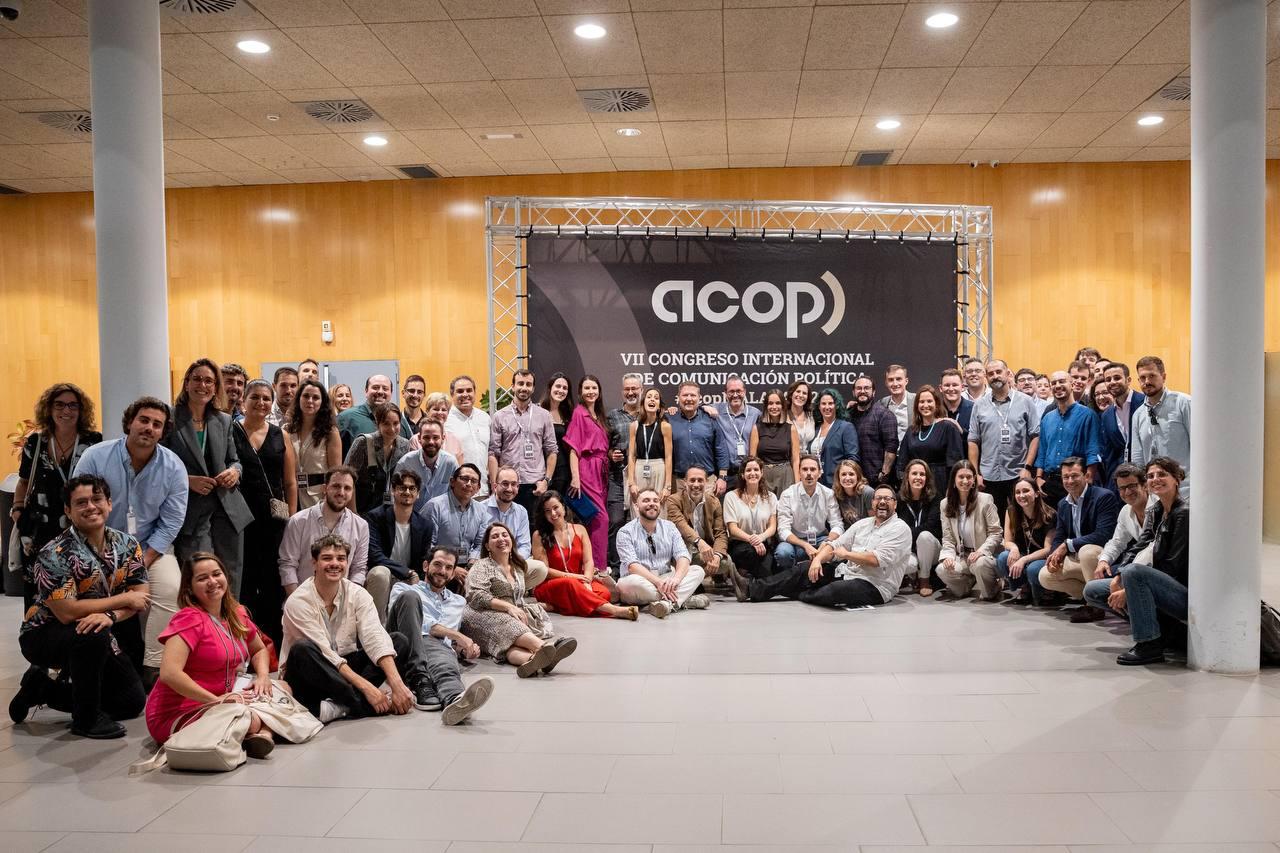
A group photograph at the Seventh International Congress on Political Communication, Málaga 2024.
The final panel, entitled “There is a future in the profession!”, conveyed both unease and excitement about generative AI’s potential. One attendee then tried to put AI’s capabilities into perspective, arguing that people still have poetry and irony to set us apart. Another participant asked ChatGPT to create an ironic poem in the style of Antonio Machado. The AI composed it masterfully, prompting applause and laughter from the audience… And so the congress’s final roundtable ended: with political communication professionals applauding ChatGPT, acclaiming the best of us all.
Pablo Martín Diez
Academic Director of the ALEPH Educational Institution
Cite this essay
Pablo Martín Diez. “From scepticism to acclaim: AI takes centre stage at ACOP’s Seventh International Congress.” estrategIA, issue 052, 25 September 2024. English edition, 29 September 2026. https://elcontemplador.github.io/estrategia-english/essays/052/