Historical note: this essay was published on 11 December 2024. Its references to recent releases, prices and the coming years retain that date’s perspective. The English wording in the screenshots is transcribed from the preserved images; quoted wording elsewhere is translated from the Spanish unless the visible English original is reproduced.
In these first days of December, we have witnessed an enormous explosion in the development of artificial intelligence. Among the most significant announcements are the launch of the o1 model and its o1 Pro version (with more computing time and tied to a $200 monthly subscription), as well as this past Monday’s launch of Sora and a system with advanced vision capabilities integrated into voice applications, whose demo was presented last Sunday on “60 Minutes”. All of this comes from OpenAI, as part of a 12-day series of product announcements reminiscent of those Apple used to run during the Christmas season years ago.
But the other companies have also presented some very interesting advances in the past week:
- Google: It has released the latest preview version of Gemini in its open AI lab, a model that outperforms the latest version of GPT-4 and, according to leaks, might simply be the smallest Gemini 2 model.
- Grok from X.ai: It is now free.
- Aurora integrated into Grok: X.ai’s AI launched a new image model capable of an extraordinary degree of realism. Although it was quickly withdrawn over the weekend, it returned on Monday, without a model name, integrated directly into Grok.
- Meta: It has released an open model with just 70 billion parameters, just as powerful as the previous 405-billion-parameter model it presented only a few months ago, despite being almost six times smaller.
- Microsoft: It has presented a system that allows AI to see your PC screen, for now integrated into the browser, and assist you by voice in real time.
These advances matter not only for their present capabilities but, above all, because they point to a clear path towards artificial general intelligence, or AGI, in the coming years or even months. According to some OpenAI researchers, models such as o1 Pro already outperform the average human across a wide range of tasks.
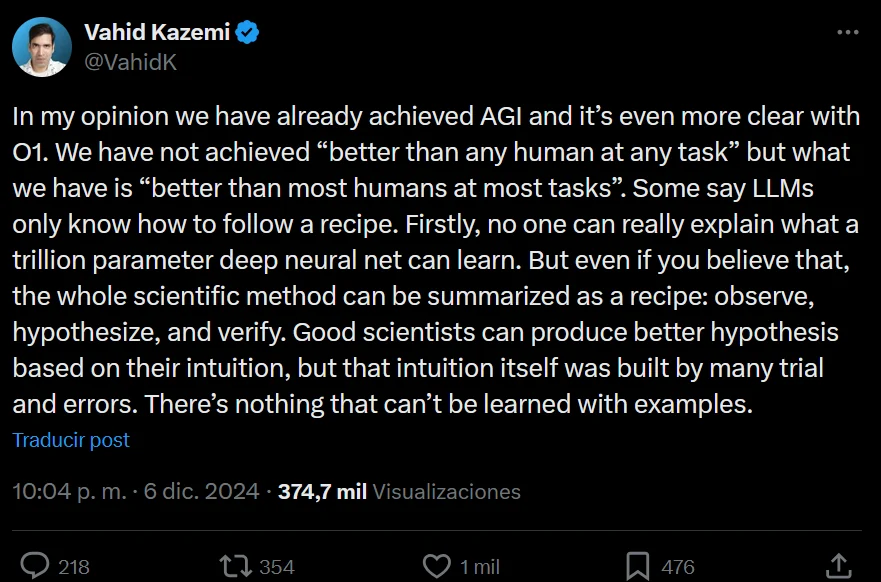
Original English in the screenshot — Vahid Kazemi (@VahidK), 6 December 2024:
In my opinion we have already achieved AGI and it’s even more clear with O1. We have not achieved “better than any human at any task” but what we have is “better than most humans at most tasks”. Some say LLMs only know how to follow a recipe. Firstly, no one can really explain what a trillion parameter deep neural net can learn. But even if you believe that, the whole scientific method can be summarized as a recipe: observe, hypothesize, and verify. Good scientists can produce better hypothesis based on their intuition, but that intuition itself was built by many trial and errors. There’s nothing that can’t be learned with examples.
But even if we take the stronger definition of AGI, “better than any human at every task”, last week’s technological revelations tell us that we are not too far away. The major AI labs also tell us that they already know the path to get there, because o1, and even more so in its Pro implementation, is already capable of things like these.
So much so that we already need the best experts in each field to judge the true capabilities of these reasoning models. They are “too clever” for us to find tasks that can readily challenge them, and their main uses lie in science, mathematics and highly complex tasks requiring very advanced reasoning, as Wharton professor and AI expert Ethan Mollick points out in these tweets:
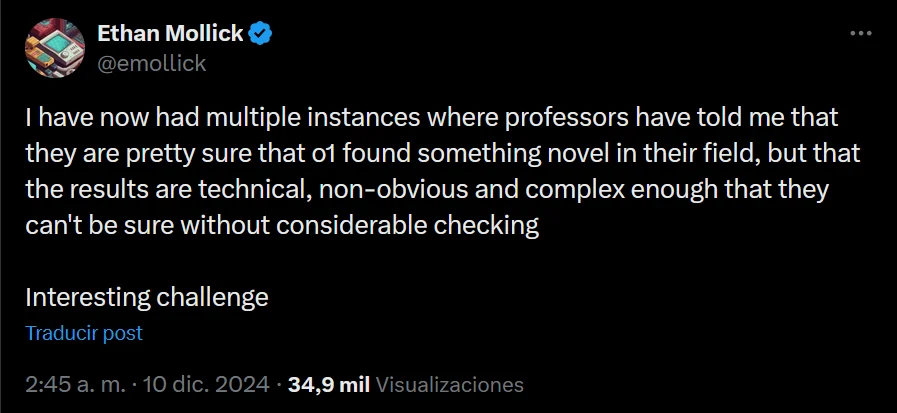
Original English in the screenshot — Ethan Mollick (@emollick), 10 December 2024:
I have now had multiple instances where professors have told me that they are pretty sure that o1 found something novel in their field, but that the results are technical, non-obvious and complex enough that they can't be sure without considerable checking
Interesting challenge
We have already had the opportunity to run quite a few tests with o1, though not with its even more powerful Pro system, which costs $200 a month and is aimed at very specific fields that can make the most of its extra computing time. It is truly impressive, but it is very hard to find “everyday” professional use cases that really exploit the model’s full power. Thanks to Carlos López Arístegui, Vice-Rector for Academic Affairs at ESIC, who very kindly shared his latest business case study so that we could test the model, we have seen that it needs even more complex challenges to make it “think”.
One of our goals for 2025 is to try to build a small collection of especially complex political cases, ideally without pre-existing data on the internet that might “rig” the models’ performance: they should not have been trained on the answers or on what “happened” afterwards — for example, if we are discussing electoral analysis and a subsequent election produced a particular result. This would allow us to test whether these new models can really make a difference in politics and government, which is enormously likely, but above all how we can use them well, even to live up to this observation by Peter Welinder, one of OpenAI’s senior executives: “It’s exhilarating—and maybe a bit humiliating—to take direction from a model that’s clearly smarter than you.”
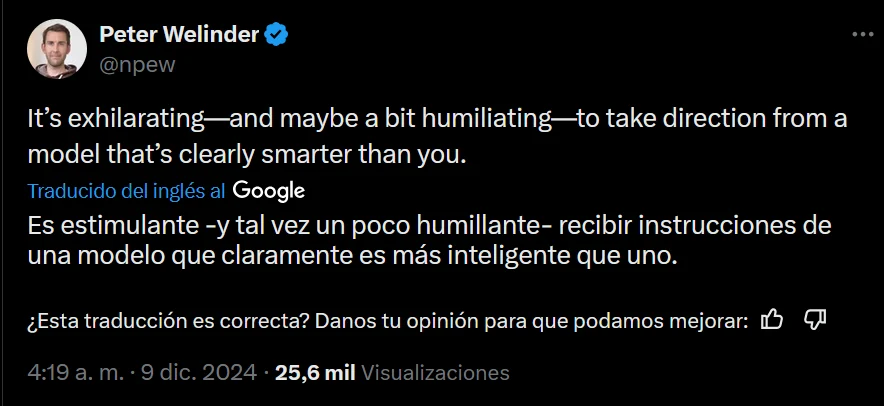
Original English in the screenshot — Peter Welinder (@npew), 9 December 2024:
It’s exhilarating—and maybe a bit humiliating—to take direction from a model that’s clearly smarter than you.
In politics and government, we will have to consider how to obtain valuable data and complex problems that allow us to ask genuinely difficult questions that can really benefit from the greater intelligence of reasoning models.
This reflection on politics and government brings us to the key question. AI is advancing in leaps and bounds. We are beginning to have models more intelligent than the average human, which will soon be able to carry out tasks as agents — that is probably where we will see the next great leap in their adoption across society — and meanwhile, what are our representatives doing? Are they not looking up?
What about politicians?
We already have models more intelligent than humans in a great many activities. We know they are improving at a speed that is hard to believe: every few months we see major leaps in their reasoning, capabilities and integrations. We know these models can already underpin agents that, as early as next year, will go beyond chat-style interaction to carry out complex tasks requiring several steps and different tools. Yet when one looks at the political class close to home, and with very few exceptions across the world, the impression is that almost nothing is being done — at least publicly; there is always the hope that much more preparation is taking place in private, without our being told about it.
Some countries have proposed rather generic legislation with room for improvement. In cases such as the European Union, it is full of good intentions but poses enormous problems for the competitive development of AI — for now, for example, Sora is being released in almost every country in the world except the United Kingdom and the European Union… And little else. Meanwhile, the world’s major corporations are pouring hundreds of billions of dollars into developing new AI models, with Chinese investment comparable in scale. Yet we see our politicians embroiled in their usual power struggles, concerned with gaining or retaining power, with nineteenth-century questions of identity or territory, or with the perennial corruption scandals. And is nobody looking up? Does that meteorite, which will soon bring the AI explosion and is already about to strike, mean nothing to them?
As I know that many politicians read these lines every week, from my position as a mere lookout watching the advance of AI, I have little option other than to be especially clear in a newsletter like today’s: to climb the ship’s mainmast and shout “Land! Land!”, without much hope that anything will be done. At least I trust that, a few years from now, none of those reading these lines will say that nobody warned them about the “meteorite”. More than that, I hope many will at least begin thinking about how to adapt to the change.
Against this backdrop of AI progress, the question is not so much whether it will have a massive transformative effect on our society, our politics and employment, but when. One cannot help asking: what are politicians waiting for before commissioning multiple serious studies and developing real funding mechanisms for life in a world where humans are not the only intelligent species on Earth, and probably not even the most intelligent in a few decades? Are we going to wait until unemployment starts spiralling out of control before we begin studying how to fund and implement a universal basic income that protects citizens’ most basic living standards? We face astonishing technologies that could be democratised and give us all power unlike anything we have ever had, but that also carry an enormous risk of becoming systems that concentrate still more power and wealth in the hands of a few countries and billionaires.
This is easier to understand with an example, so here is a very simple one of my own devising, showing a clear route to jobs disappearing. Very soon — I do not think I am taking much of a risk in saying that fewer than five years will pass — three executives at company X, a bank, for example, will decide to leave and set up company Z. Unlike X, a large multinational, this new company Z will not have 30,000 employees. It will have 300, assisted by the latest AIs, and will do the same work as X, or even better, with much lower labour and technology costs and far greater agility because of its smaller organisational size. Its products will therefore be more attractive, with lower fees and higher returns, and it will soon start taking X’s entire market — since consumers generally prefer better, cheaper products. X will respond by implementing more AI and laying off thousands of workers.
Perhaps X will save itself in time; perhaps it will not. Along the way, probably tens of thousands of workers will find themselves at home without a job. A few will make use of AI and start new businesses in that sector or others, taking advantage of new opportunities. For most, however, it will be the end of their working lives, because AIs will be better, cheaper, work 24 hours a day, seven days a week, not join unions, not fall ill… Are governments around the world already thinking seriously about this? And here we are considering mainly “white-collar” jobs first, but AI-powered robots are already almost knocking at the door.
What will governments do with civil servants in predominantly administrative roles, who will be the first affected? Large companies will dismiss an enormous proportion of their workforce, replacing it with AI. Will the public sector be allowed to retain countless people for whom there is no objective need? How will public administration be restructured? The challenges that politics, governments and the entire public sector will face in the next few years, in direct employment alone, are enormous. Yet the impression is that they continue spending their time and energy on other matters, as though this one did not exist. Believe me, it does.
As for universal basic income, or UBI, a very complex subject to which we will probably devote a future article, this is perhaps the approach I find most convincing, developed by Berkeley professor James F. O’Brien. It seeks to balance AI’s growing productivity with social equity, ensuring that the future of automation benefits everyone, not just those who control these technologies. It also fits best with the point at which AIs do most of the work. It cannot be implemented — or at least is not necessary — before widespread unemployment caused by AI begins. On grounds of human dignity, it could be perfectly understandable already, because a person’s value, and this is a personal philosophical position, is independent of their ability to generate money; but that would entail other kinds of costs. We cannot wait much longer, however, because the change is very likely to be rapid, and putting UBI properly into operation means restructuring the entire existing welfare state and benefits system.
It is also true that, for this UBI model to work, the companies in your country or region need to be competitive in that post-AGI world and able to pay the levies that would fund UBI under a model such as O’Brien’s. The exception would be a global system, something surely desirable but quite difficult even to conceive of at present. Judging by investment so far, it seems that not much is being done on this front either, apart from in the United States and China. This issue’s news section includes a new European attempt: interesting, but clearly insufficient.
Freedom from that “biblical curse” that, for many human beings, is the obligation to work to survive should not be a bad thing if it is managed well — although the transition to a world beyond scarcity could be psychologically traumatic in many ways, given such radical changes in so little time. But AI with advanced reasoning models will probably bring enormous transformations in fields beyond employment, making it essential for governments to start planning ahead now. If lifespans begin to grow longer and longer, as seems quite likely with new technologies and enormous changes in healthcare systems, what happens to the sustainability of pensions? They will probably have to be redefined within a UBI framework or something similar. Simply posing the basic questions about defence would provide material for another enormous and complex article. Then there is education, the infrastructure required…
Given the nature of this newsletter, we are focusing here on asking governments and politicians for a swift, decisive response to the approaching meteorite. But it is important that businesses also come to terms — that we come to terms — with the reality of these new AIs as soon as possible, for example by doing what Wharton professor Ethan Mollick proposes, right now:
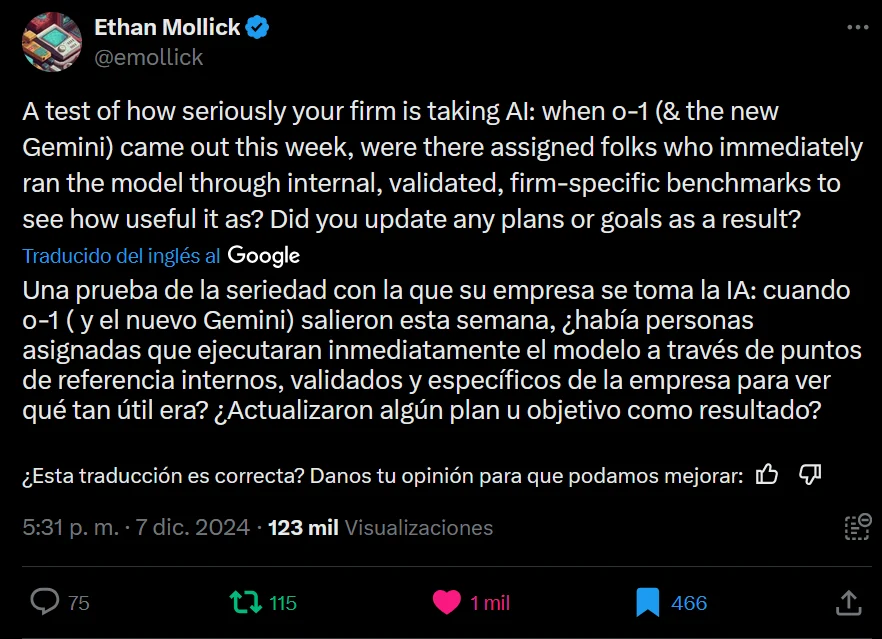
Original English in the screenshot — Ethan Mollick (@emollick), 7 December 2024:
A test of how seriously your firm is taking AI: when o-1 (& the new Gemini) came out this week, were there assigned folks who immediately ran the model through internal, validated, firm-specific benchmarks to see how useful it as? Did you update any plans or goals as a result?
We must also prepare as individuals to make use of all this new AI potential, integrating it positively and productively into our daily lives and overcoming old habits. I confess that I sometimes still search on Google, as I have for almost the past 25 years of my life, even though I know that ChatGPT’s new search engine and especially Perplexity are clearly superior, unless I simply want a URL. These tools also complement education — another field in which we need radical reflection and change in the period ahead. I particularly like this prompt, which I saw over the weekend and share below, and which I hope to incorporate into my learning conversations with ChatGPT:

Original English in the screenshot — Arjun Khemani (@arjunkhemani), 7 December 2024:
My favorite ChatGPT prompt is: “I want you to keep talking to me and asking me questions until I understand [any hard topic I want to learn about].”
Finally, I simply want to say that “not looking up” is not a good solution. The meteorite that triggers the explosion — in this case, it may be a good explosion in a great many respects — may still be delayed by a few years. It may even pass close by without affecting us structurally, although that now seems highly unlikely. But the answer is NOT to be unprepared, ignore it and act as though it did not exist. This humble journalist and teacher can do no more than put this text forward as a call to action, now, because time is running out and “the coming wave” is no longer on the horizon: it is right above us.
Fernando Nieto Lobato
Director of Digital Innovation at Institución Educativa ALEPH
P.S. I saw this short video after finishing the article, but I find it so revealing that I have to share it with you. At the press conference before the 2024 Nobel Prize ceremony, this year’s Nobel laureate in Physics — also referring to the prediction of the Nobel laureate in Chemistry sitting alongside him — says that ASI will arrive in 5–20 years: not AGI, artificial general intelligence, but the next step, superintelligence. And he has been a well-known sceptic in the AI field, despite being one of its fathers.
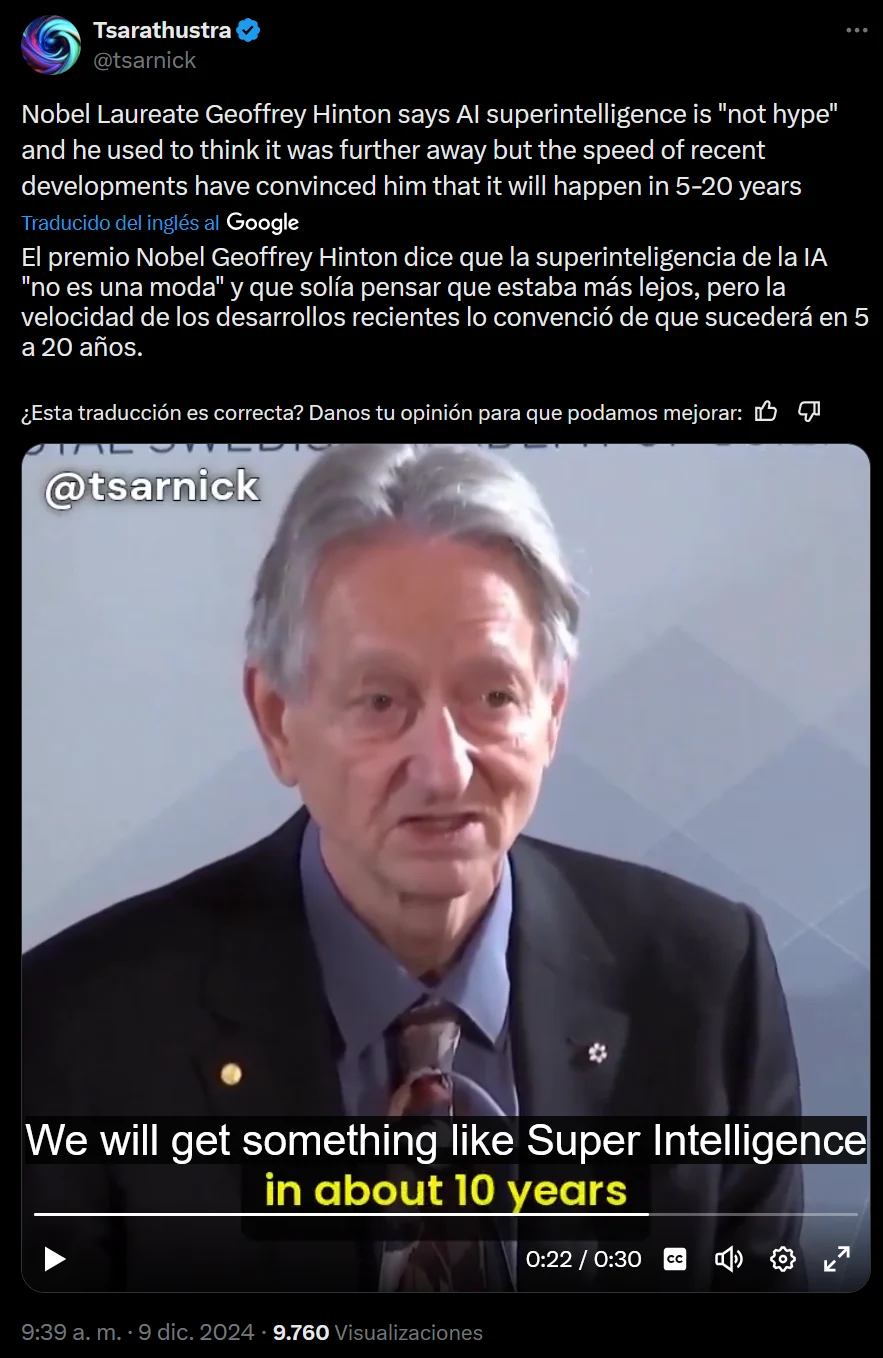
Original English in the screenshot — Tsarathustra (@tsarnick), 9 December 2024:
Nobel Laureate Geoffrey Hinton says AI superintelligence is "not hype" and he used to think it was further away but the speed of recent developments have convinced him that it will happen in 5-20 years
Visible video subtitle:
We will get something like Super Intelligence in about 10 years
Cite this essay
Fernando Nieto Lobato. ““Don’t look up”: artificial intelligence is overtaking us. What about our governments?.” estrategIA, issue 063, 11 December 2024. English edition, 29 September 2026. https://elcontemplador.github.io/estrategia-english/essays/063/