Archive note: published on 29 January 2025. This essay preserves the original’s announced investment, historical cost comparisons and forecasts; these are not verified expenditure or an updated assessment. Quotations are translated from the Spanish narrative, while the English text visible in screenshots is transcribed separately. The source inconsistently calls Trump “former president” in its account of his response; this translation uses his name without that title.
In the history of the United States, certain projects have gone beyond technology to become symbols of national ambition and catalysts for human progress. The Manhattan Project, which unlocked the secrets of the atom, and the Apollo programme, which took humans to the Moon, not only defined an era but demonstrated the country’s capacity to mobilise resources and talent in pursuit of seemingly unattainable goals. Now, with Project Stargate, the United States is embarking on another adventure of epic proportions, this time in the intangible but equally strategic realm of artificial intelligence.
Announced with President Donald Trump’s customary media spectacle on 21 January 2025, Stargate is not merely a technology initiative but a statement of intent in the growing global race for AI dominance. With projected investment of up to $500 billion by 2029, this public-private consortium, led by giants such as OpenAI, SoftBank and Oracle, aims to build unprecedented AI infrastructure on US soil. The question echoing through Silicon Valley and Washington’s centres of power is whether Stargate will be the Manhattan Project of the twenty-first century, driving another quantum leap for humanity, or an extraordinarily expensive silicon mirage, a casualty of technological exuberance and geopolitical tensions.
Historical parallels: Manhattan, Apollo and Stargate in figures
To grasp Stargate’s scale, it is essential to compare it with its historical predecessors. The Manhattan Project in the 1940s cost around $30 billion in present-day terms, representing 1.5% of US gross domestic product (GDP) at the time. The Apollo programme in the 1960s required between $170 billion and $180 billion in today’s dollars, close to 0.5% of GDP. Stargate’s $500 billion ambition amounts to 1.7% of current US GDP, exceeding even the Manhattan Project’s relative economic effort.
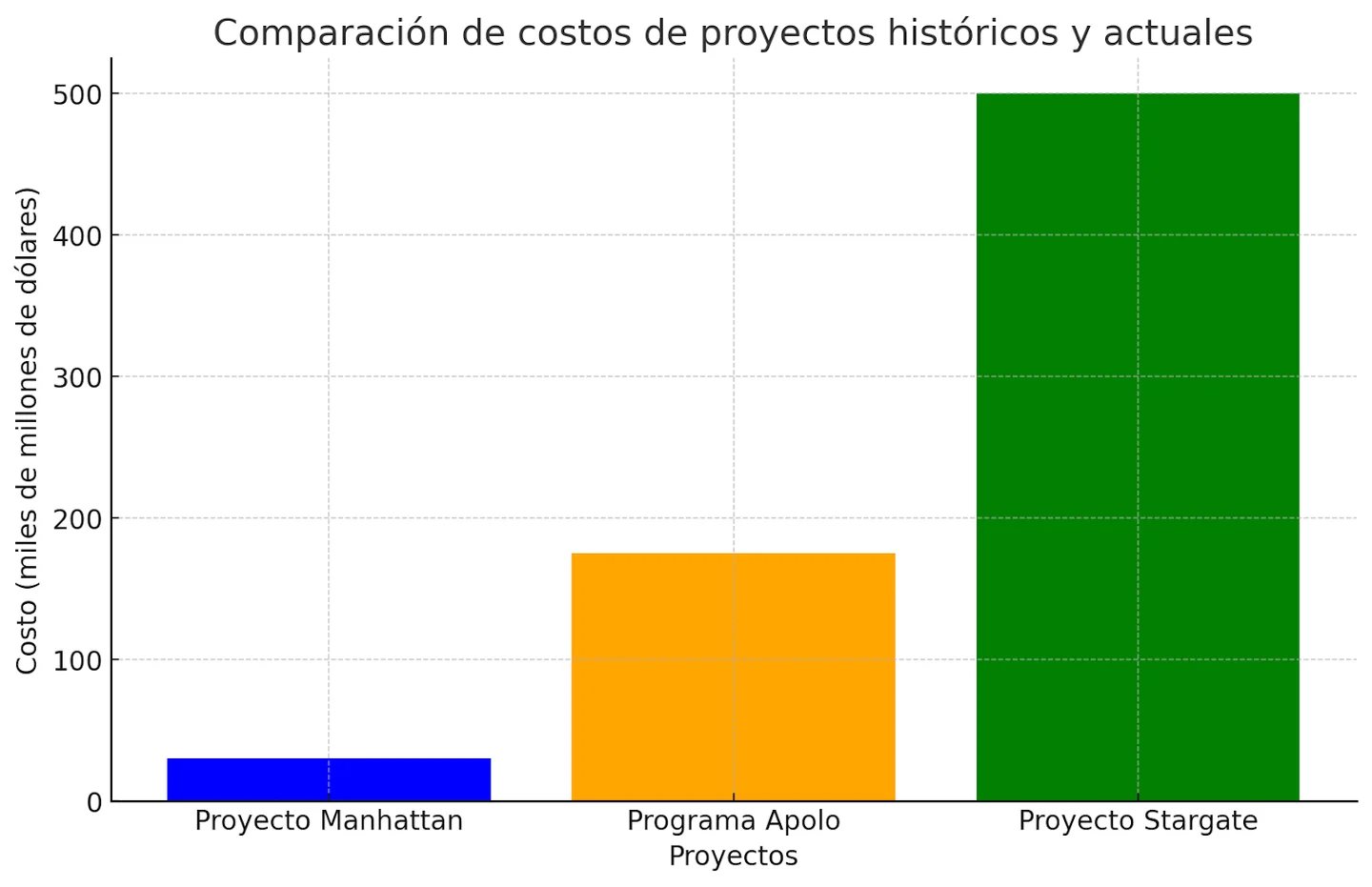
Original chart: “Comparison of the costs of historical and current projects”. Vertical axis: cost in billions of dollars; horizontal axis: projects. The bars show Manhattan at about $30 billion, Apollo at $175 billion and Stargate at $500 billion. These reproduce the article’s historical comparison and proposed Stargate budget, not a record of actual Stargate spending.
Beyond the figures, however, the differences are as revealing as the similarities. Manhattan and Apollo were wholly government-led projects, directed and financed by the federal state, with highly specific objectives and strong motivations of national security in Manhattan’s case and geopolitical prestige in Apollo’s. Stargate, by contrast, is a hybrid creature in which the private sector takes the financial and operational lead, with Washington’s blessing and political support. Where Manhattan and Apollo sought singular milestones — the atomic bomb and the Moon landing — Stargate aims to build a long-term ecosystem for AI innovation: foundational infrastructure for a future in which artificial intelligence permeates every aspect of the economy and society.
The impact of Manhattan and Apollo on humanity’s advancement is undeniable. The former, although born of wartime necessity, opened the nuclear age and laid the foundations for atomic energy and particle-physics research. The latter, driven by Cold War rivalry, not only took us to the Moon but catalysed advances in microelectronics, materials and telecommunications that we now take for granted. In its promise to unleash AI’s potential, Stargate belongs to this tradition of transformative projects. If successful, it could drive scientific discoveries in fields as diverse as medicine, energy and climate change, while revolutionising entire industries and creating new forms of interaction between humans and machines.
Texas: the new Silicon Valley — or just an oasis of servers?
Stargate’s physical heart will beat in Abilene, Texas, a choice that underscores the search for pragmatism in this megaproject. The availability of vast tracts of land, the growing strength of the Texan technology sector and access to reliable — though not necessarily clean — energy make the region a logical location for the colossal data centres Stargate plans to build. The creation of 100,000 jobs is projected, an attractive promise in a state seeking to diversify its economy beyond oil and cattle ranching. Yet turning Texas into a Silicon Valley of the South, as some dream of doing, is far from automatic. Stargate could be a catalyst, but it could also become an island of servers in the prairie unless accompanied by investment in education, talent and a wider innovation ecosystem.
Altman versus Musk: a heated conflict at the summit of AI
Only hours after the lavish Stargate announcement at the White House on Tuesday 21 January 2025, the fanfare had barely faded when Elon Musk fired the first salvo from his platform on X. “They simply don’t have the money,” Musk declared, undermining the megaproject’s financial credibility at a stroke. In a second message that same night, the xAI magnate was more specific: “SoftBank has considerably less than $10 billion secured.” Adding drama to his attack, Musk claimed to have this information “on good authority”, without revealing further details about his sources. The shock waves through social media and technology circles were immediate.
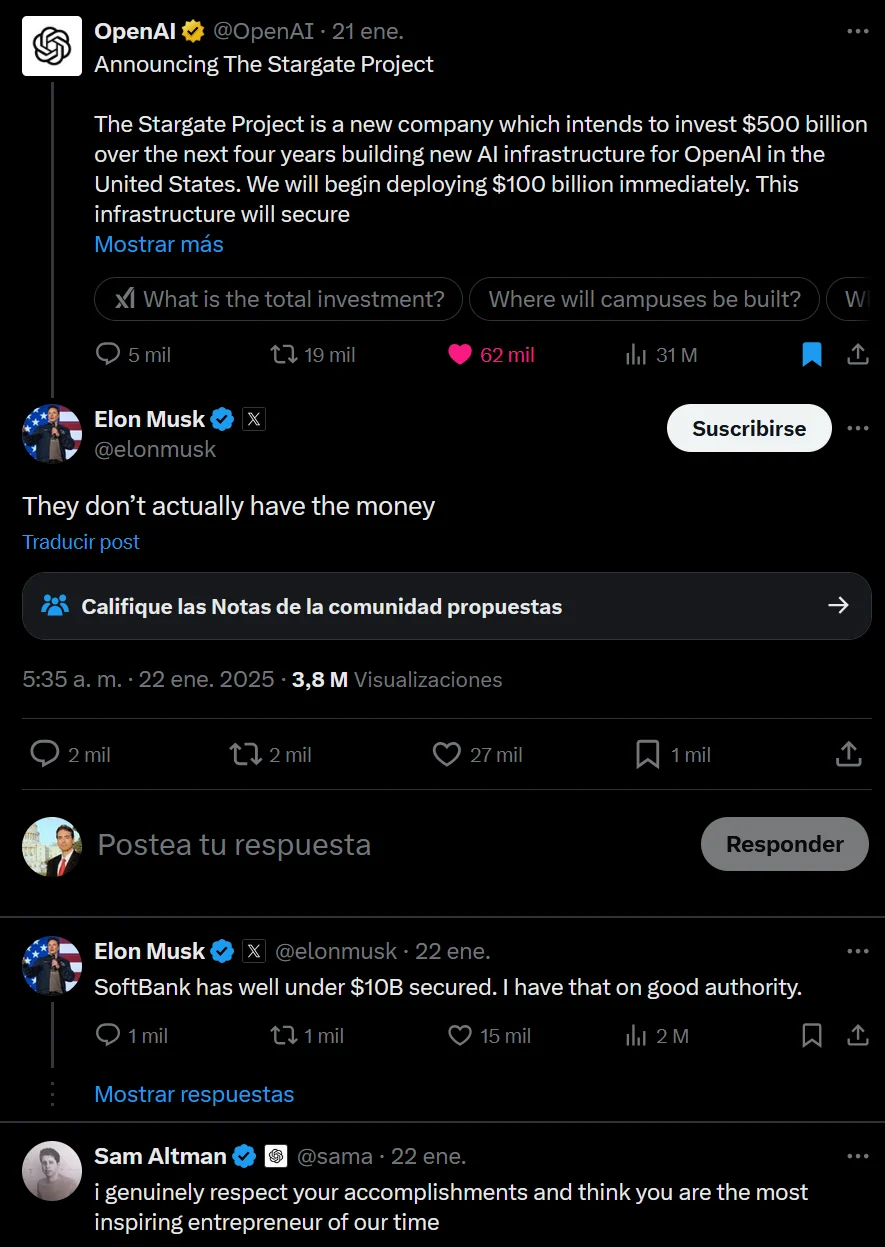
Text visible in the original screenshot, distinct from the translated narrative:
OpenAI, 21 January: Announcing The Stargate Project
The Stargate Project is a new company which intends to invest $500 billion over the next four years building new AI infrastructure for OpenAI in the United States. We will begin deploying $100 billion immediately. This infrastructure will secureThe announcement is truncated here by “Show more” in the screenshot.
Elon Musk: They don’t actually have the money
Elon Musk, 22 January: SoftBank has well under $10B secured. I have that on good authority.
Sam Altman, 22 January: i genuinely respect your accomplishments and think you are the most inspiring entrepreneur of our time
The last reply is cut off at the bottom of the image. The displayed timestamp for Musk’s first reply is 22 January 2025; the narrative describes the US announcement evening.
The response from Sam Altman, OpenAI’s CEO and a central figure in Stargate, was swift. The following day, Wednesday 22 January, Altman replied directly to Musk on X. “Incorrect, as you surely know,” he wrote, combining a direct rebuttal with a pointed suggestion about Musk’s inside knowledge. To challenge his rival further, Altman issued a public invitation: “Come and visit the first construction site,” daring Musk to see the project’s progress in Abilene, Texas, for himself. In a final message on this first day of public skirmishing, Altman added a double-edged remark: “This is great for the country. I realise that what is great for the country is not always optimal for your companies.” The implication was clear: the US national interest, represented by Stargate, might not coincide with Elon Musk’s business agenda and technological empire.
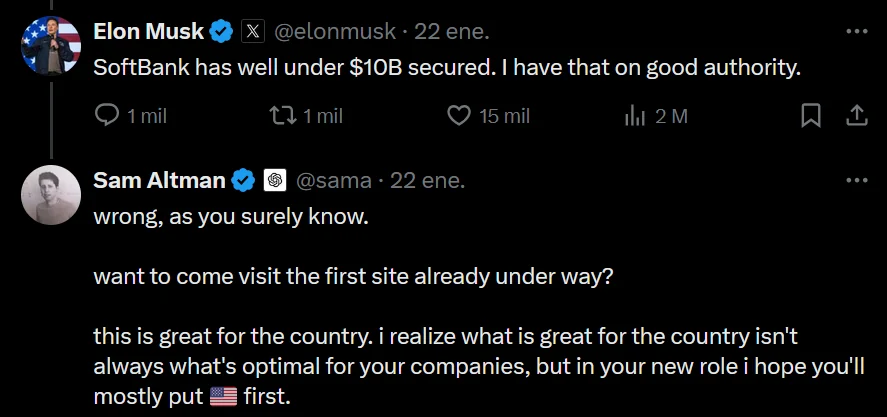
English text in the screenshot, dated 22 January:
Elon Musk: SoftBank has well under $10B secured. I have that on good authority.
Sam Altman: wrong, as you surely know.
want to come visit the first site already under way?
this is great for the country. i realize what is great for the country isn't always what's optimal for your companies, but in your new role i hope you'll mostly put 🇺🇸 first.
The war of words between the two AI titans had reached its peak, revealing not only a personal rivalry but a clash of visions over technology’s future and US leadership.
Trump plays down the Musk–Altman dispute and reveals a hidden motive: “Elon hates someone in the deal”
Faced with the media storm generated by the Altman–Musk confrontation, Trump soon stepped in to comment. True to form, he chose to minimise the importance of Musk’s criticism, playing it down and stressing the personal dimension of the conflict. “Musk’s criticism doesn’t bother me at all,” he declared with studied indifference. He then revealed a previously unknown element: “He hates one of the people in the deal.” With this blunt statement, Trump confirmed that personal animosity lay behind Musk’s position, though without identifying the Stargate participant who was the object of his aversion. Adding a final touch of intrigue, Trump disclosed that he had spoken to Musk after his initial posts, without offering details of that telephone conversation.
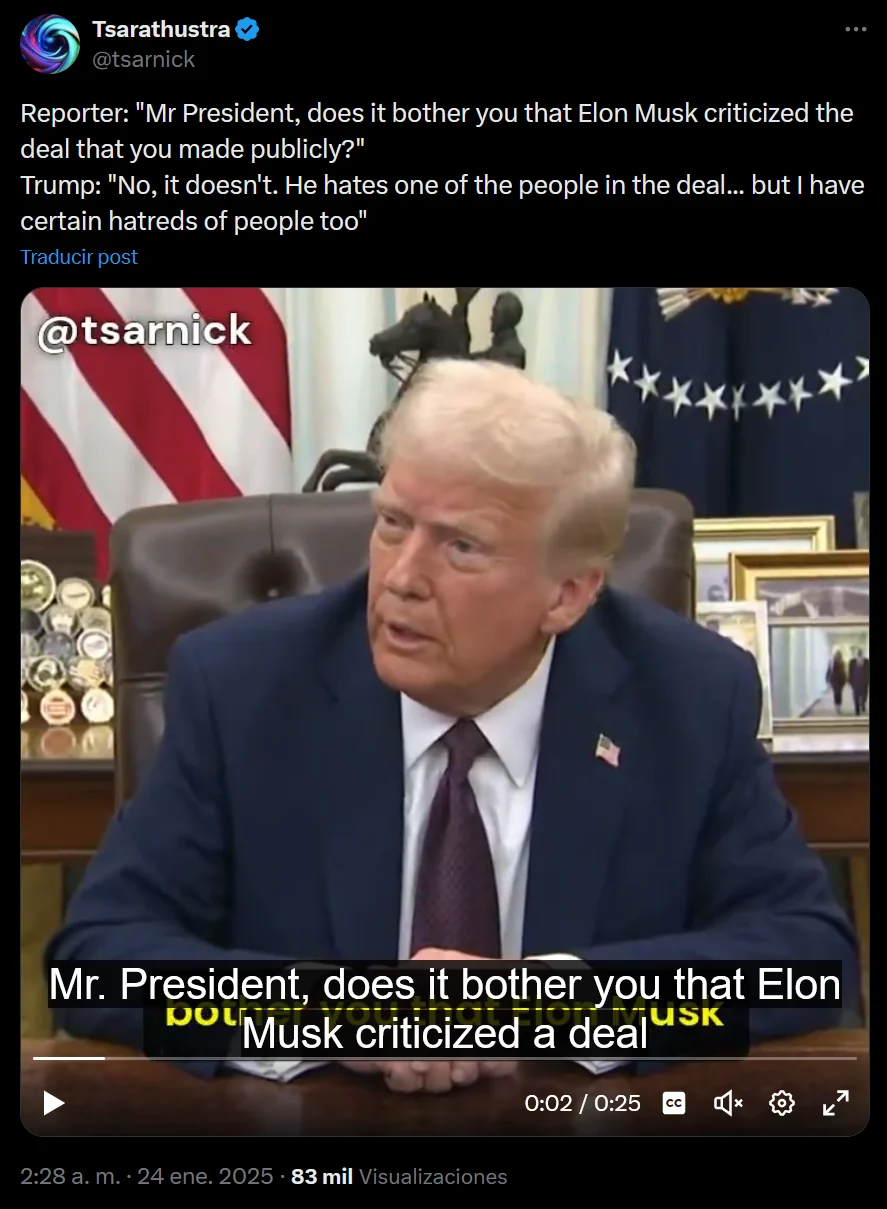
Text in the original post by Tsarathustra, dated 24 January 2025:
Reporter: “Mr President, does it bother you that Elon Musk criticized the deal that you made publicly?”
Trump: “No, it doesn't. He hates one of the people in the deal... but I have certain hatreds of people too”
The retained image is a video still, not a playable local video; the image links to the original post.
Trump’s remarks added another layer of complexity to Stargate’s already intricate landscape. By presenting personal “hatred” as the driver of Musk’s criticism, Trump sought to divert attention from the financial or strategic doubts raised by xAI’s founder, reducing the conflict to a personal dispute. Yet his revelation also fuelled speculation about the identity of the “hated” individual and possible hidden grievances or rivalries within Stargate. In any event, Trump’s intervention made clear that the Altman–Musk controversy was no mere flash in the pan, but a central element in the narrative and the challenges this ambitious project will face on the path to becoming reality.
A gateway to the future or a multibillion-dollar waste?
Project Stargate stands as a bold wager, an attempt to replicate the audacity and vision of projects such as Manhattan and Apollo in the digital age. Its transformative potential is immense, but so are its challenges. Securing the promised funding, overcoming competitive tensions — this very week we have seen the stock-market disruption caused by a model such as DeepSeek R1, discussed in the original newsletter’s practical section — managing the ethical and social implications of large-scale AI, and navigating political turbulence are formidable obstacles.
If Stargate overcomes them, it could consolidate US leadership in AI, drive a new cycle of economic growth and open up scientific and technological possibilities hitherto unimaginable. But if it fails, it could become a monument to overconfidence and strategic short-sightedness, a reminder that even the most ambitious projects can founder without rigorous management, vision and a sense of global responsibility. The future of AI — and perhaps the future of US technological hegemony — hangs in the balance in this half-trillion-dollar experiment called Stargate.
Fernando Nieto Lobato
Director of Digital Innovation, Institución Educativa ALEPH
PS. For readers seeking a more detailed analysis of the project’s technical characteristics, these two links offer interesting additional information:
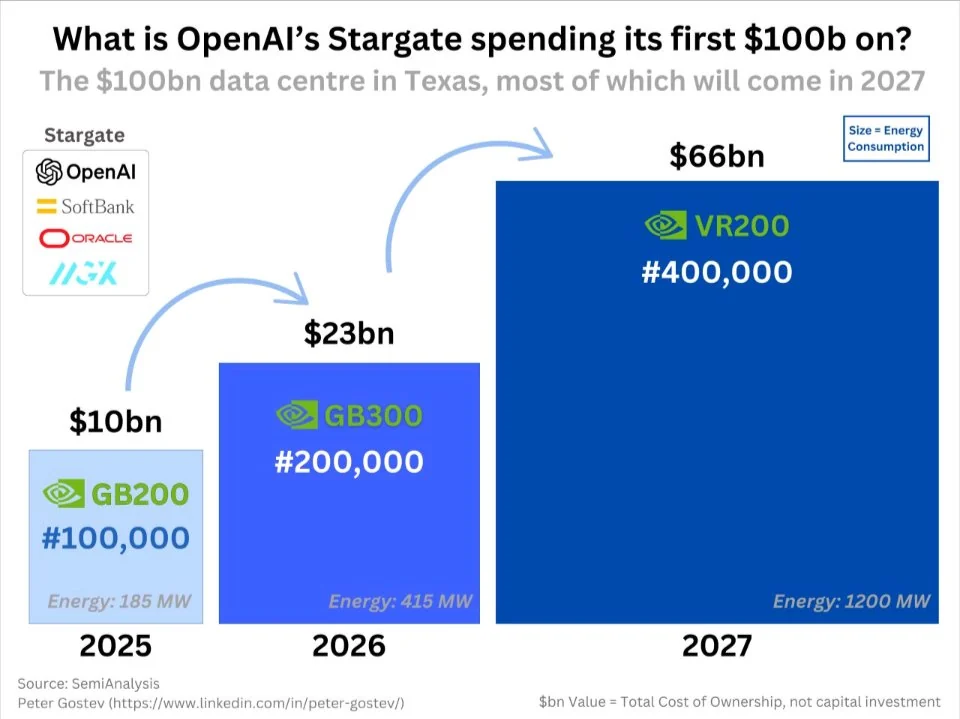
Data transcribed from the original infographic, “What is OpenAI’s Stargate spending its first $100b on?” Its subtitle describes a $100bn data centre in Texas, most of which would come in 2027. These are the graphic’s historical projections.
Scroll across the table to read all columns.
| Year | Hardware label in the graphic | Quantity shown | Cost shown | Energy figure shown |
|---|---|---|---|---|
| 2025 | GB200 | 100,000 | $10bn | 185 MW |
| 2026 | GB300 | 200,000 | $23bn | 415 MW |
| 2027 | VR200 | 400,000 | $66bn | 1,200 MW |
The graphic labels OpenAI, SoftBank, Oracle and MGX as Stargate participants. It states that box size represents energy consumption and that dollar values represent total cost of ownership, not capital investment. Credit printed on the image: SemiAnalysis; Peter Gostev (https://www.linkedin.com/in/peter-gostev/).
https://semianalysis.com/2025/01/23/openai-stargate-joint-venture-demystified/
https://www.linkedin.com/feed/update/urn:li:activity:7288311506138464256/
Cite this essay
Fernando Nieto Lobato. “Stargate: $500 billion for AI — the most ambitious technology project in history?.” estrategIA, issue 070, 29 January 2025. English edition, 29 September 2026. https://elcontemplador.github.io/estrategia-english/essays/070/