“AI solves in two days a superbug problem that took scientists years.”
Translation note: the headline and José R. Penadés quotations below are translated from the Spanish wording in the original article; their published English wording has not been independently verified.
That BBC story, dated 20 February (also available in Spanish here), has shaken the scientific world in recent days because of the potential it reveals. In barely two days, artificial intelligence solved a mystery about superbugs that had consumed a decade of human effort at Imperial College London. This is no isolated achievement: AI has been producing excellent results in science for some time. But it was the latest spark that prompted this newsletter. At a time when humanity faces colossal challenges, from antibiotic resistance to climate change, AI is emerging as the catalyst for an unprecedented scientific revolution. It is time to shine a brighter light, including from modest publications such as estrategIA, on how this technology is redefining the pace and scale of discovery, transforming science from a measured discipline into an agile, exponential force—a transformation that politics and government must take into account.
Imperial College's milestone: a decade compressed into 48 hours thanks to Co-scientist
For anyone who did not pause to click through and read the story, for more than ten years the Imperial College team led by Professor José R. Penadés investigated how superbugs develop resistance to antibiotics. Their theory, still in the process of publication, proposed that these bacteria form a kind of “tail” from fragments of viruses, allowing them to jump between species as though they had biological master keys. It was arduous work: a jigsaw of experiments and patiently accumulated data. Then AI entered the picture. In just 48 hours, a new tool not only confirmed the hypothesis but offered four additional ideas, all scientifically plausible.
Penadés's reaction was as visceral as it was revealing. Stunned while out shopping, he asked for a moment alone to take in what had happened. In an email to Google, he asked, half jokingly: “You have access to my computer, is that right?” The answer was an emphatic no. “It is not just that the main hypothesis was correct,” Penadés explained to the BBC, “but that they gave us four others, and all of them made sense. One had never occurred to us, and we are now working on it.”
This Imperial College breakthrough was made possible by Co-scientist, a new Google AI tool based on the Gemini 2.0 system. Designed as a research companion, Co-scientist allows scientists to accelerate the creative and analytical process. Researchers can give it a goal in natural language—for example, understanding bacterial resistance—and the AI responds with testable hypotheses, a summary of relevant literature and a possible experimental plan. Its strength lies in a multi-agent system that emulates the scientific method: it generates ideas, refines them and grounds them in data from scientific databases. In the superbug case, it not only replicated a decade of work but opened unexpected paths, showing that AI can be more than a tool: it can be a “muse”.
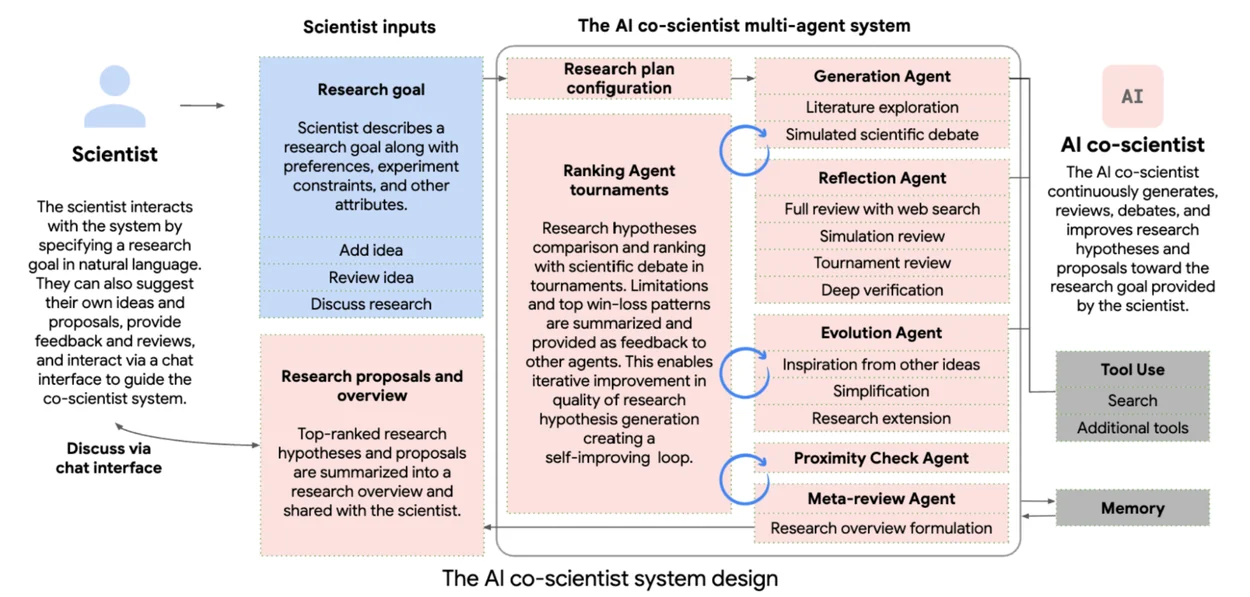
Accessible transcription of the diagram's original English text, “The AI co-scientist system design”:
- Scientist: “The scientist interacts with the system by specifying a research goal in natural language. They can also suggest their own ideas and proposals, provide feedback and reviews, and interact via a chat interface to guide the co-scientist system.” The return channel is labelled “Discuss via chat interface”.
- Scientist inputs — Research goal: “Scientist describes a research goal along with preferences, experiment constraints, and other attributes.” Other inputs: “Add idea”, “Review idea”, “Discuss research”.
- Research proposals and overview: “Top-ranked research hypotheses and proposals are summarized into a research overview and shared with the scientist.”
- The AI co-scientist multi-agent system: “Research plan configuration”; “Ranking Agent tournaments”; “Generation Agent” with “Literature exploration” and “Simulated scientific debate”; “Reflection Agent” with “Full review with web search”, “Simulation review”, “Tournament review” and “Deep verification”; “Evolution Agent” with “Inspiration from other ideas”, “Simplification” and “Research extension”; “Proximity Check Agent”; “Meta-review Agent” with “Research overview formulation”.
- Ranking Agent tournaments: “Research hypotheses comparison and ranking with scientific debate in tournaments. Limitations and top win-loss patterns are summarized and provided as feedback to other agents. This enables iterative improvement in quality of research hypothesis generation creating a self-improving loop.”
- AI co-scientist: “The AI co-scientist continuously generates, reviews, debates, and improves research hypotheses and proposals toward the research goal provided by the scientist.”
- Tool Use: “Search”, “Additional tools”. The system also connects to “Memory”.
AI on the scientific podium: from the Nobel Prize to new horizons
AI's impact on science extends far beyond this case. In 2024, as we reported, the Nobel Prize in Chemistry recognised the creators of AlphaFold, a system from Google-owned DeepMind that solved a 50-year-old problem: predicting the three-dimensional structure of proteins. Used by 2.5 million researchers in 190 countries, AlphaFold has accelerated progress in biomedicine and drug design, becoming a pillar of modern science. Nor do the examples stop there: recent years have already brought highly notable models such as ClimateNet and GNoME. They show how AI is compressing years of work into months, or even days, redefining what is possible. What is most fascinating is that every week—I would almost say every day—we come across news of AI accelerating scientific discovery. Consider these examples:
- 20 February: MIT presents FragFold, an AI system that predicts protein fragments capable of binding to or inhibiting key proteins, opening new possibilities for research and therapeutic applications.
- 21 February, published in Science: Mal-ID, a machine-learning system, analyses B- and T-cell immune receptors to predict disease, distinguishing between healthy individuals, people with viral infections or autoimmune diseases, and those vaccinated against influenza.
- 24 February: NuFold, a computational solution for modelling RNA structures in 3D that could accelerate medical discoveries by decades.
Open questions: politics faces exponential science
Faced with the unprecedented acceleration of AI-driven research, crucial questions arise that demand political answers:
- How will we ensure that AI regulation does not hold back its innovative potential, while also ensuring that these technologies are used ethically and safely?
- How will governments guarantee equitable access to these transformative technologies, preventing only the best-resourced nations or institutions from dominating advances?
- Are education systems ready to train a new generation of scientists to work alongside tools such as Co-scientist? And how will the impact on employment be mitigated if AI automates tasks that previously required years of human effort?
- How will transparency be promoted in the development and use of AI tools, preventing technological power from becoming concentrated in the hands of a few actors?
- Are governments ready to update regulatory and R&D investment frameworks, adapting to an era in which the speed of discovery redefines the public agenda?
These questions, and the many new ones that will arise, invite deep reflection on the role of governments in managing an AI-driven scientific revolution in which innovation must go hand in hand with ethics, equity and transparency. They demand not just answers but a bold political vision that balances a determined drive for innovation with responsibility, ensuring that the benefits of AI in science reach all humanity.
Fernando Nieto Lobato
Director of Digital Innovation at the ALEPH Educational Institution
Cite this essay
Fernando Nieto Lobato. “Exponential innovation: how AI is redefining science and challenging those who govern.” estrategIA, issue 074, 26 February 2025. English edition, 29 September 2026. https://elcontemplador.github.io/estrategia-english/essays/074/