As you know, our recommendation of the week in the last issue of estrategIA was a stimulating video conversation between Jon Hernández and José María Lassalle. Following that recommendation, and thinking particularly of those who enjoyed it as much as we did and wanted to explore the excellent questions it raised more deeply, I have spent the past few days reading Lassalle's latest book, Civilización artificial, or Artificial Civilisation. Here is a short review that might also whet your reading appetite.
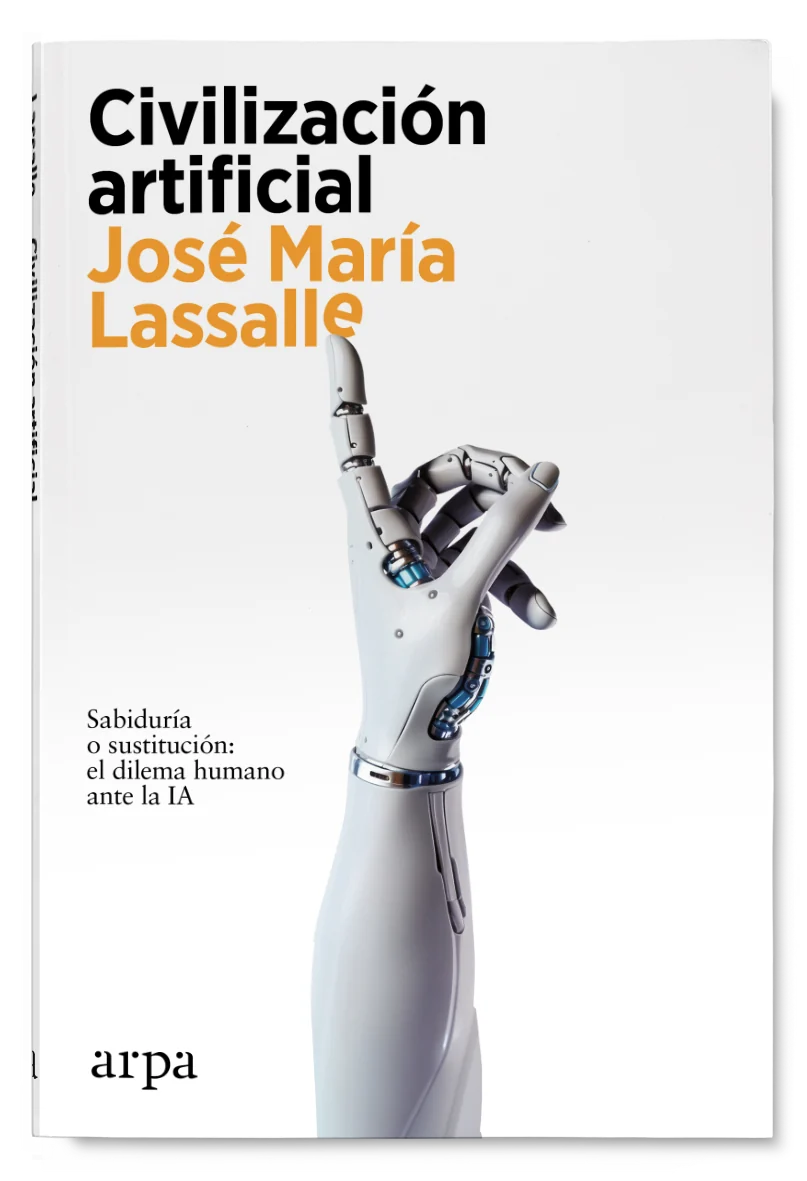
The original Spanish cover reads “Civilización artificial”, by José María Lassalle, published by Arpa. The title and subtitle translate as “Artificial civilisation: wisdom or replacement—the human dilemma in the face of AI”. These are translations for this review, not a claim that an English edition exists.
Unlike many other books we have examined in estrategIA, this is neither a practical manual nor a conventional technological manifesto. It is a deep philosophical and political immersion in the AI tsunami that is already soaking us to the bone.
Lassalle, wearing the twin hats of a former Secretary of State for the Information Society and the Digital Agenda—and, before that, Secretary of State for Culture—and a seasoned scholar, offers a privileged perspective. His high-level political career, combined with a solid academic grounding, makes him an exceptional observer of this silent but seismic revolution.
Before delving into the core of his argument, I would offer two preliminary observations that I consider important.
First, “Artificial Civilisation” is not light reading. Prepare for a dense book, a veritable intellectual banquet featuring more than 30 philosophers and thinkers, from the Greek classics to major contemporary minds. It demands attention and reflection, but amply rewards the patient reader willing to navigate its pages. Paradoxically, however, this depth is also one of its strengths, offering a robust conceptual framework for understanding the magnitude of the change we are living through.
Second—and this is perhaps our principal reservation—we wholeheartedly agree with the constructive disagreement Jon Hernández raised in the interview: timing. The book, published in April 2024 and probably written the previous year, may err towards a certain “slowness” in its chronology. At that time, some academic circles still placed strong artificial intelligence on a horizon two decades away, and certain additional biases concerning the potential “danger of AI” were more pronounced. The reality, as events in recent months have shown with dizzying speed, is that acceleration is the norm. Even within “academia”, forecasts for the arrival of artificial general intelligence or even superintelligence have been brought forward dramatically, to the end of this decade or the beginning of the next at the latest. Another question, given the complexity of the terminology, is whether Lassalle means only AI with consciousness similar to ours when he refers to strong AI. That is very difficult to place on a timeline, and might not even occur as such in the coming decades. AI with capabilities superior to ours will not be knocking on the door in twenty years: it is already sitting on the sofa, beginning to redesign the house as it pleases. This temporal urgency, which the book perhaps does not emphasise as forcefully as current events warrant, in no way invalidates its analysis. But it does require us to read with a stopwatch in hand, aware that the future it describes is converging on us at breakneck speed.
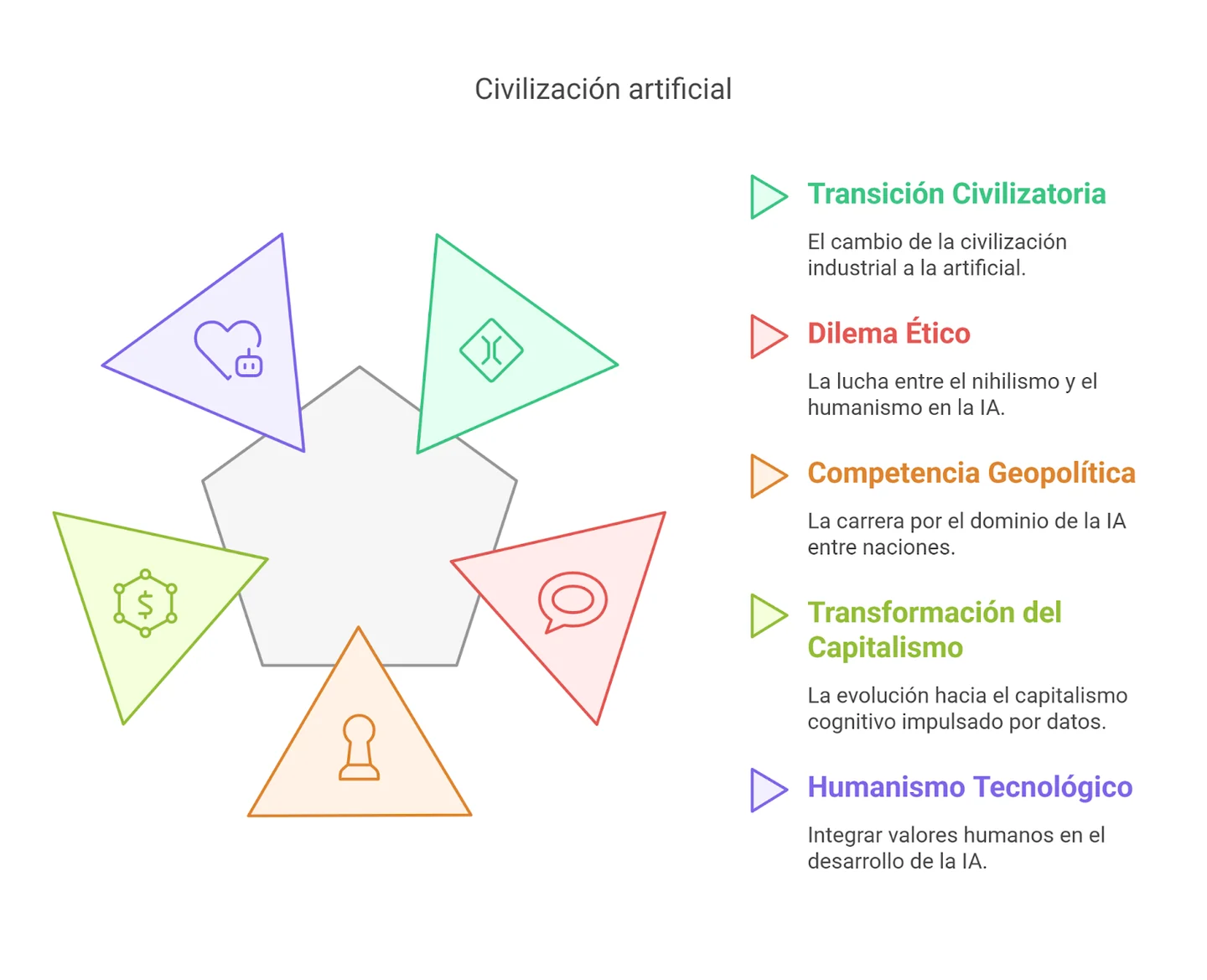
Full translation of the infographic, “Artificial civilisation”:
- Civilisational transition: the shift from industrial to artificial civilisation.
- Ethical dilemma: the struggle between nihilism and humanism in AI.
- Geopolitical competition: the race between nations for dominance in AI.
- The transformation of capitalism: the move towards data-driven cognitive capitalism.
- Technological humanism: integrating human values into AI development.
With those considerations addressed, Artificial Civilisation unfolds a fascinating conceptual map for understanding the age of the thinking machine. To avoid overwhelming you with the nuances of its philosophical depth, we can distil the book's central ideas, which set its course from chapter to chapter, into the following key points.
1. The advent of artificial civilisation
Lassalle argues that we are witnessing a civilisational transition of historic proportions, comparable to the Neolithic Revolution, the invention of the printing press or the Industrial Revolution. AI is not merely another tool but the catalyst for a new paradigm: an “artificial civilisation” that redefines the coordinates of our existence. This new era marks the twilight of the industrial and liberal civilisation born of the Enlightenment, replaced by an ecosystem in which artificial intelligence becomes the foundational infrastructure of society, the economy and politics.
2. AI's Faustian dilemma: humanism versus technological nihilism
At the heart of the book lies a fundamental ethical question: should AI develop without restriction, autonomously maximising its capabilities and power, or should it be subordinated to a higher human purpose? Lassalle places us before a “Faustian dilemma”, a crossroads at which we must choose between nihilistic AI, driven solely by efficiency and technical progress without an ethical horizon, and humanistic AI serving humanity's overall well-being. The drift towards nihilism, he warns, leads us towards an “AI-cracy” in which machines, devoid of wisdom and transcendent purpose, could displace human beings as the axis of existence, creating a profound crisis of existence and meaning.
3. The geopolitics of AI: the struggle for hegemony in the algorithmic age
AI development is not a neutral process; it is intrinsically bound to geopolitical competition between the great powers, principally the United States and China. Lassalle describes a “race for hegemony” in which both countries seek to lead AI innovation to gain military, economic and political advantages. Given its publication date, the book naturally does not incorporate the new parameters Trump adds to the equation, but it sets out a general framework that does not seem to have changed very much.
This competition, lacking a global ethical framework and fuelled by the logic of power, accelerates AI development while increasing the risks of global fragmentation and potential conflict, particularly in autonomous weapons. On this global chessboard, Europe seeks a difficult balance, trying to position itself through a model that prioritises ethics and regulation. Its ability to influence this dynamic without missing the train to the future remains uncertain, all the more so following Trump's victory. Yet, both in the book and in the interview, Lassalle advocates a “European path” towards AGI that we at estrategIA fully share: one that, without anchoring us in the past and while firmly embracing all the good this technology brings, projects a new humanism rooted in Europe's intellectual tradition into the emerging civilisation.
4. The transformation of capitalism and the future of work
AI transforms not only politics and society but also the foundations of capitalism. Lassalle explains how artificial intelligence, together with earlier developments such as the internet and its platform economy, is turning industrial capitalism into “cognitive capitalism”, in which data and algorithms become the new factors of production. This transformation radically changes the nature of work, replacing intellectual and creative tasks previously regarded as the exclusive preserve of human beings. The result is a potential destabilisation of the welfare state and liberal democracy, with the risk of growing social inequality and erosion of the middle classes, traditionally the foundation of social peace.
In this context, the author presents basic income as an interesting tool, perhaps inevitable and necessary but insufficient, in a scenario where AI radically redefines the concepts of value and social participation. Implementing it would require rethinking distributive justice in a world where algorithmic capital replaces human labour as the primary source of wealth.
5. The need for technological humanism
Faced with the risks of uncontrolled and potentially dehumanising AI, Lassalle advocates a “technological humanism” that places artificial intelligence at the service of human well-being and dignity. This technological humanism means recovering the concept of wisdom, understood as a higher level of understanding that transcends mere specialist knowledge and is connected to purpose, meaning and transcendence. Human wisdom, grounded in experience, reflection and awareness of our own limitations, must guide AI's development and governance, preventing the purely rational, efficient logic of machines from stripping us of our humanity. This new humanism means subordinating AI to transcendent ends, regulating its development through global ethical standards—certainly without paralysing or obstructing it—and rejecting the utopia of machine perfection, embracing imperfection and vulnerability as essential features of the human condition.
I think a good way to conclude this review of a work whose value lies far more in how it invites us to think about the existential issues AI brings than in giving clear answers to questions we cannot yet define is to put the following question directly to you. Lassalle asks it towards the end of his introduction, and it neatly encapsulates the central dilemma posed by the arrival of this new artificial civilisation waiting just around the corner:
Do we want to prevent the imposition of a technological nihilism that maximises AI's will to power as its own apotheosis? Or do we wish to offer a human alternative that places AI's power at the service of a higher purpose, allowing us to evolve from the Homo digitalis we are into the Homo deus we could become?
Translation note: the closing quotation is translated from the Spanish excerpt reproduced in the original article, not from a verified English edition.
Fernando Nieto Lobato
Director of Digital Innovation at the ALEPH Educational Institution
Cite this essay
Fernando Nieto Lobato. “The age of thinking machines: navigating Lassalle's “Artificial Civilisation”.” estrategIA, issue 077, 19 March 2025. English edition, 29 September 2026. https://elcontemplador.github.io/estrategia-english/essays/077/