Archive note: published on 30 April 2025. Forecasts, robot specifications and policy references retain that date’s perspective. The quotation attributed to Marina Bill is translated from the Spanish source; its original English wording has not been verified.
From steam to silicon: why we are talking about robots — and AI — today
Tomorrow is 1 May, International Workers’ Day, a date born amid the clamour of nineteenth-century factories to demand an eight-hour working day. Almost a century and a half later, the very concept of work is beginning to enter a new phase. We are at another technological crossroads: the emergence of AI and a new generation of intelligent robots. Their true muscle is not just metal, but the advanced artificial intelligence — including generative approaches — that enables them to understand natural-language instructions, move nimbly on two legs and, most disruptively, learn complex tasks in a matter of hours, often training in hyperrealistic AI-generated simulations before interacting with the physical environment. This fusion of AI and robotics is what radically distinguishes the new humanoids and cobots — collaborative robots designed to work alongside humans in a shared environment — from their predecessors.
Publishing this analysis today, on the eve of International Workers’ Day, is an urgent invitation to reflect on the nature of the work ahead of us. Following AI’s initial disruption of intellectual or “office” jobs, already under way, we can see another, equally powerful disruption reaching other kinds of employment within a few years as new generations of robots become widespread.
A silent tsunami: the scale of the phenomenon
Robotisation, as a general concept, is not merely a future promise: it is a reality accelerating at an unprecedented pace. The latest World Robotics (2024) report from the International Federation of Robotics (IFR) puts the number of operational industrial robots at 4.28 million worldwide, up 10% on the previous year. New installations have exceeded half a million a year for three consecutive years. Although Asia remains the epicentre, accounting for 70% of new installations, Europe, at 17%, and the Americas, at 10%, are also breaking their own records. “We have never seen such a rapid pace of adoption,” said IFR president Marina Bill. The robotic tide, driven by AI, is rising — and fast.
Snapshots of a future already here: recent examples
What distinguishes this new generation of robots is not just their number, but their intelligence and versatility. They are no longer merely mechanical arms inside cages. Let us look at several recent examples illustrating different aspects of this qualitative leap. Although this is by no means a systematic selection, we believe, dear readers, that seeing these prototypes in action can often be worth a thousand words:
Archive media note: the Spanish article refers to demonstration videos that are not preserved as playable media or linked assets in the local source. No missing video destinations have been reconstructed.
-
The humanoid arrives in the warehouse: recently, Digit, Agility Robotics’ bipedal robot, began working shoulder to shoulder with human operators in logistics centres belonging to giants such as Amazon. Handling containers weighing up to 16 kg, this scaled pilot marks humanoids’ entry into logistics, fertile ground for automating repetitive tasks.
-
And it reaches the factory too: as can already be seen in this BMW video from just three weeks ago, humanoid robots are being integrated into vehicle assembly lines. The example also shows how striking technological advances in this field can be over just a few months.
-
Robots that replicate themselves: in February, Apptronik announced an agreement with Jabil for its humanoid, Apollo, to take part in the assembly line. What is new? Among the parts it will assemble will be those of other Apollo robots. This milestone points not only to a drastic reduction in costs, but also to the emergence of general-purpose robots capable of adapting to different manufacturing tasks, including making their own “species”.
-
Mastering fine dexterity: the last human stronghold? Delicate manipulation. Sanctuary AI challenged it in March by unveiling the seventh generation of its Phoenix robot, demonstrating how advanced tactile sensors and sophisticated multimodal AI models, capable of rapid learning, allow a task to be mastered in less than 24 hours. The barrier of manual dexterity is beginning to crack.
-
A robot half-marathon in Beijing: at an event held on 19 April 2025, 21 humanoid robots joined 12,000 human runners in the Beijing half-marathon, marking the first time bipedal machines had competed in a 21-kilometre race. Developed by companies such as Noetix Robotics and DroidVP, the robots varied in size and design. Although many encountered difficulties such as falls and overheating, six completed the course. The standout was Tiangong Ultra, from the Beijing Humanoid Robot Innovation Centre, which finished in 2 hours and 40 minutes thanks to its optimised design and an advanced algorithm imitating the human stride. Although most required constant human assistance, the event symbolises a significant advance in integrating AI and robotics into complex human activities, revealing both the progress achieved and the remaining challenges in humanoid robots’ autonomy and adaptability.
The employment equation: destruction, creation and adaptation
These examples are not mere anecdotes. They are the spearhead of a profound transformation. The robots already being developed, equipped with computer vision, natural-language processing and autonomous planning, are beginning to possess a “cognitive” capacity driven by the latest AI advances — from computer vision to language processing and reinforcement learning — that greatly expands the range of tasks that can be automated. Debate about their impact on employment is intense and polarised, with often conflicting views:
-
The scale: the IMF warns that 40% of jobs worldwide (and up to 60% in advanced economies) contain tasks susceptible to full or partial automation by AI and advanced robotics in the coming years.
-
The net balance: however, the World Economic Forum projects that, although 92 million jobs will be displaced by 2030, 170 million will be created in new occupational categories, from robot maintenance technicians and AI programmers to digital twin designers and robotics ethics specialists.
Forecasting is extraordinarily difficult at a time of such rapid change, but many experts suggest that employment automation will follow a two-stage pattern: first, generative AI and agent systems will multiply productivity in intellectual and office tasks; a few years later, we will see more extensive robotisation of physical work, because the need to manufacture the machines physically creates significant bottlenecks for mass global adoption. When agile, low-cost, general-purpose robots become widespread in factories, warehouses and services, many manual functions will require only minimal supervisory teams. Although new occupations will emerge around the design, maintenance and ethical governance of these technologies, their rate of creation will struggle to offset, in the short and medium term, the net destruction of traditional jobs brought about by this twin productivity boost. The real challenge will be less about slowing technical progress than managing a transition that, without agile policies for redistribution, new skills training and social protection, could lead to structural unemployment and ever-deeper inequalities.
Towards 2030–2035: five key trends to watch
The current pace of robotics development, combined with AI, suggests acceleration over the next five years. Five trends could set the direction:
Mass deployment of humanoids: China’s ambitious plan to establish a complete supply chain for bipedal robots in 2025 and integrate them deeply into its economy by 2027 will push prices down and accelerate global adoption.
Cobots for everyone: falling sensor prices and easier programming, even by voice, will mean collaborative robots cease to be the exclusive preserve of large corporations and reach small and medium-sized businesses, becoming as commonplace as 3D printers are today.
Deep AI–robotics convergence and generative training: generative AI, driven by Nvidia, OpenAI, Google and others, not only strengthens robots’ “brains” but revolutionises their training. It is used to create vast simulations in which robots learn complex skills, such as fine manipulation or bipedal navigation, before deployment. These foundation models for robotics will also make it possible to transfer skills almost effortlessly between different robot body types, creating far more versatile physical agents.
New capital–labour dynamics: when an advanced robot costs less than the average annual salary in a developed country, capital–labour elasticity will increase. This could intensify downward pressure on wages for tasks that machines can easily replicate.
Proactive regulation: the entry into force of rules such as the European AI Act will classify many workplace robots as high-risk systems. This will require safety audits, impact assessments and greater algorithmic transparency before they can be marketed.
Navigating the transition: towards a robotic social pact
To ensure that the promise of a “robotic dividend” over the coming decades — higher productivity and freedom from arduous tasks — does not widen the social divide, action on several fronts is surely crucial, as various international organisations recommend:
Radical lifelong learning: strong tax incentives for companies investing in reskilling and upskilling, and agile micro-credential systems that allow workers to acquire new skills quickly.
Adaptive safety nets: modernise social protection through sectoral transition funds, perhaps financed by a tax on extreme automation or the resulting profits, to support workers during retraining.
Shared algorithmic governance: encourage trade union and worker participation in overseeing algorithms that manage shifts, allocate tasks, assess performance or even contribute to dismissal decisions.
Ethics and safety by design: require safe-by-design principles for robots that physically interact with humans, and explainability obligations for those making autonomous decisions with a significant impact.
Conclusions
Robots that load pallets at Amazon, assemble themselves or run half-marathons are no longer science fiction: they are at the forefront of the present and foreshadow a qualitative shift in the relationship between humans and machines at work. History teaches us that societies prosper by embracing innovation while investing in their human capital and robust safety nets.
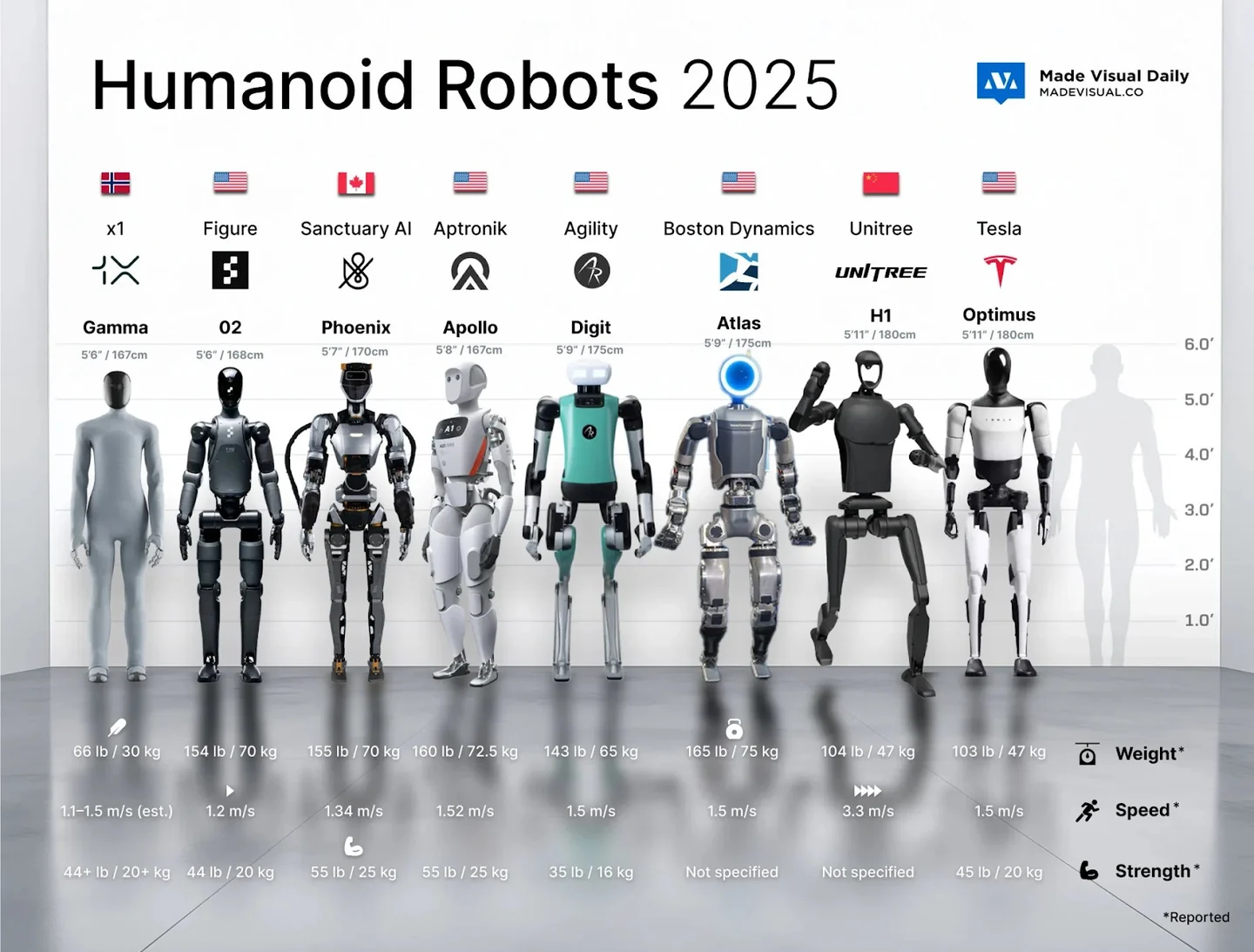
Transcription of the original English graphic, “Humanoid Robots 2025”, credited to Made Visual Daily, MADEVISUAL.CO. Country flags, manufacturer and model labels, and all reported specifications are preserved below. The graphic marks weight, speed and strength with an asterisk meaning “Reported”; its height scale runs from 1 to 6 feet. Spellings and imperial/metric inconsistencies are retained as printed, including “x1”, “Aptronik” and Apollo’s height.
Scroll across the table to read all columns.
| Manufacturer shown | Flag | Model | Height shown | Weight reported | Speed reported | Strength reported |
|---|---|---|---|---|---|---|
| x1 | Norway | Gamma | 5′6″ / 167 cm | 66 lb / 30 kg | 1.1–1.5 m/s (estimated) | 44+ lb / 20+ kg |
| Figure | United States | 02 | 5′6″ / 168 cm | 154 lb / 70 kg | 1.2 m/s | 44 lb / 20 kg |
| Sanctuary AI | Canada | Phoenix | 5′7″ / 170 cm | 155 lb / 70 kg | 1.34 m/s | 55 lb / 25 kg |
| Aptronik | United States | Apollo | 5′8″ / 167 cm | 160 lb / 72.5 kg | 1.52 m/s | 55 lb / 25 kg |
| Agility | United States | Digit | 5′9″ / 175 cm | 143 lb / 65 kg | 1.5 m/s | 35 lb / 16 kg |
| Boston Dynamics | United States | Atlas | 5′9″ / 175 cm | 165 lb / 75 kg | 1.5 m/s | Not specified |
| Unitree | China | H1 | 5′11″ / 180 cm | 104 lb / 47 kg | 3.3 m/s | Not specified |
| Tesla | United States | Optimus | 5′11″ / 180 cm | 103 lb / 47 kg | 1.5 m/s | 45 lb / 20 kg |
Over the next five, ten or fifteen years, these intelligent robots will move beyond headlines and laboratories into everyday life: hospitals, workshops, building sites, small logistics businesses and probably even our homes. The key question is not whether they will arrive, but when and, above all, how we will collectively manage their impact.
On this eve of Workers’ Day, the best way to honour past struggles is not to fear machines, but to prepare ourselves to think actively about our place alongside them. The aim is for artificial muscle to free us from the tedious and dangerous, boost productivity and generate resources to invest more in what is distinctly human: creativity, care, strategy and, yes, leisure too.
Director of Digital Innovation at Institución Educativa ALEPH
Cite this essay
Fernando Nieto Lobato. “The dawn of artificial muscle: how a new wave of intelligent robots could redraw the employment map.” estrategIA, issue 083, 30 April 2025. English edition, 29 September 2026. https://elcontemplador.github.io/estrategia-english/essays/083/