Translation note: quotations from Adela Cortina below are translated from the Spanish article. English renderings of the book’s title and subtitle are explanatory, not the titles of a verified English-language edition.
Almost every week, we encounter grandiose promises and predictions, often expressed boastfully, by technology gurus and magnates. In the face of this hubris — the ancient excess the Greeks associated with the arrogance of those who believed themselves above fate — Adela Cortina, Professor of Ethics and Political Philosophy at the University of Valencia and a member of Spain’s Royal Academy of Moral and Political Sciences, offers a critical, prudent and wise perspective that helps us look beyond the dizzying spiral of technological innovations and impacts. In her book ¿Ética o ideología de la inteligencia artificial? — “Ethics or ideology of artificial intelligence?” — the philosopher proposes an ethical framework for AI’s advance, while warning of the risks currently facing society and democracy. Ours is an age that prizes a misguided boldness rooted in arrogance over prudence, which Aristotle called the greatest intellectual virtue.
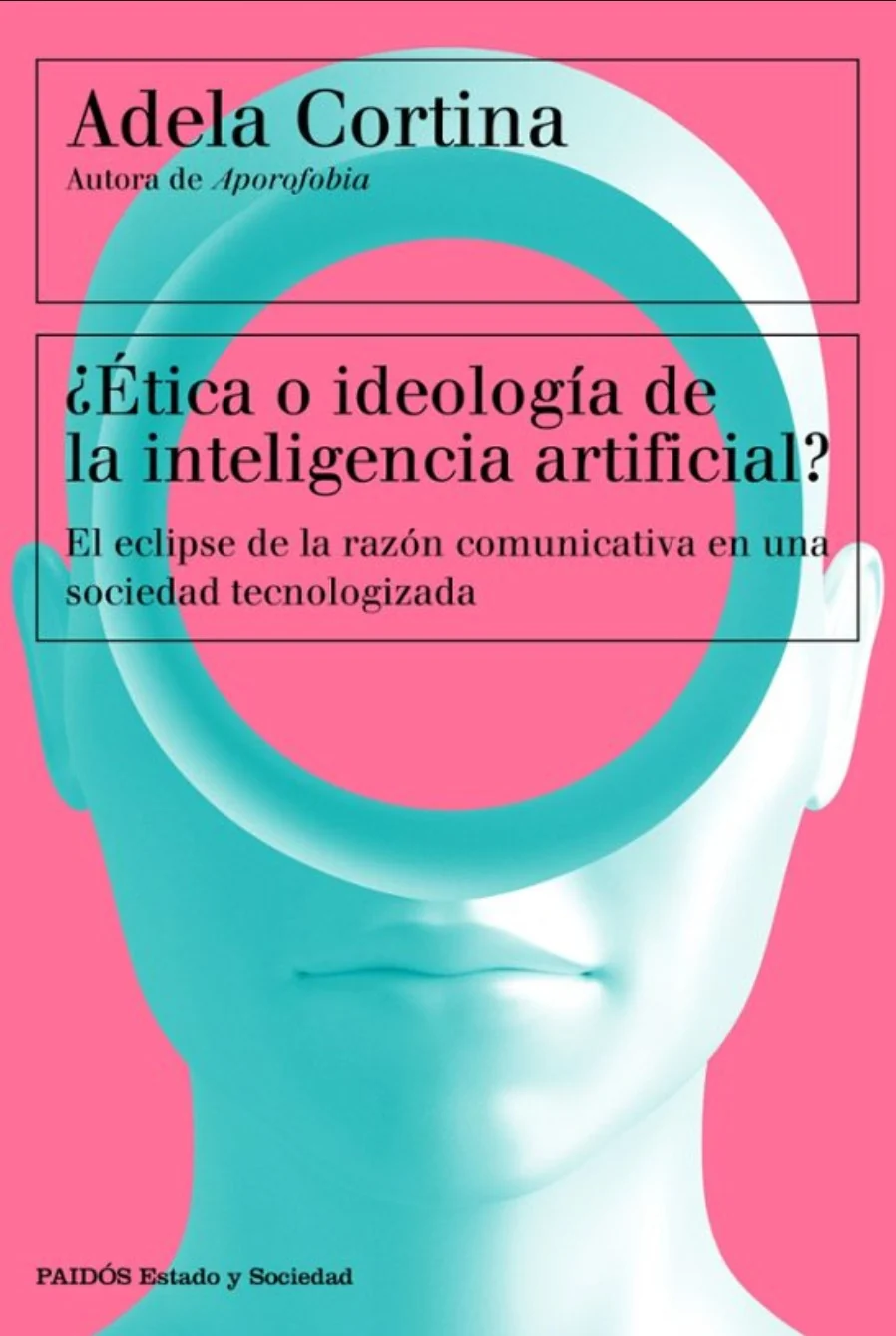
Cover text: Adela Cortina, author of Aporofobia. Title: ¿Ética o ideología de la inteligencia artificial? — “Ethics or ideology of artificial intelligence?” Subtitle: El eclipse de la razón comunicativa en una sociedad tecnologizada — “The eclipse of communicative reason in a technological society”. Publisher/series: Paidós, Estado y Sociedad — “State and Society”.
The ethical principles of the 4.0 revolution
Adela Cortina argues that this new technological wave should adhere to the following ethical principles:
1) Beneficence: the benefits must reach everyone, not just a few. To achieve this, the author maintains, the state must intervene.
2) Autonomy and dignity: in the opening pages, Cortina draws attention to a crucial issue: “the immense difference between using intelligent systems when making decisions and delegating to those intelligent systems decisions that are significant for the lives of people and nature”. In this regard, she reminds us that “intelligent systems are not autonomous; they do not have free will”. Therefore, “decisions affecting people’s lives cannot be placed in the hands of intelligent machines without human oversight […] A human being must always make the final decision and be able to account for it, if necessary. Machines lack context and an environment; an environment can be created, but they lack common sense”.
What if technology advances and AI acquires common sense? The philosopher argues that general intelligence cannot exist without a body: “machines lack the common-sense knowledge made possible by our embodied experiences”.
3) Explainability and accountability: we have a right to know how our data are used and how the algorithm handles them. “Believing that technologies are neutral is pure ideology.” “As Habermas rightly said, science and technology can become ideology: that distorted and distorting view of reality that allows the powerful to satisfy their illegitimate interests and exercise domination.”
4) Do no harm: full digital citizenship rights to address challenges such as cybersecurity, data protection, privacy, the protection of intimate life and protection from harmful content.
5) Promote a just world: particularly in relation to the impact on the labour market. The author refers to several solutions already examined in detail in this newsletter.
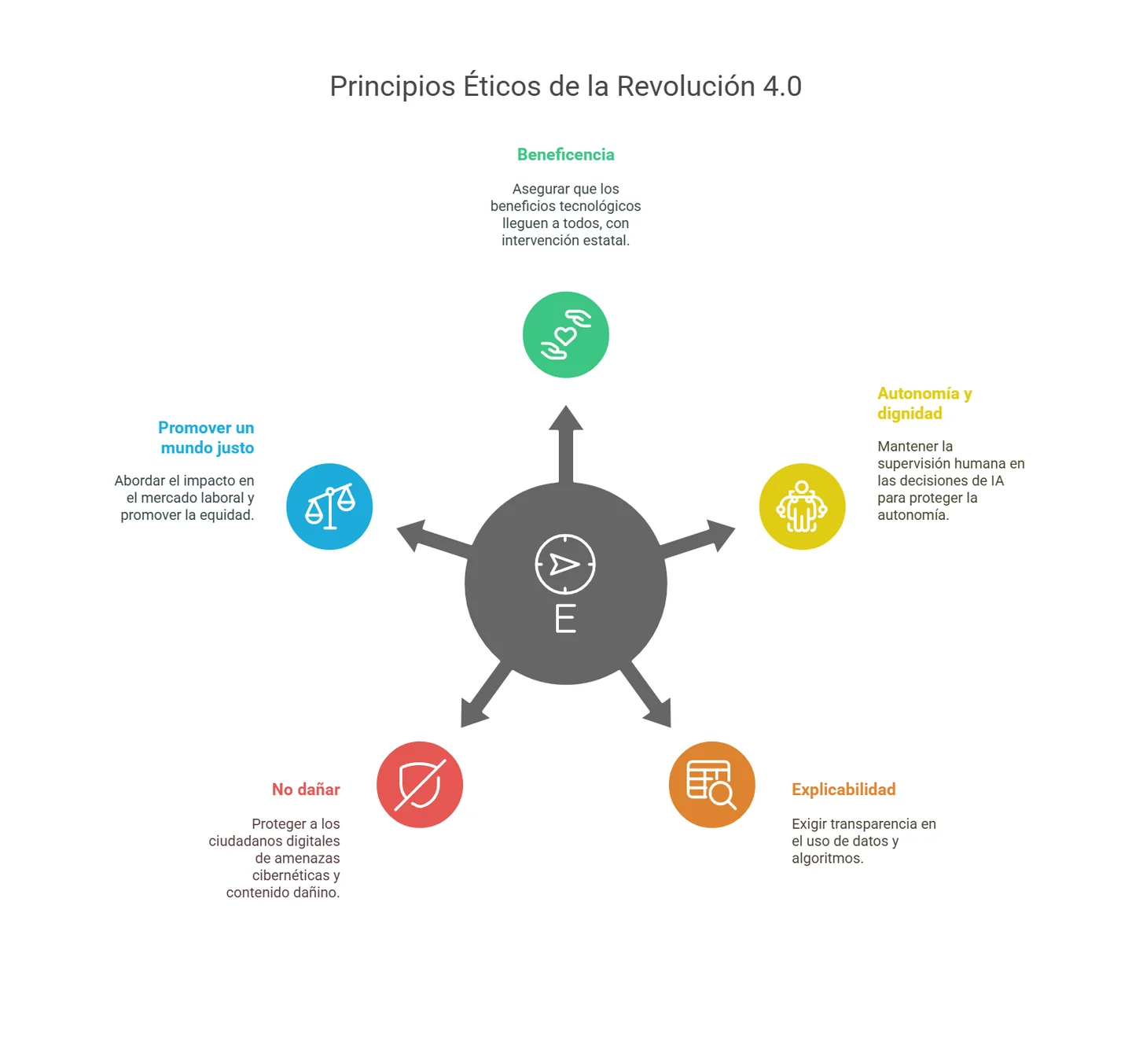
Full translation of “Ethical principles of the 4.0 revolution”:
- Beneficence: ensure that technological benefits reach everyone, with state intervention.
- Autonomy and dignity: maintain human oversight of AI decisions to protect autonomy.
- Explainability: require transparency in the use of data and algorithms.
- Do no harm: protect digital citizens from cyber threats and harmful content.
- Promote a just world: address the impact on the labour market and promote fairness.
Alongside establishing moral principles, the author reviews ethical frameworks that could be applied to intelligent systems. Cortina argues that “a deontological framework for integrating ethical rules into machines’ ‘brains’ is the most appropriate because, although the machine is not conscious of it, it will try to protect beings that are valuable in themselves […] My proposal is a dialogical deontology that uses the method of critical hermeneutics”. In other words, some things are right as a matter of principle, such as respect for human dignity. The remaining principles and rules should be developed through complex public debate, rather than imposed by a handful of companies or governments. Those principles must also be subject to critical interpretation, to ensure that AI rests on ethics rather than on an ideology imposed through science or technology.
Not just ethics and philosophy, but politics too
Given this article’s limited space, I will confine myself to two key political issues, although Adela Cortina’s book contains many references to this field that I am sure will interest this newsletter’s readers.
Geostrategy: the AI race is also a race for global hegemony. Presenting certain developments as inevitable or inherently “ethical” can serve to justify massive investment, selective deregulation or the adoption of technologies that ultimately concentrate power in a few corporations or states. In any event, she is very clear about the strategy the European Union should pursue: “in accordance with the basic principle of respect for human dignity, promoting AI is a moral, political and economic obligation for the European Union. If Europe does not rise to this challenge, it will be condemned to irrelevance”.
The eclipse of communicative reason: this is perhaps the book’s most powerful concept for understanding AI’s impact on democracy. Cortina, a follower of Habermas, argues that the “technological society” is undergoing an “eclipse of communicative reason”. Connectivity intensified by social media and digital platforms does not necessarily translate into better, truthful and deliberative communication. On the contrary, “strategic reason” — manipulation, disinformation and polarisation — often prevails, seeking illegitimate advantage rather than mutual understanding. This eclipse is a “radical challenge to democracy”, because it makes it harder to build an inclusive “we” capable of taking decisions together. Public policy should therefore foster a digital ecosystem that promotes informed dialogue and “plain language”, rather than encouraging fragmentation, dogmatism and moralism — cancel culture.
Finally, in response to these challenges, Adela Cortina turns to the crucial role of education. She recognises AI’s potential benefits in education, such as personalisation and access to knowledge, but issues a forceful warning about its risks: a widening digital divide, algorithmic bias and, fundamentally, the erosion of personal autonomy and critical thinking. Cortina proposes that education should help us think for ourselves while connecting well with others, encouraging public conversation and criticism.
Until now, a robot’s morality belonged to science fiction. But we live in remarkable times, which have led even one of the most important philosophers in the Spanish- and Portuguese-speaking world to reflect on AI’s ethical foundations. Read this book. It is straightforward, written for everyone, not for advanced readers of philosophy. I am sure you will enjoy it as much as I did and appreciate the significance of wisdom built on humility.
Academic Director of Institución Educativa ALEPH and Editor of estrategIA
Cite this essay
Pablo Martín Diez. “Who should decide in the age of artificial intelligence? Ethics, prudence and human dignity in the face of algorithmic power.” estrategIA, issue 085, 14 May 2025. English edition, 29 September 2026. https://elcontemplador.github.io/estrategia-english/essays/085/