Generative AI's arrival in education is rapidly dismantling the methodological foundations of a teaching system that had been showing signs of exhaustion for years. While some institutions and teachers try to hold back the tide — restricting AI use, imposing bans, returning to handwritten examinations and so on — other voices argue that this technology can be a strategic ally in transforming teaching. Today we bring you one of those voices: Javier Battilana Urbieta, Rector of Universidad Columbia del Paraguay, an institution with close academic ties to Institución Educativa ALEPH.
At the opening faculty meeting of the academic year, Battilana encouraged his teaching staff to incorporate generative AI into their practice, renew their methods and explore new models of learning. He also shared concrete examples of how he uses it in his own courses, demonstrating that educational innovation begins with pedagogical leadership.
In this estrategIA article, Javier Battilana specifically explores how conversational AI can become a digital adviser: a new strategic ally for political leaders and public officials seeking to think better, decide better and anticipate the future.
Throughout history, leadership has been accompanied by the figure of the adviser: someone able to guide, inspire and broaden a leader's outlook at decisive moments. Today, the arrival of conversational artificial intelligence opens a new era in which “digital advisers” assume a similar role, but with cognitive capabilities enhanced by machine learning and natural language processing. This article reflects on the evolution of the concept of advising and examines how human–AI interaction redefines analysis, decision-making and action in contemporary leadership.

1. Decision before action
Humanity's great transformations have grown out of decisions preceded by reflection. Every consequential action began as a considered decision.
This sequence — deciding before acting — marks the difference between the impulsive and the momentous. At the root of every good decision, there is usually a conversation: a dialogue with oneself, or with someone whose wisdom illuminates the possible paths.
Here the adviser emerges, not as someone who dictates what must be done, but as someone who helps us think better. In the biographies of great leaders, from politicians and scientists to philosophers and artists, we always find someone who served as an intellectual and emotional mirror.
2. The adviser in the history of leadership
Biographers and historians have documented how kings, presidents, scientists and innovators turned to mentors, teachers or advisers for perspective. Sometimes it was a relative; at other times, a teacher, a philosopher or a strategist.
In every case, the adviser acted as a catalyst for critical thinking and moral discernment.
Even the legends and myths surrounding great leaders, enveloped in an aura of mysticism, retain this guiding figure: someone who influences without imposing, accompanies without replacing, and guides without dominating.
3. Intellectual synergy: when two intelligences strengthen each other
Human intelligence, conventionally measured through intelligence quotient, or IQ, varies widely. The average is around 100; a university-educated professional falls between 100 and 120; Einstein or Hawking between 160 and 170; and Marilyn vos Savant, with an IQ of 228, heads the known records.
This comparison invites us to ask:
Can an adviser with a high IQ enhance a leader's practical or emotional intelligence?
Is there an intellectual synergy that transcends the sum of two minds and produces expanded thought?
Although precise measurement would be impossible, historical examples show that collaboration between brilliant minds multiplies the possibilities for understanding and action, and that collective intelligence often exceeds individual intelligence.
4. From human advisers to digital advisers
Until recently, imagining a dialogue with a genius from the past — Einstein, Socrates, Mandela or Marie Curie — was an exercise in imagination. Books, letters and audiovisual records were the only ways to access their thinking.
Today, conversational artificial intelligence has turned that possibility into an everyday experience.
Through deep learning and natural-language modelling, we can assign specific roles to an AI, configure its tone, perspective and knowledge, and engage it in a dialogue of considerable intellectual depth.
For the first time, anyone can have a digital adviser on their device with intelligence equivalent to, or even greater than, that of a human genius, available at any time to analyse, suggest and broaden horizons.
5. Leadership facing an unpredictable future
The contemporary world is changing at an unprecedented pace. Paradigms transform before they have settled, and predicting the future has become more uncertain than ever.
In this situation, the most valuable skill will not simply be the ability to adapt, but the ability to engage intelligently with artificial intelligence.
Mastering the art of writing prompts — clear, searching and strategic questions and instructions — will be as essential as learning to write, argue or program once was.
Those who can communicate effectively with their digital advisers will achieve the same kind of synergy that once united great leaders with their human mentors.
Conclusion
The leaders of the past relied on human advisers to think better, decide better and act more wisely.
The leaders of the future will do the same, but with digital allies able to reason, learn and accompany them in real time.
The real challenge will not be to replace human intelligence, but to learn to expand it through dialogue with our new digital advisers.
Rector of Universidad Columbia del Paraguay
We asked Gemini 3 Pro, in one of our first tests of the model released yesterday, to create an infographic summarising the article. You can see it below.
Archive note: “yesterday” refers to the original publication on 19 November 2025. The following infographic and its quotations are translated from the Spanish source.
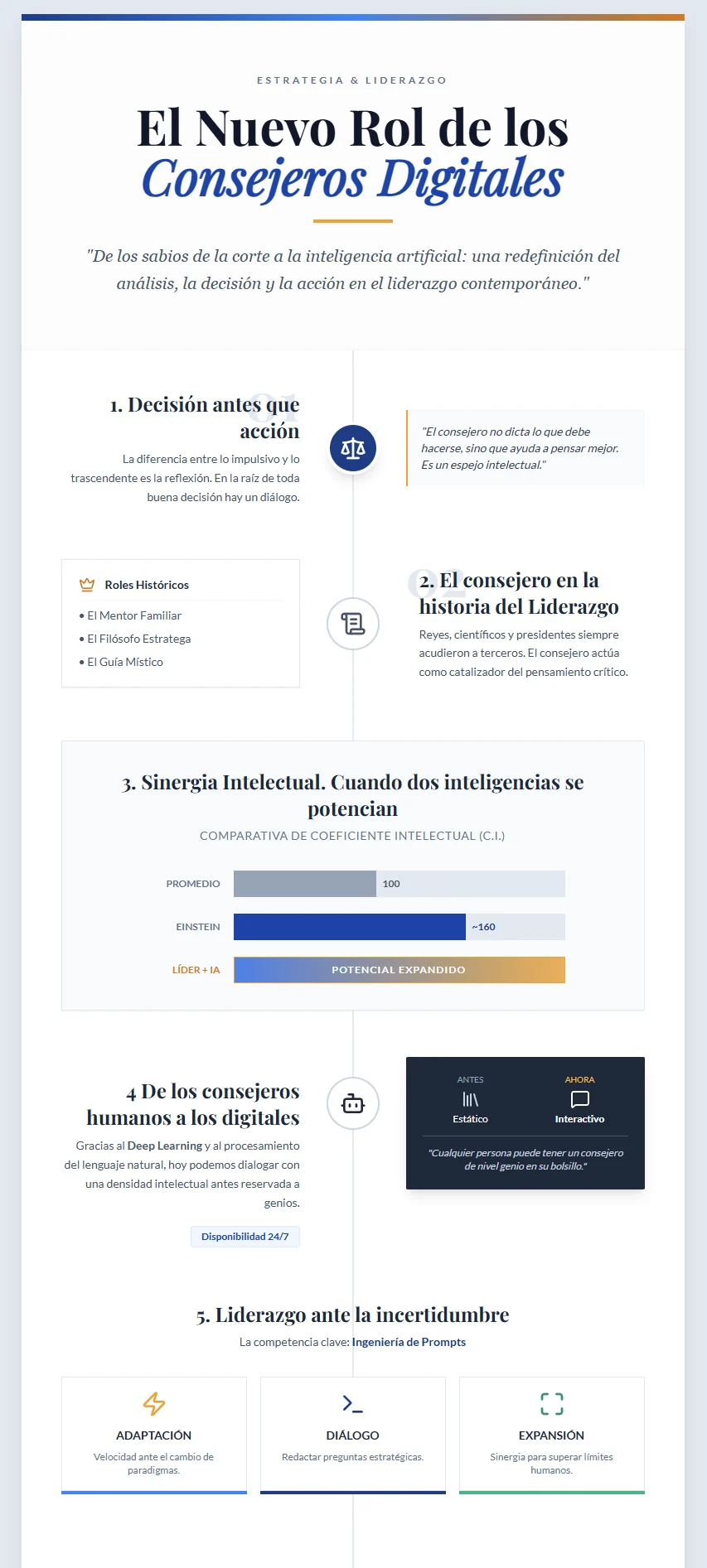
English translation of the complete infographic text:
Strategy and leadership — The new role of digital advisers
“From the sages of the court to artificial intelligence: redefining analysis, decision-making and action in contemporary leadership.”
- Decision before action. The difference between the impulsive and the momentous is reflection. At the root of every good decision lies a dialogue. “The adviser does not dictate what should be done, but helps us think better. They are an intellectual mirror.”
- The adviser in the history of leadership. Kings, scientists and presidents have always turned to others. The adviser acts as a catalyst for critical thinking. Historical roles: the family mentor, the philosopher-strategist and the mystical guide.
- Intellectual synergy: when two intelligences strengthen each other. IQ comparison: average, 100; Einstein, approximately 160; leader + AI, “expanded potential”. The graphic gives no numerical IQ for the final category.
- From human advisers to digital advisers. Through deep learning and natural language processing, we can now conduct dialogues with an intellectual depth once reserved for geniuses. Availability: 24/7. Before: static. Now: interactive. “Anyone can have an adviser of genius-level ability in their pocket.”
- Leadership in the face of uncertainty. The key skill: prompt engineering. Adaptation: speed in responding to paradigm shifts. Dialogue: writing strategic questions. Expansion: synergy to move beyond human limits.
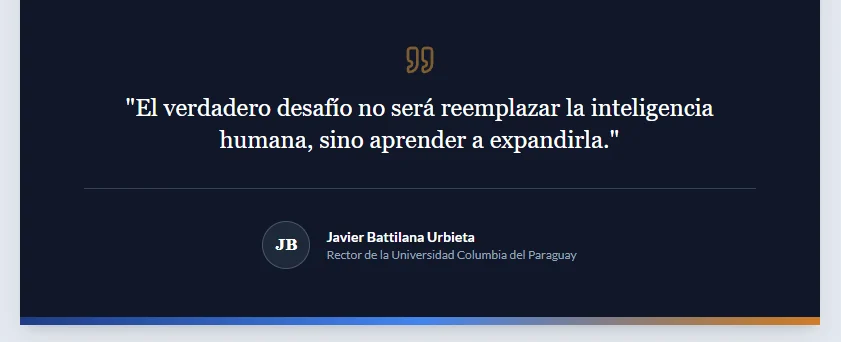
Final panel, translated: “The real challenge will not be to replace human intelligence, but to learn to expand it.” Javier Battilana Urbieta, Rector of Universidad Columbia del Paraguay.
Cite this essay
Javier Battilana Urbieta. “The new role of digital advisers.” estrategIA, issue 112, 19 November 2025. English edition, 29 September 2026. https://elcontemplador.github.io/estrategia-english/essays/112/