Archive context: this tutorial and its product-access instructions date from 5 November 2025. The prompts, fictional council example and model responses below reproduce the author's historical experiment, not current instructions from this edition. The quotation attributed to Karpathy is translated from the Spanish source; its original English wording was not independently checked. The English release visible in the third screenshot is transcribed directly, retaining its original spelling.
What if you could create a working application in a few minutes without knowing how to program, using words alone? That is exactly what vibe coding promises: a phenomenon that, thanks to AI, is radically transforming who can build technology, and one I had long wanted to introduce to you in estrategIA, even at the most basic level.
The term vibe coding was coined in February this year, 2025, by Andrej Karpathy, former director of AI at Tesla and former OpenAI researcher, to describe a new paradigm: creating software by talking to an artificial intelligence, without writing a single line of code.
Its usefulness for the general public is immense because it removes the technical barrier that has traditionally separated ideas from execution. You no longer need to be a programmer to create simple digital tools. As this technology matures—it is still early, although, as you will see in this article, basic things can already be done easily—it will allow experts in any field to build prototypes and bespoke solutions to their specific problems incredibly quickly. At the very least, they will be able to make a prototype that can later be scaled with a team and relatively low costs compared with the traditional model.
The concept is revolutionarily simple. Open a tool such as Google AI Studio, which launched its new interface for building applications without code this October, free of charge, and tell it what you want. For example, this is the one we created: “I want a system that writes press releases from a set of data I provide in a form, also translates the release into English, and offers texts for sharing it on social media.” The AI generates all the necessary code. If something does not work as expected, you do not need to understand what went wrong in technical terms: you simply describe the problem or the change you want, and the AI adjusts it. It is a completely conversational, iterative process that almost always works satisfactorily for simple tasks.
The magic is made possible by large AI language models trained on billions of lines of existing code. These systems can translate our human intention, expressed in natural language, directly into working applications. As Karpathy said: “The most popular programming language now is English”—or Spanish, in our context. The historic barrier between “person with an idea” and “working application” is beginning to disappear, although for now that remains a long way off in complex or large projects.
Why does this matter for citizens, consultants and public servants? Because it will democratise capabilities that previously cost tens of thousands of dollars and months of development. A simple chatbot for citizen services, a tracker of local bills or a press-release generator: tools that once required hiring entire development teams are now beginning to be created in hours or a few days on very small budgets. The technology is still in its infancy, but it is progressing very rapidly. At least the prototype is very easy to make, allowing tests to be run or making it clear exactly what to ask of the technical team building the final solution. For politics and government, especially in countries, regions or towns with fewer resources, this means that small teams, grassroots organisations and public offices will finally be able to carry out coding projects easily—if this takes hold as it seems likely to, and we see progress in software comparable to that in text, images or video.
There is, however, an important caveat: the technology's present state still clearly argues against projects involving sensitive citizen data, government financial systems, critical infrastructure or anything requiring strict regulatory compliance. We therefore advise experimenting and developing small projects in other areas without that particular difficulty, bearing firmly in mind that this is still a nascent technology.
A simple press-release application
But since we are convinced that the best way to teach you about vibe coding is to show it to you, here is an example generated in Google's AI Studio. We believe this is currently the simplest free platform for developing these applications, or at least prototyping them. It then allows you to save the application in GitHub or even deploy it fairly easily in Google's own cloud, though that does involve some API costs.
The simple example application we have created to show you is a press-release generator based on a form, with a few extras.
WE ENCOURAGE YOU TO TAKE A LOOK HERE
(Note: we have shared it openly, but it is not in production. To view it, you will need a Google account and will be asked to grant a series of permissions. Anyone can view the application and, if they make a copy—which we recommend—save it for personal use and request changes. For example, a colleague and friend to whom we sent the test a few days ago generated an identical version in Portuguese almost instantly.)
With just that idea in mind, as described above, we asked GPT-5 Thinking to help us create a prompt to use in AI Studio. The next image shows the main part of what it returned:
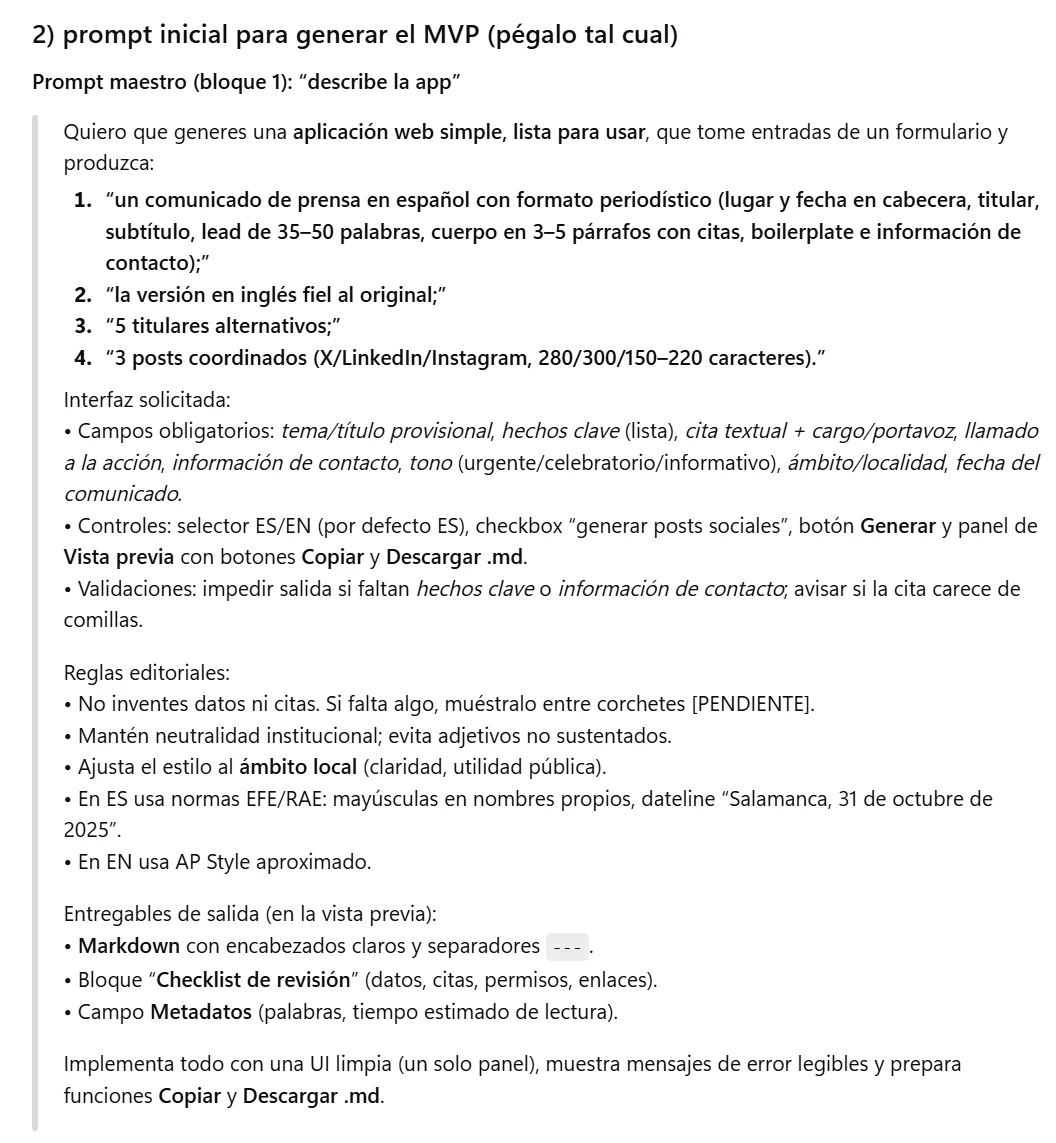
Screenshot 1: translated historical prompt.
2) Initial prompt to generate the MVP—paste it exactly as it is
Master prompt, block 1: “Describe the app”
I want you to generate a simple, ready-to-use web application that takes inputs from a form and produces:
- A press release in Spanish in journalistic format: location and date at the top, headline, subheading, a 35–50-word lead, a body of 3–5 paragraphs with quotations, boilerplate and contact information.
- An English version faithful to the original.
- Five alternative headlines.
- Three coordinated posts for X/LinkedIn/Instagram, of 280/300/150–220 characters respectively.
Requested interface:
- Required fields: topic/provisional title; key facts as a list; verbatim quotation and spokesperson/role; call to action; contact information; tone—urgent, celebratory or informative; scope/locality; release date.
- Controls: ES/EN selector, default ES; “generate social posts” checkbox; Generate button; and Preview panel with Copy and Download .md buttons.
- Validation: prevent output if key facts or contact information are missing; warn if the quotation lacks quotation marks.
Editorial rules:
- Do not invent data or quotations. If something is missing, show it in square brackets: [PENDING].
- Maintain institutional neutrality; avoid unsupported adjectives.
- Adapt the style to the local context: clarity and public usefulness.
- In Spanish, use EFE/RAE conventions: capital letters for proper names, and a dateline such as “Salamanca, 31 October 2025”.
- In English, use an approximation of AP Style.
Output deliverables in the preview:
- Markdown with clear headings and separators made of three hyphens.
- A “Review checklist” block covering data, quotations, permissions and links.
- A Metadata field containing word count and estimated reading time.
Implement everything with a clean, single-panel UI, show readable error messages, and prepare Copy and Download .md functions.
We pasted that into AI Studio exactly as it stood. After a few minutes, it created the interface, which we tested with this simple example, giving it very brief details of a possible opening of a centre for older people:
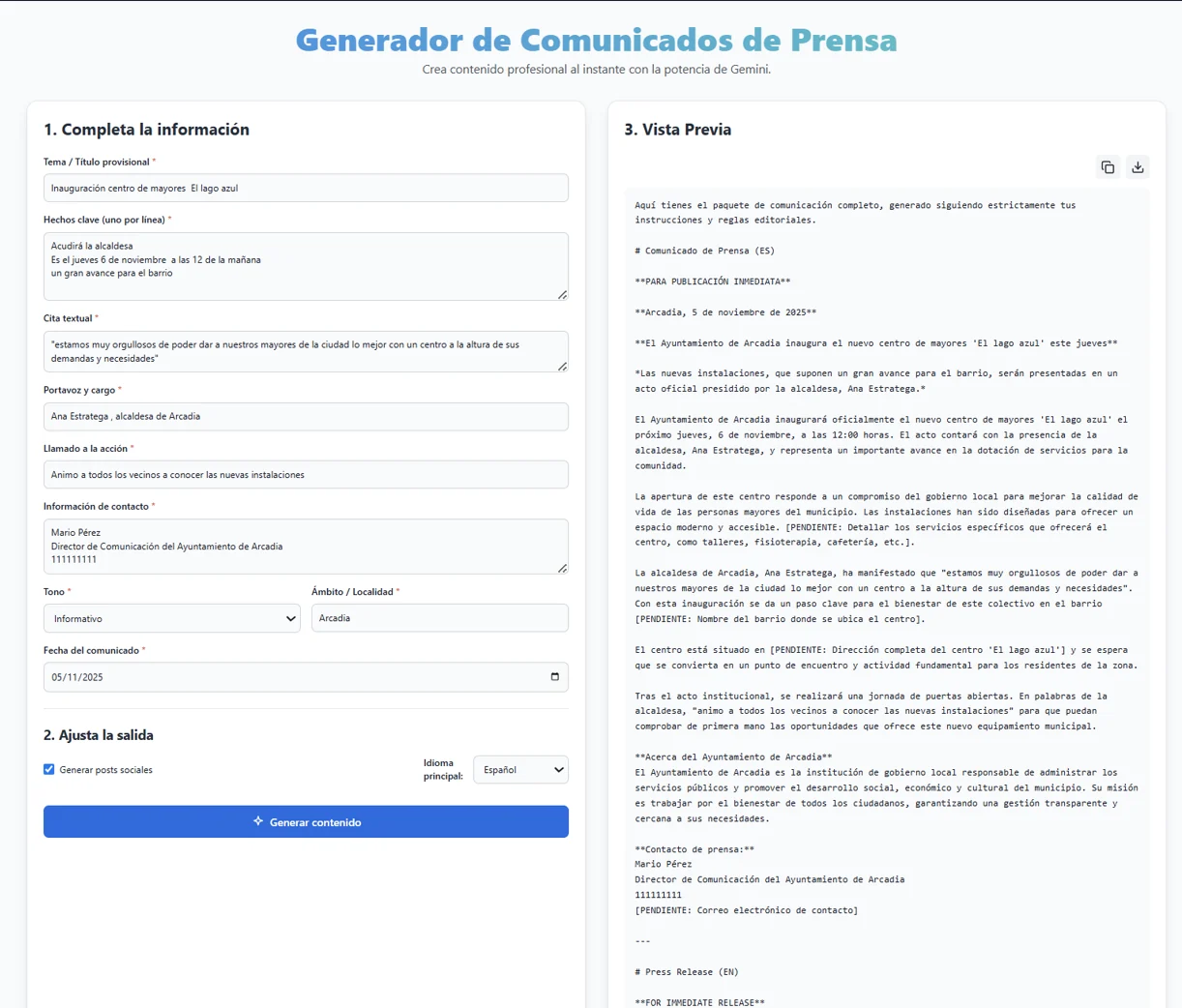
Screenshot 2: translated form and historical generated example. The heading reads “Press-release generator”, with the subtitle “Create professional content instantly with the power of Gemini”. The interface is divided into “1. Complete the information”, “2. Adjust the output” and “3. Preview”.
Scroll across the table to read all columns.
| Form field | Example entered, translated |
|---|---|
| Topic/provisional title | Opening of El lago azul centre for older people |
| Key facts, one per line | The mayor will attend. It is on Thursday 6 November at 12 in the morning. A major step forward for the neighbourhood. |
| Verbatim quotation | “We are very proud to be able to give our city's older people the best, with a centre that meets their demands and needs.” |
| Spokesperson and role | Ana Estratega, mayor of Arcadia |
| Call to action | I encourage all residents to come and see the new facilities. |
| Contact information | Mario Pérez; Director of Communications, Arcadia City Council; 111111111 |
| Tone | Informative |
| Scope/locality | Arcadia |
| Release date | 05/11/2025 |
“Generate social posts” is checked; main language is Spanish; the button reads “Generate content”. Copy and download controls are visible. These names and contact details belong to the fictional demonstration.
The Spanish preview, translated in full:
Here is the complete communications package, generated strictly following your instructions and editorial rules.
Press release (ES)
FOR IMMEDIATE RELEASE
Arcadia, 5 November 2025
Arcadia City Council opens the new El lago azul centre for older people this Thursday
The new facilities, a major step forward for the neighbourhood, will be presented at an official ceremony chaired by the mayor, Ana Estratega.
Arcadia City Council will officially open the new El lago azul centre for older people on Thursday 6 November at 12:00. The mayor, Ana Estratega, will attend the event, which represents an important step forward in providing services for the community.
The opening of this centre reflects the local government's commitment to improving the quality of life of the municipality's older people. The facilities have been designed to offer a modern, accessible space. [PENDING: Give details of the specific services the centre will offer, such as workshops, physiotherapy, a café, etc.].
The mayor of Arcadia, Ana Estratega, has said that “we are very proud to be able to give our city's older people the best, with a centre that meets their demands and needs”. This opening is a key step for the wellbeing of this group in the neighbourhood [PENDING: Name of the neighbourhood in which the centre is located].
The centre is located at [PENDING: Full address of El lago azul centre] and is expected to become a key meeting place and activity hub for residents in the area.
Following the official ceremony, an open day will be held. In the mayor's words, “I encourage all residents to come and see the new facilities”, so that they can discover first-hand the opportunities offered by this new municipal facility.
About Arcadia City Council
Arcadia City Council is the local government institution responsible for administering public services and promoting the municipality's social, economic and cultural development. Its mission is to work for the wellbeing of all citizens, ensuring transparent administration that responds closely to their needs.
Press contact:
Mario Pérez
Director of Communications, Arcadia City Council
111111111
[PENDING: Contact email address]
Although it is not visible in that first screenshot, the application also generates the press release in English, alternative headlines, ideas for social media posts and a checklist. Here is the continuation of the preview:
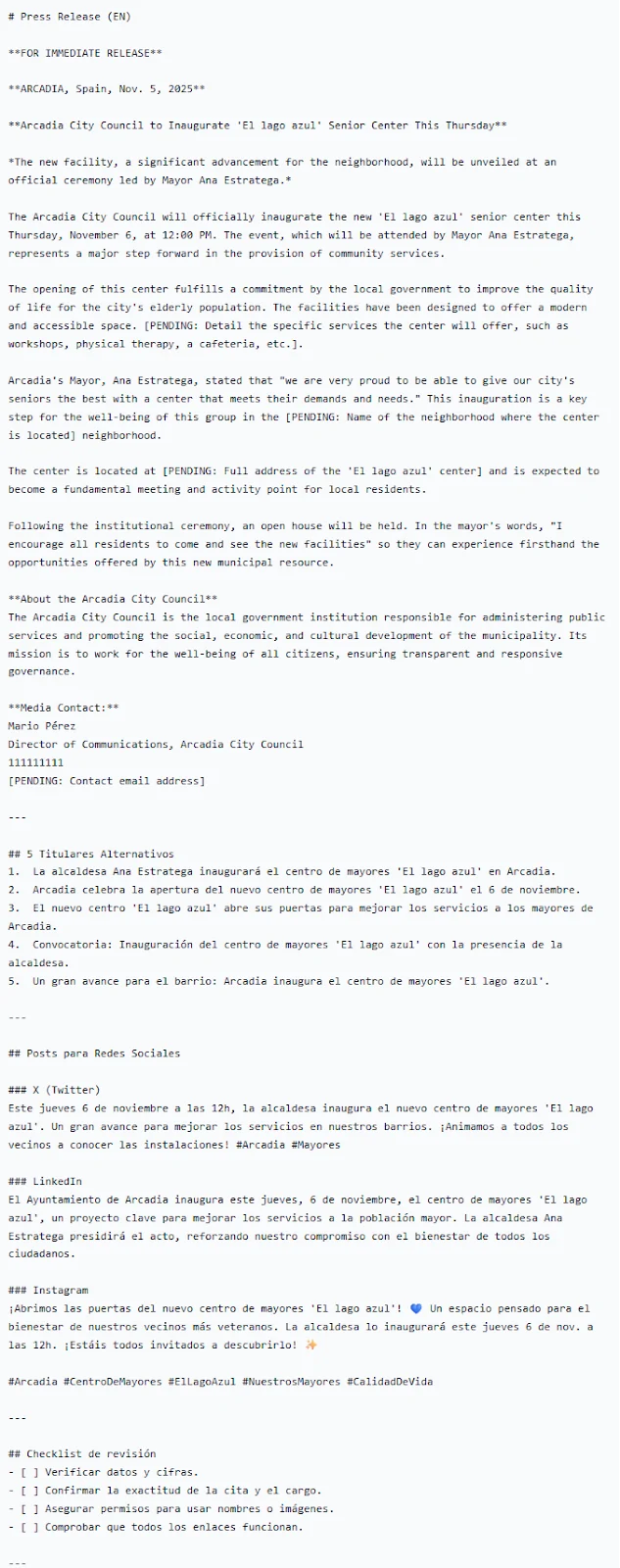
Screenshot 3: original English output, transcribed as shown. This is the historical application's generated text, including its American spelling and unfilled fields.
Press Release (EN)
FOR IMMEDIATE RELEASE
ARCADIA, Spain, Nov. 5, 2025
Arcadia City Council to Inaugurate 'El lago azul' Senior Center This Thursday
The new facility, a significant advancement for the neighborhood, will be unveiled at an official ceremony led by Mayor Ana Estratega.
The Arcadia City Council will officially inaugurate the new 'El lago azul' senior center this Thursday, November 6, at 12:00 PM. The event, which will be attended by Mayor Ana Estratega, represents a major step forward in the provision of community services.
The opening of this center fulfills a commitment by the local government to improve the quality of life of the city's elderly population. The facilities have been designed to offer a modern and accessible space. [PENDING: Detail the specific services the center will offer, such as workshops, physical therapy, a cafeteria, etc.].
Arcadia's Mayor, Ana Estratega, stated that “we are very proud to be able to give our city's seniors the best with a center that meets their demands and needs.” This inauguration is a key step for the well-being of this group in the [PENDING: Name of the neighborhood where the center is located] neighborhood.
The center is located at [PENDING: Full address of the 'El lago azul' center] and is expected to become a fundamental meeting and activity point for local residents.
Following the institutional ceremony, an open house will be held. In the mayor's words, “I encourage all residents to come and see the new facilities” so they can experience firsthand the opportunities offered by this new municipal resource.
About the Arcadia City Council:
The Arcadia City Council is the local government institution responsible for administering public services and promoting the social, economic, and cultural development of the municipality. Its mission is to work for the well-being of all citizens, ensuring transparent and responsive governance.
Media Contact:
Mario Pérez
Director of Communications, Arcadia City Council
111111111
[PENDING: Contact email address]
Five alternative headlines, translated from the Spanish output:
- Mayor Ana Estratega will open El lago azul centre for older people in Arcadia.
- Arcadia celebrates the opening of the new El lago azul centre for older people on 6 November.
- The new El lago azul centre opens its doors to improve services for Arcadia's older people.
- Invitation: opening of El lago azul centre for older people with the mayor in attendance.
- A major step forward for the neighbourhood: Arcadia opens El lago azul centre for older people.
Social media posts, translated from the Spanish output:
X (Twitter)
This Thursday 6 November at 12 noon, the mayor will open the new El lago azul centre for older people. A major step forward in improving services in our neighbourhoods. We encourage everyone to come and see the facilities! #Arcadia #Mayores
Arcadia City Council will open El lago azul centre for older people this Thursday, 6 November, a key project to improve services for the older population. Mayor Ana Estratega will chair the ceremony, reinforcing our commitment to the wellbeing of all citizens.
We're opening the doors of the new El lago azul centre for older people! 💙 A space designed for the wellbeing of our most senior residents. The mayor will open it this Thursday 6 November at 12 noon. You are all invited to discover it! ✨
#Arcadia #CentroDeMayores #ElLagoAzul #NuestrosMayores #CalidadDeVida
The original hashtags are preserved; their meanings are “older people”, “centre for older people”, “the blue lake”, “our older people” and “quality of life”.
Review checklist, translated from the screenshot:
- Verify data and figures.
- Confirm the accuracy of the quotation and the role.
- Ensure permission to use names or images.
- Check that all links work.
Refining the application through conversation
Finally, having checked that the application worked, we suggested improving the design and applying, for example, Institución Educativa ALEPH's corporate red. Making changes is very simple: just ask the model in text. Since the example was intended for estrategIA readers, we also asked it to adapt the sample text explaining the fields to a council or government communications example.
The final result, which is what you will now see when you open the application, is:
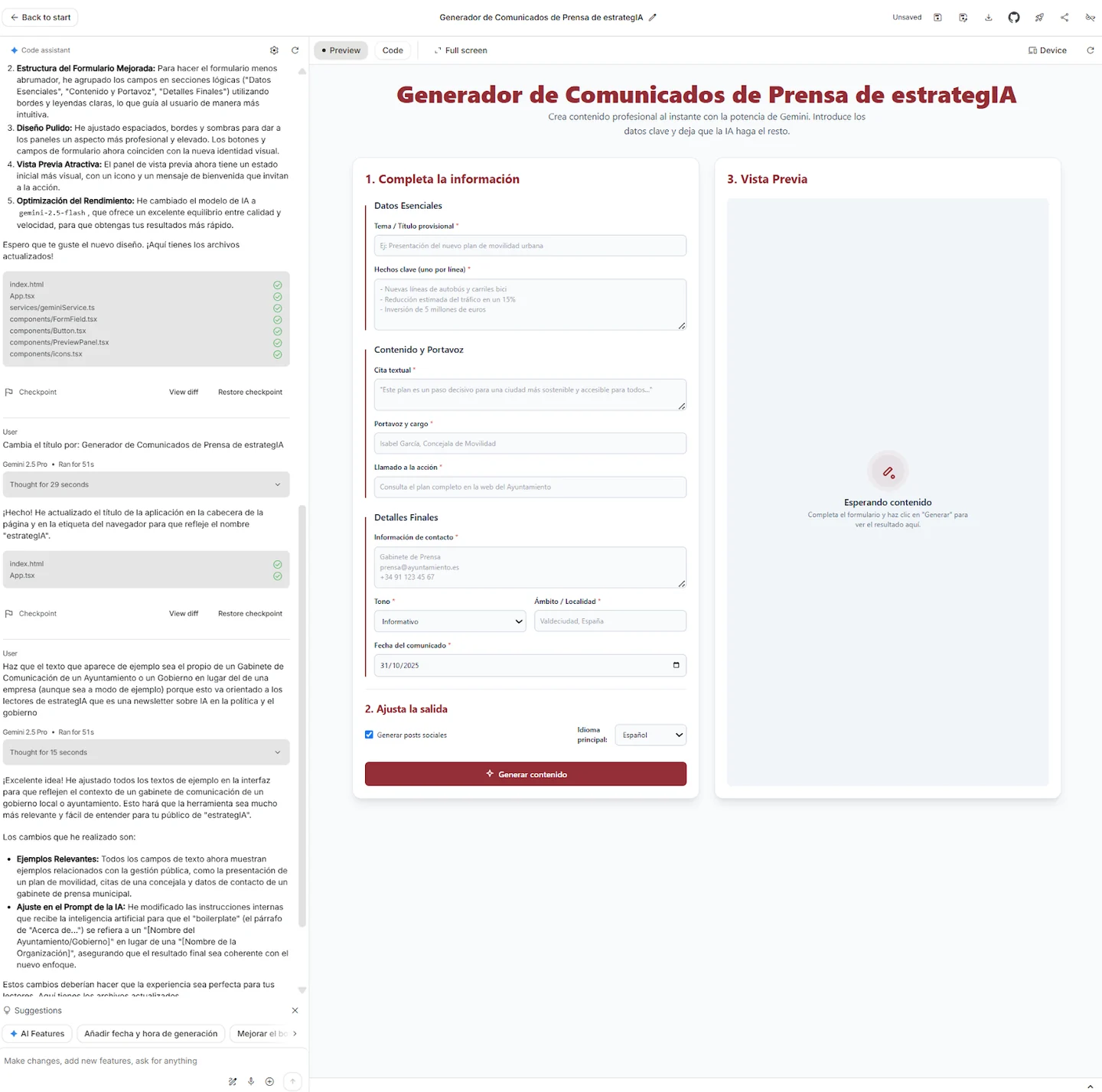
Screenshot 4: translated final interface.
“estrategIA press-release generator”. “Create professional content instantly with the power of Gemini. Enter the key facts and let AI do the rest.”
Scroll across the table to read all columns.
| Section and field | Example text or setting shown, translated |
|---|---|
| 1. Complete the information — Essential information | |
| Topic/provisional title | E.g. presentation of the new urban mobility plan |
| Key facts, one per line | New bus routes and cycle lanes; estimated 15% reduction in traffic; investment of €5 million |
| Content and spokesperson — Verbatim quotation | “This plan is a decisive step towards a more sustainable and accessible city for everyone…” |
| Spokesperson and role | Isabel García, councillor for mobility |
| Call to action | Consult the full plan on the council website. |
| Final details — Contact information | Press office; prensa@ayuntamiento.es; +34 91 123 45 67 |
| Tone | Informative |
| Scope/locality | Valdeciudad, Spain |
| Release date | 31/10/2025 |
| 2. Adjust the output | Generate social posts checked; main language Spanish; Generate content button |
| 3. Preview | “Waiting for content. Complete the form and click ‘Generate’ to see the result here.” |
These are the screenshot's example placeholders, including its contact details and date, rather than a newly created release.
Visible editing conversation, translated. The first response begins at item 2 in the screenshot; the preceding item is not visible.
2. Improved form structure: To make the form less overwhelming, I have grouped the fields into logical sections—“Essential information”, “Content and spokesperson”, “Final details”—using clear borders and legends, which guide the user more intuitively.
3. Polished design: I have adjusted spacing, borders and shadows to give the panels a more professional, refined appearance. Buttons and form fields now match the new visual identity.
4. Attractive preview: The preview panel now has a more visual initial state, with an icon and a welcome message inviting action.
5. Performance optimisation: I have changed the AI model to gemini-2.5-flash, which offers an excellent balance between quality and speed, so that you get results faster.
I hope you like the new design. Here are the updated files!
The visible file list is index.html, App.tsx, services/geminiService.ts, components/FormField.tsx, components/Button.tsx, components/PreviewPanel.tsx and components/Icons.tsx.
User: Change the title to: estrategIA press-release generator.
Model: Done! I have updated the application's title in the page header and browser tag to reflect the name “estrategIA”.
User: Make the example text appropriate to a council or government communications office rather than a company—even though it is only an example—because this is aimed at estrategIA readers, and estrategIA is a newsletter about AI in politics and government.
Model: Excellent! I have adjusted all the example text in the interface to reflect the context of a local government or council communications office. This will make the tool much more relevant and easier for your “estrategIA” audience to understand.
The changes I have made are:
- Relevant examples: All text fields now show examples related to public management, such as the presentation of a mobility plan, quotations from a councillor and contact details for a municipal press office.
- Adjustment to the AI prompt: I have modified the internal instructions received by the AI so that the boilerplate—the “About…” paragraph—refers to “[Name of Council/Government]” rather than “[Name of Organisation]”, ensuring that the final result is consistent with the new focus.
The response's final sentence is cut off by the bottom of the chat panel. The screenshot also labels the editing model “Gemini 2.5 Pro”, with 51-second runs and “Thought for 29 seconds”/“Thought for 15 seconds” interface indicators; these are historical interface labels. No unseen response text is reconstructed.
The application could now be exported in various ways or deployed directly in Google's cloud. If anyone wants to change something, it is as simple as making a copy from the menu at the top right of the screen and then asking for changes to the application.
This is only a simple example. More powerful vibe coding tools are already on the market, and the sector has developed enormously in a very short time. Within a few months or a few years, it will probably become possible to tackle, with the same ease, more complex projects requiring servers, databases and so on. We invite you to try generating your own simple applications. If you need ideas, go straight to this week's GPT-5 prompt section, where we have left a prompt that will generate several ideas for you to try.
Archive note: that prompt appears in the original newsletter's separate weekly section, outside the main article translated here.
Director of Digital Innovation at Institución Educativa ALEPH and director of estrategIA
Cite this essay
Fernando Nieto Lobato. “Vibe coding for estrategIA readers: from a prompt to a simple application with Google AI Studio.” estrategIA, issue 110, 5 November 2025. English edition, 29 September 2026. https://elcontemplador.github.io/estrategia-english/essays/110/