Archive note: this special issue was published on 31 December 2025. Descriptions of access, features and interfaces refer to that date. The summaries and claims in the generated graphics are preserved as historical examples; they have not been independently reverified. Quotations in their English alternatives are translations of the Spanish shown.
For several months, we had wanted to bring you a main article about NotebookLM, one of the best artificial intelligence tools available today — which you can also use extensively for free. This final issue of the year offered us an excellent opportunity to do so, because it lets us combine introducing you to this highly recommended tool, with an educational emphasis so that you can see how to use it for your own projects, and bringing you an interactive summary of the year in estrategIA — in other words, our entire perspective on artificial intelligence in 2025.
To do this, we are following — with due allowance for the obvious differences in scale, and noting that our project was already under way before we learnt about theirs — The Economist's approach in its highly recommended Archive 1945 special, built from the issues published at the time about the year 1945. As everyone knows, that was a historic year: it brought the Second World War to a close, witnessed the dropping of the atomic bombs, and began the world's realignment into blocs that would shape almost the rest of the twentieth century. Here is our NotebookLM notebook, into which we have brought together all the text of the estrategIA articles published in 2025.
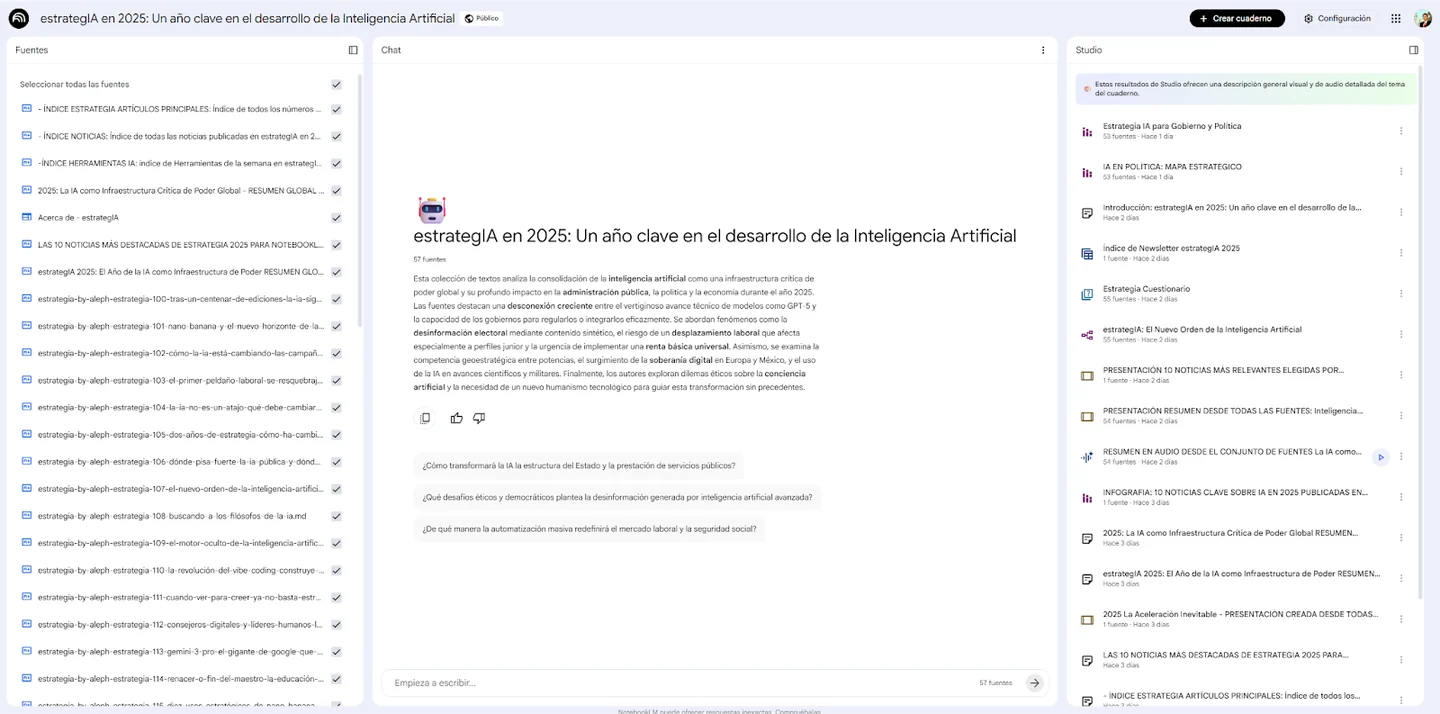
English alternative to the notebook screenshot: The notebook is titled “estrategIA in 2025: a key year in the development of Artificial Intelligence” and is marked “Public”. The centre shows 57 sources and this generated introduction:
This collection of texts analyses the consolidation of artificial intelligence as critical infrastructure for global power, and its profound impact on public administration, politics and the economy during 2025. The sources highlight a growing disconnect between the dizzying technical advances of models such as GPT-5 and governments' ability to regulate or integrate them effectively. They address subjects including electoral disinformation through synthetic content, the risk of job displacement that particularly affects junior profiles, and the urgency of implementing a universal basic income. They also examine geostrategic competition between powers, the emergence of digital sovereignty in Europe and Mexico, and the use of AI in scientific and military advances. Finally, the authors explore ethical dilemmas concerning artificial consciousness and the need for a new technological humanism to guide this unprecedented transformation.
The three suggested questions are: “How will AI transform the structure of the state and the delivery of public services?”; “What ethical and democratic challenges does disinformation generated by advanced AI pose?”; and “How will mass automation redefine the labour market and social security?” The input says “Start typing...”.
The left-hand “Sources” column contains indexes of main articles, news and tools, year summaries, an About page and individual newsletter issues, with a “Select all sources” control. The right-hand “Studio” column contains infographics, an introduction, a newsletter index, a quiz, presentations, an audio summary and other generated documents. Several filenames and output titles end in ellipses in the screenshot; their hidden endings are not reconstructed here.
In this NotebookLM EstrategIA 2025 notebook, which we invite you to visit, you will find all this year's information collected together. You can chat about everything we have published, and explore the presentations, infographics, audio, videos and other multimedia material we have created for you with this Google AI service.
Although we encourage you to go directly to the tool — it is free, and at most will ask you to sign in with a Google account — here are two interesting examples of the infographics it generated: one summarising the year overall, and another bringing together the stories NotebookLM chose as the most significant from everything we published this year.
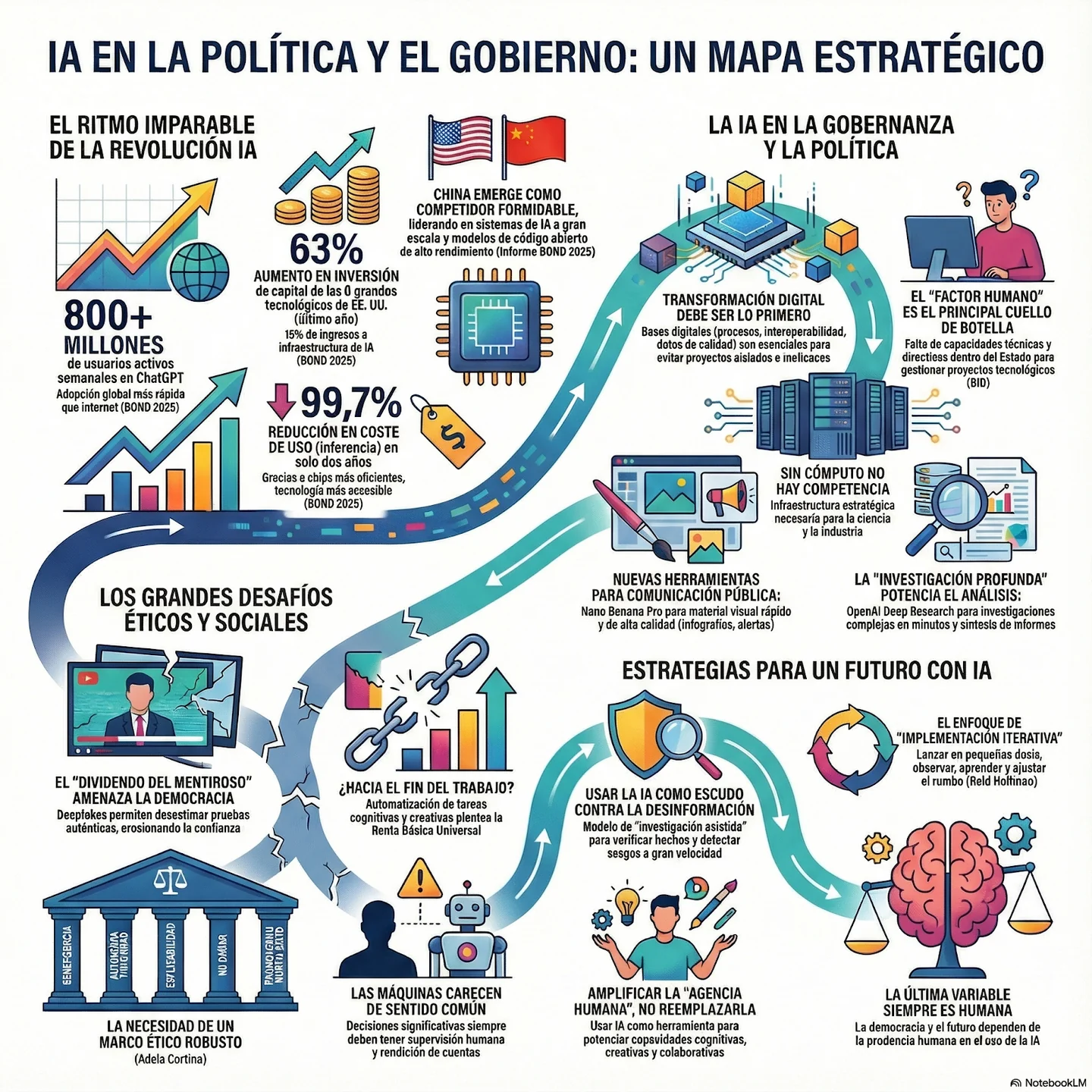
English alternative — AI in politics and government: a strategic map.
The unstoppable pace of the AI revolution
- 800+ million weekly active ChatGPT users. Faster global adoption than the internet (BOND 2025).
- 63% increase in capital investment by large US technology companies over the past year; 15% of revenue directed to AI infrastructure (BOND 2025). The number identifying the group of companies is malformed in the generated image and is not reconstructed.
- 99.7% reduction in usage cost — inference — in just two years. More efficient chips make the technology more affordable (BOND 2025).
- China emerges as a formidable competitor, leading in large-scale AI systems and high-performance open-source models (BOND 2025 report).
AI in governance and politics
- Digital transformation must come first. Digital foundations — processes, interoperability and quality data — are essential to avoid isolated, ineffective projects.
- The “human factor” is the main bottleneck. A lack of technical and managerial capabilities within the state to manage technology projects (IDB).
- Without compute, there is no competition. Strategic infrastructure is necessary for science and industry.
- New tools for public communication: Nano Banana Pro for fast, high-quality visual material, including infographics and alerts.
- “Deep research” strengthens analysis: OpenAI Deep Research for complex investigations in minutes and report synthesis.
The major ethical and social challenges
- The “liar's dividend” threatens democracy. Deepfakes allow authentic evidence to be dismissed, eroding trust.
- Towards the end of work? Automation of cognitive and creative tasks raises the question of Universal Basic Income.
- The need for a robust ethical framework — Adela Cortina. The small labels on the illustrated temple's columns are garbled and cannot be reliably translated.
- Machines lack common sense. Significant decisions must always have human oversight and accountability.
Strategies for a future with AI
- Use AI as a shield against disinformation. An “assisted investigation” model to verify facts and detect bias at high speed.
- The “iterative deployment” approach: launch in small doses, observe, learn and adjust course. The name in the accompanying attribution is garbled in the generated graphic and is not reconstructed.
- Amplify “human agency”, rather than replacing it. Use AI as a tool to strengthen cognitive, creative and collaborative capabilities.
- The final variable is always human. Democracy and the future depend on human prudence in the use of AI.
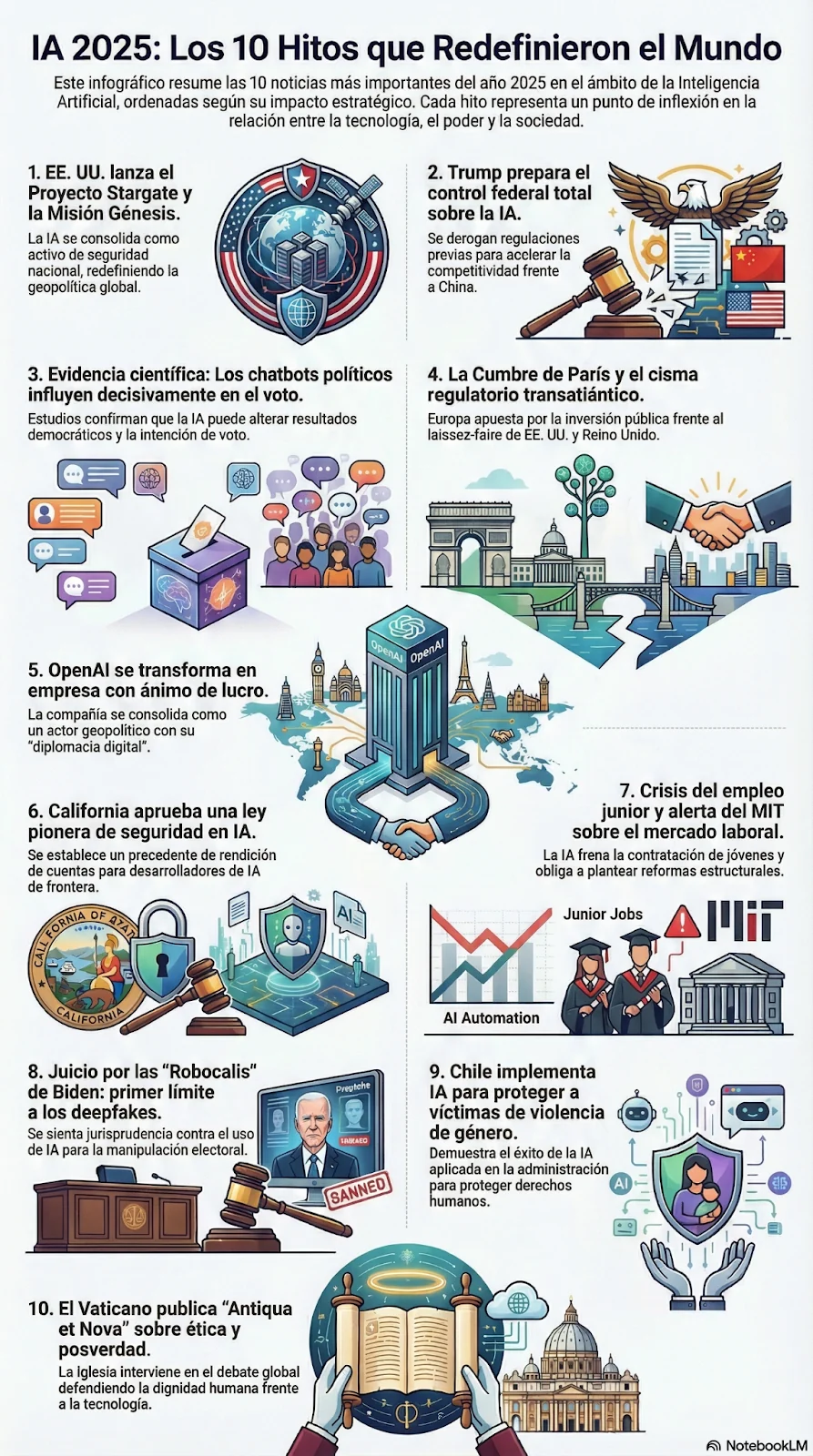
English alternative — AI 2025: the ten milestones that redefined the world.
This infographic summarises the ten most important AI news stories of 2025, ordered by strategic impact. Each milestone represents a turning point in the relationship between technology, power and society.
- The US launches Project Stargate and the Genesis Mission. AI becomes established as a national security asset, redefining global geopolitics.
- Trump prepares total federal control over AI. Earlier regulations are repealed to accelerate competitiveness against China.
- Scientific evidence: political chatbots decisively influence voting. Studies confirm that AI can alter democratic outcomes and voting intentions.
- The Paris Summit and the transatlantic regulatory divide. Europe backs public investment in contrast to the laissez-faire approach of the US and the UK.
- OpenAI becomes a for-profit company. The company consolidates its position as a geopolitical actor through its “digital diplomacy”.
- California passes a pioneering AI safety law. A precedent for accountability is established for frontier AI developers.
- The crisis in junior employment and MIT's warning about the labour market. AI slows the recruitment of young people and forces consideration of structural reforms. The illustration labels its opposing arrows “Junior Jobs” and “AI Automation”.
- Trial over the Biden “robocalls”: the first limit on deepfakes. Case law is established against the use of AI for electoral manipulation.
- Chile implements AI to protect victims of gender-based violence. It demonstrates the success of AI applied in public administration to protect human rights.
- The Vatican publishes “Antiqua et Nova” on ethics and post-truth. The Church intervenes in the global debate, defending human dignity in the face of technology.
As well as sharing this “interactive yearbook” of estrategIA 2025, this special issue has an educational purpose. We will therefore briefly explain how we created the project — we have also included “educational” explanations in the titles of much of the extra content generated — because we believe that NotebookLM is currently one of the tools that can offer many of you the most value, with its straightforward application of AI to a closed collection of documents.
To create the NotebookLM notebook, our first step was to export all the 2025 issues of estrategIA from Substack and import them as sources.
If you are looking at it on a PC, you can see those sources on the left of your screen. In the centre is a “chat” where you can ask questions of all that information, and in the right-hand column are all the audiovisual material, reports and interactive items created from the content. That section is closed here, but in your own NotebookLM notebooks you can request as many as you wish. This image, created with Nano Banana Pro from our own screenshot of the NotebookLM notebook, should make it easier to visualise:
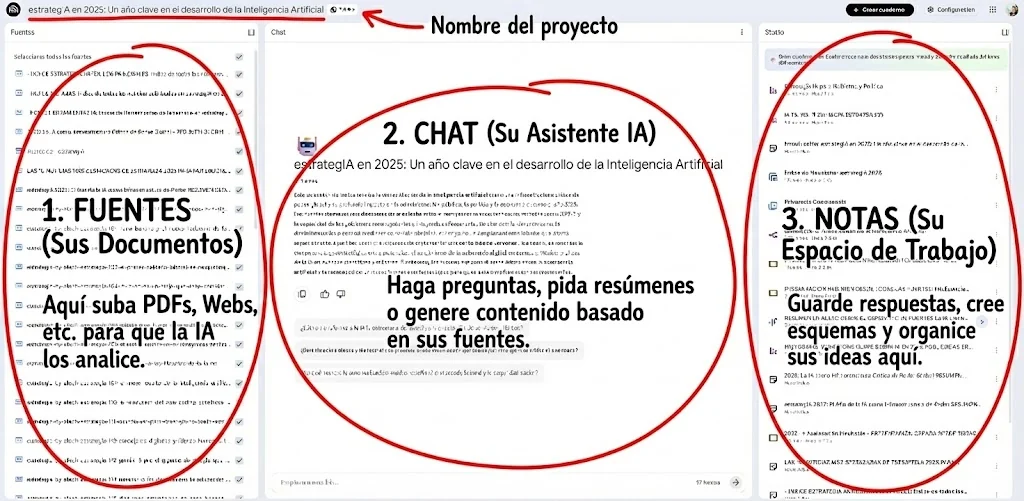
English alternative to the instructional overlay: “Project name” points to the title at the top. 1. Sources — your documents: upload PDFs, websites and so on here for the AI to analyse. 2. Chat — your AI assistant: ask questions, request summaries or generate content based on your sources. 3. Notes — your workspace: save answers, create outlines and organise your ideas here. The underlying small interface text is a distorted duplicate of the earlier screenshot, not additional instructions.
After importing the content, we began working with it in the chat, using prompts that ChatGPT and Gemini helped us make more precise. We asked NotebookLM to produce a summary document for each subject covered in estrategIA this year, based on the main article; a summary of all the news published in 2025; and, finally, one covering the recommended tools. These requests, like some later ones, were then saved as notes and also exported as sources, so that we could subsequently create multimedia content from some of them.
With this information in place, we asked for more evaluative work: an article summarising the year overall, also available in the documents section, or a selection of the ten most significant stories of 2025. We later asked it to turn that document into the infographic shown above.
Using either the full set of documents or an individual one, we then requested — as you can see in the third column — infographics, “PowerPoint-style” slide presentations, audio summaries, video summaries and a data table. The latter is one of the features added to NotebookLM in recent weeks; as an example, it created an index-style table of all the issues. There is also an interesting quiz, which we recommend if you regularly read estrategIA, because it will remind you of many things you have learnt by reading this newsletter during 2025.
It is also worth highlighting that, for the past few days, Gemini has allowed NotebookLM to be imported as a source. That means we can work with all this structured information using more powerful AI models such as Gemini 3 Pro, which also have access to other tools, including internet search and code generation.
The import process is almost the same as importing an image: simply click “+”, select NotebookLM, and then choose the notebook you want to import. This has allowed us to work with the entire year's estrategIA content in that notebook, generate a summary article from it and, from that article, create as an example a very simple HTML infographic. We reproduce it below, converted into images for this newsletter, to close both this article and 2025.
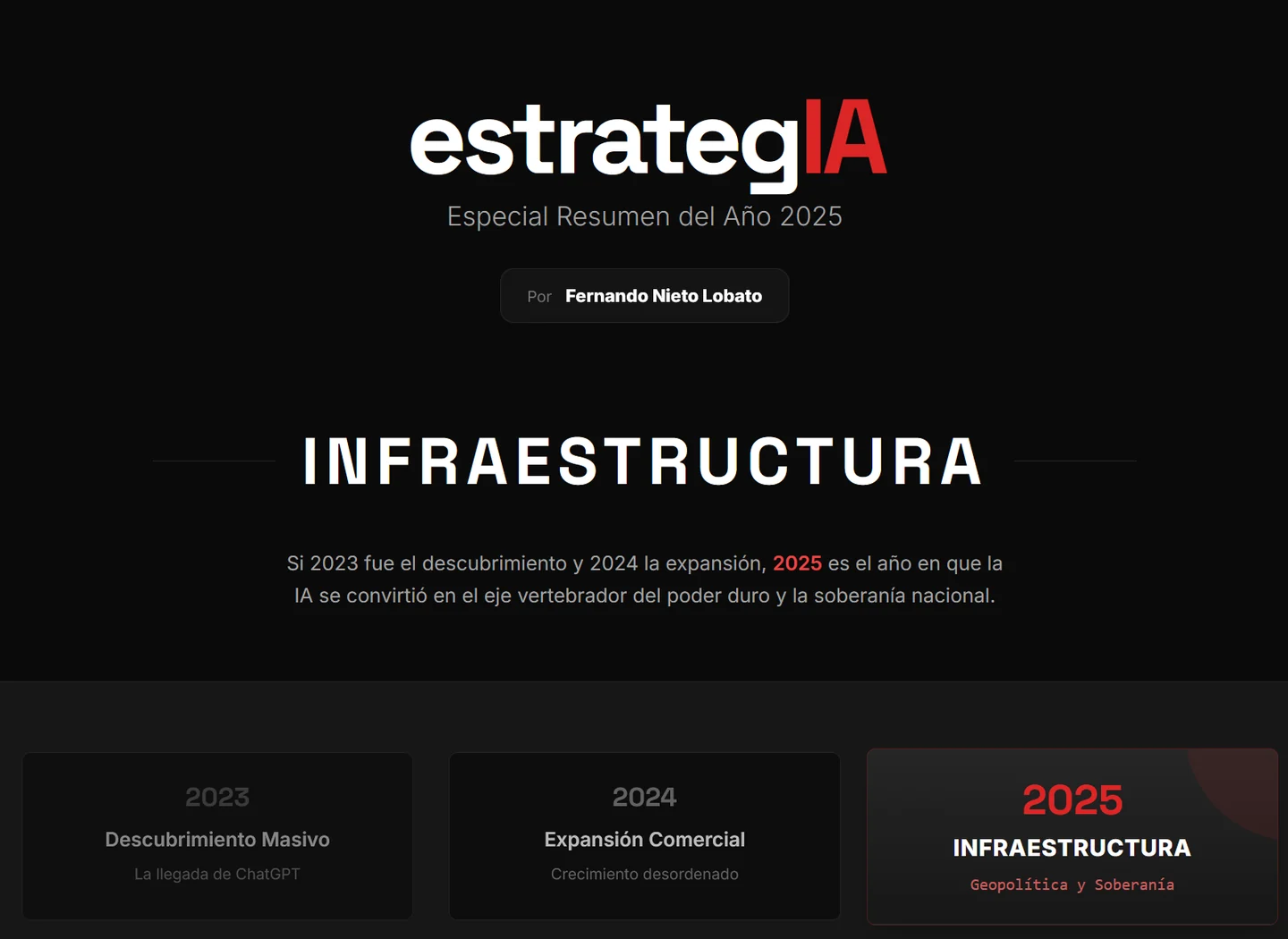
English alternative — estrategIA, 2025 year-end special. By Fernando Nieto Lobato.
Infrastructure. If 2023 was the year of discovery and 2024 the year of expansion, 2025 is the year AI became the organising backbone of hard power and national sovereignty.
Scroll across the table to read all columns.
| Year | Stage | Description |
|---|---|---|
| 2023 | Mass discovery | The arrival of ChatGPT |
| 2024 | Commercial expansion | Disorderly growth |
| 2025 | Infrastructure | Geopolitics and sovereignty |
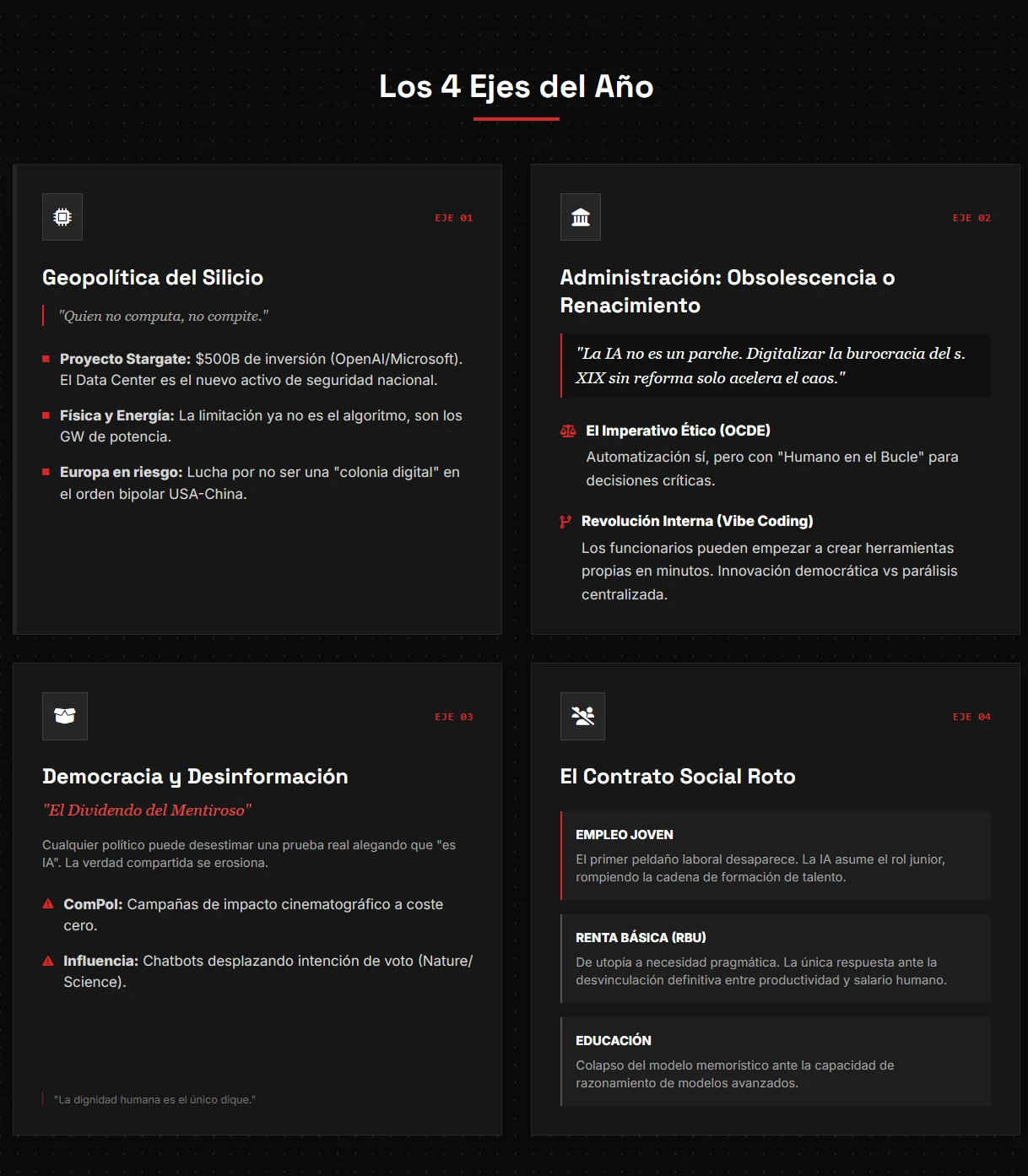
English alternative — the year's four themes.
Theme 01: silicon geopolitics. “Without compute, you cannot compete.”
- Project Stargate: $500 billion in investment (OpenAI/Microsoft). The data centre is the new national security asset.
- Physics and energy: the constraint is no longer the algorithm, but gigawatts of power.
- Europe at risk: the struggle to avoid becoming a “digital colony” in the bipolar US–China order.
Theme 02: public administration — obsolescence or rebirth. “AI is not a patch. Digitising nineteenth-century bureaucracy without reform only accelerates chaos.”
- The ethical imperative — OECD: automation, yes, but with a “human in the loop” for critical decisions.
- Internal revolution — vibe coding: civil servants can begin creating their own tools in minutes. Democratic innovation versus centralised paralysis.
Theme 03: democracy and disinformation. “The liar's dividend.”
Any politician can dismiss real evidence by claiming “it's AI”. Shared truth is eroded.
- Political communication: campaigns with cinematic impact at zero cost.
- Influence: chatbots shifting voting intentions (Nature/Science).
“Human dignity is the only bulwark.”
Theme 04: the broken social contract.
- Youth employment: the first rung of the career ladder disappears. AI takes on the junior role, breaking the chain through which talent is trained.
- Basic income — UBI: from utopia to pragmatic necessity. The only answer to the permanent separation of productivity from human wages.
- Education: the rote-learning model collapses in the face of advanced models' reasoning ability.
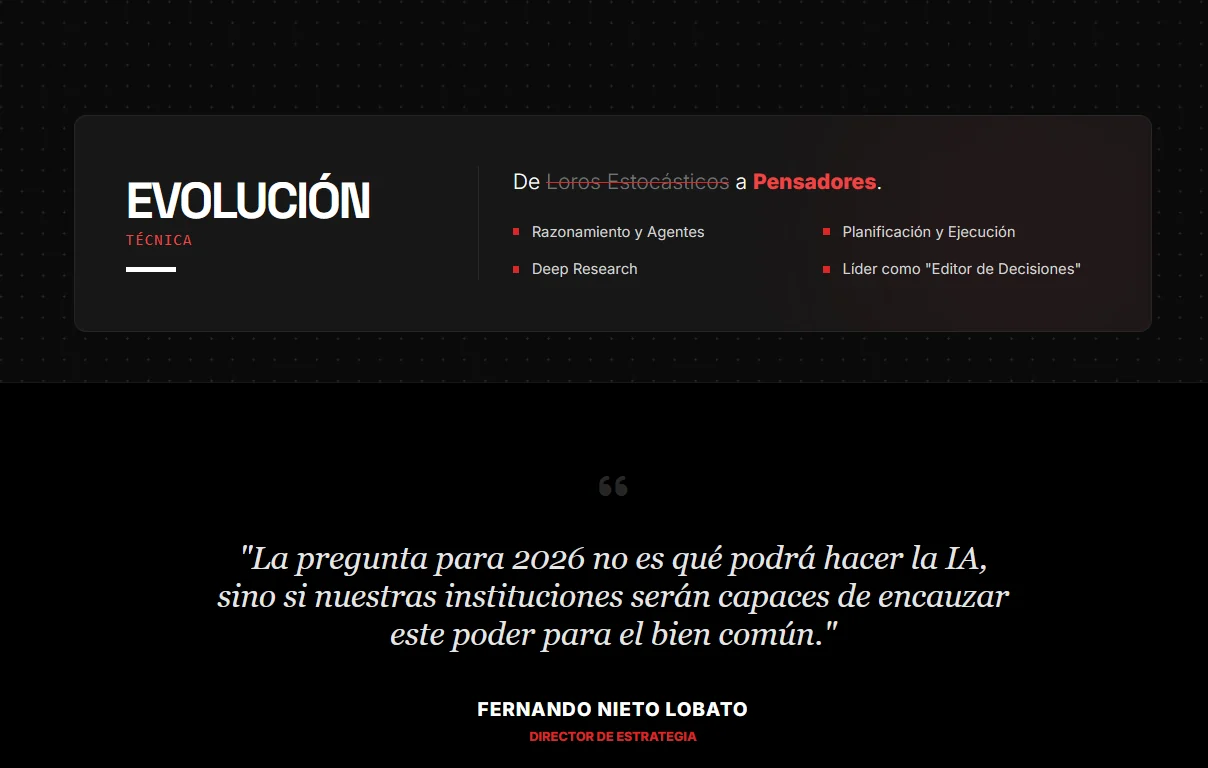
English alternative — technical evolution. From ~~stochastic parrots~~ to thinkers.
- Reasoning and agents.
- Deep Research.
- Planning and execution.
- The leader as an “editor of decisions”.
“The question for 2026 is not what AI will be able to do, but whether our institutions will be capable of directing this power towards the common good.”
— Fernando Nieto Lobato, editor of estrategIA.
Director of Digital Innovation at Institución Educativa ALEPH and editor of estrategIA
P.S. We wish all of you a happy and prosperous New Year, and thank you for joining us every week. We look forward to seeing you in 2026.
Image text: “Happy 2026 — estrategIA”.
Cite this essay
Fernando Nieto Lobato. “The year in AI through estrategIA: interact with all our 2025 content in NotebookLM.” estrategIA, issue 118, 31 December 2025. English edition, 29 September 2026. https://elcontemplador.github.io/estrategia-english/essays/118/