Archive note: this article was published on 7 January 2026. Its assessments of 2025 and expectations for 2026 are preserved in their original historical context. The Demis Hassabis quotation below is retranslated from the Spanish in the source; its original English wording has not been verified.
Exactly a year ago, in estrategIA #66, we opened 2025 with a warning and five important requests to politicians for that year. We said then that artificial intelligence would cease to be a tool and become the engine of a revolution comparable to the Industrial Revolution — or even, as Nobel laureate Demis Hassabis said last year, “ten times bigger and ten times faster”. Our technical diagnosis was not wrong: 2025 was a year of significant acceleration, with the arrival of reasoning models such as the o3 family, GPT-5 and Gemini 3, and the consolidation of AI as critical infrastructure.
Yet looking in the rear-view mirror leaves a bittersweet feeling. Technology has moved at Formula One speed, while politics — with honourable exceptions, particularly in defence and security — has continued travelling by horse-drawn carriage. Politicians, as has become customary, have responded to the urgency of power, not to the urgency of people's needs.
We are entering 2026, a year that promises to be even more disruptive with the mass arrival of autonomous agents: systems that do more than chat; they act and execute tasks. It is time for an honest audit. What did politicians get right about AI in 2025? Where did they fail? And, most importantly, what should we demand of them in 2026?
Auditing 2025: between the infrastructure of power and social neglect
If we had to sum up the political response of 2025 in one sentence, it would be: “Concrete was prioritised; people were forgotten.”
Many governments understood AI as a matter of geopolitical strength, investing heavily in data centres and energy — hard power — while neglecting internal transformation and social protection — soft power.
Here is a quick assessment of the five requests we made a year ago. To produce it, we used several artificial intelligence systems with full access to all of estrategIA's content and the web, and asked them to analyse how far the requests we made in January 2025 had been met.
1. “Make AI a priority”
- The verdict: FULFILLED — but only at the geopolitical level.
- The reality: AI did indeed become an affair of state. We saw the US launch Project Stargate — $500 billion — and Europe announce its AI gigafactories after the Paris Summit. Leaders understood that “without compute, you cannot compete”.
- The “but”: it was a national security priority, rather than a public service priority. While billions were invested in chips, day-to-day administration continued without substantial changes, and political elites' training in these matters remains inadequate.
2. “Develop it safely, but quickly”
- The verdict: UNBALANCED — plenty of speed, fragmented safety.
- The reality: the balance tipped decisively towards competitive speed. Trump's second term and his deregulatory turn set the global direction, forcing Europe and China to accelerate to avoid being left behind.
- The “but”: safety was pushed into the background or fragmented into local initiatives, such as the California law. Ethics was overtaken by commercial and military urgency.
3. “Protect people, not jobs”
- The verdict: FAILURE — the first warning signs are being ignored.
- The reality: perhaps the most painful point. While Harvard and MIT were announcing that AI was already breaking the labour market for junior workers — “seniority-biased technological change”, governments made no structural moves.
- The “but”: there was no real progress on Universal Basic Income — UBI — except perhaps in Ireland, nor any substantial education reforms. The twentieth-century employment status quo was protected while AI began closing off younger generations' access to the future. In this area, we are still at the start of the process, but to think that this early stage will last a long time is to ignore entirely the distinctive characteristics of artificial intelligence as a technology.
4. “Be willing to break things — institutions”
- The verdict: PARALYSIS — AI washing instead of reform.
- The reality: apart from the military sphere, which began replacing Napoleonic structures with AI agents, bureaucracy was not reformed. There were isolated, brilliant cases, such as the Chilean initiative to protect victims of gender-based violence that we covered, but the general pattern was more pilots and anecdotes than real transformation.
- The “but”: instead of redesigning processes, many public administrations simply applied technological patches to inefficient bureaucracies. There is no real willingness to change in ways that make use of the new technology's potential.
5. “Plan for the future”
- The verdict: SHORT-SIGHTED — electoral short-termism.
- The reality: politics continued to live from day to day, using AI for the permanent campaign and the “electoral battle without rules”, instead of planning the new social contract and the necessary reforms. Governments continued governing for the next election, while we face a disruptive technology that will transform the world for the next generations.
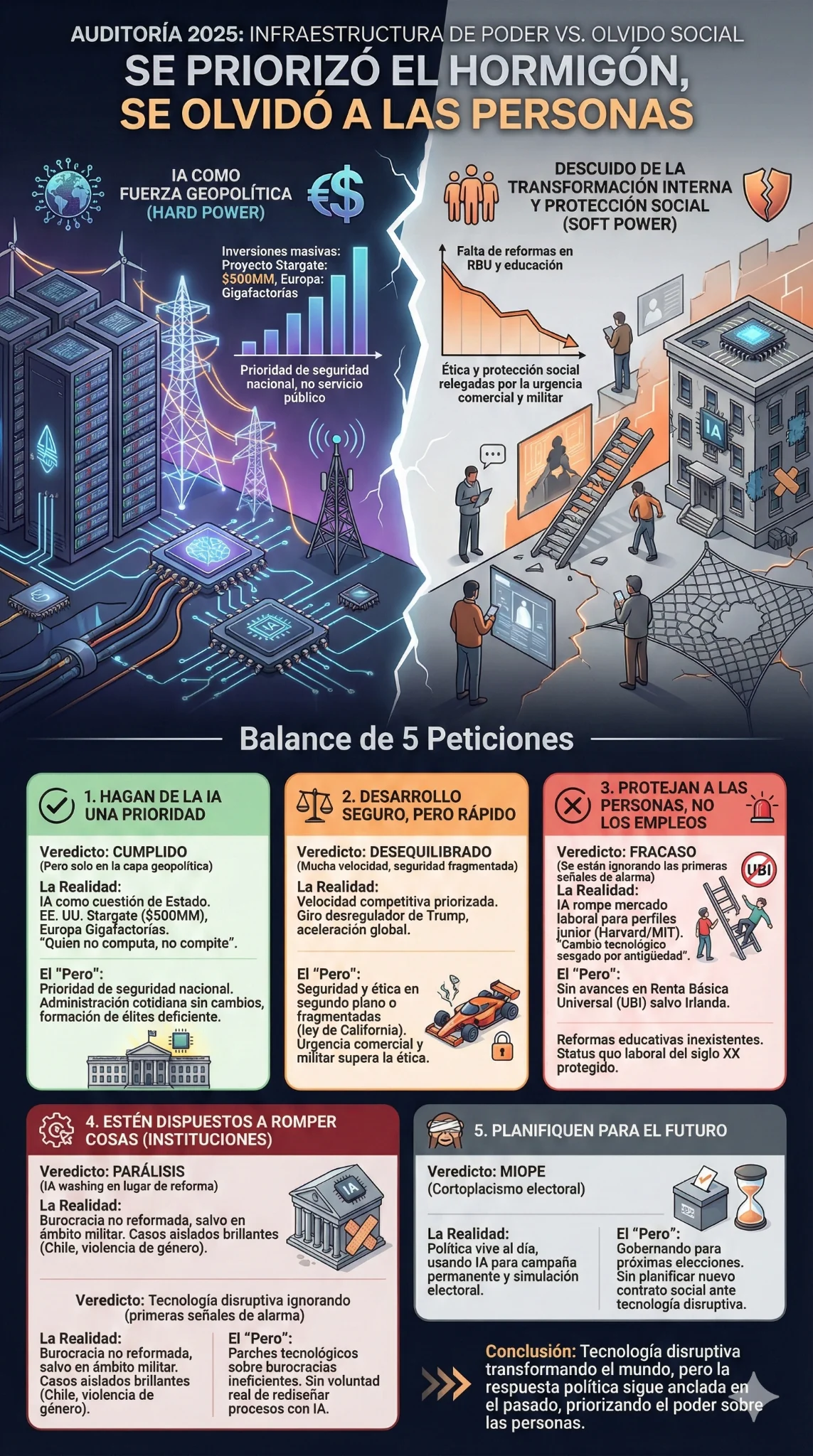
English alternative — Audit 2025: infrastructure of power versus social neglect. “Concrete was prioritised; people were forgotten.”
AI as geopolitical strength — hard power: massive investment; Project Stargate, labelled “$500MM”; Europe: gigafactories. A national security priority rather than a public service priority.
Neglect of internal transformation and social protection — soft power: lack of reforms in UBI and education. Ethics and social protection pushed aside by commercial and military urgency.
The graphic prints “$500MM”; the article's body gives $500 billion. The graphic's notation is preserved here without silently resolving it.
Assessment of five requests:
- Make AI a priority. Verdict: fulfilled, but only at the geopolitical level. Reality: AI as an affair of state; US Stargate — again labelled “$500MM” — and European gigafactories. “Without compute, you cannot compete.” The “but”: national security took priority; daily administration remained unchanged and elite training was inadequate.
- Safe but rapid development. Verdict: unbalanced — plenty of speed, fragmented safety. Reality: competitive speed prioritised, Trump's deregulatory turn and global acceleration. The “but”: safety and ethics were secondary or fragmented — California's law — and commercial and military urgency overtook ethics.
- Protect people, not jobs. Verdict: failure — the first warning signs are being ignored. Reality: AI disrupts the labour market for junior workers, Harvard/MIT, “seniority-biased technological change”. The “but”: no progress in Universal Basic Income except Ireland; education reforms absent; the twentieth-century employment status quo protected.
- Be willing to break things — institutions. Verdict: paralysis — AI washing instead of reform. Reality: bureaucracy unreformed outside the military; isolated brilliant cases — Chile and gender-based violence. The “but”: technological patches on inefficient bureaucracies; no real willingness to redesign processes with AI. The generated panel repeats its reality statement and inserts an awkward second verdict: “Disruptive technology ignoring — first warning signs”. This duplicate, malformed wording is present in the original graphic.
- Plan for the future. Verdict: short-sighted — electoral short-termism. Reality: day-to-day politics, using AI for permanent campaigning and electoral simulation. The “but”: governing for the next election without planning a new social contract in the face of disruptive technology.
Conclusion: disruptive technology is transforming the world, but the political response remains anchored in the past, prioritising power over people.
2026: five new requests for the approaching agentic era
The context in 2026 is radically different. We are no longer talking only about generating text or images. We are talking about agents that book flights, negotiate contracts, write code and operate machinery beginning to become widespread. The European regulation — the AI Act — enters its full operational phase, and AI's ability to act in the physical world is beginning to become real.
We are therefore updating our requests. Prioritisation is no longer enough: we now ask for capacity, execution and humanity.
1. Build real state capacity — beyond regulation
In 2025, we saw that passing a law such as the AI Act is of little use if there is nobody to implement it. Our request for 2026 is to move from paper to muscle, and for governments to start applying and promoting AI to improve citizens' lives.
- The proposal: we do not want more expert committees writing white papers. We need delivery units working across government, equipped with budgets and real technical talent, capable of procuring technology, approving algorithms and, above all, auditing what is happening inside the administration's black box.
- The objective: for the state to stop being a captive customer of the big technology companies and regain the technical sovereignty to understand and direct what it buys, and to drive structural change.
2. From pilots to services: automation with public metrics
The time for pilot projects that die in a press release is over. Public administration is full of proofs of concept that never scale, while models are already reaching levels of quality that make it possible to improve many processes and services.
- The proposal: we believe a short portfolio of 10–15 high-impact use cases is needed — for example, processing benefits, healthcare waiting lists, tax fraud and justice — to be implemented nationally in 2026.
- The key: they must be accompanied by public accountability metrics. If AI reduces the wait for a court ruling or a benefit payment, citizens should know by how much and how. Efficiency must become a new democratic dividend.
3. Declare AI literacy a national emergency — and a right
If AI is the new electricity, AI illiteracy is the new social exclusion. In 2026, knowing how to interact with intelligent agents will not be an advantage on a CV, but a requirement for citizenship and employability.
- The proposal: launch a National AI Literacy Plan, compulsory for all public employees and offered at scale to the public. We are not talking about traditional courses, but training in critical thinking, agent supervision and human–machine collaboration.
- The key: inequality in 2026 will be measured not only by income, but by the degree to which individuals can amplify their abilities through AI. The state must ensure that access to this superintelligence is universal, rather than an elite privilege. Failing to do this work will only widen the gap between AI (super)users and people excluded from the technology.
4. Protect shared truth: an infrastructure of trust
The year 2025 taught us the danger of the “liar's dividend” and the erosion of reality. In a year when voices and images can be forged in real time, democracy is at risk if we cannot tell what is real.
- The proposal: move from cybersecurity to epistemic security. We demand that all official communication — video, audio and text — be required to incorporate verifiable content credentials. The state cannot ask for blind trust: its channels must offer mathematical certainty about provenance, so that any citizen can distinguish an official source from manipulation without doubt.
- The defence: we need rapid-response protocols for crises of deep disinformation, treating information integrity as critical infrastructure on the same level as the electricity grid or water supply.
5. Engineering the new social contract — taxation and income
We insist on this again, but with greater urgency. The 2025 crisis in junior employment suggested by several significant studies was only a warning. If AI increases productivity and corporate profits soar while the wage bill shrinks, the welfare state's fiscal equation breaks down. In the coming years, we will see major changes that may also happen very quickly.
- The proposal: stop viewing Universal Basic Income or AI dividends as utopias of the left or the right. Start designing the fiscal engineering needed to sustain them, and begin working, at least, with pilot programmes such as Ireland's.
- The measure: seriously study future taxes on computation — tax the compute — or on automation that leads to a net loss of jobs, to finance a possible citizens' transition fund.
In Spain, we currently have an intense debate about pensions and intergenerational solidarity. Incredible as it may seem, the automation of jobs that is very likely to occur on a massive scale over the next ten years is not being brought into that debate. This is a form of short-sightedness we cannot afford.
Conclusion: from the infrastructure of power to social infrastructure
After last year's poor performance on these tasks, our message to our representatives for 2026 is clear: in 2025, some countries succeeded in building or planning the infrastructure of power — data centres, models and national security. Now, in 2026, active planning and construction of social infrastructure must begin.
If we allow the gap between the speed of AI agents and the slowness of the social response to keep widening, we will face more than a problem of unemployment or bureaucracy: we will face a crisis of legitimacy in the democratic system.
The technological developments of 2025 continue to suggest that AI is very likely to change everything, even though we are still at the beginning of the transition from technical capabilities to the “real world”. The question for 2026 is not whether the technology will be ready — it will — but whether politics will rise to the challenge of making that change liveable for the majority in the future.
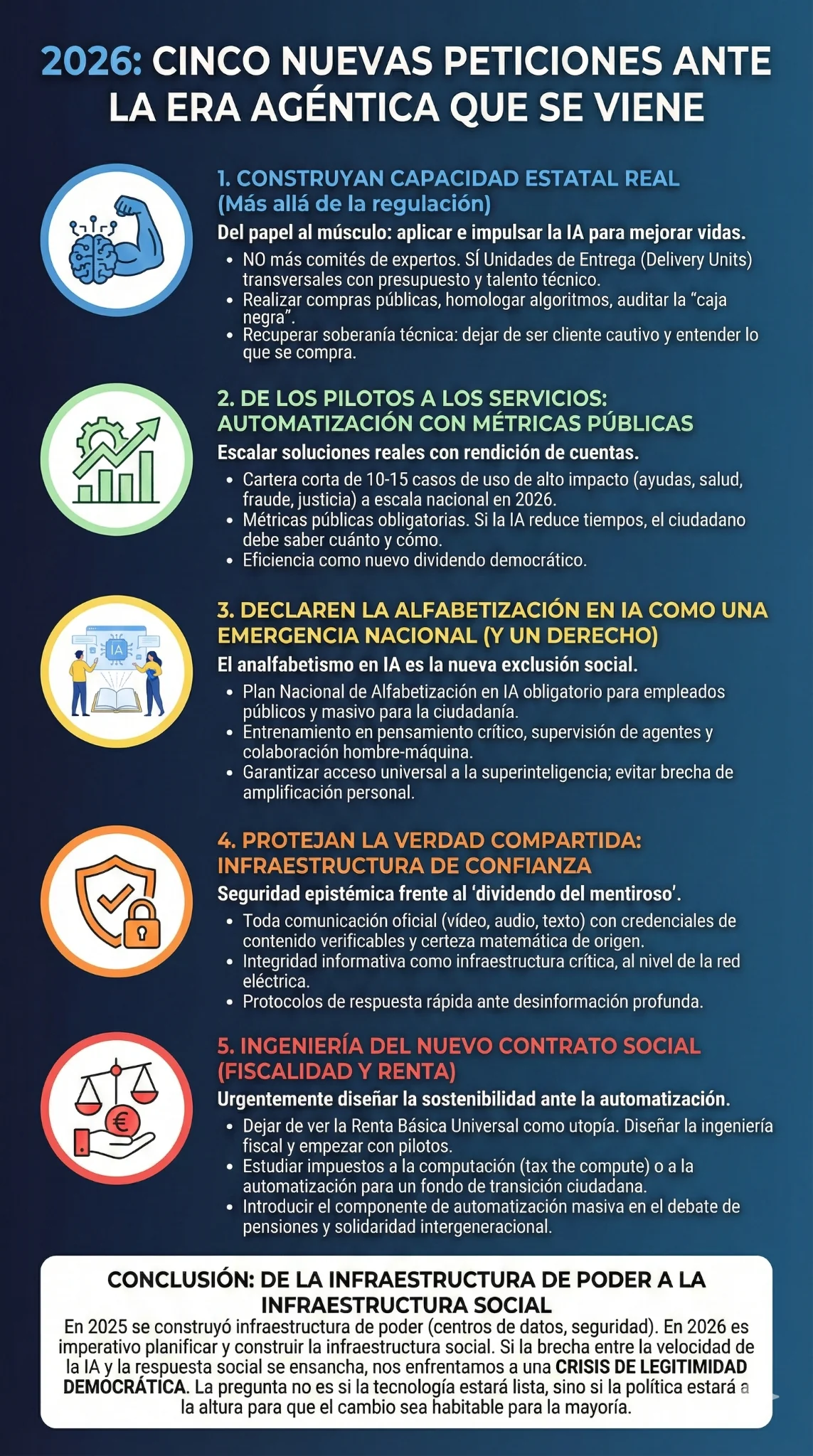
English alternative — 2026: five new requests for the approaching agentic era.
1. Build real state capacity — beyond regulation. From paper to muscle: apply and promote AI to improve lives.
- No more expert committees. Yes to delivery units working across government, with budgets and technical talent.
- Procure technology, approve algorithms and audit the “black box”.
- Regain technical sovereignty: stop being a captive customer and understand what is being bought.
2. From pilots to services: automation with public metrics. Scale real solutions with accountability.
- A short portfolio of 10–15 high-impact use cases — benefits, health, fraud and justice — at national scale in 2026.
- Mandatory public metrics. If AI reduces waiting times, citizens must know by how much and how.
- Efficiency as a new democratic dividend.
3. Declare AI literacy a national emergency — and a right. AI illiteracy is the new social exclusion.
- A National AI Literacy Plan, compulsory for public employees and offered at scale to the public.
- Training in critical thinking, agent supervision and human–machine collaboration.
- Ensure universal access to superintelligence; avoid a gap in individuals' ability to amplify their capabilities.
4. Protect shared truth: an infrastructure of trust. Epistemic security against the “liar's dividend”.
- All official communication — video, audio and text — to carry verifiable content credentials and mathematical certainty about provenance.
- Information integrity as critical infrastructure, on the same level as the electricity grid.
- Rapid-response protocols for deep disinformation.
5. Engineering the new social contract — taxation and income. Urgently design for sustainability in the face of automation.
- Stop treating Universal Basic Income as a utopia. Design the fiscal engineering and begin with pilots.
- Study taxes on computation — tax the compute — or automation, to finance a citizens' transition fund.
- Bring mass automation into the debate about pensions and intergenerational solidarity.
Conclusion: from the infrastructure of power to social infrastructure. In 2025, the infrastructure of power was built — data centres and security. In 2026, social infrastructure must be planned and built. If the gap between AI's speed and the social response widens, we face a crisis of democratic legitimacy. The question is no longer whether the technology will be ready, but whether politics will rise to the challenge of making the change liveable for the majority.
Director of Digital Innovation at Institución Educativa ALEPH and editor of estrategIA
Cite this essay
Fernando Nieto Lobato. “Will politics rise to the challenge of AI in 2026? Five new requests from estrategIA.” estrategIA, issue 119, 7 January 2026. English edition, 29 September 2026. https://elcontemplador.github.io/estrategia-english/essays/119/